If you have browsed a Korean web novel or webtoon app, you have seen the pattern: titles that read like plot summaries rather than book titles. The Reason Why Raeliana Ended Up at the Duke's Mansion, I Became the Villainess in a Disastrous Novel, The Strongest in the Universe Are Obsessed With Me.
To readers used to Western titles built on mystery or metaphor, this looks like an accident, or even bad writing. It is neither. It is a deliberate, well-understood convention of the Korean web novel industry, and it exists for reasons tied directly to how these stories are discovered, read, and sold.
The short version
- Spoiler-style titles are deliberate marketing, not bad writing or accidents.
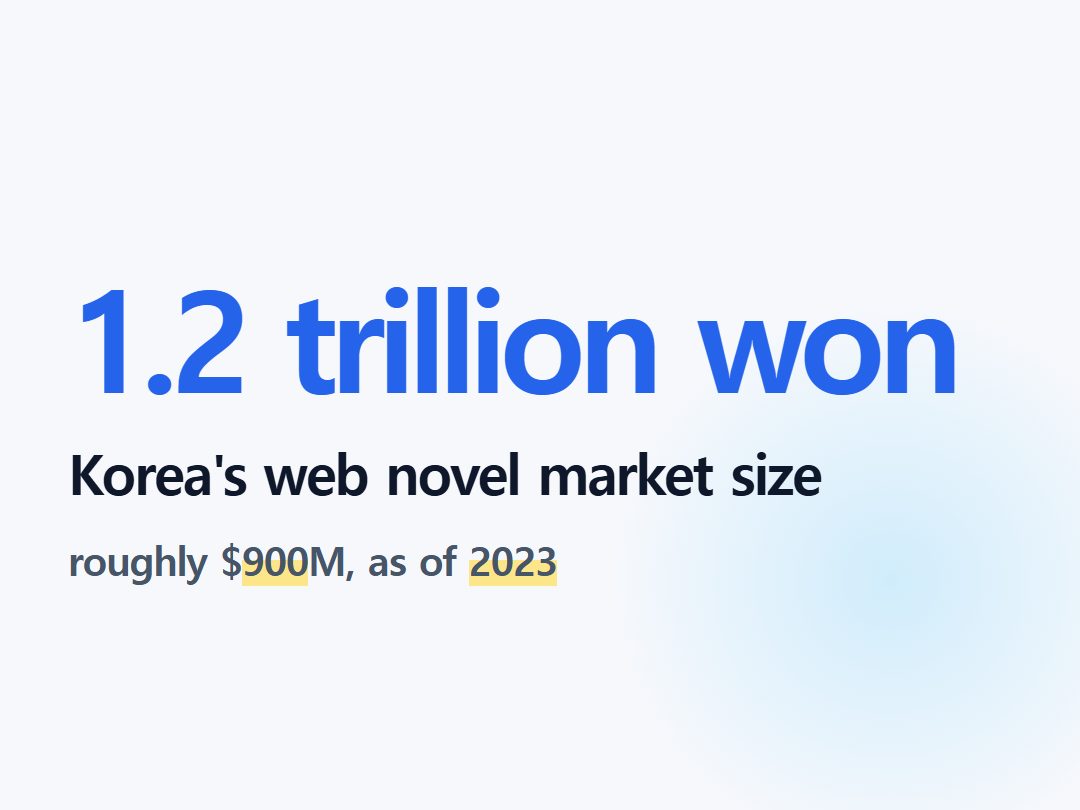
- Korea's web novel market reached an estimated 1.2 trillion won by 2023.
- Naver and CJ ENM acquired Munpia in 2021, consolidating rival platforms.
Raeliana's title spells out its own premise
The Reason Why Raeliana Ended Up at the Duke's Mansion is a real example, not a joke title.
Written by the author Milcha, it was first serialized on the platform KakaoPage in 2016 under the Korean title Geunyeoga Gongjagjeoro Gaya Haetdeon Sajeong (roughly, “The Circumstances That Made Her Go to the Duke’s Mansion”).
A webtoon adaptation illustrated by Whale followed on KakaoPage in 2017, and an anime adaptation aired in 2023. Both the Korean original and the English title do the same job: they tell you, before you click, that the female lead ends up at a duke's mansion and that a fake or strategic engagement is involved. That is not a leaked ending. It is the premise, printed on the cover.
This is standard practice across the genre. Titles routinely announce the setup, the twist, or the emotional hook up front: a modern woman wakes up inside the novel she was reading, a side character realizes she is fated to die, a villainess decides to rewrite her own ending. None of this is considered spoiling in the Korean web novel market. It is considered marketing copy.
Why do Korean web novel titles spoil themselves?
To understand why Korean web novels spoil themselves in the title, you have to understand the environment they are competing in. Web novels (웹소설) in Korea are serialized fiction published episode by episode on platforms such as KakaoPage, Naver Series, Munpia, and Ridibooks, usually sold per chapter for a small fee. Thousands of new titles are uploaded every month on these platforms.
A reader scrolling a genre list or a search results page decides whether to open a story based on a thumbnail and a title, often in under a second. In that environment, a title that hints vaguely at mood or theme is a liability. A title that states the hook directly is a competitive advantage.
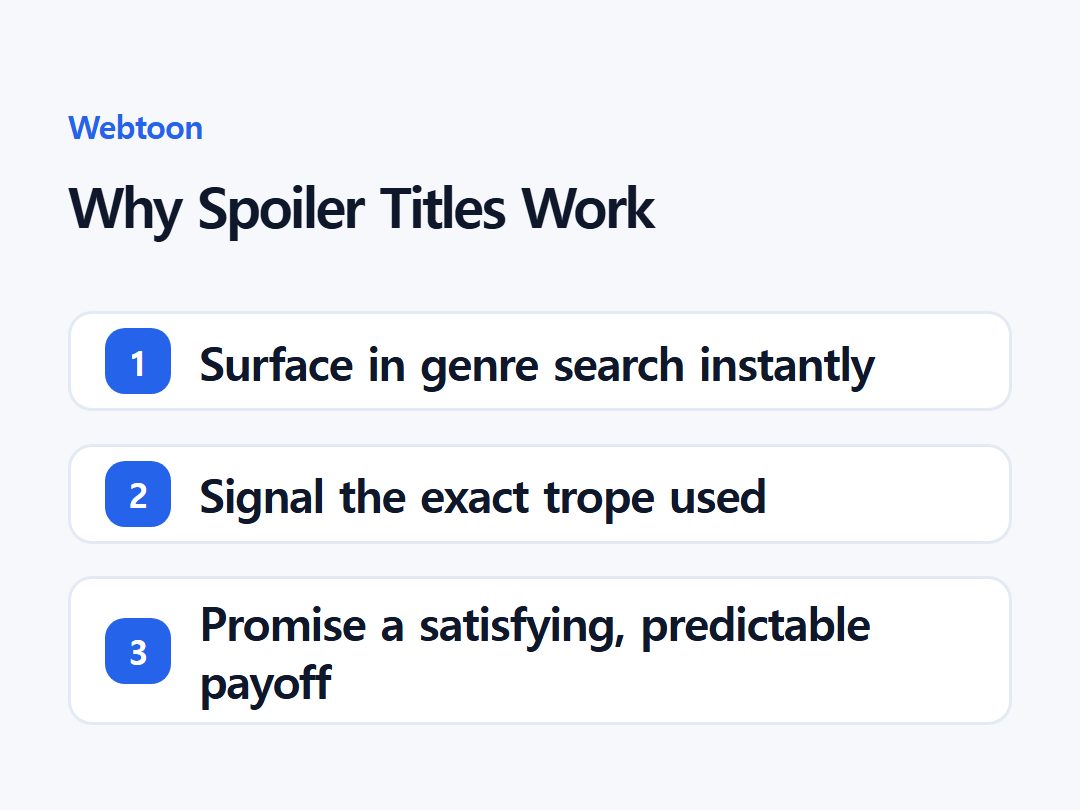
Three mechanics explain why spoiler-style titles work so well in this market.
First, search and discovery. Web novel platforms function less like bookstores and more like search engines with genre filters.
Readers searching for a specific trope — a female lead who becomes a duchess, a protagonist who gets revenge on a former family, a possession into a doomed side character — often type exactly that phrase into the search bar.
A title that contains the trope in plain language is more likely to surface in those searches and in algorithmic recommendation feeds than a title built on wordplay or allusion.
Second, genre and trope signaling. Korean web novels, especially in the romance fantasy genre known as 로판 (ro-pan), are built heavily around a small set of recognizable plot devices: 회귀 (regression, where the protagonist relives events with memories of the future), 빙의 (possession, where a modern person's consciousness enters a fictional character), and 환생 (reincarnation into a new body or world).
These three are so dominant that Korean readers and writers shorthand them together as 회빙환.
A title that immediately signals which of these devices is in play, and what the payoff will be, tells a genre-literate reader exactly what kind of ride they are getting before they spend a single episode's worth of currency on it.
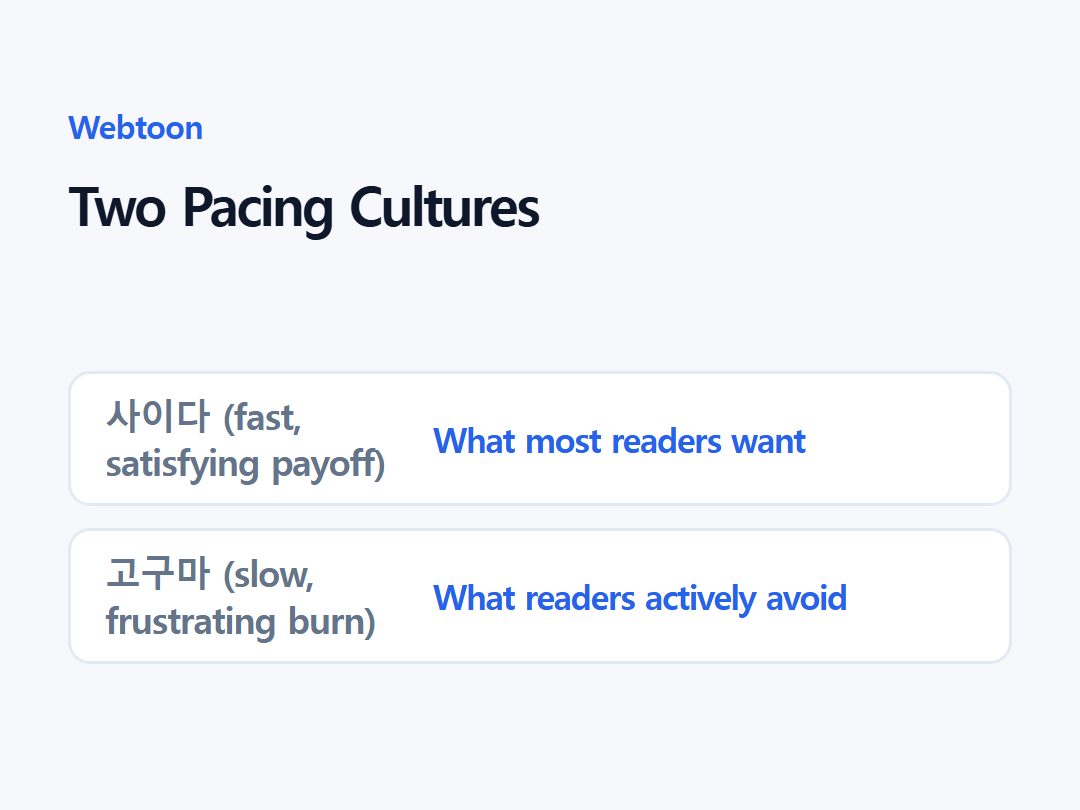
Third, and most specific to this market, predictability is a selling point rather than a flaw. Korean web novel readers have their own vocabulary for pacing satisfaction: 사이다 (literally “soda,” used for fast, satisfying, conflict-resolving plot beats) versus 고구마 (literally “sweet potato,” used for slow, frustrating, stuck-in-your-throat plotting).
Because episodes are purchased individually, readers are wary of investing money in a slow-burn story that might disappoint them with unresolved frustration.
A title that reveals the ending state — she does end up at the duke's mansion, she does become the strongest, she does escape the disastrous novel — functions as a guarantee of payoff.
It reduces the reader's risk before they buy the first chapter, the same function a trailer serves for a film, except compressed into a single line of text.
Put together, a Korean web novel title is not trying to be literary. It is trying to do the job of a search query, a genre tag, and a promise of satisfaction, all at once, in the two or three seconds a reader spends deciding whether to tap.
Two decades of platform rivalry built this norm
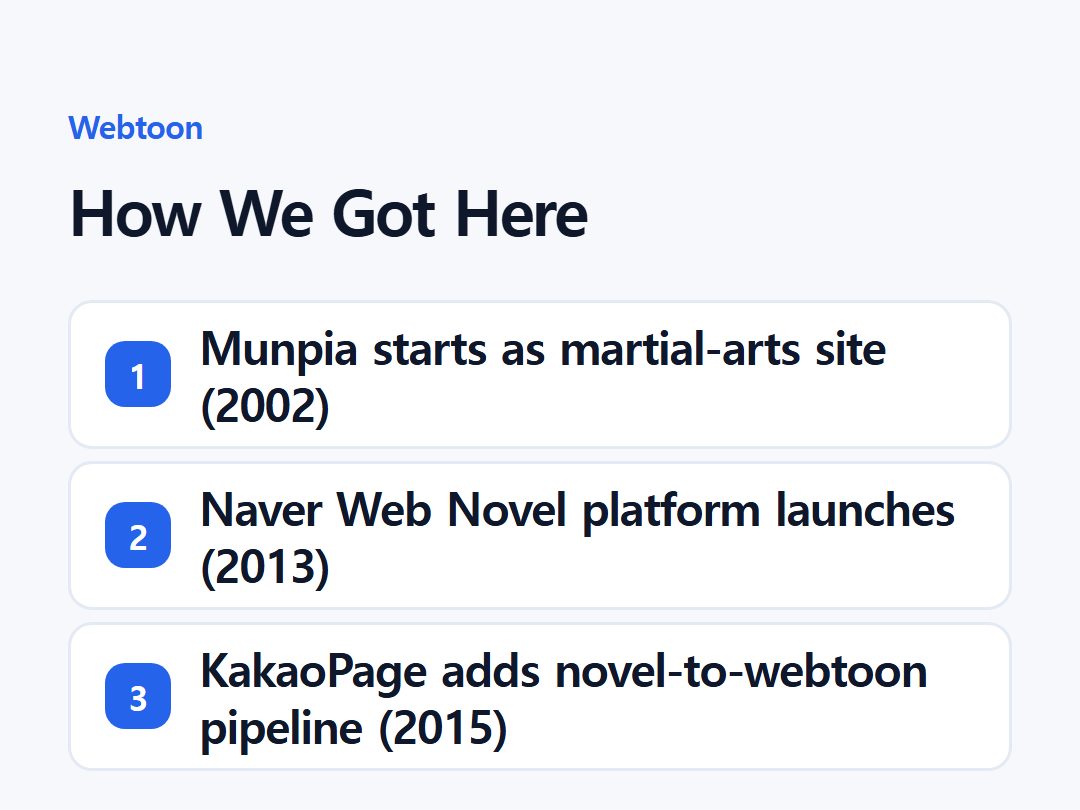
This convention did not appear overnight; it grew out of two decades of platform competition. Korea's online serialized fiction scene traces back to sites like Munpia, which began in 2002 as a martial-arts fiction community and formally took the Munpia name in 2006.
Joara introduced a subscription model in 2008, and BookCube popularized pay-per-chapter sales around 2013.
The category was formalized industry-wide when Naver launched Naver Web Novel in 2013, followed by KakaoPage's “wait for free” model in 2014 and, critically, KakaoPage's novel-to-webtoon adaptation pipeline in 2015.
That pipeline changed the economics of titling.
Once a hit web novel could be greenlit as a webtoon, and a hit webtoon could be greenlit as a drama or anime, a title's job expanded: it now had to work as a hook across multiple formats and, increasingly, in translation for platforms like Tapas and Tappytoon serving international readers.
A title that already summarizes the premise travels well across that adaptation chain, because the hook does not need to be rebuilt for each new format — it is already the title.
The business scale behind this is substantial. Industry estimates place Korea's web novel market at roughly 600 billion won in 2021, growing to an estimated 1.2 trillion won (about 900 million US dollars) by 2023, driven largely by the KakaoPage and Naver Series ecosystems.
In 2021, Naver, together with CJ Group's CJ ENM, acquired Munpia, consolidating three of the industry's original competing platforms under overlapping corporate ownership.
That consolidation reinforced a single, shared set of platform incentives — search visibility, per-chapter conversion, adaptation potential — across almost the entire domestic market, which is part of why the spoiler-title convention now looks so uniform across different platforms and publishers rather than being the quirk of one company.
Will spoiler titles work for readers abroad?
The open question is what happens to this convention as Korean web novels reach larger English-language audiences through platforms like Tapas, Tappytoon, and Wattpad, and through webtoon and anime adaptations that use the same source titles.
So far, English localizations have generally kept the spoiler-forward structure rather than softening it — Why Raeliana Ended Up at the Duke's Mansion and I Became the Villainess in a Disastrous Novel are marketed abroad with the same premise-in-the-title approach used domestically, suggesting publishers believe the convention still functions as a hook for readers unfamiliar with the genre's shorthand.
What remains unresolved is whether that translates into the same trust signal for readers who do not already know the 사이다/고구마 distinction or the 회빙환 shorthand. For Korean readers, a spoiler title is shorthand for a promise the genre reliably keeps.
For new international readers encountering the convention for the first time, it can still simply read as an oddly long, overly revealing title — meaning the marketing logic behind it, more than the titles themselves, is often the part that needs explaining.
Korean web novel platform milestones
| Year | Platform | Milestone |
|---|---|---|
| 2002 | Munpia | Began as a martial-arts fiction community |
| 2006 | Munpia | Formally took the Munpia name |
| 2008 | Joara | Introduced a subscription model |
| 2013 | BookCube | Popularized pay-per-chapter sales |
| 2013 | Naver | Launched Naver Web Novel |
| 2014 | KakaoPage | Introduced "wait for free" model |
| 2015 | KakaoPage | Launched novel-to-webtoon adaptation pipeline |
Frequently asked
Why do Korean web novel titles give away the plot?
Because readers scroll crowded platforms and decide whether to open a story in under a second, so a title that states the hook directly works as a search query, genre tag, and promise of payoff all at once.
What do 사이다 and 고구마 mean in Korean web novels?
사이다 (soda) describes fast, satisfying plot beats, while 고구마 (sweet potato) describes slow, frustrating ones; since episodes are bought individually, a spoiler-style title signals a story will deliver 사이다 rather than 고구마.
How big is the Korean web novel market?
Industry estimates put it at roughly 600 billion won in 2021, growing to about 1.2 trillion won (roughly 900 million US dollars) by 2023.
Sources
Every factual claim above is traceable. We do not translate articles — we gather facts from multiple outlets and write them ourselves.
- Why Raeliana Ended Up at the Duke's Mansion — Wikipedia
- Web novels in South Korea — Wikipedia
- Entertainment industry races to buy rights to web novels, comics — The Korea Times
- Korean Webnovels Global 2026: The English-Language Takeover — Seoulz
- Why Do So Many Korean Webnovels Make the Villainess the Heroine? — Medium
- 회빙환 (Hoe-Bing-Hwan) — Namuwiki
- Korean Webnovel Trends: KakaoPage, Naver Series, Munpia, Tapas, Wuxiaworld, and Tappytoon — KLitReads