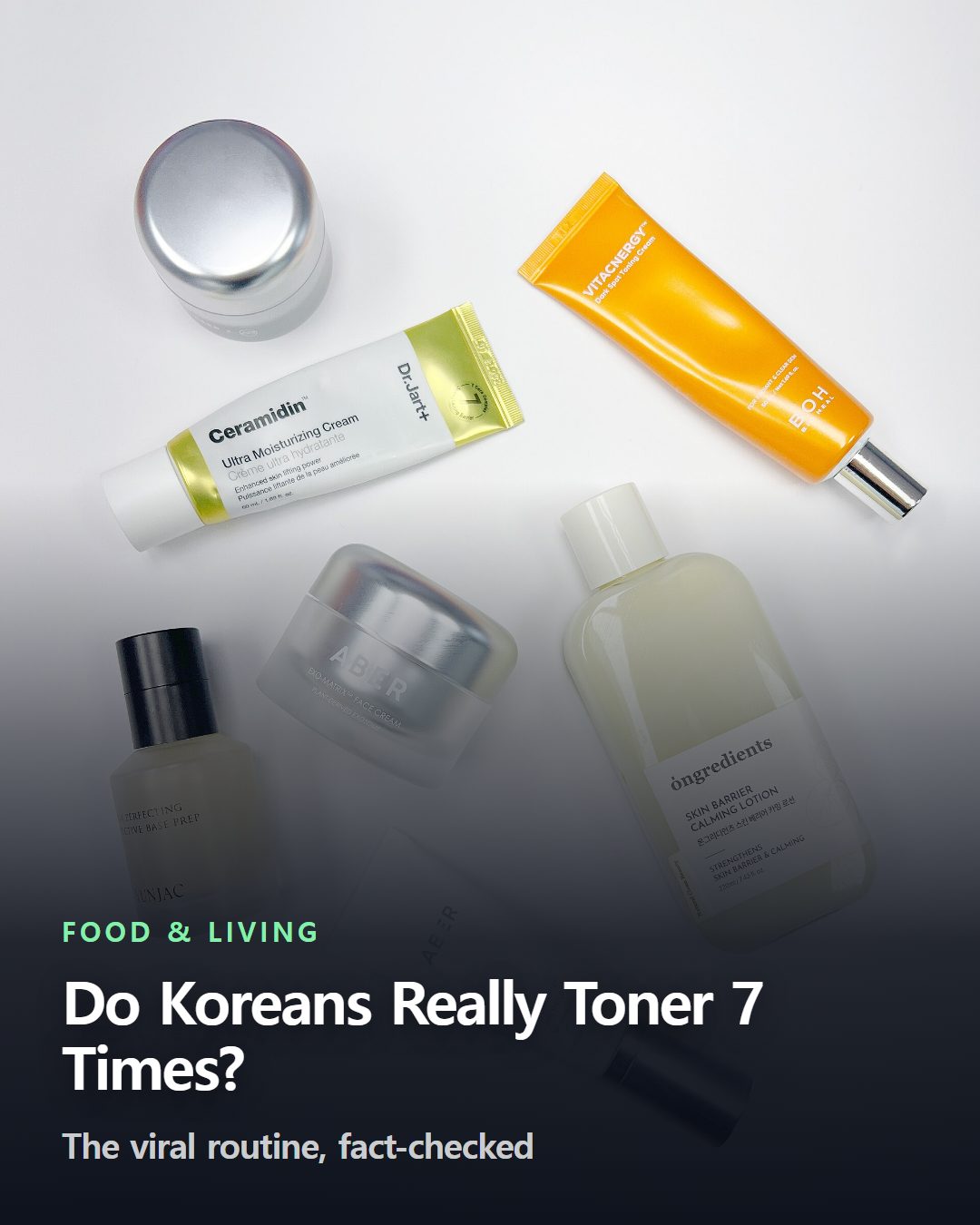
If you have spent any time in the K-beauty corner of the internet, you have seen the instructions: cleanse, then pat a watery toner onto your face — not once, but up to seven times — before moving on to the rest of your routine.
It is called the "7-skin method," and it is usually introduced as a secret of flawless Korean skin. It is a real technique that some people in Korea do practice. But the idea that it describes how most Korean women actually start their day does not hold up.
It is closer to a marketing-friendly export version of a niche trend than a national ritual.
The short version
- The '7-skin method' is real but not a daily habit for most Korean women.
- Korean surveys show women use far fewer products than the famous '10-step' routine claims.
- Both numbered routines were coined for Western marketing, not authentic Korean daily practice.
This distinction matters for a simple reason: it is not the first time this has happened, and understanding why reveals more about how K-beauty gets marketed abroad than it does about Korean skin.
Is the '7-skin' count actually a strict rule?
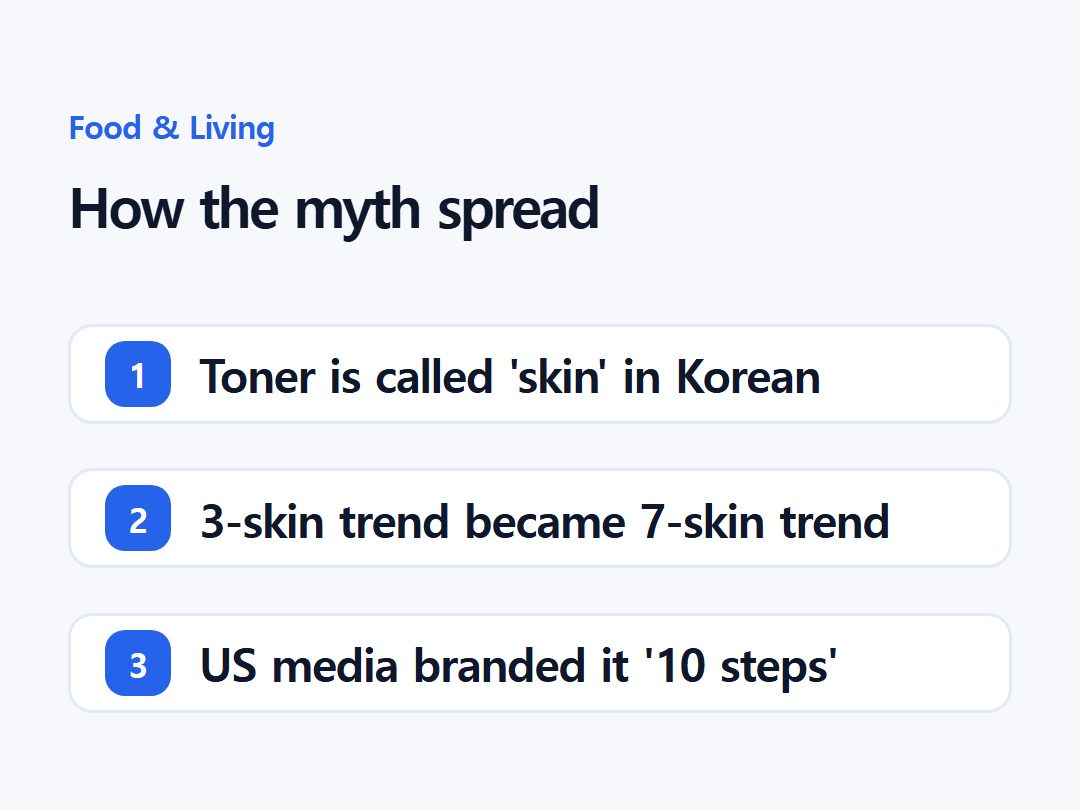
The "7-skin method" refers to applying a lightweight, alcohol-free toner in thin layers directly after cleansing, letting each layer absorb before adding the next, with the goal of building up hydration for the dewy, translucent look Koreans call "glass skin." The technique traces to Korean beauty blogs and online communities around 2016–2017, where it appears to have evolved out of an earlier, less famous "3-skin" version.
By April 2017, the Korean fashion magazine W Korea was already writing about it as a familiar trend that people were doing incorrectly, not as a newly discovered secret — the piece opens by addressing readers who had "tried the 7-skin method and were only disappointed," then explains the correct technique rather than its origin story.
Even the guides written for a Korean audience treat the number seven loosely. Layer until your skin feels saturated, not sticky, they advise; oilier skin may only need three layers, drier skin more. The number in the name was never meant to be a strict rule — which makes it an odd thing to have become an internationally quoted fact about Korean beauty culture.

Did Korean women actually invent the 10-step routine?
The gap international readers are missing is this: the "7-skin method" is not a stray internet exaggeration. It is a small example of a much larger and well-documented pattern — the packaging of Korean skincare into simple, quotable numbers for markets outside Korea, numbers that often do not describe what people in Korea actually do.
The clearest precedent is the famous "10-step Korean skincare routine," the idea that Korean women cleanse, tone, essence, ampoule, serum, sheet-mask, eye cream, moisturize, and sunscreen their way through ten products every single day. That phrase did not originate in Korea.
It was coined in English, in an April 2014 Into the Gloss article by Charlotte Cho — an American entrepreneur who had lived in Seoul and co-founded the U.S. K-beauty retailer Soko Glam — after she introduced the concept in an interview with Elle.
Cho was cataloguing product categories available in the Korean market for curious American readers, not describing a routine every Korean woman followed. The framing stuck anyway, because "10 steps" is a tidy, sellable story for an audience being introduced to a market it knew little about.
People inside the K-beauty industry have said as much on the record.
Brian Oh, CEO of the Korean-American skincare brand VENN, has called the ten-step routine "a total myth perpetuated by American marketing companies," adding that Korean attitudes toward layering products had already been shifting toward minimalism for years.
Christine Chang, co-founder of the K-beauty brand Glow Recipe, has said the same: the ten-to-fifteen-step routine is "definitely one of those myths" and does not represent how women in Korea actually approach skincare.
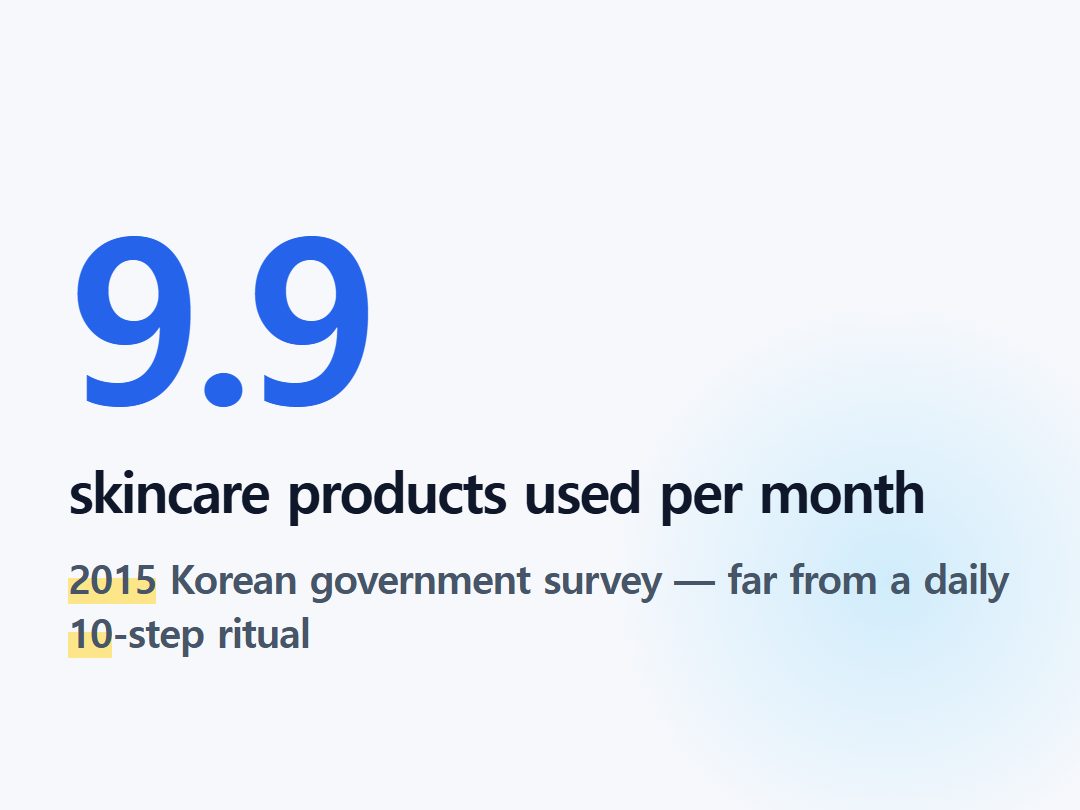
The data backs them up. A 2015 survey by South Korea's Ministry of Food and Drug Safety found the average Korean woman used 9.9 skincare products per month — not per day, and nowhere near a daily ten-step ritual. A 2021 survey of 1,500 Korean women by the research firm Kantar found that 28 percent used just three products in their morning routine and another 23 percent used only two, not counting cleanser.
The 7-skin method fits the same mold on a smaller scale. It is a real technique, practiced by some people, amplified into a defining national habit by beauty media and retailers who benefit from a story that sells more toner.
Part of the confusion is even linguistic: Koreans commonly call toner "seukin" (스킨), a Konglish borrowing from the English word "skin," so "7-skin" more accurately translates to "toner applied seven times" rather than anything about literal skin layers.
Readers encountering the name in English can easily mistake a translation quirk for a mystical seven-layer ritual.
None of this means the technique does not work for some skin types, or that no one in Korea does it.
It means the number seven, and the idea that this is standard practice, is a marketing simplification — the same move that produced the ten-step routine a few years earlier, aimed at the same audience: international consumers new to Korean beauty products who respond better to a clear, dramatic-sounding rule than to "it depends on your skin."
How American retailers packaged K-beauty into simple rules
K-beauty's rise abroad has a fairly specific timeline. Korean beauty products barely registered with American consumers before the early 2010s.
Retailers built specifically to import and explain Korean skincare to English-speaking shoppers — Soko Glam and Peach & Lily, both founded in 2012, followed by Glow Recipe in 2014 — did the work of translating an unfamiliar market into something approachable.
That meant giving Western media and shoppers simple frameworks: numbered steps, named methods, catchy rules. The "10-step routine" was the first and biggest of these frameworks; it generated years of press coverage and cemented an image of Korean women as skincare maximalists.
The "7-skin method" arrived a few years later, riding the same wave.
It emerged from Korean online beauty communities as one technique among many — alongside double cleansing, sheet masking, and the toner-soaked cotton pad method — but it was the kind of technique that traveled well: a single memorable number, an easy before-and-after story, and a plausible-sounding mechanism (gradual hydration layering) that made it feel like insider knowledge rather than a trend that a beauty blog had just amplified.
What actually happened inside Korea over the same period looks different. Rather than adding more steps, dermatologists and skincare brands in Korea have spent recent years pushing in the opposite direction.
Industry figures describe a shift toward what is now often called "skinimalism" — paring routines down to a handful of products chosen for a person's specific skin, out of concern that stacking too many products and active ingredients damages the skin barrier rather than improving it.
That shift undercuts the seven-layer, ten-step narratives even further: the products marketed abroad as authentically Korean maximalism arrived in the West around the same time Korean consumers themselves were moving toward doing less.

Whether the 'skinimalism' correction reaches international readers
The gap between K-beauty's export image and everyday practice in Korea is not likely to close on its own, because it is commercially useful to keep it open.
Numbered, named routines are easy to market, easy to build product bundles around, and easy for beauty media to turn into headlines — a genuinely case-by-case answer like "apply toner until your skin feels comfortable" does not sell nearly as well.
Expect new named "methods" to keep emerging from Korean online beauty communities and to keep getting picked up, simplified, and rebranded for international audiences the same way the 7-skin method and the 10-step routine were.
What is worth watching is whether the "skinimalism" correction — the industry's own acknowledgment that more steps is not automatically better — reaches the same international audiences that absorbed the original maximalist narratives. So far, the more dramatic version of the story travels faster than the correction does.
Marketing claim vs. actual practice
| Method | Marketing Claim | What the Data Shows | Origin |
|---|---|---|---|
| 7-Skin Method | Toner patted onto skin up to seven times | Guides advise layering until skin feels saturated, not a fixed count — oily skin may need only three layers | Korean online beauty communities, c. 2016–2017 |
| 10-Step Routine | Cleanse, tone, essence, ampoule, serum, sheet-mask, eye cream, moisturize, sunscreen — daily | 2015 survey: 9.9 products per month, not per day; 2021 survey: 28% use just three products, 23% use only two | Coined in English by Charlotte Cho, Into the Gloss, April 2014 |
Frequently asked
Is the 7-skin method really a Korean beauty routine?
It's a real technique from Korean online beauty communities, but guides treat the number loosely and it doesn't describe how most Korean women actually start their day.
Did Korean women actually invent the 10-step skincare routine?
No — it was coined in English by Charlotte Cho in an April 2014 Into the Gloss article to catalogue product categories for American readers, not to describe a daily routine Koreans followed.
How many skincare products do Korean women actually use?
A 2015 Ministry of Food and Drug Safety survey found the average was 9.9 products per month, and a 2021 Kantar survey found 28% of women use just three products in their morning routine.
Sources
Every factual claim above is traceable. We do not translate articles — we gather facts from multiple outlets and write them ourselves.
- The 10-Step Korean Skincare Routine — Into The Gloss
- The 10-Step Skin Routine Is A Myth – Here's What Korean Women Really Use — Refinery29
- The 10 Step Korean Skin Care Routine Is Not Real (And Never Was) — The Monodist
- Soko Glam's Charlotte Cho Has Already Upended The Beauty Industry — And It's Only The Start — Bustle
- '7스킨'이 뭐기에 (What's this '7-skin' thing?) — W Korea
- 7 스킨법이 내 피부에 맞지 않는 이유 (Why the 7-skin method may not suit your skin) — Signature MG


