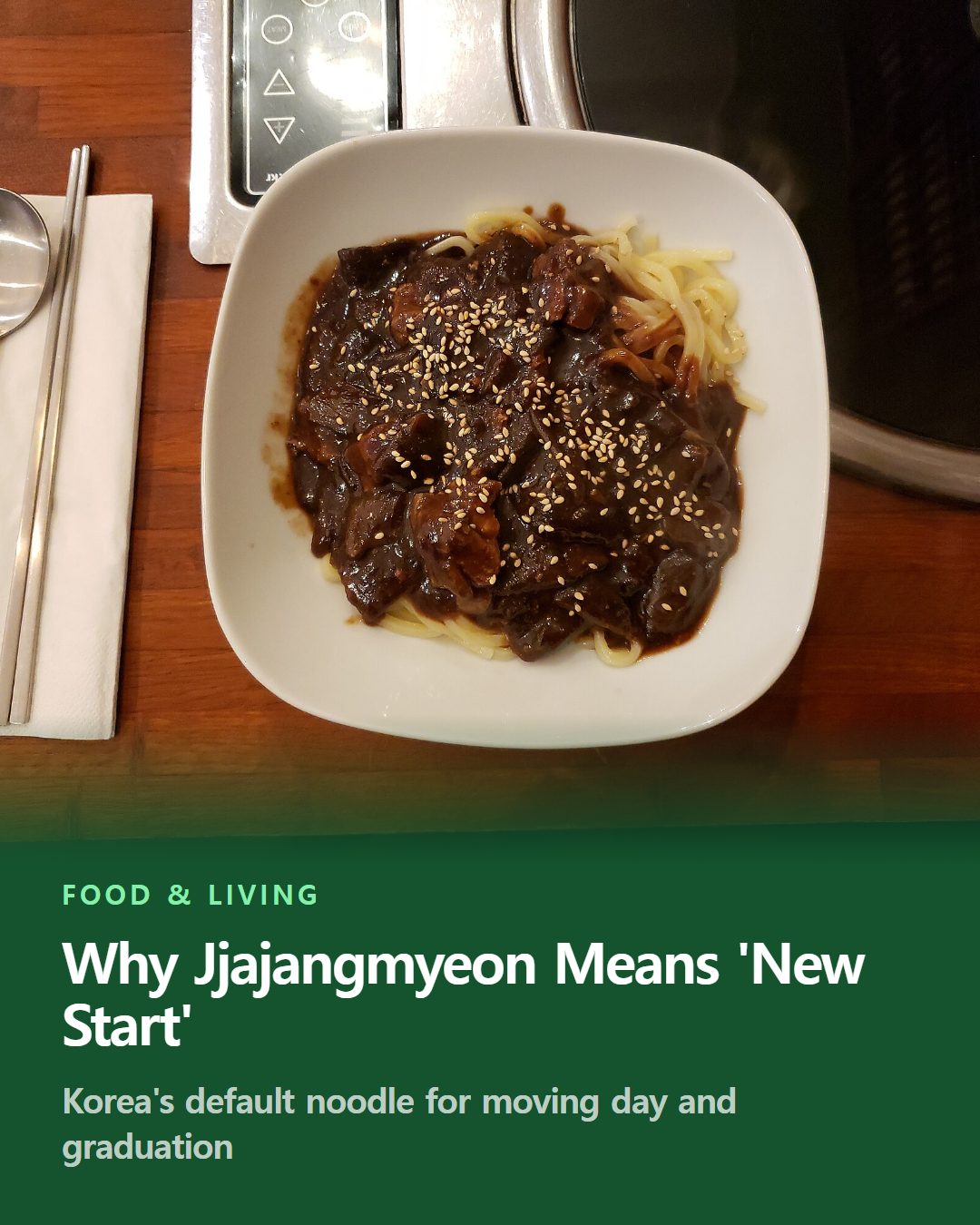
In Korea, moving into a new apartment or walking out of a graduation ceremony tends to end the same way: a delivery order of jjajangmyeon, noodles tossed in a thick, near-black bean sauce.
The custom is consistent enough that "did you order jjajangmyeon yet?" is a stock joke aimed at anyone mid-move, and family dinners after graduation ceremonies still gravitate toward the same neighborhood Chinese restaurant. Neither ritual is really about the noodles.
Both point to how a 20th-century immigrant dish became Korea's default way of marking a fresh start cheaply and quickly.
The short version
- Jjajangmyeon became Korea's default fresh-start meal for cheap, fast, no-cleanup delivery.
- Hwagyo immigrants invented the dish after Korea barred them from owning land or businesses.
- A bowl cost 100 won in 1970; it now averages over 7,000 won.
Why do Koreans eat jjajangmyeon after moving or graduating?
Jjajangmyeon (also spelled jajangmyeon) is a Korean-Chinese noodle dish topped with a sauce made from chunjang, a fermented black soybean paste stir-fried with pork and vegetables.
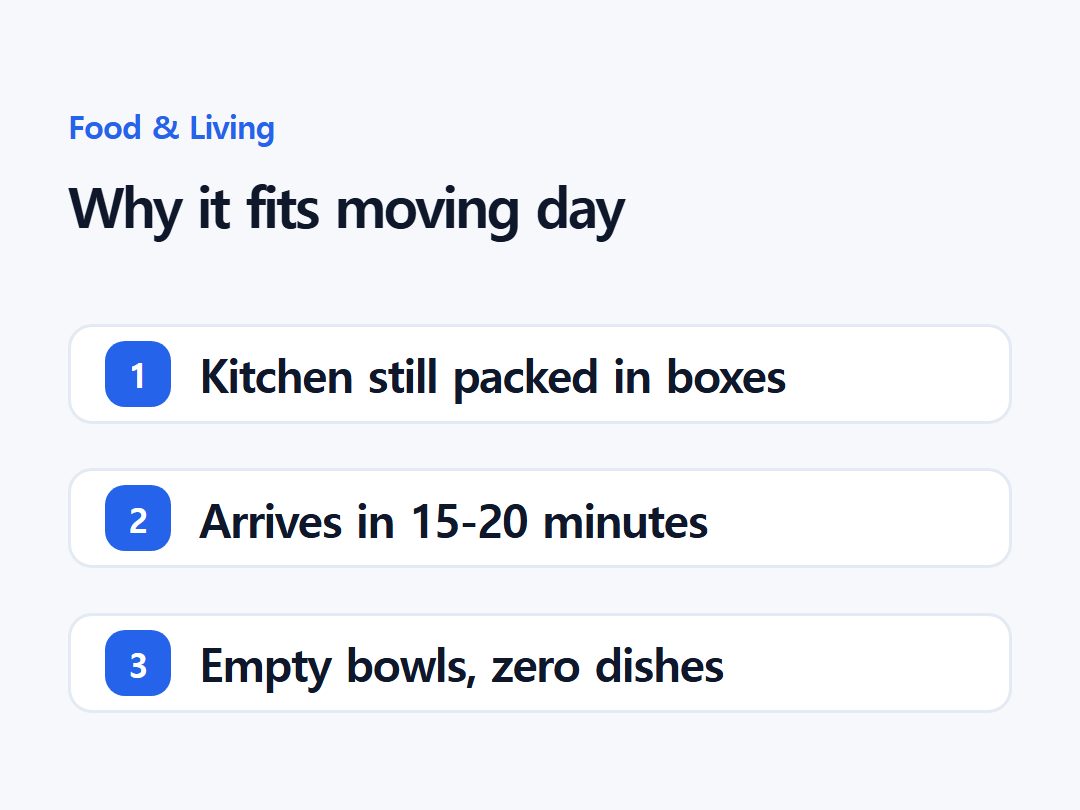
On moving day, it is the near-automatic order once the last box is inside and the kitchen is still packed away: the dish typically arrives within 15 to 20 minutes, is eaten straight from the delivery bowls, and requires no cleanup, since the empty bowls simply go back outside the door for the restaurant to collect later.
At graduation ceremonies, extended families still gather at a Chinese restaurant afterward for a jjajangmyeon meal, a small ritual that predates the ceremony photos now posted online. Neither custom is organized by any institution; it persists purely because enough Korean households keep doing it.
How banned Hwagyo turned to Korea's early delivery trade
To understand why this specific dish attached itself to two unrelated life events, an international reader needs two pieces of background that Korean readers absorb without thinking about it: who actually built Korean-Chinese food in Korea, and how Korea's delivery system grew up around it.
Jjajangmyeon did not start out as Korean food. It traces back to laborers from China's Shandong province who settled around Incheon after the port opened to foreign trade in 1883 and a Chinese settlement district was established there the following year.
These migrants and their descendants, collectively known in Korean as Hwagyo (화교, ethnic Chinese residents of Korea), brought a Shandong habit of eating wheat noodles with fermented bean paste and adapted it into something new.
Chunjang, the sweeter, caramelized black bean paste that gives jjajangmyeon its color, does not exist in Chinese cuisine outside Korea, according to Seo Hak-bo, a Korean-Chinese restaurateur whose father immigrated from Shandong.
For much of the 20th century, the Hwagyo community that popularized this dish also lived under significant legal restriction.
Governments in Seoul largely treated Hwagyo residents as foreign nationals long after their families had lived on the peninsula for generations. A 1961 law banning foreign nationals from owning land hit Hwagyo households directly, many of whom had built wealth in property; a 1962 currency reform then forced anyone holding large amounts of old cash to deposit it in banks rather than convert it freely, a measure widely understood at the time to target the Hwagyo habit of keeping savings in cash rather than accounts.
Restrictions on foreign-owned businesses persisted in various forms until they were lifted as part of the IMF-era reforms of the late 1990s.
Restaurants were one of the few trades still open to a community shut out of land ownership and most licensed industries — part of why Korean-Chinese cooking, rather than any other immigrant cuisine, became the trade the Hwagyo were pushed into and eventually came to define.
That history collided with Korea's particular delivery infrastructure. Chinese restaurants in Seoul and Incheon were already delivering food by bicycle in the 1930s, decades before telephones were common in ordinary households.
By the 1960s and 70s, delivery by motorcycle with a metal box strapped to the back was a familiar street scene, and jjajangmyeon restaurants were among the only businesses that could reliably get hot food to a customer's door on short notice — precisely the two conditions a household needs on the day it is moving, when the kitchen is unusable, or celebrating a graduation, when a family wants to gather without cooking. No other dish had built out that delivery reflex as early or as widely.
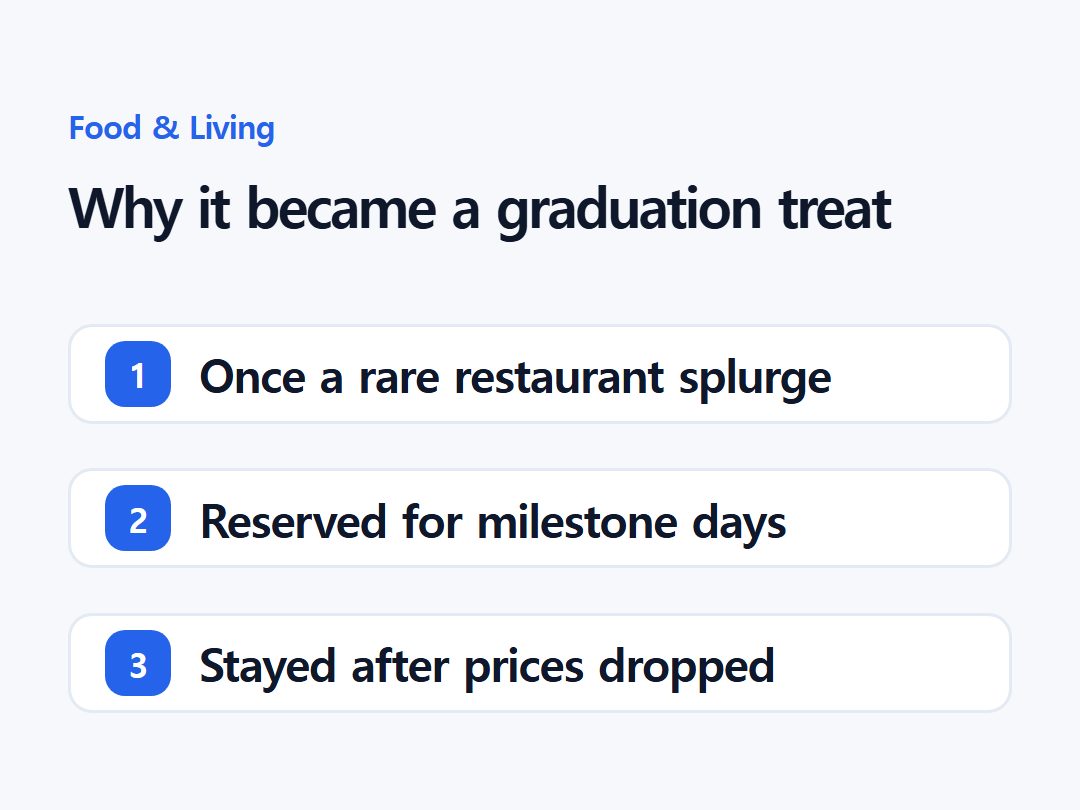
Price is the other half of the story, and it flipped over time. In the 1950s through 70s, when Korea was still a low-income, largely agrarian economy, eating at any restaurant was a luxury most families reserved for special occasions — a graduation, a birthday, an exam finished.
Jjajangmyeon, served at proper sit-down Chinese restaurants, was the treat parents could still afford on those days, so it became the meal attached to the milestone itself.
The dish only came to be seen as cheap, everyday food later, once incomes rose through the 1980s and 90s — by which point the graduation-day habit had already set.
Jjajangmyeon marks celebrations today for roughly the same reason a distinctly special-occasion dish was Sunday-only in an earlier era: cultural habits tend to outlast the economics that created them.
How one Incheon restaurant's dish became a price gauge
The commonly cited origin point is Gonghwachun, a restaurant-and-inn opened in Incheon's Chinatown between 1905 and 1908 by Woo Hee-gwang, a migrant from Shandong.
Gonghwachun is widely credited, though not without dispute among Incheon's Chinese community, as the establishment that put "jajangmyeon" on a menu as a named dish rather than a generic laborer's meal.
The restaurant did not survive Korea's later restrictions on foreign-owned business: it closed in 1983, and its owning family relocated to Taiwan. The original building was designated a registered cultural property in 2006 and now operates as a jajangmyeon museum.
The dish's price has been tracked closely enough over the decades that Korean media use it informally as a cost-of-living gauge, the way the "Big Mac Index" is used internationally.
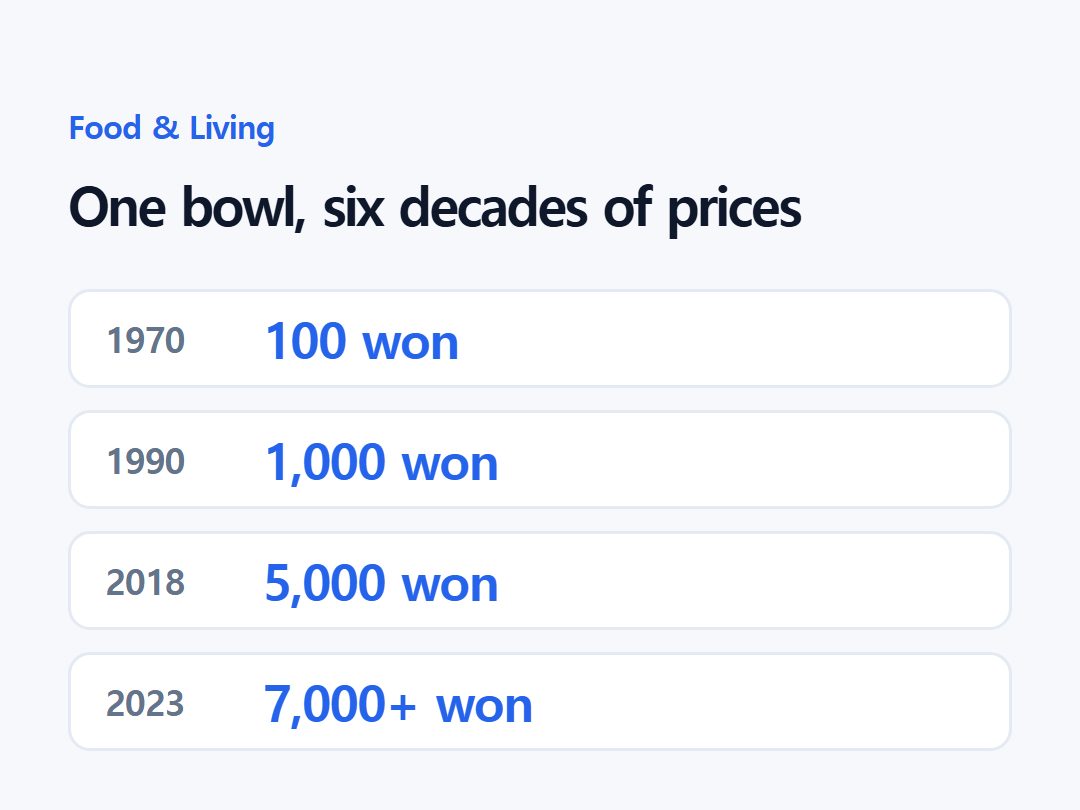
A bowl cost roughly 100 won when Korean price-tracking data begins in 1970, crossed 1,000 won around 1990, reached 2,000 won by the mid-1990s, and kept climbing — 3,000 won in the early 2000s, 4,000 won by 2011, 5,000 won by 2018.
The most recent surveys put Seoul's average bowl above 7,000 won as of 2023, driven largely by the cost of flour, pork, onions and chunjang itself.
Delivery culture grew alongside it. Household telephone ownership was still rare through the 1970s, which limited food ordering mostly to offices and institutions that already had phone lines.
That changed through the 1980s, when household phone ownership became common at the same time Korea's apartment-building boom put large numbers of people into dense, easily served high-rises — the same housing stock that today makes a mover's kitchen unusable on move-in day.
Chinese restaurants delivering jjajangmyeon by phone became a fixture of that decade, well before Korea's now-famous delivery-app industry existed.
Will the moving-day and graduation tradition last?
The ritual persists even as its original logic — jjajangmyeon as a rare, affordable treat — has largely eroded.
Seoul's average bowl now regularly turns up in local price-inflation coverage the way gasoline or grocery prices do elsewhere, and Statistics Korea's ongoing review of its consumer price index basket, which is expected to shift its base year, will determine whether the dish keeps its informal status as a tracked household item.
Whether the custom itself keeps its grip on graduation and moving days is a separate, softer question.
Younger Koreans now have far more delivery options than their parents did, yet the habit still shows up in ordinary and celebrity life alike: BTS member Jungkook's bandmates joined him for jjajangmyeon at the same restaurant on both his high school entrance in 2014 and his graduation in 2017, a detail Korean fans noticed immediately and most international fans missed entirely.
That kind of unplanned, generational repetition — not any campaign or subsidy — is what has kept a 19th-century immigrant noodle dish as Korea's default way of marking the end of one chapter and the start of another.
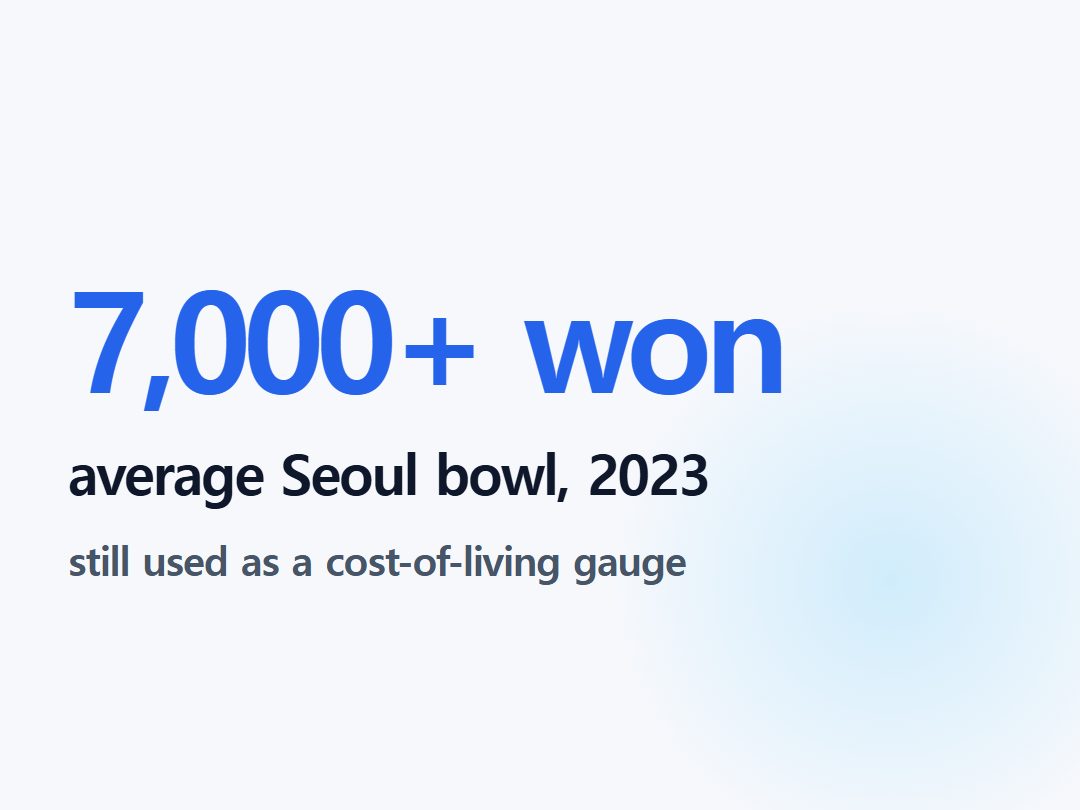
Price of a bowl of jjajangmyeon in Seoul, 1970–2023
| Year | Price |
|---|---|
| 1970 | ~100 won |
| ~1990 | ~1,000 won |
| mid-1990s | ~2,000 won |
| early 2000s | ~3,000 won |
| 2011 | ~4,000 won |
| 2018 | ~5,000 won |
| 2023 | 7,000+ won |
Frequently asked
Why do Koreans eat jjajangmyeon when they move house?
It typically arrives within 15 to 20 minutes, requires no cooking, and the empty bowls just go back outside the door — ideal when the kitchen is still packed in boxes.
Is jjajangmyeon Chinese or Korean food?
It comes from Hwagyo (ethnic Chinese) immigrants from Shandong who settled in Incheon after 1883, but chunjang, the black bean paste that gives it its color, does not exist in Chinese cuisine outside Korea.
How much does jjajangmyeon cost in Korea today?
Seoul's average bowl was above 7,000 won as of 2023, up from roughly 100 won when Korean price-tracking data begins in 1970.
Sources
Every factual claim above is traceable. We do not translate articles — we gather facts from multiple outlets and write them ourselves.
- [Visual History of Korea] Jjajangmyeon, Korean Chinese dish invented in Incheon by Chinese migrant workers — The Korea Herald
- The birth of Jajangmyeon, "Incheon Gonghwachun" — Seoul Metropolitan Government
- Jjajangmyeon: A Korean-Chinese Favorite for All Ages — Korea Tourism Organization (VisitKorea)
- Chinese people in Korea — Wikipedia
- Gonghwachun — Wikipedia
- Delivery culture in South Korea — Wikipedia
- 서민음식 짜장면, 1970년엔 100원이었는데 올해 평균 가격은 — Kyunghyang Shinmun
- BTS Celebrates Jungkook's Graduation By Recreating Photo From His First Day Of High School — Soompi