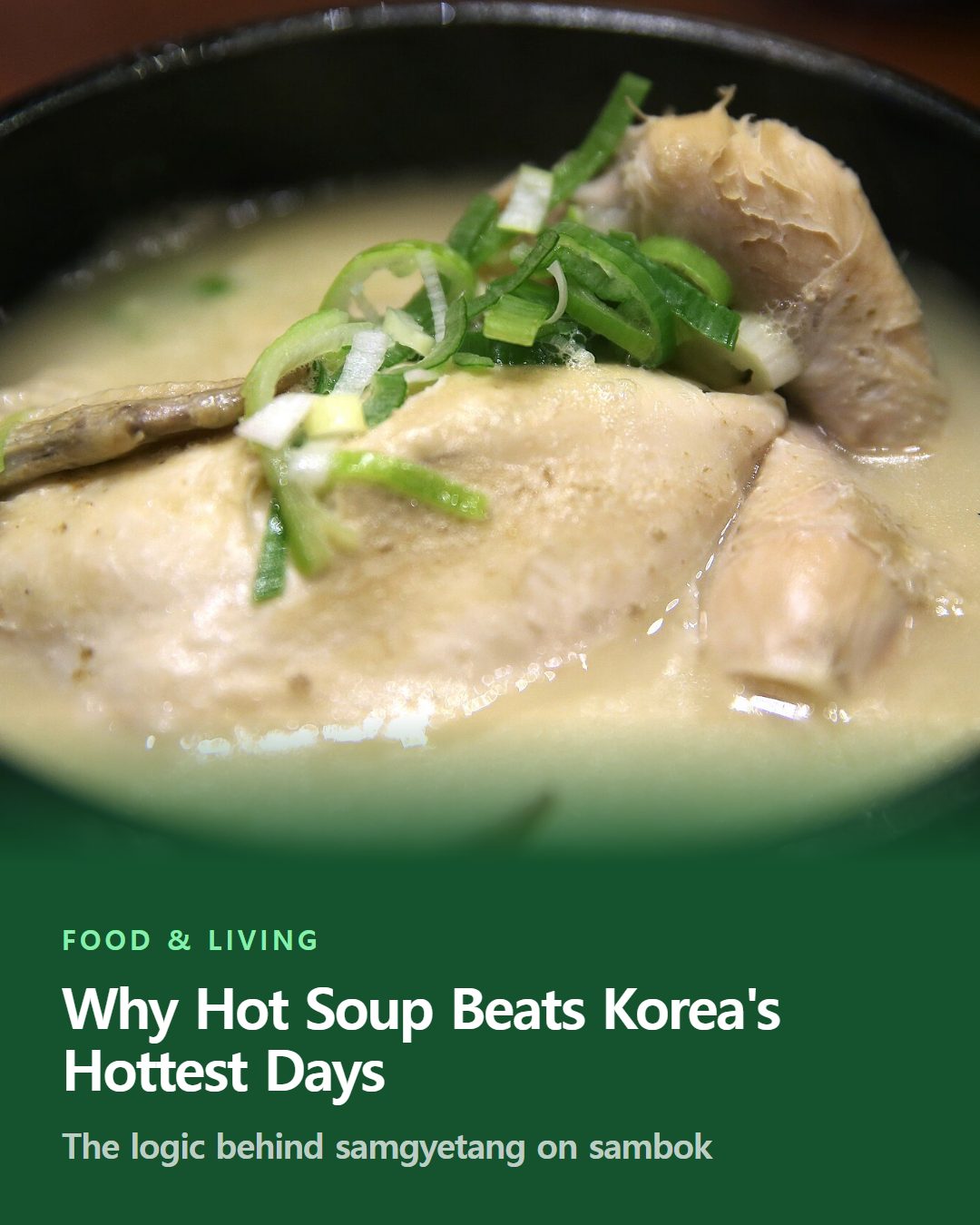
A soup built for the year's hottest days
Every summer, Korean restaurants fill with customers ordering a pot of soup so hot it arrives still bubbling, on days when outdoor temperatures can top 33°C (91°F). The dish is samgyetang, a whole young chicken stuffed with glutinous rice, garlic, jujube, and ginseng, simmered until the meat falls off the bone.
The short version
- Sambok falls on three fixed days between mid-July and mid-August.
- Samgyetang only became a national dish after the 1960s.
- Dog meat soup, not samgyetang, was Korea's original bok-day food.
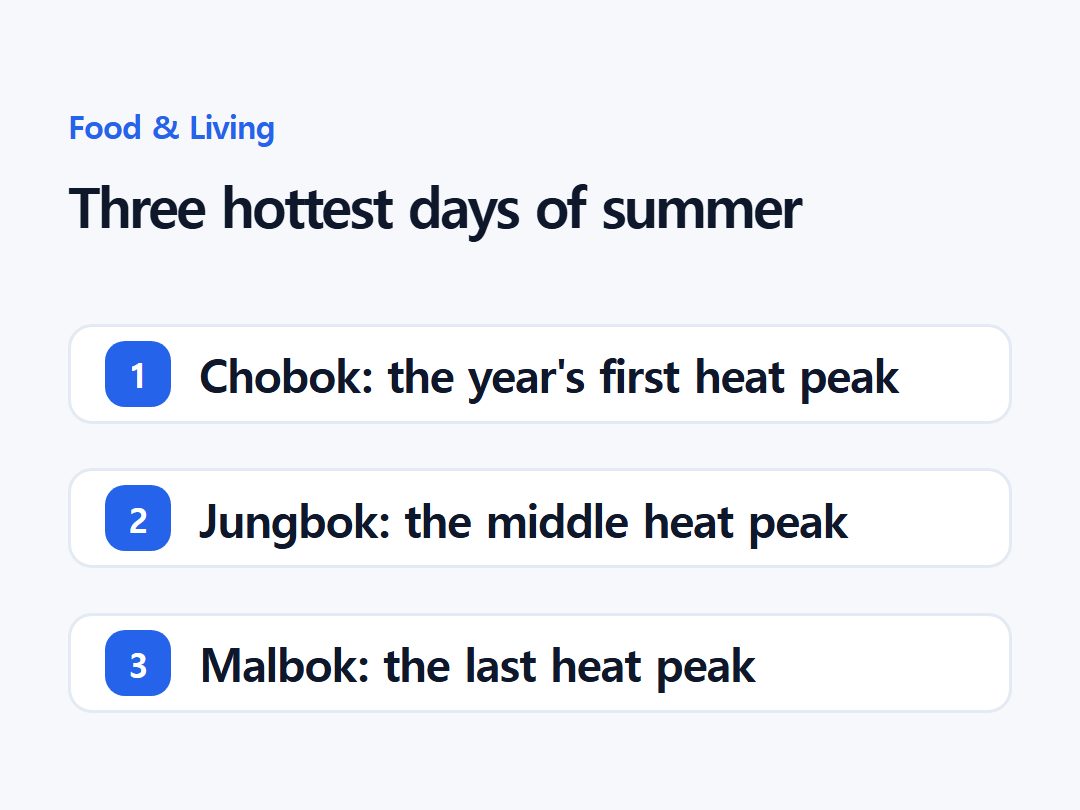
The timing is not random. Koreans eat it most heavily during sambok (삼복), three specific calendar days called Chobok, Jungbok, and Malbok, that fall between mid-July and mid-August and mark the year's peak heat.
To an outsider, ordering hot soup to cool down looks backwards. To most Koreans, it is unremarkable, a seasonal habit inherited from grandparents rather than something anyone stops to explain.
Why does eating hot soup cool you down?
The reasoning has a name: 이열치열 (yi yeol chi yeol), literally "control heat with heat." It comes from traditional East Asian medicine, which holds that summer heat pushes the body's energy outward, leaving the digestive system weak even as the air outside feels unbearable.
Under this framework, cold food during a heatwave does not help; it shocks a stomach that is already struggling. A hot, nutrient-dense soup is instead believed to support digestion and replace the energy sweat carries away.
The astrology behind bok's three fixed days
The three days are not arbitrary either. On the traditional East Asian calendar, each bok falls on a "gyeongil" (경일), a day associated with the element metal, which corresponds to autumn. The character 伏 (bok) means "to lie prostrate," and folk explanations describe it as autumn's cool energy collapsing beneath summer's dominant heat.
The custom of marking these days predates Korea itself. Sima Qian's Records of the Grand Historian, written around 100 BC, credits Duke De of Qin with holding the first recorded "bok" ritual roughly two thousand years ago, distributing meat at the city gates to ward off summer's harmful energy.

From royal ice rations to everyday feasting
When the custom reached Korea, it took a more institutional form. During the Joseon dynasty (1392–1910), the royal court marked sambok by distributing ice and meat to high officials, a genuine luxury since only those holding a "bingpyo" (빙표), or ice permit, could collect ice from the royal ice house.
Outside the palace, the same days functioned differently: as a custom-sanctioned excuse to eat better than usual during the most physically demanding stretch of the farming calendar, when appetite dropped just as the workload peaked.
Chicken was affordable, ginseng was a luxury
Samgyetang's ingredients reflect economics as much as medicine. Cattle were too valuable as farm labor to slaughter casually, and pigs were not raised for on-demand eating. Chickens, hatched in spring, reached ideal size by midsummer, making them the meat an ordinary household could most easily afford.
Ginseng, by contrast, stayed expensive well into the 20th century. Its presence in the dish long signaled a household's status, which is also why the dish's name eventually changed.
Ginseng-and-chicken broths existed long before samgyetang had a settled name or recipe. Korean records describe simpler predecessor soups, such as "yeongyetang" and "chonggyetang," dating back to the 17th century, typically just chicken and garlic simmered in water rather than today's ginseng-heavy version.
When a meal doubles as medicine and memory
The chicken-and-ginseng pairing reflects a broader idea in Korean food culture: yak-sik-dong-won (약식동원), "food and medicine share the same root." Traditional physicians did not draw a hard line between a meal and a remedy.
The 17th-century medical text Dongui Bogam, still cited as a foundation of Korean traditional medicine, describes chicken as beneficial for restoring strength in summer. That gave the samgyetang concept a documented medical basis well before the dish had its modern name.
The ritual is also social. Restaurants serving samgyetang on bok days are often crowded and un-air-conditioned by tradition, with diners sweating over identical bowls at shared tables, so the discomfort becomes something everyone endures together rather than something to avoid.
For many older Koreans, that memory is tied to family: grandparents once treated the meal as a near-obligatory seasonal duty, not a discretionary restaurant order.
The name swap nobody planned
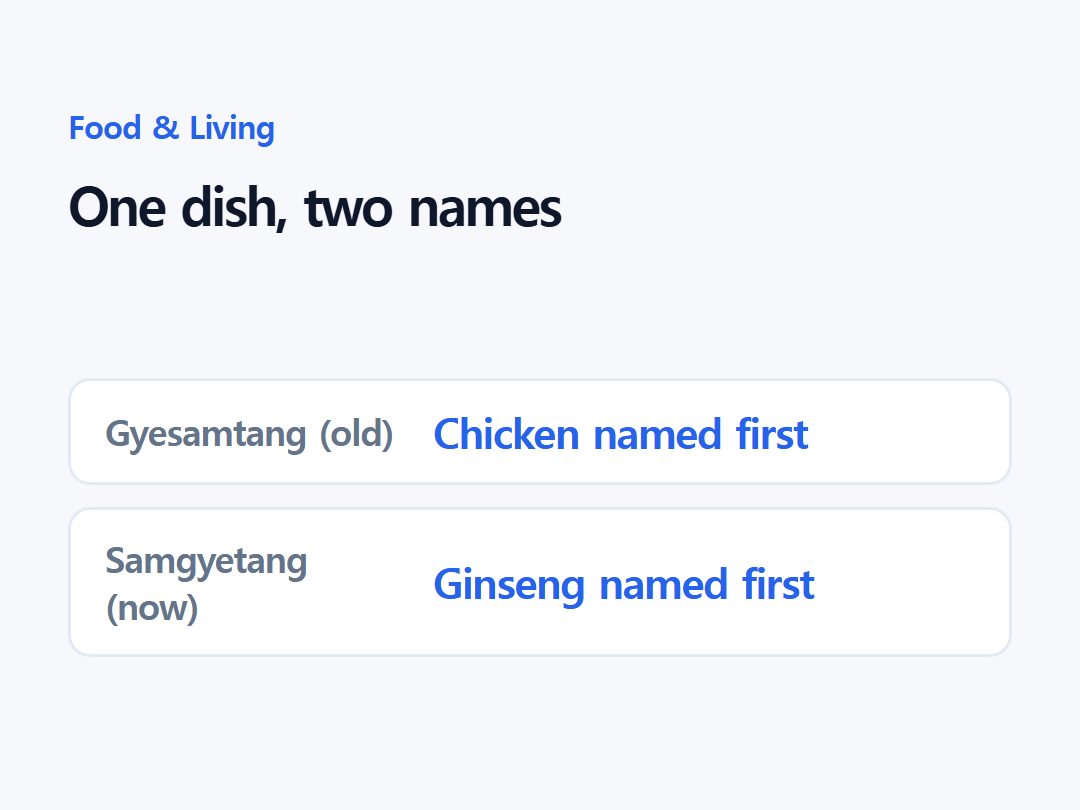
The dish was originally called gyesamtang (계삼탕), chicken (gye) listed first as the main ingredient, ginseng (sam) second. As ginseng grew more expensive and prestigious than the chicken itself, everyday speech flipped the order, and "samgyetang" eventually became standard.
The word "samgyetang" first appears in print in a Japanese colonial-era document from 1910, with a similar recipe described in a 1917 Korean cookbook. These were still niche, costly dishes, not yet the mass summer food Koreans know today.
How a luxury tonic became a national habit
For much of the early 20th century, ginseng chicken remained a wealthy household's dish. A 1937 article in the newspaper Dong-a Ilbo describes "gyesam" as a summer tonic in demand among those who could afford it, still a marker of privilege rather than a national custom.
A 1921 cookbook by Bang Sin-young contains the earliest known written recipe using ginseng powder inside chicken, though the ingredient remained a luxury reserved for wealthier households at the time.
That changed after the 1960s. Cold-chain distribution made fresh ginseng available nationwide, and government poultry policy expanded chicken supply. Seoul restaurants began advertising "samgyetang," with ginseng now first in the name, by the mid-1960s, and by the mid-1970s the dish was widely described as summer's essential nourishing food.
Commercial expansion followed quickly: canned versions launched in 1974, retort-pouch packaging arrived in 1983, and exports to Japan, the Americas, Hong Kong, and Southeast Asia began in 1985.
The dog meat soup samgyetang replaced
Samgyetang was not always the default bok-day food. For much of Korean history, the more common dish was gaejang (개장), a dog meat soup, with regional variants developed for households that avoided it.
- Gaejang: dog meat soup, the historical default
- Yukgaejang: a beef alternative popularized in 19th-century Daegu
- Patjuk and similar porridges: lighter regional alternatives
Samgyetang displaced these older dishes only gradually, as affordable chicken and ginseng became widely available, becoming the dish most associated with sambok by the late 20th century.
Will younger Koreans keep the sambok tradition alive?
Recognition of samgyetang abroad got a boost from television: the 2016 K-drama (a Korean television drama, a major cultural export) Descendants of the Sun shows its lead characters cooking and eating samgyetang, a scene widely credited with a spike in the dish's popularity among Chinese audiences after the show aired.
Domestically, the tradition it grew out of is closing for good. South Korea's National Assembly passed a law in January 2024 banning the breeding, slaughter, and sale of dogs for meat, with the ban fully taking effect in 2027. It formally ends the food custom that samgyetang itself gradually displaced over the 20th century, though eating dog meat as an individual is not criminalized under the law.
Surveys cited by animal welfare groups suggest most Koreans, especially younger generations, had already stopped eating dog meat before the law passed, which makes samgyetang's position as the default bok-day dish more secure than ever.
What is less settled is whether younger Koreans keep the sambok custom itself. Delivery apps now offer samgyetang on bok days without a restaurant visit, and some younger consumers treat it as an occasional treat rather than the near-medicinal obligation their grandparents once observed.
The timeline from luxury tonic to commercial product
| Year | Development |
|---|---|
| 1910 | Word "samgyetang" first appears in print in a colonial-era document |
| 1937 | Dong-a Ilbo describes "gyesam" as a summer tonic for the wealthy |
| 1960s | Cold-chain distribution and poultry policy expand ginseng and chicken supply nationwide |
| Mid-1960s | Seoul restaurants begin advertising "samgyetang" |
| Mid-1970s | Dish widely described as summer's essential nourishing food |
| 1974 | Canned versions launch |
| 1983 | Retort-pouch packaging arrives |
| 1985 | Exports begin to Japan, the Americas, Hong Kong, and Southeast Asia |
Frequently asked
Why do Koreans eat hot soup in the summer?
It follows 이열치열 (yi yeol chi yeol), the belief that hot, nutrient-dense food supports digestion and restores the energy summer heat and sweat drain from the body.
What did Koreans eat before samgyetang on bok days?
The historical default was gaejang, a dog meat soup, with beef-based yukgaejang and porridges like patjuk as regional alternatives.
Is dog meat still legal in Korea?
South Korea's National Assembly passed a law in January 2024 banning the breeding, slaughter, and sale of dogs for meat, with the ban fully taking effect in 2027.
Sources
Every factual claim above is traceable. We do not translate articles — we gather facts from multiple outlets and write them ourselves.
- 복날과 삼계탕 (Boknal and Samgyetang) — Korea Heritage Service (국가유산청)
- 초복·중복·말복에 알아두면 좋은 삼계탕 문화사 — National Folk Museum of Korea
- 삼계탕의 원래 이름은 '계삼탕'···삼계탕은 왜 복날 먹을까? — Kyunghyang Shinmun
- Why Koreans eat Samgyetang or ginseng and chicken soup on the hottest days of summer — Gulf News
- Fire With Fire: The Korean Ginseng Chicken Soup Ritual Behind the Hottest Days of Summer — Seoulz
- South Korea Finally Passes Historic Ban on Dog Meat Industry — TIME
- South Korea ends the dog meat industry: A model for change — Humane World for Animals
- Drama, Celebrities and Food Part 2: Descendants of the Sun and Samgyetang — Hallyu & Food


