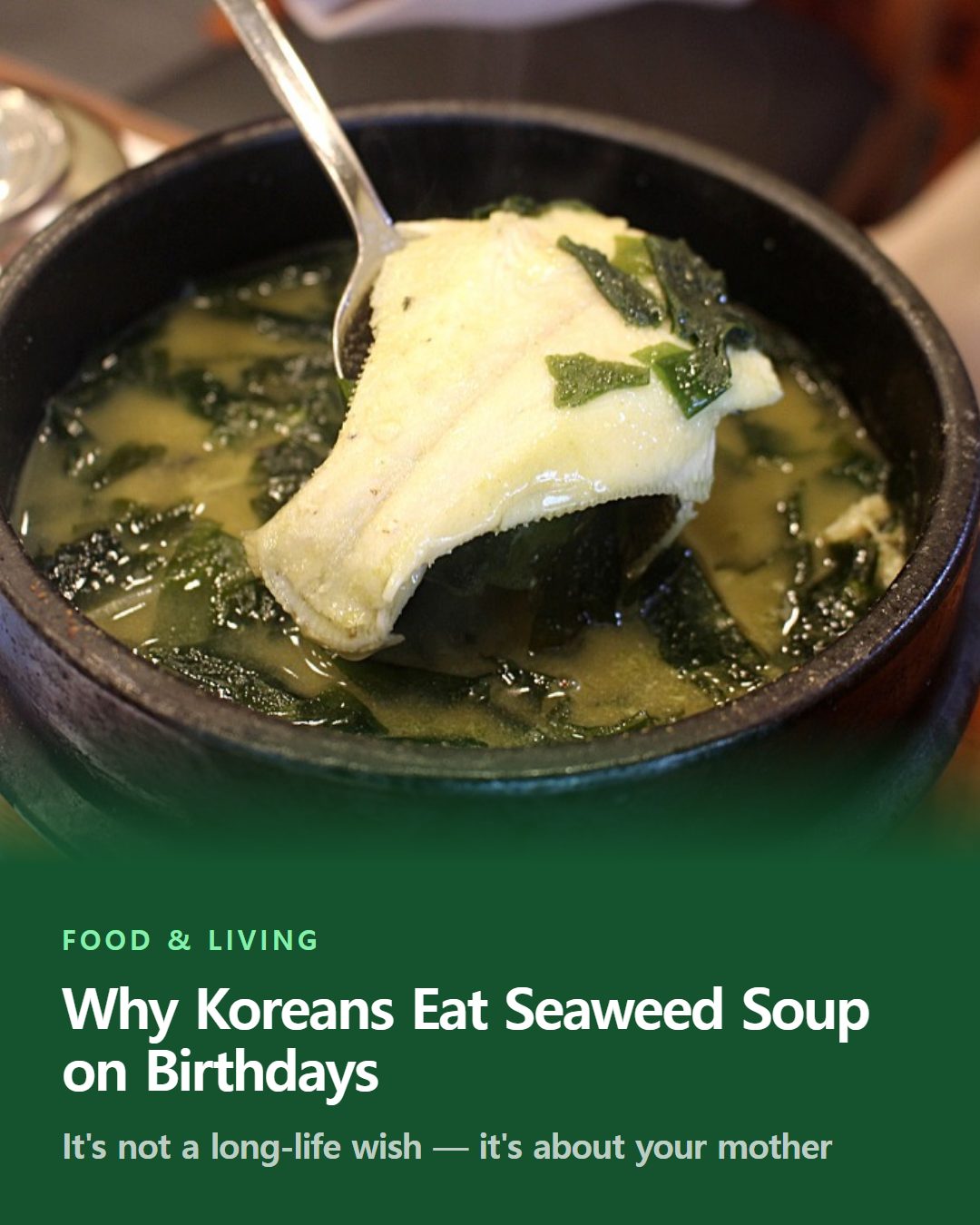
On birthdays in Korea, the dish that shows up on the table isn't cake — it's a bowl of miyeokguk (미역국), a plain, dark broth built from dried seaweed simmered with beef or fish.
Restaurants add it to birthday-week lunch specials, mothers make it before their children leave for school, and "did you eat your miyeokguk today?" is a standard birthday-morning text.
For readers outside Korea, the natural assumption is that it's a long-life food, like noodles at a Chinese birthday or a red-bean dish elsewhere in Asia. It isn't.
Miyeokguk is a birthday food because it was never a birthday food to begin with — it was a recovery food for new mothers, and Koreans still eat it on their own birthday to acknowledge that fact.
The short version
- Miyeokguk began as recovery food for new mothers, not a birthday wish.
- Koreans eat it yearly to honor their mother's postpartum recovery, not themselves.
- The exam-day taboo comes from 1907 wordplay, unrelated to the birthday custom.
Same soup every birthday, but never before exams
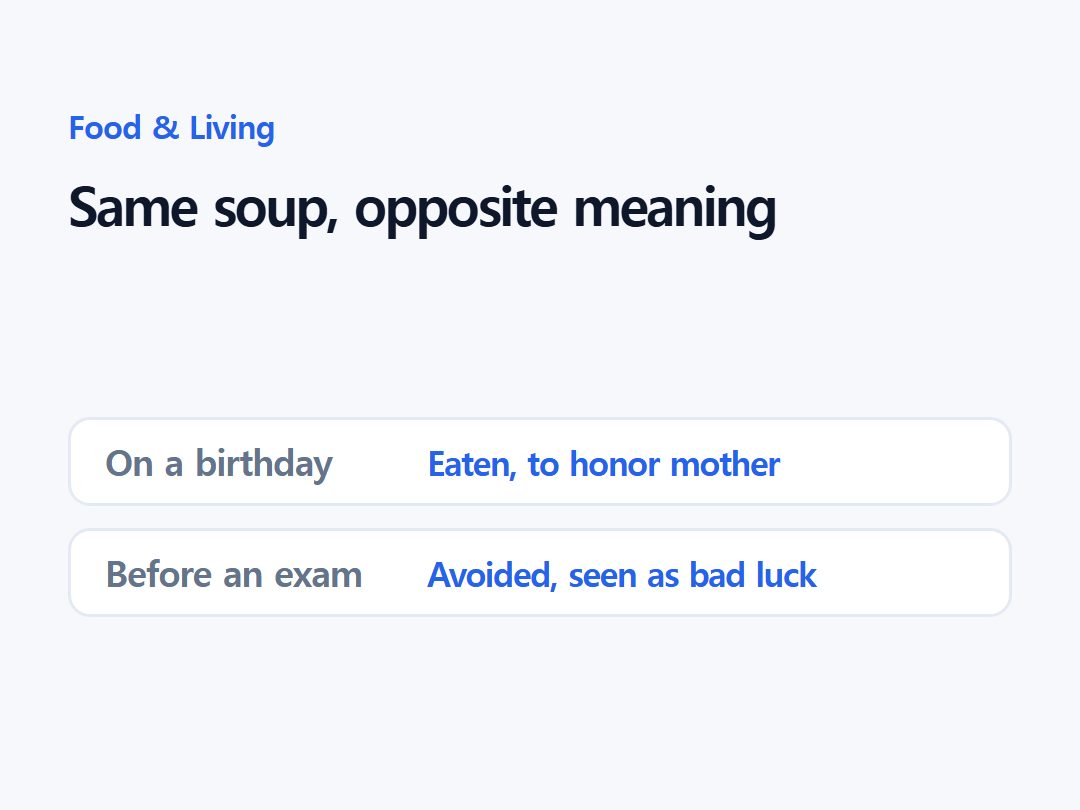
Miyeokguk is one of the most consistent food customs in Korea: a seaweed-and-broth soup served specifically on the day a person was born, every year, for life. It is not tied to a particular age or milestone — a five-year-old and an eighty-year-old eat the same dish, on the same day, for the same reason.
The custom sits alongside a second, stricter one: many Korean households avoid serving miyeokguk before a major exam, because of a separate superstition linking the soup's slippery texture to "slipping up" (failing).
That second custom is well known even among Koreans who couldn't explain where the birthday version actually came from.
Why do Koreans eat this soup on birthdays?
The part international readers usually miss is that miyeokguk's birthday role is a borrowed meaning, layered on top of its original, more literal one: it is what Korean women have eaten for weeks after childbirth.
Seaweed is rich in calcium, iron and iodine — nutrients that support recovery from blood loss and support lactation — and Korean records describe it being fed to postpartum women for centuries.
An 8th-century Tang Chinese reference work, the Chohakgi, notes that people on the Korean peninsula fed seaweed to women who had just given birth. A Joseon-era study of women's customs, the Joseonyeosokgo, describes new mothers eating three bowls of seaweed soup with rice after delivery.
The Joseon scholar Yi Ik, in his writings, compared miyeokguk's benefit to a postpartum woman to that of a rare tonic. This wasn't folk belief without basis — modern nutrition science confirms wakame seaweed is genuinely high in the minerals a postpartum body needs.
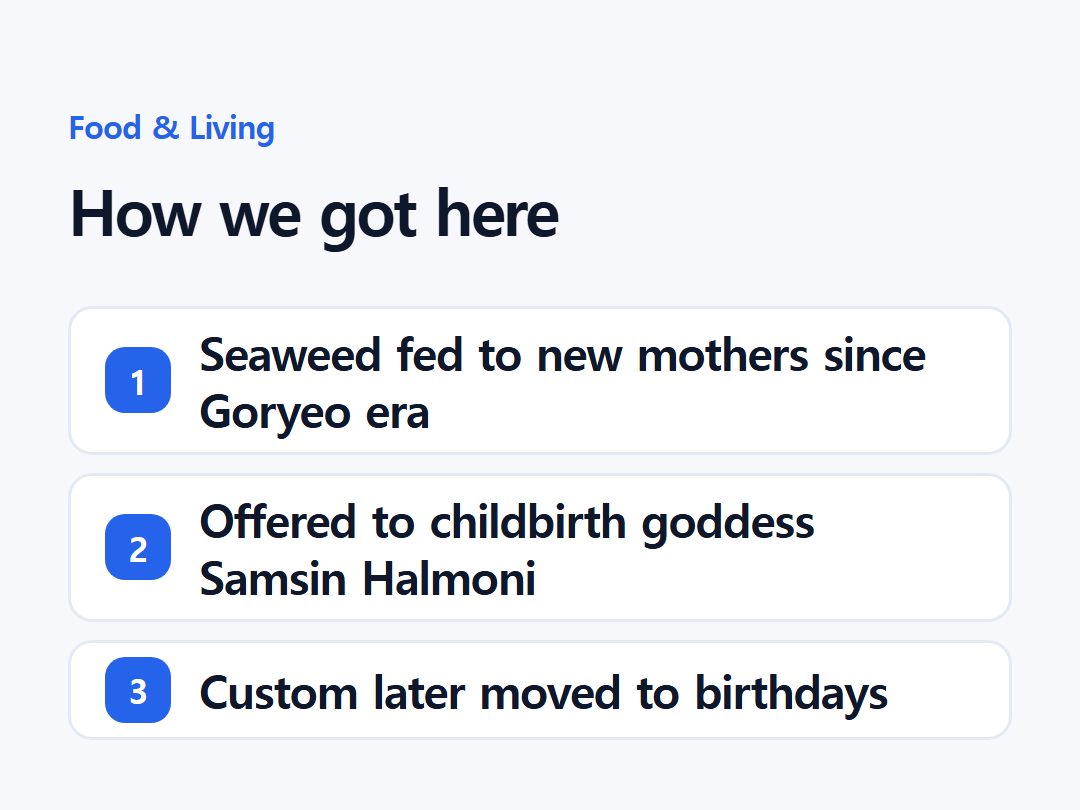
The soup's role didn't stop at recovery. In Korean folk religion, the same bowl of miyeokguk was placed by a mother's bedside as an offering to Samsin Halmoni, a trio of grandmother goddesses believed to oversee childbirth and a newborn's fate. Families prepared it again on the baby's third day, and again on the 21st day (a period called samchilil), each time thanking the goddess and praying for the child's health.
So when a Korean eats miyeokguk on their own birthday, the plain reading — this is a wish for me — is backwards. The soup on the table is a recreation of the exact bowl their mother ate in the days after giving birth to them.
Eating it is understood as a small, yearly acknowledgment of that recovery: not "may I live long," but closer to "I remember what it cost you to have me." Several Korean explainer pieces on the custom put it almost identically: the birthday bowl exists to make people reflect on their mother's labor and gratitude toward her, not to bless the birthday person's own future.
That distinction — recovery food for her, gratitude food for me — is the whole gap between how this looks from outside Korea and what it actually signals inside it.
This is also why the custom carries almost no wish-making language. Birthday traditions built around long life or luck — noodles, rice cakes, candles — center the person having the birthday. Miyeokguk centers someone else in the room, or someone not in the room at all.
It is one of relatively few widely practiced food customs anywhere that is explicitly about a parent on the day meant to celebrate the child, which is part of why Korean explainer articles keep returning to it even though nearly every Korean adult already knows the story.
The custom also still runs in the other direction, literally.
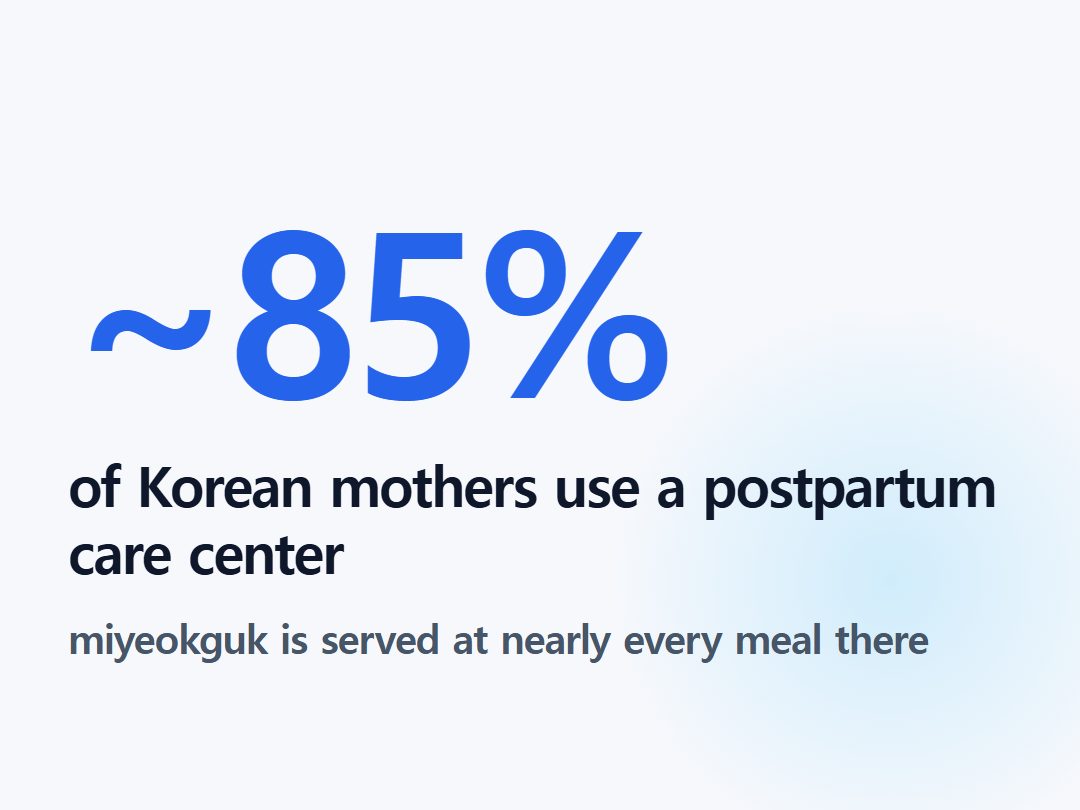
Since the mid-2010s, purpose-built postpartum care centers called sanhujoriwon (also called joriwon) have become the default recovery option for new mothers in Korea's cities — one government survey found roughly 85% of Korean mothers used one, staying an average of about 12 days at a typical cost near 2.9 million won (roughly $1,900).
Miyeokguk, delivered with every meal, remains the one constant across nearly all of them. The birthday custom and the maternity-ward custom are not two separate traditions that happen to share an ingredient; they are the same tradition, split across two contexts a century apart.
Two separate origin stories, centuries apart
The origin story most Koreans know is a whale legend, first written down in detail by the late-Joseon scholar Yi Gyu-gyeong. In it, a man swallowed by a whale observes that the whale's blood is dark and clotted after giving birth, and watches seaweed appear to clear it.
He escapes and spreads the observation that seaweed helps postpartum recovery. Whether or not anyone treated the story as literal fact, it functioned as an explanation for a practice that already existed and needed a memorable reason to be passed down.
The documentary trail is older and more concrete than the legend. Chinese sources from the Tang dynasty (7th–10th century) already describe the practice on the Korean peninsula, meaning the custom likely predates written record entirely.
By the Goryeo (918–1392) and Joseon (1392–1897) dynasties, seaweed soup for new mothers was a fixture, reinforced by the Samsin Halmoni ritual described above.
The shift to a birthday dish came later, as an extension: a food strongly associated with a person's actual birth naturally migrated to the anniversary of that birth, carrying its original meaning — thanks to the mother — along with it, rather than acquiring a new "long life" meaning the way many other birthday foods across Asia did.
The exam-day taboo has a separate and unrelated history.
One widely cited explanation ties it to language, not superstition about slipping: after Korea's imperial army was forcibly disbanded in 1907, the Korean word for that disbandment (haesan, 解散) became a euphemism people avoided saying aloud, substituting a homophone — haesan (解産), meaning "giving birth" — and by extension, the soup eaten after giving birth.
Under Japanese colonial rule, "eating miyeokguk" became slang for losing a job or position, a meaning later generalized to failing an exam. The two customs — birthday reverence and exam-day avoidance — trace back to different centuries and different logics, even though they involve the same bowl of soup.

Whether a shrinking birth rate could change this
The custom isn't static. Instant and packaged miyeokguk sales rise every year around national exam season and birthday periods, and Korean media outlets still run seasonal explainers reminding younger readers why the two occasions treat the same soup so differently.
Postpartum care itself is also shifting: as more Korean mothers choose sanhujoriwon over home recovery, and as Korea's birth rate remains among the lowest in the world, some commentators have asked whether a tradition rooted so specifically in childbirth will hold the same meaning for generations having fewer children, or none.
For now, the custom persists largely unchanged — surveys and food-culture writers continue to describe miyeokguk as the one dish nearly every Korean household still serves on a birthday, for the same reason it always has: not for the person eating it, but for the mother who ate it first.
How the miyeokguk custom developed over time
| Period | What happened |
|---|---|
| 8th century (Tang dynasty) | Chinese reference work Chohakgi notes Koreans fed seaweed to postpartum women |
| Joseon era | Joseonyeosokgo describes new mothers eating three bowls of seaweed soup with rice after delivery |
| Late Joseon | Scholar Yi Gyu-gyeong records the whale legend explaining why seaweed helps recovery |
| 1907 | Disbanding of Korea's imperial army creates a homophone linking miyeokguk to failure/job loss |
| Mid-2010s–today | Sanhujoriwon postpartum centers become the default; miyeokguk remains the one constant meal |
Frequently asked
Why do Koreans eat seaweed soup (miyeokguk) on their birthday?
Miyeokguk was originally a recovery food for new mothers, so eating it on your birthday is a yearly acknowledgment of the mother who ate the same soup after giving birth to you.
Why do Koreans avoid miyeokguk before exams?
The taboo traces to 1907, when a homophone for Korea's disbanded imperial army came to mean 'losing a job,' a meaning later generalized under Japanese colonial rule to failing an exam — a separate history from the birthday custom.
What do Korean mothers eat after giving birth?
New mothers traditionally eat miyeokguk for weeks after childbirth for its calcium, iron and iodine, a practice documented since the 8th-century Tang dynasty and still served at nearly all modern sanhujoriwon postpartum care centers.
Sources
Every factual claim above is traceable. We do not translate articles — we gather facts from multiple outlets and write them ourselves.
- Miyeok-guk — Wikipedia
- How seaweed soup became Korea's traditional birthday dish — Korea.net (Republic of Korea government)
- Why Do Koreans Eat Seaweed Soup On Birthdays?—A Custom Where Traditional Wisdom Meets Science — Koreaboo
- 생일에 미역국 먹는 인문학적 이유 — 한국외식신문 (Korea Food Times)
- 생일날 왜 미역국을 먹을까? — Bizwatch
- [속담 속 바다이야기] '미역국 먹다' — 강원도민일보 (Kado.net)
- "미역국은 피해라" 속설에도…수능날 먹기 좋은 음식은 — SBS 뉴스
- [WHY] The art of premium postpartum care at Korea's sanhujoriwon — Korea JoongAng Daily
- For new moms in Seoul, 3 weeks of pampering and sleep at a joriwon — The Seattle Times