Say goodbye to a cashier in Seoul, and the phrase they use will be different from the one you use back — even though you're both leaving the same conversation at the same moment. That's not rudeness. It's grammar.
The short version
- Korean picks 가세요 or 계세요 based on who is leaving, not speaking.
- 안녕하세요 means hello only — it's never used as goodbye.
- Institute-approved phone goodbye is 계세요; most Koreans say 들어가세요 instead.
Korean doesn't have one all-purpose word for "goodbye." It has at least two, and mixing them up is the single most common mistake Korean-language learners make once they're past the beginner stage.
Korean splits "goodbye" by who is walking away
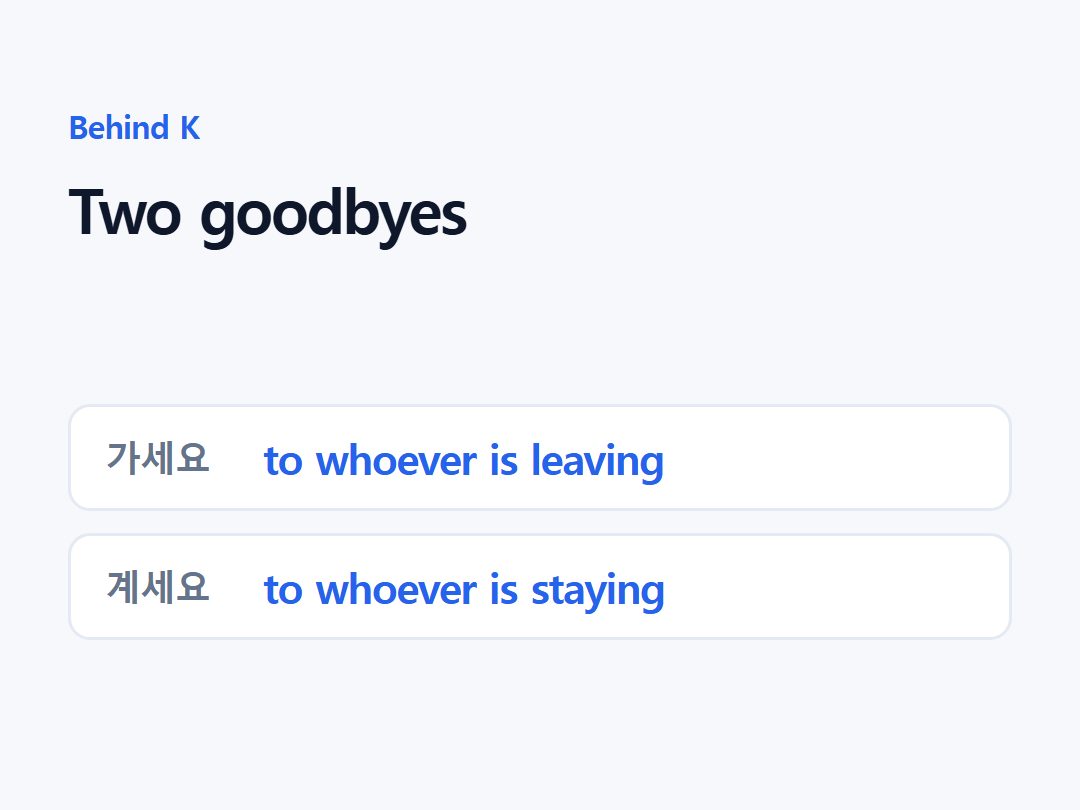
안녕히 가세요 (annyeonghi gaseyo) means "go in peace." 안녕히 계세요 (annyeonghi gyeseyo) means "stay in peace." The one you use depends entirely on whether the person you're talking to is the one leaving or the one staying put.
A shop clerk who stays behind the counter says 가세요 to the customer walking out. The customer, who is leaving the clerk behind in the store, says 계세요 back. Both are saying goodbye — they're just describing two different physical facts.
안녕하세요 is a hello, never a goodbye
This is where the assumption most learners bring to Korean breaks down. 안녕하세요 (annyeonghaseyo), the standard "hello," is built from the same root as both farewells — but it only works in one direction. Koreans don't say it on the way out.
Learners coming from languages with a single word that covers arrivals and departures expect Korean's hello to double as its goodbye too. Instead, the greeting stays fixed in place, and the farewell forks into two.
The literal meaning is "go/stay in peace," not "bye"
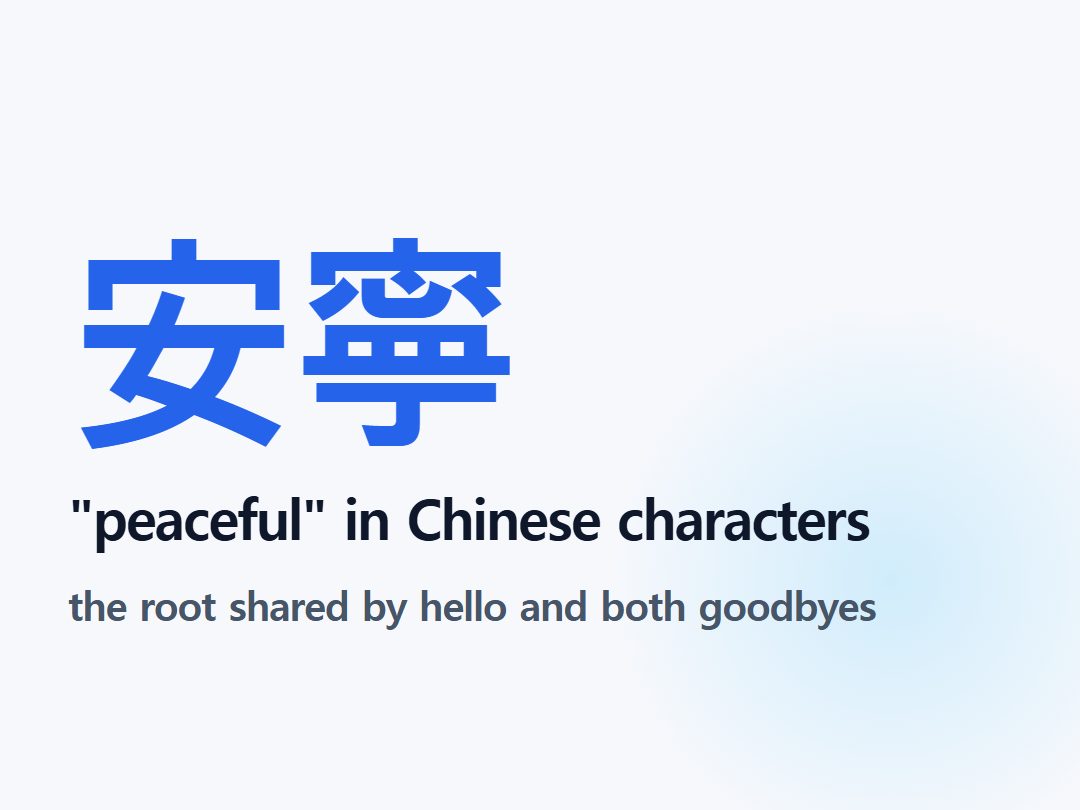
안녕 (annyeong) comes from the Chinese characters 安 and 寧, both of which mean "peaceful." Put together, they don't mean "goodbye" at all — they mean something closer to "well-being" or "peace."
In classical Chinese texts, 安寧 described the peace of a household or a state, not something said to a person's face. Korean is the language that repurposed it as a personal greeting — a usage that shows up in Joseon-era court records asking after someone's health, centuries before it became today's default hello.
So 안녕히 가세요 isn't really "goodbye" in the English sense. It's closer to "may your going be peaceful" — a small, specific wish aimed at whatever the other person is about to do.
Why the rule tracks the listener, not the speaker
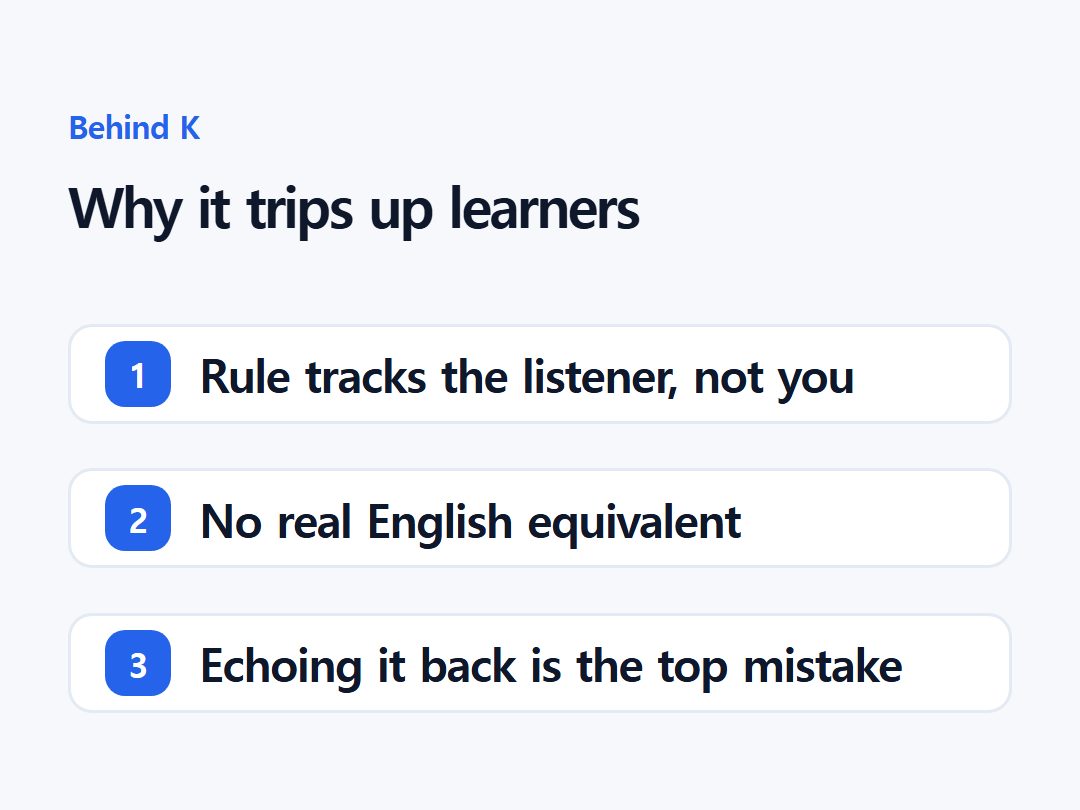
This is the part that actually explains the confusion, and it's bigger than two phrases. English "goodbye" doesn't care who is leaving — the word is identical whether you're walking out the door or watching someone else walk out. Korean's farewell is built the opposite way: it tracks what the other person is doing, never what you are doing.
Learners who struggle with this usually describe the same reflex: they track their own action first, then try to adjust for the listener, and the two considerations collide. Native speakers don't run that calculation at all — the phrase is already shaped around the listener before it leaves their mouth.
That listener-first habit isn't limited to farewells.
Korean carries a broader honorific system that changes verb endings, nouns, and pronouns depending on who is being addressed and how they relate to the speaker — a system shaped by centuries of Confucian-influenced social hierarchy, where correct relative status was built into the sentence itself, not just its tone.
The two goodbyes are a small, everyday example of a much larger pattern: Korean sentences constantly ask "who, relative to whom?" before they ask anything else.
The logic holds even in edge cases. If two friends run into each other on the street and both are about to walk off in different directions, neither one is "staying" — so both say a form of 가세요 to each other, because both of them are, in fact, going.
For learners, the hard part usually isn't memorizing which word means what. It's building the habit of checking the other person's situation before speaking at all — a small mental step that native speakers take automatically and never notice they're taking.
The one swap almost every learner makes
The most common beginner mistake is echoing the exact phrase back. A clerk says 안녕히 가세요 to a departing customer; the instinct is to repeat the same words on the way out — technically telling the clerk to leave their own store.
The fix is simple once it clicks: hear 가세요 (go), answer with 계세요 (stay) — never mirror it. Koreans generally don't correct strangers on this, but the swap is common enough that it functions as a quiet, harmless marker of someone still new to the language.
Where the rule breaks down: phone calls
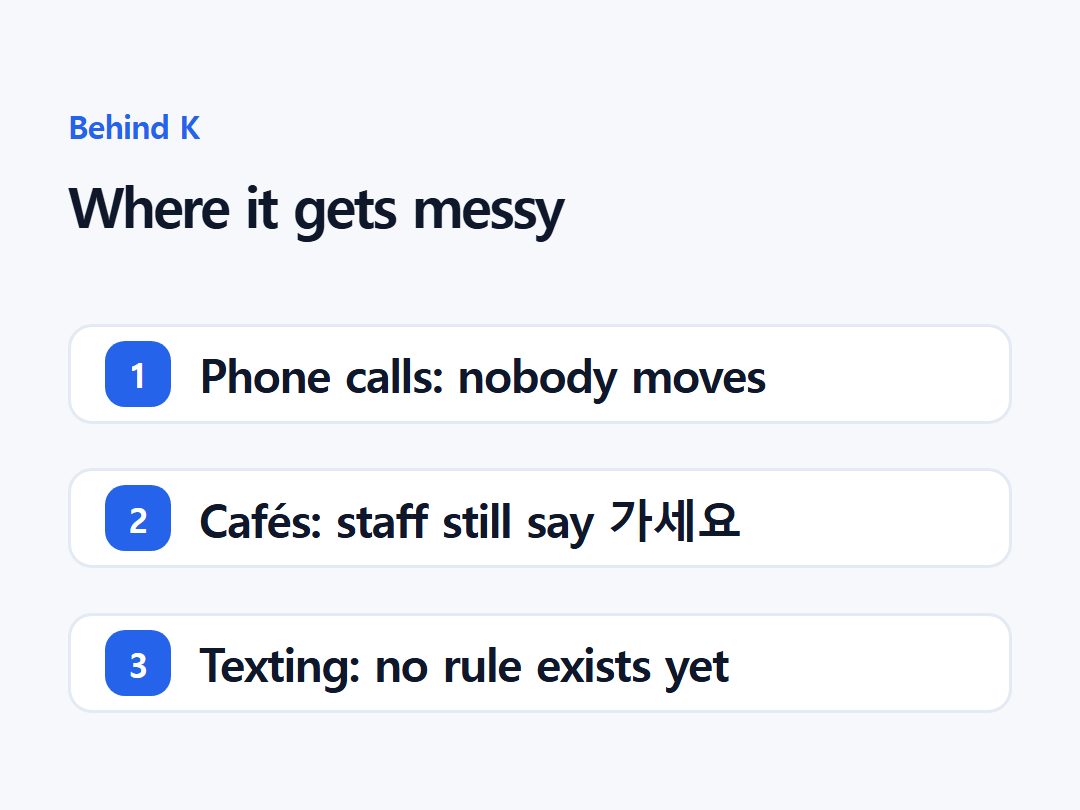
Hanging up a phone presents a genuine problem: nobody is physically walking anywhere. South Korea's National Institute of Korean Language, which publishes standard language etiquette guidance, addresses this directly — it names 안녕히 계세요 as the technically correct sign-off for ending a call, since both callers stay exactly where they are.
In practice, many Koreans say 들어가세요 ("go on inside") instead, even though the institute's own guidance flags it as non-standard. One theory traces it to the era of shared village phones, when finishing a call meant physically walking back into your own house afterward — a habit the phrase outlived by decades.
A separate rule governs who gets to hang up first: ending a call before an older person or a superior does is considered impolite, regardless of which sign-off phrase either side used. The words settle what to say; hierarchy still settles when to say it.
Formal versions exist for broadcasts and department stores
Everyday politeness has a further gear above 가세요/계세요. Ultra-formal forms appear in settings where distance and ceremony matter:
- 안녕히 가십시오 (annyeonghi gasipsio) — heard on subway announcements and news broadcasts
- 안녕히 계십시오 (annyeonghi gyesipsio) — used by staff at upscale hotels and department stores
- Both follow the identical leaving/staying logic, just at a more formal speech level
Using these with friends would sound stiff rather than polite. Korean politeness isn't a single ladder where higher is always better — it's a register matched to the specific relationship and setting.
Casual speech keeps the logic, drops the honorific
Among close friends, the leaving/staying distinction survives even after the polite endings disappear entirely.
- 잘 가 (jal ga) — "go well," said to the friend who's leaving
- 잘 있어 (jal isseo) — "stay well," said to the friend who's staying
- 안녕 (annyeong) — the informal catch-all, used loosely for both hello and bye
안녕 on its own is the exception that makes the rule visible: it's the one form that ignores the leaving/staying split, which is exactly why it works fine among friends but sounds too casual for a shopkeeper or a stranger.
What still splits Koreans themselves
Not every case is settled. When you leave a café, the staff technically stay behind the counter — by the letter of the rule, they'd say 계세요. In practice, most say 가세요 anyway, on the reasoning that staff don't "live" at the café and will leave themselves once their shift ends.
Text messages and chat apps pose a newer problem the rule was never built for: nobody is physically leaving anywhere. Koreans have improvised around this with casual sign-offs rather than a fixed standard, and unlike the phone-call case, no institute has issued formal guidance on how a conversation with no doorway should end.
None of this makes the underlying rule optional. It just shows that a grammar built around physical movement keeps meeting situations where nobody actually moves — and Korean, so far, has settled each one individually rather than rewriting the rule itself.
Korean farewells by formality level
| Register | Said to someone leaving | Said to someone staying |
|---|---|---|
| Formal (broadcasts, department stores) | 안녕히 가십시오 | 안녕히 계십시오 |
| Standard polite | 안녕히 가세요 | 안녕히 계세요 |
| Casual (friends) | 잘 가 | 잘 있어 |
Frequently asked
What's the difference between 안녕히 가세요 and 안녕히 계세요?
가세요 means "go in peace" and is said to the person leaving, while 계세요 means "stay in peace" and is said to the person staying behind.
Can you say 안녕하세요 when leaving?
No — 안녕하세요 is built from the same root as both farewells but only works as a hello; Koreans don't say it on the way out.
What's the correct way to say goodbye on the phone in Korean?
South Korea's National Institute of Korean Language names 안녕히 계세요 as technically correct since both callers stay put, though many Koreans say 들어가세요 instead.
Sources
Every factual claim above is traceable. We do not translate articles — we gather facts from multiple outlets and write them ourselves.
- 표준 언어 예절 온라인 질의 (전화를 끊을 때의 인사말) — National Institute of Korean Language (국립국어원)
- 안녕히 가세요 vs 안녕히 계세요: Go in Peace vs Stay in Peace — Elon.io
- 안녕히 가세요 vs 안녕히 계세요 | how to say "goodbye" in Korean — Korean Study Junkie
- How to Say Goodbye in Korean: 7 Essential Phrases — Migaku
- 안녕 — Wiktionary (Korean)
- '안녕히 계세요'와 '안녕히 가세요' — Brunch