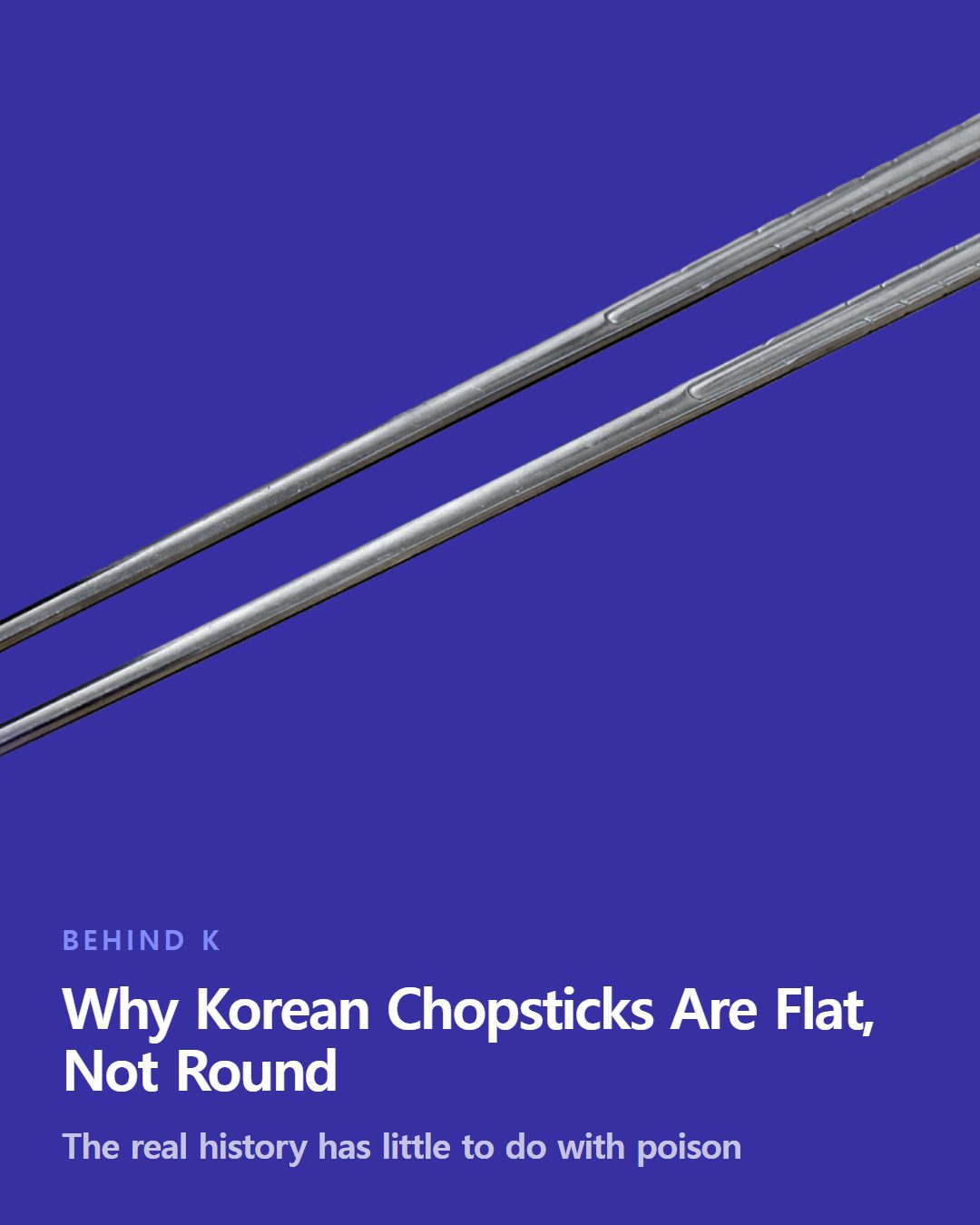
Walk into any restaurant in Seoul and the chopsticks on the table will almost certainly be flat, metal, and slightly heavier than they look. That is unusual: in China and Japan, chopsticks are round and made of wood, bamboo, or lacquer.
Korea is the outlier, and most explanations that reach international readers stop at one line — royals used silver to detect poison. That story is real, but it is not why 51 million Koreans eat with steel today.
The short version
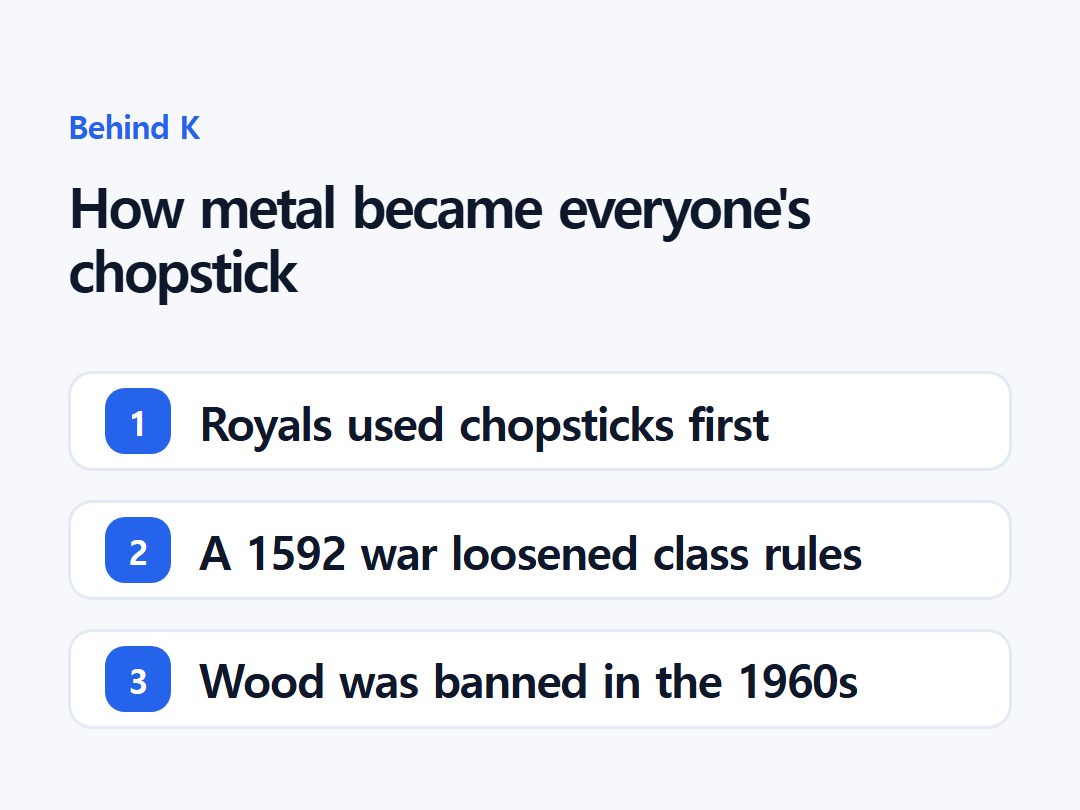
- Silver only caught some poisons — it's not why Korea eats with steel today.
- Baekje nobles used bronze chopsticks over a thousand years before Joseon began.
- A 1960s wood ban, not tradition, made flat steel Korea's default.
The poison-detection legend is only half true
During the Joseon dynasty (1392–1910), Korea's last and longest royal dynasty, kings did eat with silver chopsticks and spoons. Silver reacts with sulfur compounds in certain arsenic-based poisons and darkens on contact, so it functioned as a crude alarm system at the royal table.
The problem is that silver only reacts to some toxins, not all of them. Historians who study Joseon court records describe the practice as a partial safeguard at best — real, but far from foolproof, and confined almost entirely to the palace.
It also explains almost nothing about why an office worker in Busan eats with steel chopsticks today. That habit has separate roots that go back further than the Joseon court, and forward past it into 20th-century state policy.
Only nobles ate with chopsticks in early Joseon
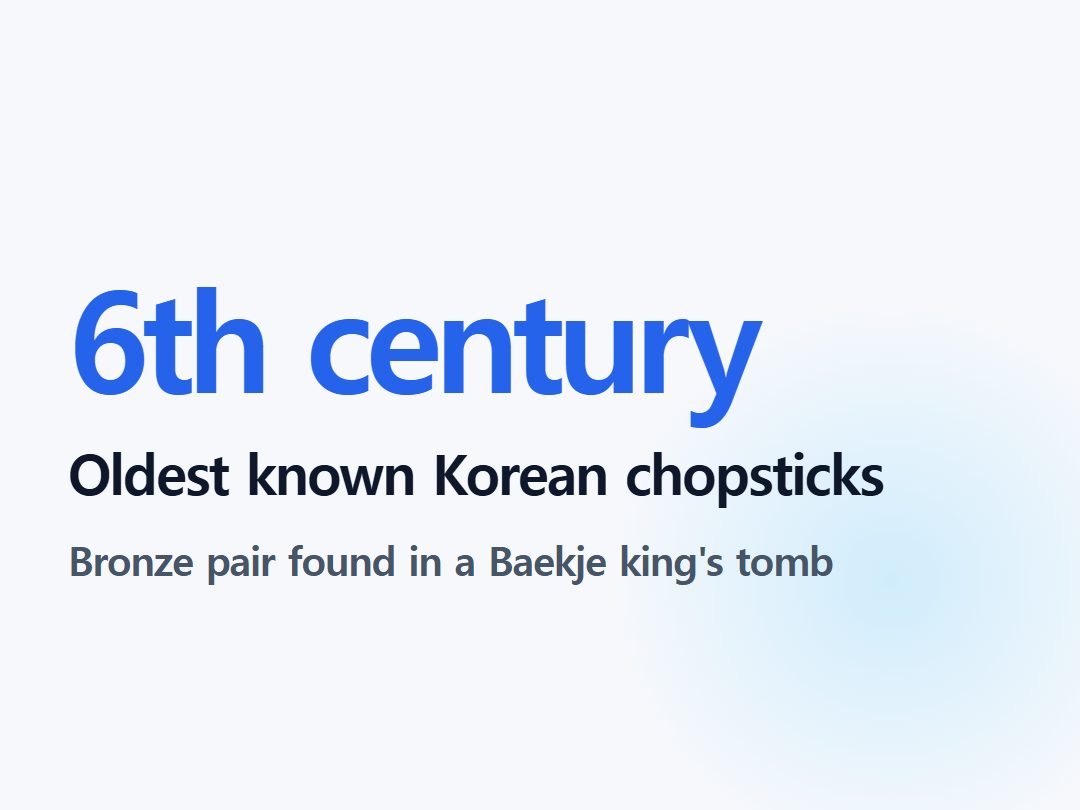
The bigger reason metal chopsticks exist at all goes back further, to the Baekje kingdom. The oldest metal chopsticks found on the Korean peninsula are a bronze pair recovered from the tomb of King Muryeong, a 6th-century Baekje ruler, alongside bronze spoons buried as funerary items.
The tomb, discovered intact near Gongju in 1971, held roughly 5,000 artifacts and remains one of the most important archaeological finds in Korean history.
Researchers still debate whether its chopsticks were made locally or imported from China, but their existence confirms that metal, not wood, was already the material of choice at the highest level of Korean society well over a thousand years before the Joseon dynasty began.
By the early and mid-Joseon period, chopstick use itself was a class marker. Confucian social hierarchy shaped nearly every part of daily life, and eating with chopsticks — reserved for foods that needed gripping — was largely a privilege of royals and the yangban noble class.
Commoners typically ate with a spoon or their hands, relying on one-bowl meals like gukbap, rice served in soup, that did not require chopsticks at all.
The spoon carried the rice; chopsticks carried the side dish
Korean dining developed a division of labor that survives today: a spoon for rice and soup, chopsticks for everything else. Koreans still call the paired set sujeo — a compound of the words for spoon and chopsticks — treated as a single utensil concept rather than two separate tools.
This matters for the metal question. Once fermented side dishes, or banchan, became a fixture of the Korean table, chopsticks needed to survive repeated contact with salt, vinegar, and chili oil. Wood was never the ideal material for that job.
A war loosened the class rules, and metal spread downward
The rigid boundary around who could use chopsticks did not hold forever. After the Japanese invasions of 1592–1598, known as the Imjin War, Joseon's social structure loosened as the economy and food culture were rebuilt.
An 18th-century genre painting titled "Lunch" by artist Kim Hong-do shows field laborers eating with both a spoon and chopsticks side by side — visual evidence that the utensil had reached ordinary households by the late Joseon period.
Silver remained too expensive for most people, so households substituted cheaper metals instead:
- Brass, for families who could manage some expense
- Bronze, more common and more durable than wood
- Iron, in poorer or rural households
Wood and bamboo chopsticks existed in Korea too, but metal had already been established as the higher-status, more durable choice — so as chopstick use spread, it spread as metal, not wood.
Small portable trays are why the shape went flat
Shape is a separate question from material, and it has its own practical history. Traditional Korean meals were often served on individual, low, portable trays called soban, rather than one large shared dining table.
A round chopstick rolls. On a small tray that might get lifted, carried, or set down at an angle, a flat chopstick simply stays put — a small design detail that mattered more in daily use than it might seem.
A factory shortcut made flat the standard, not tradition
The flat shape most Koreans use today is more recent than the historical account suggests. According to Lee Byoung-sik, CEO of Korean stainless cutlery maker Kostick, the modern flat profile has a manufacturing origin as much as a cultural one.
"Flat chopsticks made by cutting sheet metal were the most efficient option for mass production," Lee explained.
In other words, once Korea began mass-producing stainless steel chopsticks, flat was simply the cheapest, fastest shape to stamp out of sheet metal at scale — and it stuck.
A 1960s ban on wood, not hygiene, sealed the shift
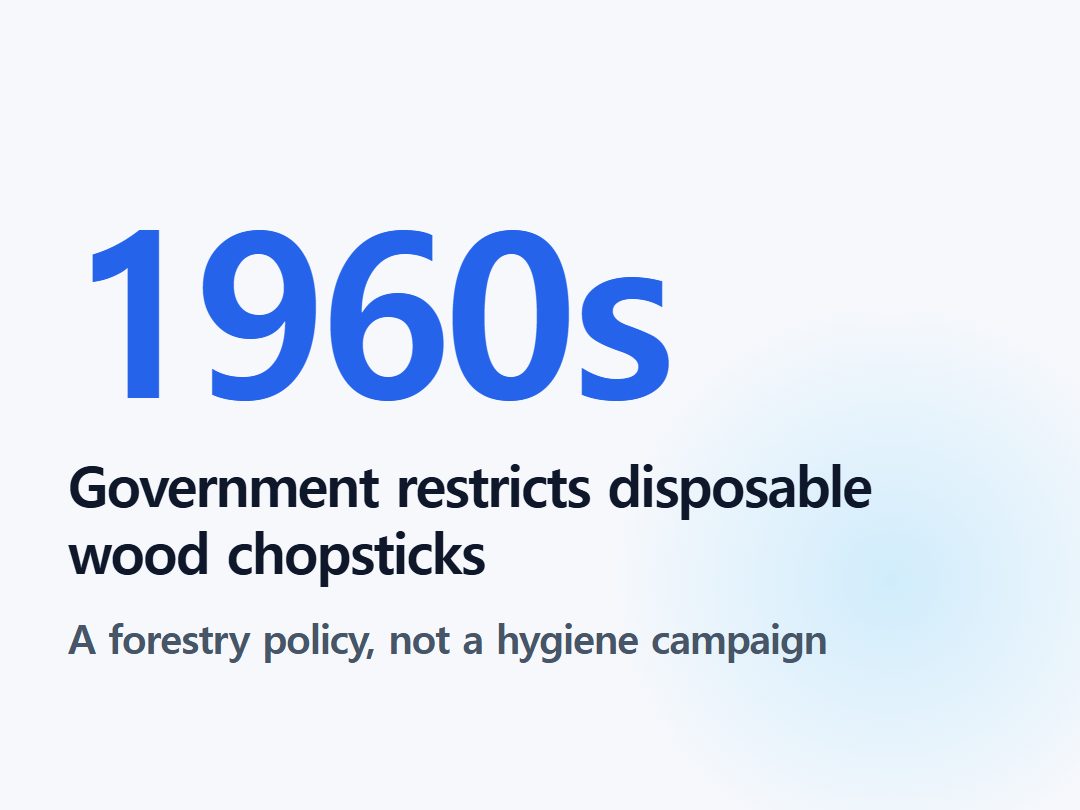
The final push away from wood was a matter of state policy, not table manners. After the 1950–1953 Korean War, the country's forests were badly depleted, and disposable wooden chopsticks in restaurants became a target of conservation policy under President Park Chung-hee's administration (1961–1979), which restricted their use to protect remaining timber.
The timing lined up with Park's broader industrial push into domestic steel production. As stainless steel became cheaper and more available at home, it filled the gap the wooden-chopstick ban left behind, and flat metal chopsticks became the default nationwide rather than a royal or upper-class item.
Metal doesn't hold the smell of kimchi
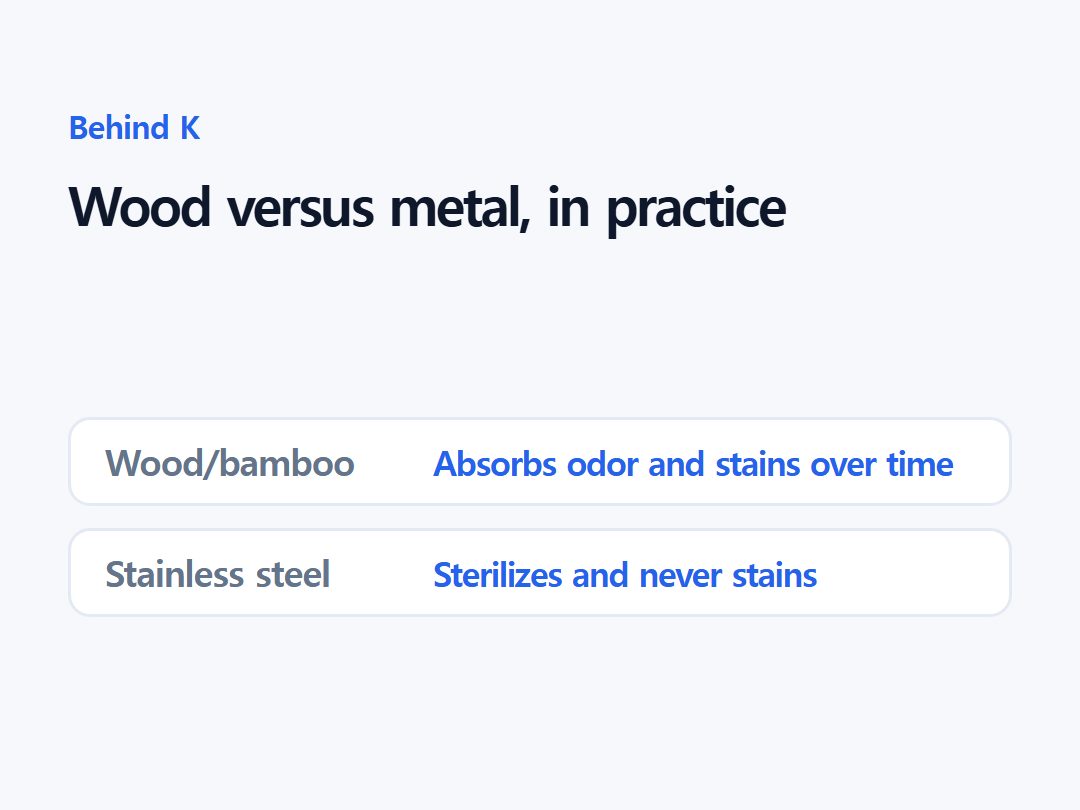
One reason the switch stuck has nothing to do with policy. Wood and bamboo are porous, and over repeated use they absorb odors and oils from strongly fermented foods like kimchi and doenjang (fermented soybean paste) — flavors that don't fully wash out.
The same pair of chopsticks might touch fermented, oily banchan at dinner and plain rice the next morning. Stainless steel can be boiled and reused indefinitely without holding onto any of it, which made it a practical fit for a cuisine built around strong, shared side dishes.
Silver never fully disappeared, it just changed occasions
Stainless steel now accounts for the overwhelming majority of chopsticks used in Korean homes and restaurants. Silver did not vanish, though — it moved from the palace to the gift shop.
Silver spoon-and-chopstick sets are still given as first-birthday (doljanchi) and wedding gifts, and some high-end restaurants set silver at the table as a deliberate nod to that older status symbolism, not as a working poison test.
What historians still don't agree on
Two details remain genuinely open. First, sources differ on how much weight to give the flat shape's anti-roll function on soban trays versus its origin as a 1960s factory shortcut for cutting sheet metal — both explanations appear in the historical record, and the surviving evidence doesn't clearly separate a practical design choice from a manufacturing accident that later got a cultural explanation attached to it.
Second, silver's poison-detection reputation is often repeated as settled fact, when it was really a limited, palace-specific practice that reacted to only certain toxins — real, but never the reason ordinary Koreans picked up metal chopsticks.
That shift came from class history, a war that loosened Confucian boundaries, a forestry policy aimed at rebuilding depleted woodland, and a fermented-food table that wood was never built to survive.
How Korea went from silver legend to steel default
| Era | What happened |
|---|---|
| 6th century (Baekje) | Bronze chopsticks buried with King Muryeong — the oldest metal chopsticks found in Korea |
| 1392–1910 (Joseon) | Royals eat with silver, which darkens on contact with some poisons; commoners use spoons only |
| 1592–1598 (Imjin War) | War loosens Confucian class rules; chopstick use spreads downward, using cheaper metals |
| 1961–1979 (Park Chung-hee) | Wooden chopsticks restricted in restaurants to protect depleted postwar forests |
| Today | Flat stainless steel, cheap to mass-produce, is the nationwide default |
Frequently asked
Why do Koreans use metal chopsticks instead of wood?
Metal chopsticks trace back to Baekje-era bronze, spread among commoners after Joseon's class rules loosened, and became the nationwide standard after a 1960s ban on wooden chopsticks aimed at protecting depleted forests.
Did Korean royals really use silver chopsticks to detect poison?
Yes, Joseon kings ate with silver because it darkens on contact with sulfur compounds in some arsenic-based poisons, but it only reacted to certain toxins and was limited to the palace.
Why are Korean chopsticks flat instead of round?
A round chopstick rolls off small portable soban trays, and according to a Korean cutlery maker, flat shapes were also the cheapest to mass-produce by cutting sheet metal.
Sources
Every factual claim above is traceable. We do not translate articles — we gather facts from multiple outlets and write them ourselves.
- [WHY] Flat, frustrating and now famous: The history of Korea's metal chopsticks — Korea JoongAng Daily
- Why Korean Chopsticks Are Built Different — Kim'C Market
- Korean Chopsticks: Why They're Metal, How To Use Them and Proper Etiquette — The Soul of Seoul
- Why Korea, China, and Japan Use Different Chopsticks — Fluent Korean
- The Tomb of King Muryeong — World History Encyclopedia