In January 2026, eight young men calling themselves ALPHA DRIVE ONE sold more than a million albums on their first day out. Eighteen months earlier, six women from six different backgrounds debuted as KATSEYE.
The short version
- Four K-pop groups since 2021 came from the same survival-show casting formula.
- Survival shows let audience votes prove demand before labels spend on a debut.
- Korean agencies pair with Western labels like Geffen and Republic to split market risk.
Neither group was picked off a demo reel by an executive. Both were assembled in public, through a televised competition where a worldwide audience voted on who made the final lineup.
That casting method has now been used by three separate Korean entertainment companies to build four groups since 2021, and a fifth attempt is already recruiting for a 2027 premiere. The reason is not that Korean labels ran out of ideas. It is that the format has become a proven way to split the financial risk of building an idol group between two companies instead of one.
How a 'survival show' turns an audition into a TV season
A survival show is a competition series, native to Korean television, in which trainees are eliminated over weeks based on coach scores and public voting until only the final lineup remains. It is a talent contest where the prize is not a record deal but a permanent spot in a group the audience just watched get built.
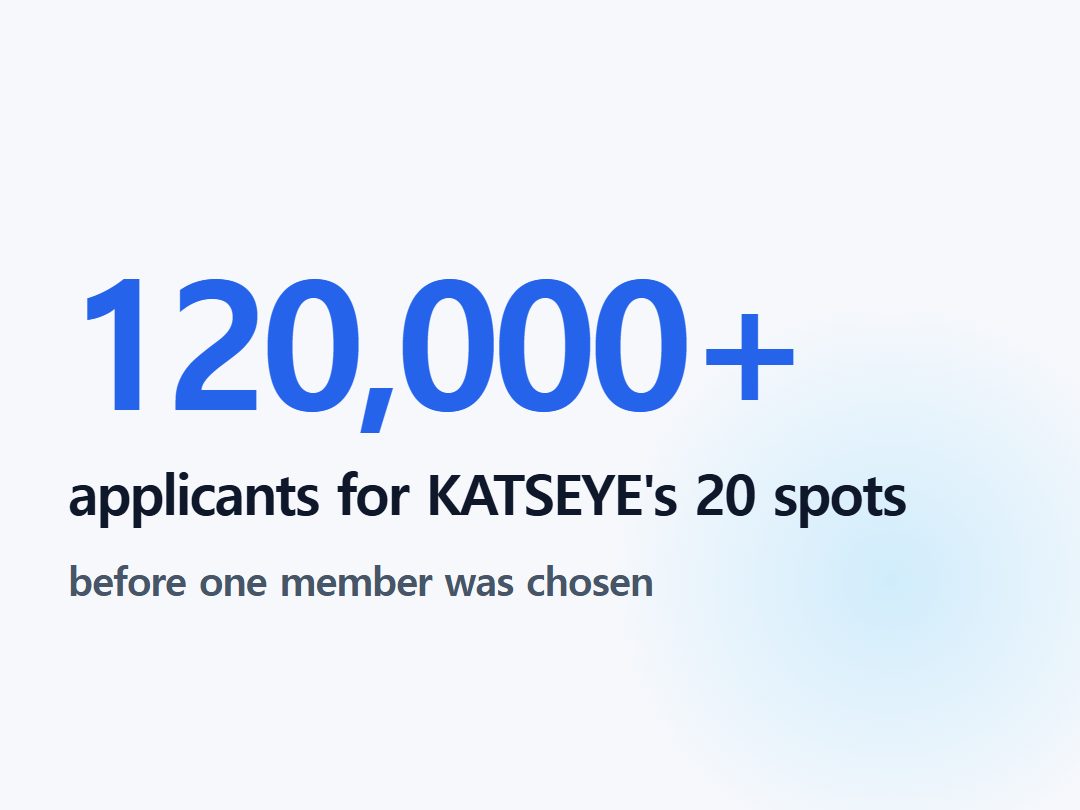
KATSEYE came out of The Debut: Dream Academy, a twelve-week competition run by HYBE and Geffen Records that narrowed twenty finalists, chosen from more than 120,000 applicants worldwide, down to six members in late 2023. JYP Entertainment and Republic Records ran the same structure a year earlier with A2K, auditioning only in five U.S. cities before flying finalists to Seoul for training.
A survival show is a market test before the group exists
Building an idol group the traditional way means an agency spends years and its own money training a lineup nobody outside the company has heard, then hopes the debut lands. A survival show inverts that. The audience decides who debuts, and their voting activity becomes free market data months before a single song is released.
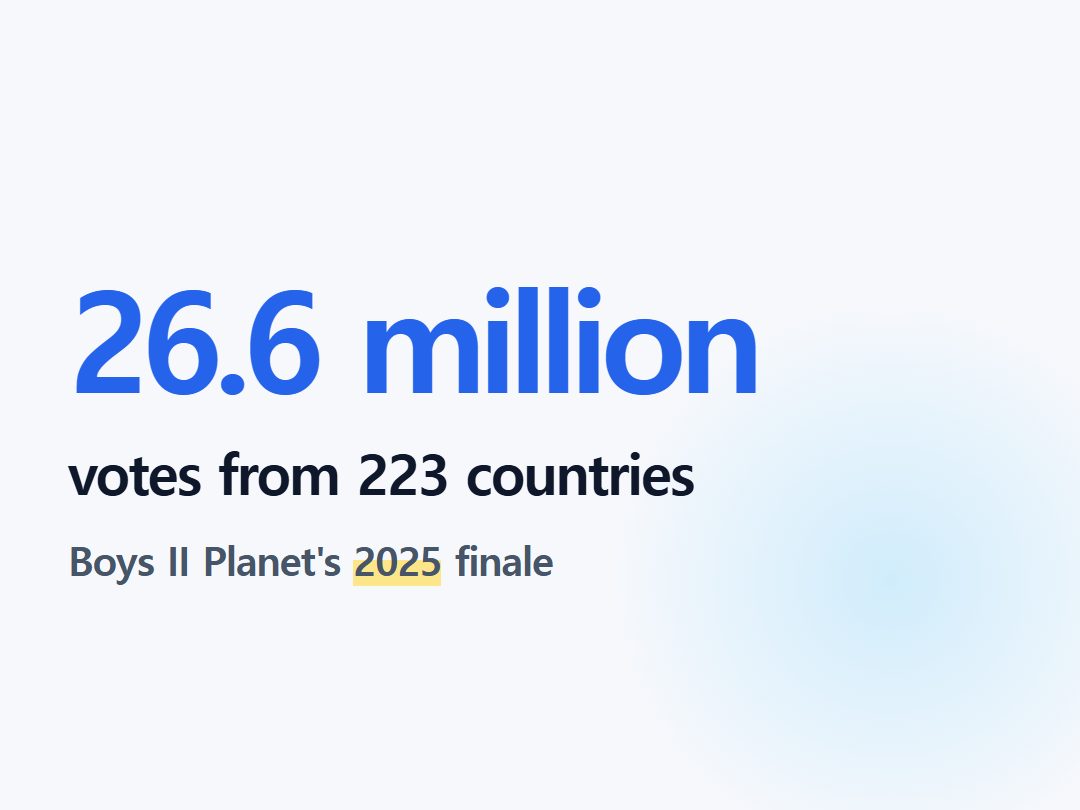
When Mnet's Boys II Planet wrapped in September 2025, its finale drew roughly 26.6 million votes from 223 countries. Those numbers existed before ALPHA DRIVE ONE ever recorded a track — proof of demand a label can point to before committing to the far larger cost of an actual debut: music videos, choreography, marketing, and touring.
That is the part worth copying. The company that would otherwise absorb the full cost of a flop instead gets months of validated audience interest before it has to spend on the expensive part.
Korean agencies bring the training system, partners bring the market
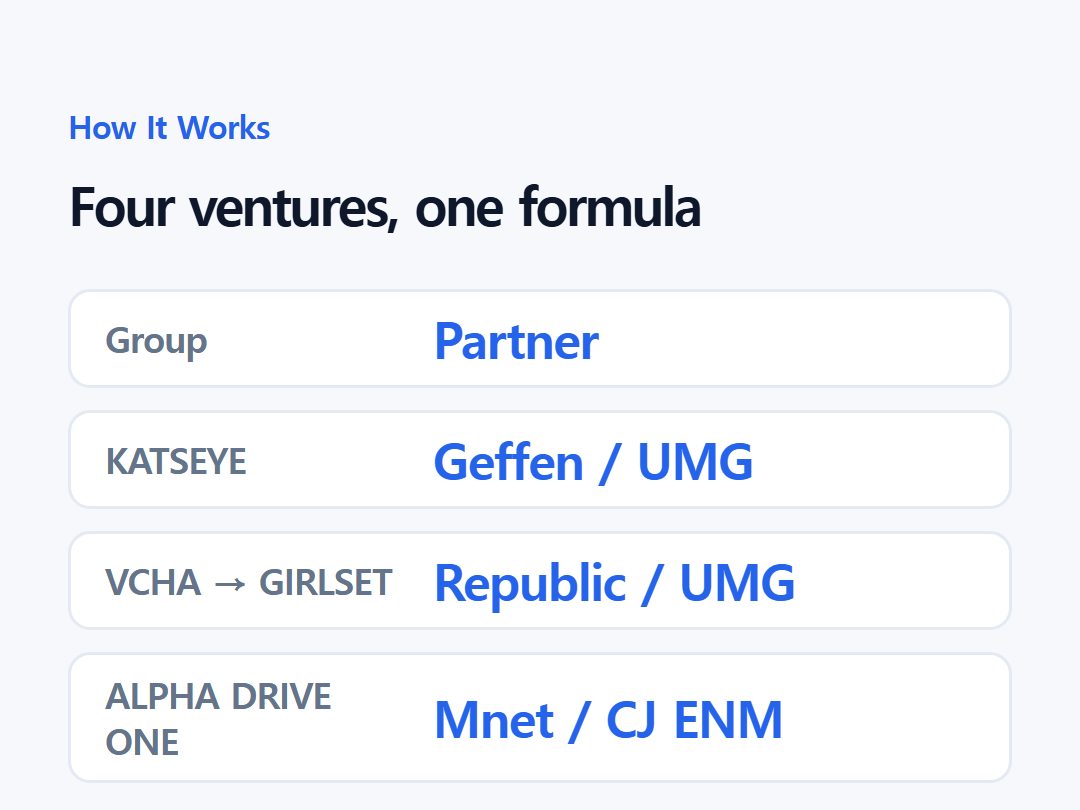
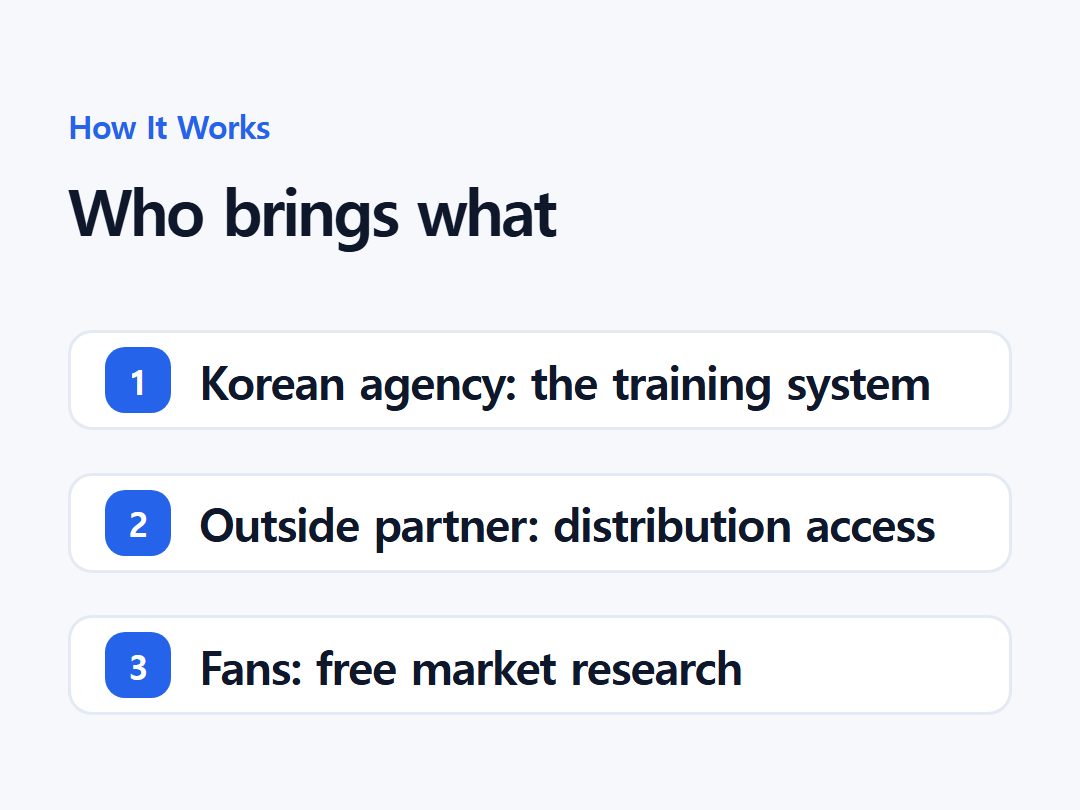
Every version of this format pairs a Korean company with a partner that can open a market the Korean company does not already control. HYBE's venture is a joint operation with Geffen Records, part of Universal Music Group. JYP extended its partnership with Republic Records, also a UMG label, specifically to cover U.S. distribution, marketing, and talent scouting for VCHA.
In return, the Korean side supplies what is generally called the agency system — the South Korean practice, running since the 1990s, of recruiting teenagers as trainees and housing and training them for years in singing, dancing, and media skills before shaping a debut lineup around what the company decides will sell.
It is the one piece a Western label cannot easily build on its own. Major labels are typically set up to sign artists who already have an audience, not to grow one from nothing.
The format was tested at home before it went global
None of this started with KATSEYE. CJ ENM's Mnet network had run domestic survival shows for years before exporting the format. Girls Planet 999, which aired in 2021, was the first version to cast across borders: 99 trainees were split into groups of three, one Korean, one Japanese, one Chinese, and eliminated as a unit if any member of the trio was voted out.
The winning nine, later named Kep1er, debuted in January 2022 with six Korean, two Japanese, and one Chinese member. The show aired simultaneously on Mnet in Korea, iQIYI in China, and AbemaTV in Japan — the same partner-for-market-access logic HYBE and JYP later applied to the U.S. with Geffen and Republic, just built on regional broadcasters instead of a Western major.
Members are cast by passport as much as by talent
Casting across nationalities is not incidental. It seeds a fanbase in more than one country before a group's first release. A2K auditioned exclusively in five U.S. cities so JYP could build American recognition before finalists ever set foot in a Seoul training room.
The logic predates this decade. Korean groups have diversified membership by nationality since the mid-2000s, when acts such as Super Junior added Chinese members to strengthen the group's standing in that market. What survival shows changed is the transparency — the casting decision now happens on camera, over weeks, with the audience watching it get made.
At least four groups have come out of the same template
Since 2021, the same basic format — cross-border casting, a televised or livestreamed competition, elimination decided partly by public vote — has produced:
- Kep1er (2022) — CJ ENM's Girls Planet 999, cast across Korea, China, and Japan
- VCHA, later renamed GIRLSET (2024) — JYP and Republic Records' A2K, cast in the United States
- KATSEYE (2024) — HYBE and Geffen's The Debut: Dream Academy, cast worldwide
- ALPHA DRIVE ONE (2026) — Mnet's Boys II Planet, a multinational lineup
A fifth attempt is already underway. CJ ENM opened applications in May 2026 for Girls Planet 2, a sequel aimed specifically at the Americas, with a premiere targeted for 2027.
Not every group that survives the show survives intact
The format's record on retention is uneven. Kep1er debuted with nine members and is down to six after three left when their contracts came up for renewal. VCHA lost two members within about a year and a half of its debut and rebranded as the four-member GIRLSET in August 2025 — a faster turnover than most idol groups formed the traditional way.
ALPHA DRIVE ONE's commercial start was the strongest of the four: 1.44 million copies of its debut EP sold in its first week, the second-highest opening week for any K-pop debut album on record.
KATSEYE, by comparison, has kept its original six members through three post-debut releases without a single departure so far. Whether a survival-show lineup holds together past its first contract renewal is still a question these four cases answer differently.
What the deals don't disclose
None of the companies involved has published how revenue, ownership, or costs are actually split between the Korean agency and its Western or regional partner. Geffen, Republic Records, and CJ ENM's various broadcast partners each supply market access, but who absorbs the loss if a group underperforms is not stated in any publicly available agreement.
Even the newest venture stays vague on that point. Applications for Girls Planet 2 opened to independent trainees, agency trainees, and already-debuted artists born before January 1, 2013, submitting in Korean, English, Japanese, Chinese, or Spanish — but CJ ENM has not said how any eventual overseas partner would share costs or profits.
That leaves the format's central appeal — shared risk — as something outside observers can only infer from how often companies keep signing up for it, not from a contract anyone has actually seen.
Four groups built from the same survival-show template
| Group | Year | Show | Partners | Casting scope |
|---|---|---|---|---|
| Kep1er | 2022 | Girls Planet 999 | CJ ENM | Korea, China, Japan |
| VCHA (now GIRLSET) | 2024 | A2K | JYP & Republic Records | United States |
| KATSEYE | 2024 | The Debut: Dream Academy | HYBE & Geffen Records | Worldwide |
| ALPHA DRIVE ONE | 2026 | Boys II Planet | Mnet | Multinational |
Frequently asked
What is a K-pop survival show?
It's a televised competition where trainees are eliminated over weeks by coach scores and public voting until only the final group lineup remains.
What groups debuted from K-pop survival shows?
Kep1er, VCHA (renamed GIRLSET), KATSEYE, and ALPHA DRIVE ONE all debuted through cross-border survival-show competitions since 2021.
Why do Korean agencies team up with US labels for these shows?
The Korean side supplies the training system while partners like Geffen Records and Republic Records provide access to a market the Korean company doesn't already control.
Sources
Every factual claim above is traceable. We do not translate articles — we gather facts from multiple outlets and write them ourselves.
- Before KATSEYE Went Viral, Its Members Were Among 20 Pop Star Academy Trainees — Netflix Tudum
- The Story Behind Netflix's Pop Star Academy: Katseye — TIME
- KATSEYE: how HYBE and Geffen's new girl group are merging K-pop and western pop to become a truly global act — NME
- Watch the trailer for Netflix's 'Pop Star Academy: KATSEYE' — NME
- JYP Entertainment x Republic Records girl group VCHA, born from the survival show 'America2Korea' — allkpop
- Girlset — Wikipedia
- Kep1er — Wikipedia
- Girls Planet 999 — Wikipedia
- 'Boys II Planet' top 8 finalists debut as ALPHA DRIVE ONE with 'EUPHORIA' — The Korea Times
- Alpha Drive One — Wikipedia
- Mnet's 'Girls Planet 2' Returns To Find Their Next Global Girl Group — Forbes
- Watch: 'Boys II Planet' Group ALPHA DRIVE ONE Hits The 'FREAK ALARM' In Dynamic Debut MV — Soompi