Two dramas can be airing on Korean television in the same month and belong to what are functionally two different industries. One tells its story in sixteen episodes and is gone within two months. The other is still running past episode one hundred, with the same actors, in the same sets, more than a year after it started.
The short version
- Daily dramas run 100+ episodes; miniseries usually run 16 or fewer.
- Daily dramas draw bigger Korean audiences than Netflix-bound miniseries.
- Hit daily dramas get extended live; miniseries end on a fixed script.
Both get called "Korean dramas" by international viewers. But the second kind — the 일일드라마, or daily drama — is watched by more people inside Korea than the prestige miniseries that reach Netflix. It also runs on a completely different set of rules, from how it's written to who pays for it.

Two production systems, one country
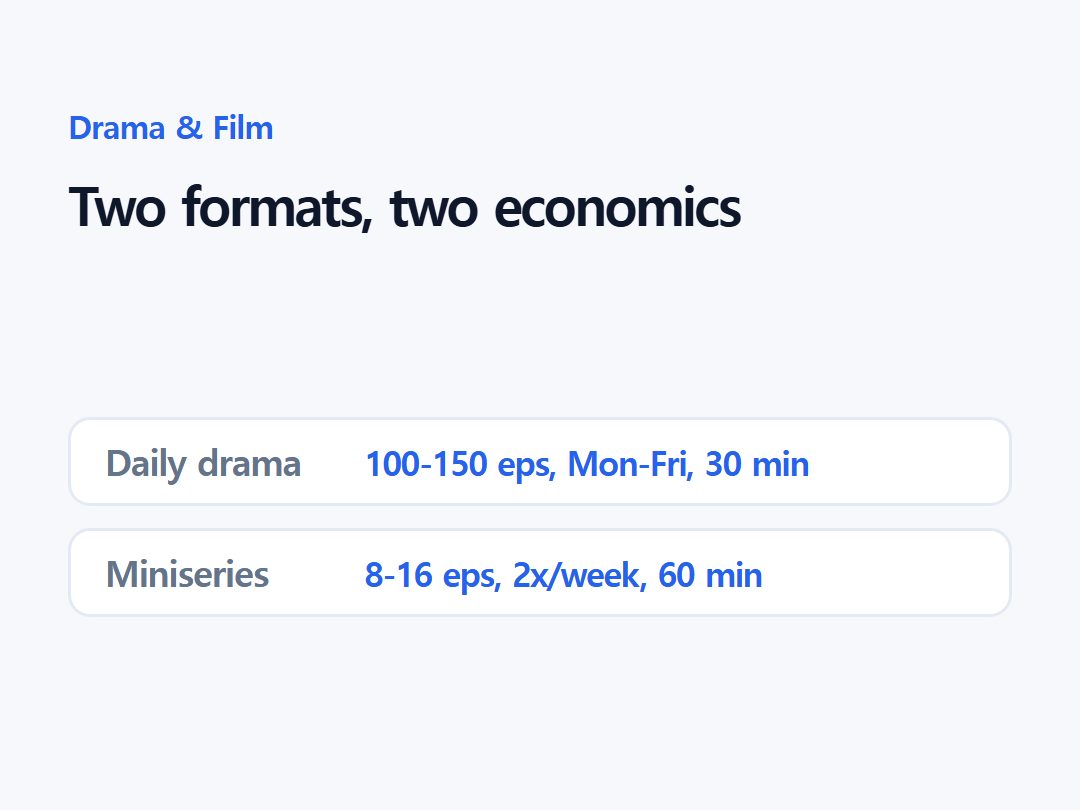
A daily drama airs Monday through Friday, in thirty-minute episodes, usually in the early evening. A run of 100 to 150 episodes is normal, not exceptional.
A miniseries airs two episodes a week, at night, in hour-long installments. For most of the 2010s that meant 16 to 24 episodes total; today it's often fewer.
| Feature | Daily drama (일일드라마) | Miniseries |
|---|---|---|
| Schedule | Monday–Friday | 2 episodes/week |
| Episode length | ~30 minutes | ~60 minutes |
| Episode count | 100–150+ | 8–16 (was 16–24) |
| Time slot | Early evening | Primetime, ~10pm |
| Core audience | Older, home viewers | Younger, streaming-first |
Who is actually watching at 7pm
Terrestrial networks — KBS, MBC, SBS — still earn most of their money from television advertising, and that advertising is sold against the audience most likely to be watching live: older viewers and people at home during the early evening.
That audience doesn't behave like a streaming audience. It watches out of habit, at a fixed hour, often as background to dinner. A daily drama is built for that habit — a recognizable cast, low-stakes family or revenge plots, and a story that can run indefinitely without asking the viewer to remember complicated arcs.
The format itself is a subscription to a routine, not a sixteen-hour movie split into parts. Broadcasters have leaned into this deliberately: KBS has built programming around viewers over 40 who still watch live TV rather than stream, with some of those shows pulling ratings above 20% at a time when primetime miniseries often struggle to clear single digits.
The script for Friday isn't finished on Monday
Korean broadcast drama has long used what the industry calls the live-shoot system: episodes are filmed days, sometimes hours, before they air, rather than fully shot in advance.
Miniseries have partly moved away from this — production usually starts a month or two before premiere, banking a handful of episodes before broadcast begins. Daily dramas, long-running serials, and sitcoms are the exception; they keep the closer-to-live schedule throughout the entire run, with scripts sometimes arriving page by page on the day of filming.
That proximity to broadcast is what makes the format so elastic. A writer can still change what happens next week based on what happened this week.
The tradeoff falls on the people making it. Actors and crew on live-shoot productions have described working days without proper sleep, receiving IV drips between takes, and getting only a few finished script pages before a scene. Daily dramas run this schedule for a year or longer instead of a few months.

A hit simply keeps going while it's on air
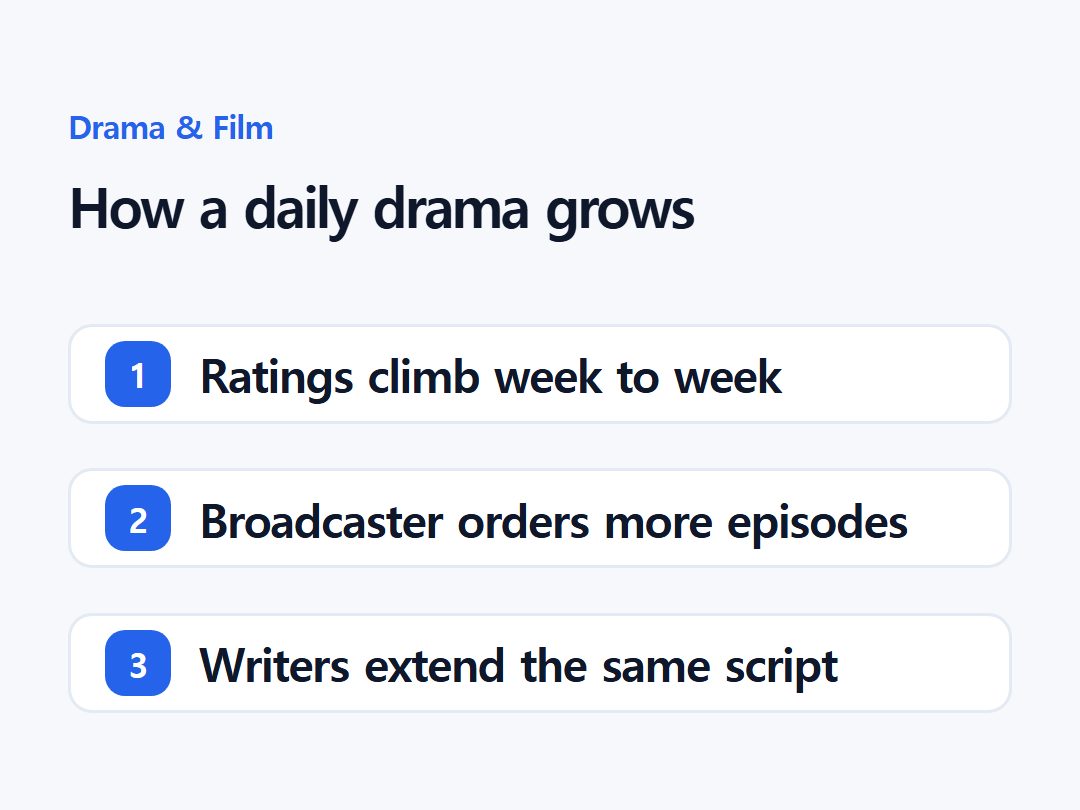
The clearest recent case is MBC's daily drama The First Man. It was announced as a 120-episode series. By episode 132, it had already been extended once, and it kept climbing — hitting a personal-best 6.1% nationwide rating that month, driven by strong VOD and buzz numbers as well as live viewership.
MBC extended it again, bringing the total to 140 episodes. The story didn't reach a pre-written ending and stop; the ending moved because the audience hadn't.
This is not unusual. Ratings-driven extension has a long history in Korean television — a 1994 MBC drama originally planned for 52 episodes was stretched to 81 as its ratings climbed past 40%, a decision later criticized for dragging out its final act.
The other side placed the opposite bet
Miniseries production made the reverse trade: a fixed, compressed length in exchange for a finished, pre-planned story. A sixteen-episode arc lets writers build toward a specific ending instead of stretching a plot to fill open-ended time.
That structure is also what made Korean dramas exportable. A finite, complete story is easy for a platform like Netflix to license, subtitle, and place in front of an international audience that has no context for the show and no patience for a hundred-episode commitment.
Airing later at night gave miniseries room the daytime slot never had. A 10pm broadcast carries a 15+ rating, which lets writers use darker plots, sharper violence, and more explicit relationships than a family-hour daily drama could.
Sixteen was never a fixed number either
Even the miniseries side keeps shrinking. The format moved from 24 episodes, to 20, to 16 as the long-standing norm — and by 2025 even that is fading, with many new shows landing at 12, 10, or fewer episodes.
Netflix's medical drama The Trauma Code illustrates the trend: it was originally planned as ten one-hour episodes, then restructured into eight 45-minute episodes for tighter pacing before release.
Three things are driving the contraction:
- Streaming audiences prefer tighter, binge-friendly seasons over slower broadcast pacing
- Rising star salaries make every extra episode more expensive to produce
- Global platforms apply the 8–10 episode format already standard outside Korea
The money moves differently in each system
Actor pay is the clearest gap between the two formats. Top miniseries leads can earn several hundred thousand dollars per episode — Lee Jung-jae was reported at roughly $1 million per episode for a Netflix series — which only makes sense across a short, high-profile run.
Daily dramas can't support those fees across 130 episodes, so they rely instead on lower-cost, ensemble casts and steady product placement (PPL) revenue that accumulates over a long broadcast window. A brand can buy into a story that's still running in six months; that's a harder pitch for a show that ends next month.
PPL can be significant on either side. A cafe chain paid over 500 million won to appear in the miniseries The Heirs, and Amorepacific reported a 75% sales jump on a lipstick shade worn by its lead. A daily drama can't offer that kind of single, high-visibility spike — but it can keep a brand on screen, quietly, for a full year.
Why this split is now under strain
The economics that built this two-track system are weakening on the terrestrial side. SBS dropped its Wednesday-Thursday drama slot in 2020 and hasn't aired a Monday-Tuesday drama since 2023; MBC went a similar stretch without one for the first time in forty years.
Total drama output actually grew — from roughly 100 series in 2021 to almost 120 in 2022 — but that growth came from cable and streaming, not from the terrestrial networks that daily dramas depend on. Falling ratings and shrinking ad revenue are squeezing the exact business model that funds the 100-episode format.
What's still unresolved
Daily dramas haven't disappeared — The First Man's ratings run shows the format can still perform. But it's increasingly an outlier propping up a shrinking terrestrial ad model, rather than proof the model is healthy.
It's also unclear where the miniseries format settles. Having already moved from 24 to 16 to 12 episodes, whether it stabilizes at 8–10 or keeps compressing under streaming pressure is not yet decided by the industry itself.
Miniseries episode counts have kept shrinking
| Era / show | Episode count |
|---|---|
| 2010s norm | 16–24 episodes |
| Long-standing standard | 16 episodes |
| By 2025 | 12, 10, or fewer episodes |
| The Trauma Code (original plan) | 10 one-hour episodes |
| The Trauma Code (final) | 8 45-minute episodes |
Frequently asked
How many episodes does a Korean daily drama have?
Daily dramas (일일드라마) typically run 100 to 150 episodes, airing Monday through Friday in about 30-minute installments.
Why are Korean dramas getting shorter?
Streaming audiences prefer tighter, binge-friendly seasons, rising star salaries make each extra episode more expensive, and global platforms apply the 8–10 episode format already standard outside Korea.
Do Korean broadcasters extend dramas based on ratings?
Yes — MBC's The First Man was announced as a 120-episode series but was extended twice to 140 episodes as ratings climbed, echoing a 1994 MBC drama stretched from 52 to 81 episodes.
Sources
Every factual claim above is traceable. We do not translate articles — we gather facts from multiple outlets and write them ourselves.
- MBC's 'The First Man' starring Ham Eun Jung extended by 20 episodes as ratings hit new high of 6.1% — allkpop
- The rise and fall of terrestrial TV dramas — The Korea Herald
- K-dramas shift to shorter seasons as 16-episode format fades — The Korea Times
- Making Korean Dramas: Live Shoots and Unpaid B-List Actors — Facts and Details
- Business of Korean Dramas: Production Costs, Income, Product Placements — Facts and Details