In 2024, the best-selling film in South Korea was not an action blockbuster or a romance. It was Exhuma, a slow, ritual-heavy story about a shaman and a geomancer hired to dig up a cursed grave. It sold 11.9 million tickets, more than any other release that year.
The short version
- Exhuma sold 11.9 million tickets in Korea, more than any 2024 release.
- Korean shamanism, or Muism, survived state campaigns that burned shrines until 1979.
- Estimates of active shamans range from 10,500 registered workers to 300,000 members.
International reviewers often describe the shaman scenes in films like Exhuma and The Wailing as atmospheric folklore, a horror-movie flourish borrowed from local superstition.
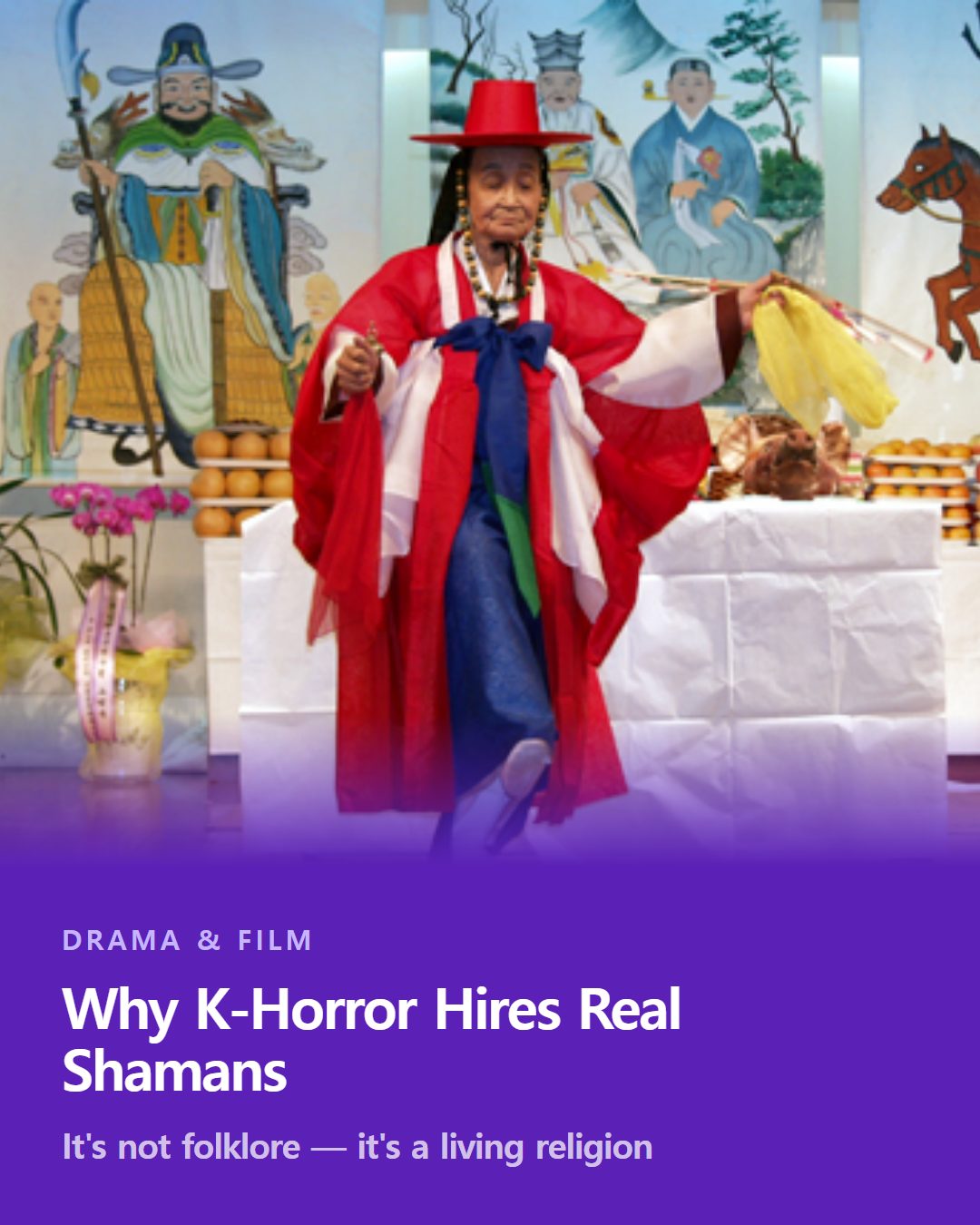
That framing misses what Korean audiences already understand: the rituals on screen are staged versions of a religion that is still practiced today, by people whose profession has a name, an association, and a contested headcount.
Exhuma's shaman scenes came from a director's own family
Director Jang Jae-hyun did not invent the rituals in Exhuma. His aunt is a practicing shaman and two of his cousins are Buddhist priests, and he has said the film's opening scene — a family haunted by a restless ancestor — happened to his own grandmother.
Jang spent two to three years meeting with shamans, geomancers, and undertakers while building the script, and the production filmed in real locations with real practitioners on set rather than building sets from scratch.

A shaman was hired to protect the set, not just advise on it
Shaman Lee Da-young was brought onto the Exhuma production for a role beyond consulting: she performed protective rituals for the cast during filming of the exorcism scenes, saying the crew did not know what might respond when the drumming and chanting began.
That detail matters for how the film was received in Korea. It signals that the production treated the ritual as something with real stakes, not a special-effects sequence to be blocked and shot like any other.
Kim Go-eun trained with shamans, not choreographers
Actress Kim Go-eun, who plays the shaman Hwa-rim, prepared by consulting practicing shamans over calls and video chats to learn chanting and movement, rather than working from a stunt or dance coach.
She specifically studied the film's daesal gut — a large-scale exorcism ritual involving animal sacrifice meant to drive out an evil presence — and has said she watched footage of real exorcisms as part of that preparation.
The Wailing treated its shaman as a professional, not a plot device
In The Wailing (2016), Hwang Jung-min's shaman character Il-gwang performs an exhausting, ritually specific gut to try to save a possessed child. Director Na Hong-jin consulted religious figures across Christianity, Buddhism, and Korean shamanism while writing the film, and deliberately declined to hand the audience a single answer about which belief system, if any, was correct.
That refusal to pick a winner reflects something true about Korea's religious landscape: shamanism, Buddhism, and Christianity coexist there, often in the same family, rather than competing for one exclusive believer.
Muism is older than every religion now sharing the country with it
Korean shamanism, known as Muism (무속), traces back to Bronze Age prehistory. One term for early Silla kings was chachaung, meaning shaman, and the tree-branch motifs on 5th- and 6th-century Silla gold crowns echo shamanic imagery found across Siberian tribal art.
Dangun, the mythical founder of the Korean people, is described with shamanic qualities and is sometimes depicted as sanshin, a mountain spirit — placing the tradition at the origin story of Korean identity itself, long before Buddhism or Christianity arrived.
The practice also splits by region. In the north, mansin shamans are traditionally understood to be possessed by the spirits they channel during a ritual, while sesŭp-mu practitioners in the south and east act as mediums without possession, often inheriting the role within a single family line.
Two governments tried to burn the tradition out of the country
Muism was not simply tolerated into the present. It survived deliberate campaigns to erase it. Confucian officials in the Joseon dynasty taxed and restricted mudang for centuries, and Japanese colonial rule (1910–1945) treated shamanic practice as backward.
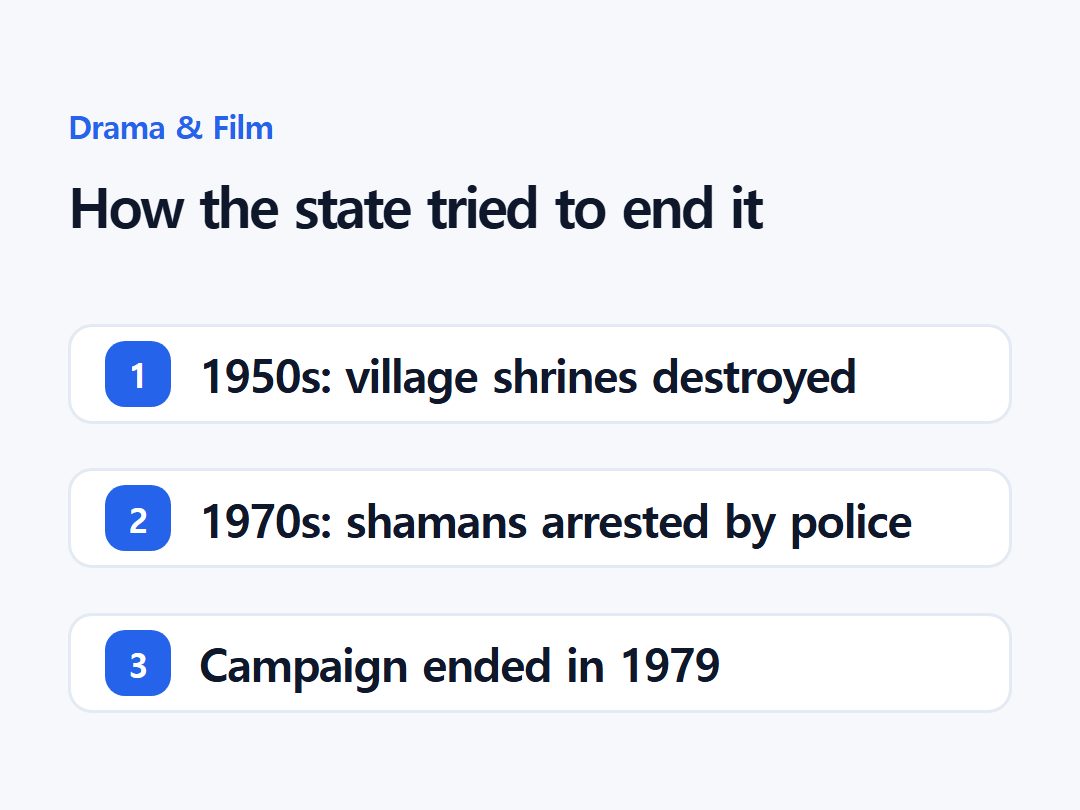
The harshest phase came under two postwar presidents:
- President Syngman Rhee's 1950s "New Life Movement" destroyed many village shrines
- President Park Chung-hee's 1970s Mishin Tapa Undong ("movement to overthrow superstition") sent police to burn shrines and arrest shamans
- The campaign ended only after Park's assassination in 1979
Shaman Kim Keum-hwa, who lived through the Park era, later recalled being "persecuted day and night" simply for practicing her craft. Those attempts to erase Muism ultimately failed, and the same state that once burned shrines later began recognizing individual rituals as protected cultural heritage.
Roughly 300,000 people still register as shamans
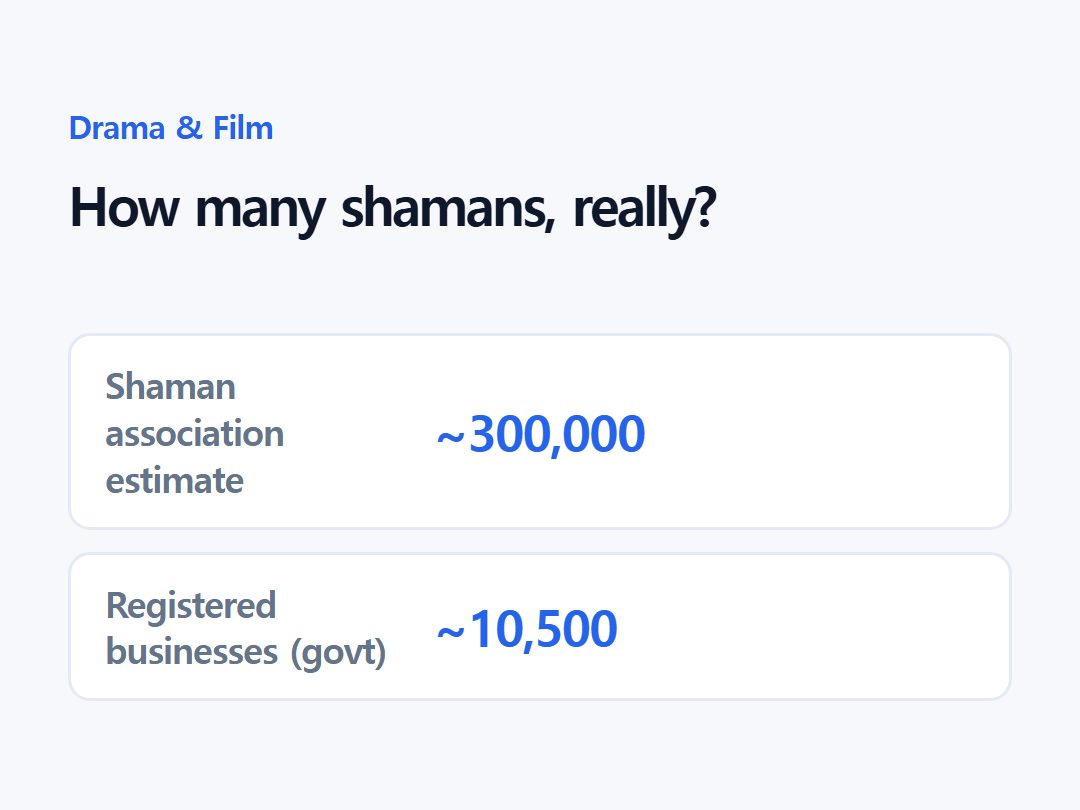
The exact size of Korea's shaman population is genuinely disputed, and that disagreement is itself informative. Viral claims of 800,000 active shamans circulated in 2025, but the Korea Gyeongshin Association — the country's largest shaman organization — called that figure an exaggeration and put its own estimate at around 300,000.
Government data, which only counts formally registered "fortune-telling and related services" businesses, is far smaller and captures a narrower slice of the same industry:
| Source | Estimate |
|---|---|
| Korea Gyeongshin Association (2025) | ~300,000 shamans |
| Statistics Korea, registered divination businesses (2023) | ~10,500 workers |
Whatever the true number, it is not zero, and it is not folklore. The Korea Gyeongshin Association says it still adds around 30 new registered members every month, a sign the profession is not simply a relic being reenacted for cameras.
One shaman ritual sits on UNESCO's heritage list
In 2009, UNESCO inscribed the Jeju Chilmeoridang Yeongdeunggut — a shamanic ritual praying for calm seas and a good harvest — on its Representative List of the Intangible Cultural Heritage of Humanity. The ritual had already been recognized as a national intangible cultural heritage item in Korea since 1980.
That double recognition, domestic and international, reframes what horror directors are drawing on: not a spooky local legend, but a documented ceremonial tradition with its own preserved chants, instruments, and choreography.
Horror is where the mainstream finally shows the ritual whole
Outside of horror cinema, Muism rarely appears on Korean screens with any seriousness — it shows up in variety shows as comic fortune-telling or gets waved away as "superstition," the same word colonial and dictatorship-era campaigns used against it.
Horror films are unusual in letting a full gut ritual play out at length, with its actual drumming patterns, chanting structure, and animal symbolism intact, rather than compressing it into a quick establishing shot.
Exhuma's score even blends pansori singing and samul nori percussion, the same instrumentation used in real ceremonies. Critics have pointed to that choice as part of why the film reads differently from Western possession stories built around one fixed liturgy.
What still divides Korean audiences about the genre
Not everyone agrees these films help the religion they depict. Some practicing shamans, like Lee Da-young, have welcomed the attention and participated directly in productions. Academics who study the field are more cautious, and the 2025 dispute over inflated population figures shows how easily the tradition gets exaggerated or flattened for a good headline, in journalism as much as in cinema.
There is also no single, agreed count of how many people still practice, and no consensus on whether box-office success actually changes how shamanism is treated in daily life, where it can still carry stigma even as it fills theaters.
How many shamans are there in Korea?
| Source | Estimate |
|---|---|
| Korea Gyeongshin Association (2025) | ~300,000 shamans |
| Statistics Korea, registered divination businesses (2023) | ~10,500 workers |
Frequently asked
Are the shamans in Korean horror movies real?
For films like Exhuma and The Wailing, directors and actors consulted real practicing shamans, and shaman Lee Da-young was hired to perform protective rituals on the Exhuma set.
How many shamans are there in South Korea?
Estimates vary widely: the Korea Gyeongshin Association puts the figure around 300,000, while Statistics Korea only counts about 10,500 formally registered divination businesses.
What is Muism, Korean shamanism?
Muism is Korea's indigenous shamanic religion, tracing back to Bronze Age prehistory, and it survived deliberate government campaigns to erase it under Japanese colonial rule and later presidents Rhee and Park.
Sources
Every factual claim above is traceable. We do not translate articles — we gather facts from multiple outlets and write them ourselves.
- Korea Box Office: 'Exhuma' Reaches $58 Million — Variety
- 'Exhuma' tops landmark 10 million admissions in South Korea — Screen International
- Kim Go-eun aimed to perfect portrayal of Korean shamans in 'Exhuma' — The Korea Herald
- Shaman Lee Da-young shares behind the scene rituals on set of Exhuma — Sportskeeda
- Director Jang Jae Hyun on creating Exhuma — #legend
- 'The Wailing': thriller posing spiritual questions — The Korea Times
- Spiritual boom? Experts debunk claims of 800,000 shamans operating in Korea — The Korea Times
- South Korea has 1 million shamans and fortune tellers — South China Morning Post
- Anti-shamanism movement in Korea — Wikipedia
- Jeju Chilmeoridang Yeongdeunggut — UNESCO Intangible Cultural Heritage