Lookism has run on Naver Webtoon since November 2014 and has passed 600 chapters without a season break. It is also, by wide agreement among its own longtime readers, one of the most criticized webtoons on the platform.
The short version
- Lookism has run since 2014, passing 600 chapters with no season break.
- Readers rate chapters publicly and low scores don't stop them reading on.
- Three separate controversies get confused: translation, craft complaints, and 2026 politics.
The criticism is not new-reader nitpicking. It comes from people who have followed the series for a decade, who score its worst chapters publicly the day they drop, and who open the next episode anyway.
That combination — persistent complaint plus persistent readership — is the actual gap for an international audience. Outside Korea, backlash usually reads as a signal that a fandom is shrinking. Inside Lookism's own comment sections, it functions closer to a running quality-control log that has never once emptied out the audience doing the logging.
Ten years, 600-plus chapters, one still-unexplained body swap
The premise is simple on paper. Bullied student Park Hyeong-seok wakes up with a second, athletic body he can switch into by falling asleep, while his original body keeps living its own separate life at night.
The two bodies are not a costume change. They take separate injuries, speak in different voices, and are written as genuinely different physical entities. Why the switch happens at all has still never been explained after more than 600 chapters.
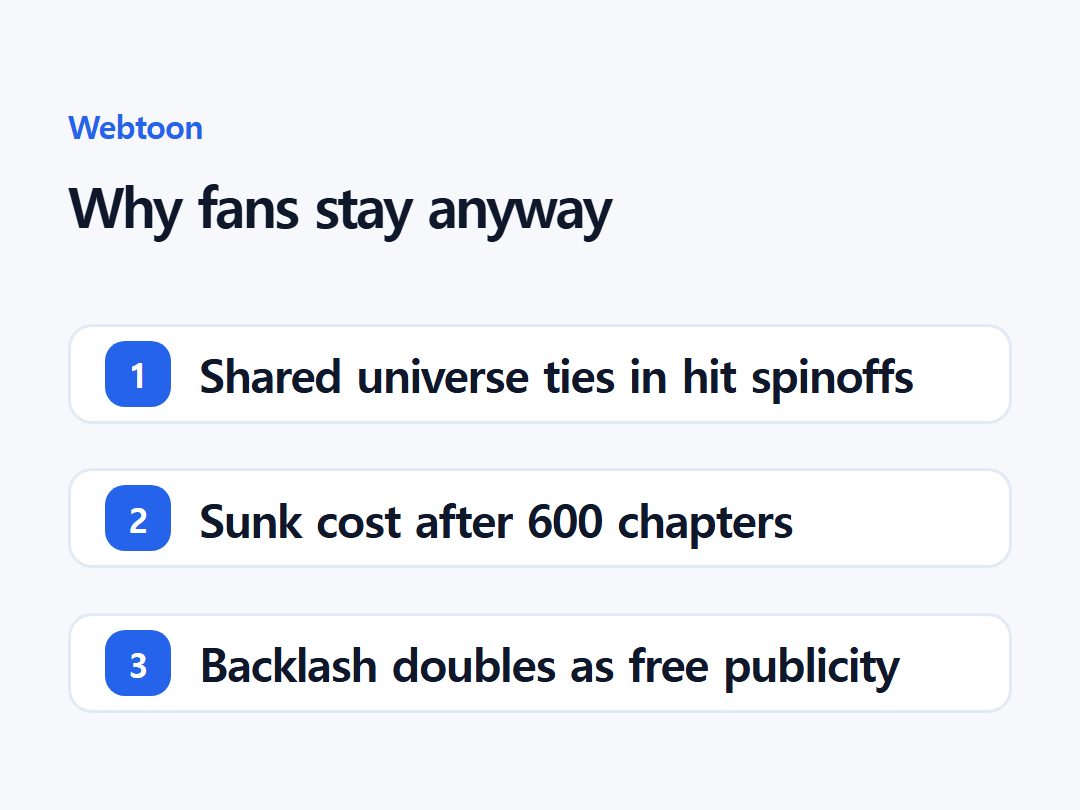
Naver scores every chapter out of 10, in public, the same day
This is the mechanic international readers usually miss. Naver Webtoon lets readers rate each individual episode out of 10 the moment they finish it, and that score is visible to everyone browsing the title.
The effect is not subtle. A single weak chapter of a different hit series, the webtoon adaptation of Extraordinary Attorney Woo, scored 5.56 out of 10 and made entertainment news within days. Lookism has hit comparable lows repeatedly — one widely cited chapter, following a run of near-perfect scores, fell to 7.52 once a disliked arc began.
That real-time scoreboard is why Lookism's backlash looks so loud from outside Korea. International fans argue about a bad arc in comment threads; Korean readers watch the argument happen as a number, attached to that exact chapter, the same day it publishes.
Nothing about this system removes a chapter from view or affects whether the next one gets made. A low score is a public verdict, not a penalty, which is exactly why a reader can rate an episode a 4 in the morning and still be reading the next one that night.
The setting collapsed loudly enough to get its own wiki page
Long-running readers use a specific term for what happened during one especially rocky stretch, the Cheonryang arc: seoljeong bunggoe, or “setting collapse” — when a story's own internal rules stop holding together.
Character hair colors changed without explanation. A backstory once described as happening “three years ago” quietly became “two years ago.” Factions moved into and out of neighborhoods with no reason given in the story itself. Fan wikis now track these as an ongoing list rather than one-off mistakes.
Park Tae-jun has acknowledged some of the errors and made small corrections, but readers note the fixes patched individual details without resolving the larger timeline contradiction underneath them.
Twenty characters can't all be the strongest fighter
A related complaint is power inflation. The story originally had two characters described as its strongest fighters. By the later chapters, fan discussion counts roughly twenty characters given that same label.
Two of them were introduced within a few episodes of each other, both billed as operating at the very top tier — the kind of repetition that tells readers the label has stopped meaning anything. Fight outcomes get explained away with a character simply “not being at full strength,” which readers say makes it impossible to know what anyone can actually do anymore.
The complaint is not unique to Lookism — long-running Korean action webtoons tend to accumulate this kind of power creep once a story outlives its original cast of rivals. What makes it land harder here is that Lookism started as a series about social hierarchy, not fighting hierarchy, so the inflation reads as the story losing track of the point it was originally making.
A story about looks became a story about turf wars
The premise readers originally signed up for was social: a boy discovering how differently the world treats an attractive body compared to an unattractive one. That framing dominates roughly the first 150 chapters.
After that point, the series shifts into what fans now half-jokingly call “fightism” — an underground martial-arts and gang-hierarchy story where the original discrimination angle becomes background noise.
One English-language reviewer who still follows the series described his own continued reading as closer to hate-reading than enjoyment, sticking around on the hope that the story would circle back to the idea that hooked him in the first place.
One franchise, three unrelated backlashes
Part of the confusion for new international readers is that searching “Lookism controversy” surfaces at least three separate stories, not one continuous scandal.
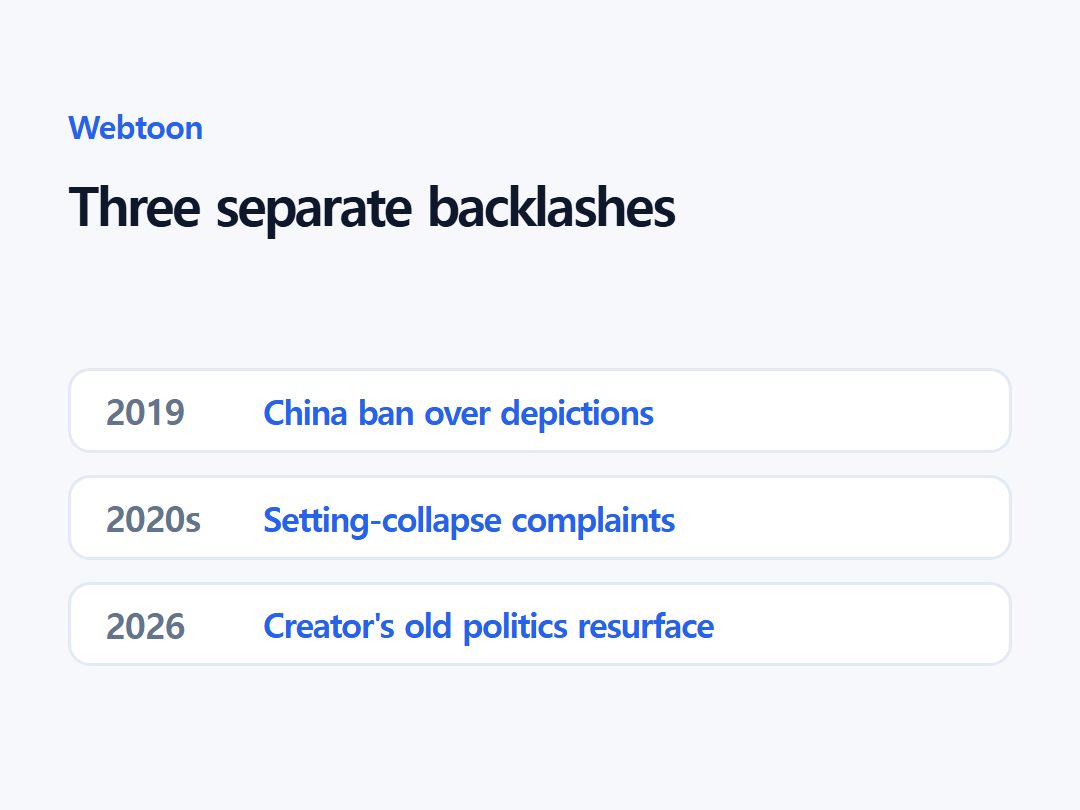
- 2019: a simplified-Chinese translation of the series was pulled after Chinese readers accused it of defamatory depictions and demanded an apology from Park Tae-jun.
- 2020s: the setting-collapse and power-inflation complaints described above — about craft, not the author's conduct.
- 2026: old allegations that Park's earlier work echoed far-right online rhetoric resurfaced once a hit drama tied to his studio started drawing renewed attention.
That last controversy is the one currently active. A live-action drama based on a spinoff in the same fictional universe, Agent Kim Reactivated, became 2026's highest-rated new drama after clearing a 21.6 percent rating — success that pulled the old claims about Park back into public view and produced boycott calls, even as reaction to the boycott itself has been mixed.
A shared universe raises the price of quitting
Lookism does not exist as a standalone story inside its own studio. Park Tae-jun's production company, renamed in 2025 from PTJ Comics to The Grimm Entertainment, built a connected “Lookism Universe” in which characters from Lookism, Viral Hit, and Manager Kim appear in each other's chapters as canon, not fan theory.
Beyond those three flagship titles, the studio credits more than a dozen further series to the same shared continuity.
The same studio has also pushed the franchise into a Netflix anime adaptation and several live-action spinoffs, keeping it multi-platform rather than confined to one app. Dropping Lookism means losing track of characters who resurface in whichever spinoff happens to be popular — right now, that spinoff is the one behind a record-breaking drama.
- Characters introduced in Lookism reappear as adults or rivals in Viral Hit.
- Manager Kim's cast crosses back into Lookism's gang-hierarchy arcs.
- A drama hit in one corner of the universe drives new readers into all of them.
That crossover pull is a large part of why long-time readers describe quitting as harder than it sounds.
What still hasn't been fixed
The timeline contradictions from the Cheonryang arc remain formally unresolved. Park's corrections addressed individual details rather than the underlying inconsistency, and a dedicated fan wiki page exists solely to track plot threads the series has raised and never closed.
The 2026 political controversy is also unsettled. Park did not write or draw the drama at the center of the boycott calls, and whether that distance is enough to separate a studio head from a hit show built on his universe remains an open, publicly argued question among Korean viewers.
What is not in dispute is the readership. Lookism has passed 10 billion cumulative views across nine languages and continues to rank among Naver's most-read titles, even as each new arc reopens the same argument over whether the story still deserves that audience.
Lookism's three separate controversies
| Year | Controversy | What it was about |
|---|---|---|
| 2019 | Chinese translation pulled | Accused of defamatory depictions; readers demanded an apology from Park Tae-jun |
| 2020s | Setting collapse & power inflation | Craft complaints about plot holes and fight-tier creep, not the author's conduct |
| 2026 | Resurfaced political allegations | Old claims Park's earlier work echoed far-right rhetoric, revived after Agent Kim Reactivated became a hit |
Frequently asked
Why do people criticize Lookism if it's still so popular?
Naver lets readers publicly score each chapter the day it drops, so loud complaints and steady readership show up side by side without one hurting the other.
What is the 2026 Lookism controversy about?
It's old allegations that Park Tae-jun's earlier work echoed far-right rhetoric, resurfacing after the spinoff drama Agent Kim Reactivated became 2026's highest-rated new drama.
How many chapters does Lookism have and is it still going?
Lookism has run on Naver Webtoon since November 2014 and passed 600 chapters without a season break, and it's still publishing.
Sources
Every factual claim above is traceable. We do not translate articles — we gather facts from multiple outlets and write them ourselves.
- Appearance supremacy (webtoon) — NamuWiki
- Appearance supremacy (Webtoon)/Criticism — NamuWiki
- Lookism - General Information — Lookism Wiki (Fandom)
- Netflix's Lookism: How Park Hyeong-seok's Body Switching Works — CBR
- Lookism Reading Guide: Where to Start, All 600+ Chapters — ChapterBrief
- Webtoon Reviews: Lookism Is a Mess — A Ray of Dawn
- 'Agent Kim Reactivated' Becomes 2026's Biggest Drama Breakout Amid Renewed Controversy Over Original Webtoon — ZAPZEE
- "It's so boring": K-drama fans slam Extraordinary Attorney Woo's webtoon — Sportskeeda
- 'Lookism' Webtoon is FIRST To Cross 10 BILLION VIEWS! — Draw and Talk Comics
- 'Lookism' to land on Netflix as 1st original animation based on Naver webtoon — The Korea Times
- Park Tae-joon Comics Company — NamuWiki
- Korean webtoon 'Lookism' creator 'The Grim Entertainment' attracts $9.1 million investment — KoreaTechDesk