Korean film and television have produced a run of hit titles built around the same premise: a student is beaten, humiliated, or extorted at school, and years later the story tracks how they get even. The Glory, Weak Hero, Bloodhounds, and Netflix's True Education all sit inside this pattern, and international viewers often read them as after-school specials — cautionary tales against bullying.
The short version
- Korean bullying dramas restage real cases the legal system barely punished.
- Juveniles under 14 can't be tried as criminals in Korea, ever.
- A teachers' union asked Netflix to cancel True Education before release.
That reading misses how the genre actually works at home. These stories are not built as morality plays. Many of their plots are pulled from documented court cases and news reports, and audiences keep returning not to be warned, but to watch a punishment that Korea's real legal system rarely delivers.
A hair-curling iron scene that came from a real 2006 case
The most notorious scene in The Glory (2022–2023) shows a group of students burning a classmate with a heated hair-curling iron. Screenwriter Kim Eun-sook has said the project began with a question her teenage daughter asked her — whether it would be worse to beat someone or to be beaten — but the show's most graphic details came from reporting on real incidents.
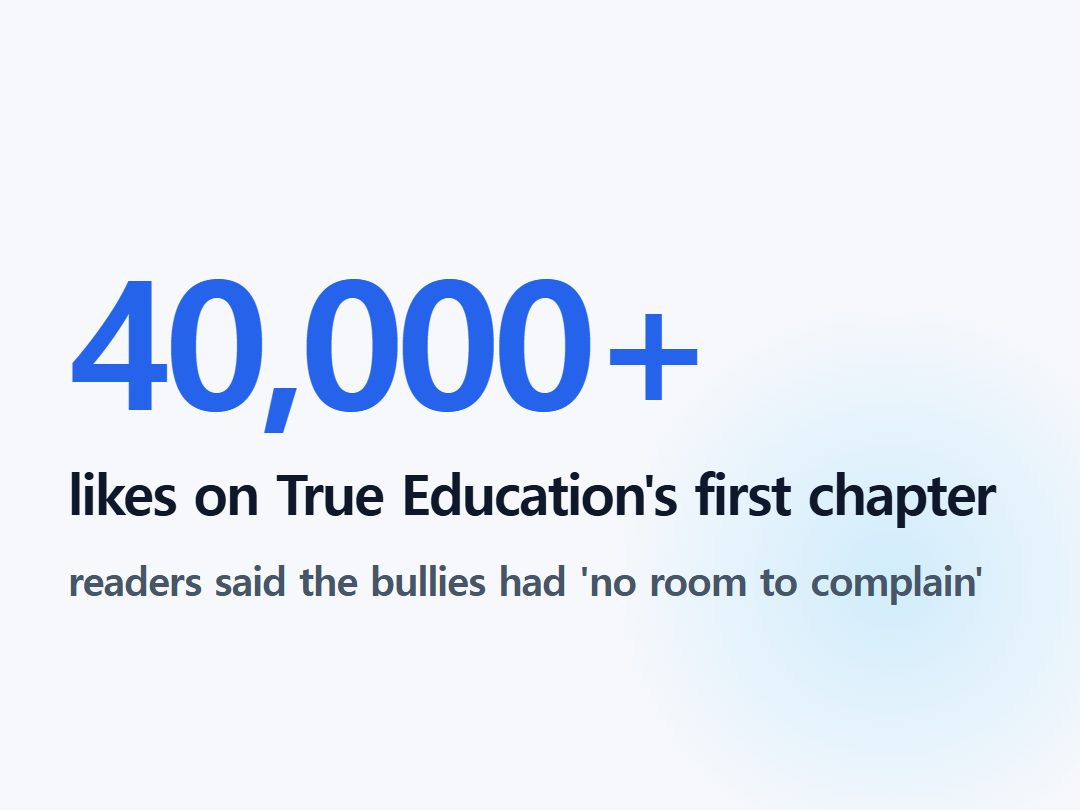
Among them: a 2006 case at a middle school in Cheongju, where students burned a classmate with a curling iron and asked her to confirm it was "hot enough" before she was hospitalized.
Once the series aired, real bullying survivors in Korea began identifying their own former tormentors online, and outlets reported the show had pushed school violence back into public conversation years after the original cases happened.
The 2021 scandal that made "were you a bully?" a routine question
The genre's commercial moment lines up with a real reckoning. Korea's #MeToo movement — which began with prosecutor Seo Ji-hyun's January 2018 allegation against a senior colleague — spread into sports in 2019, after former speed skating coach Cho Jae-beom was convicted of abusing skater Shim Suk-hee, with more athletes coming forward in judo and archery.
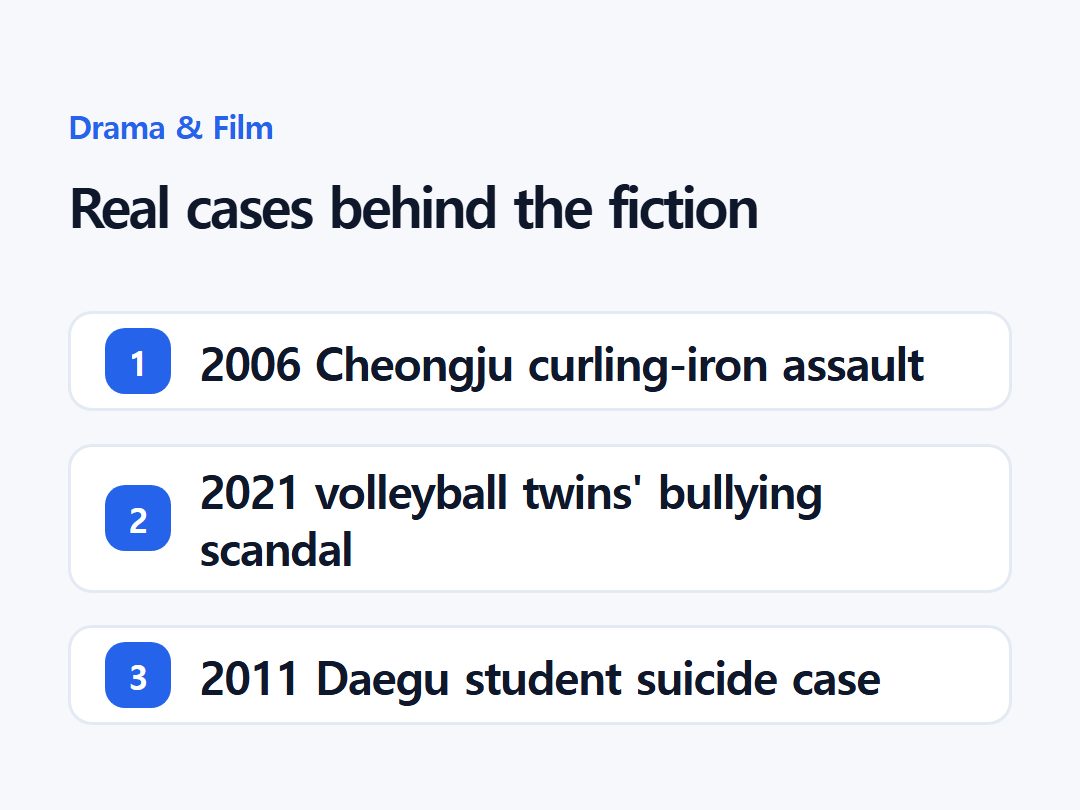
In February 2021, an anonymous post accusing professional volleyball twins Lee Jae-yeong and Lee Da-yeong of school violence — 21 separate allegations, from theft to threats with a knife — triggered a wider wave that crossed into entertainment:
- Volleyball: the Lee twins, suspended indefinitely and later banned from coaching
- Acting: Jo Byung-gyu, accused while SKY Castle was still airing
- K-pop: (G)I-DLE's Soojin, who denied the physical-violence claims against her
The Lee twins sued their accusers for defamation and eventually left to play professionally in Greece. The wave changed industry practice: background checks on a trainee's school record became close to standard before a debut, because agencies — the companies that recruit and train K-pop idols and actors for years before they publicly debut — had watched careers collapse overnight on a resurfaced accusation.
Why the legal system almost never delivers the ending
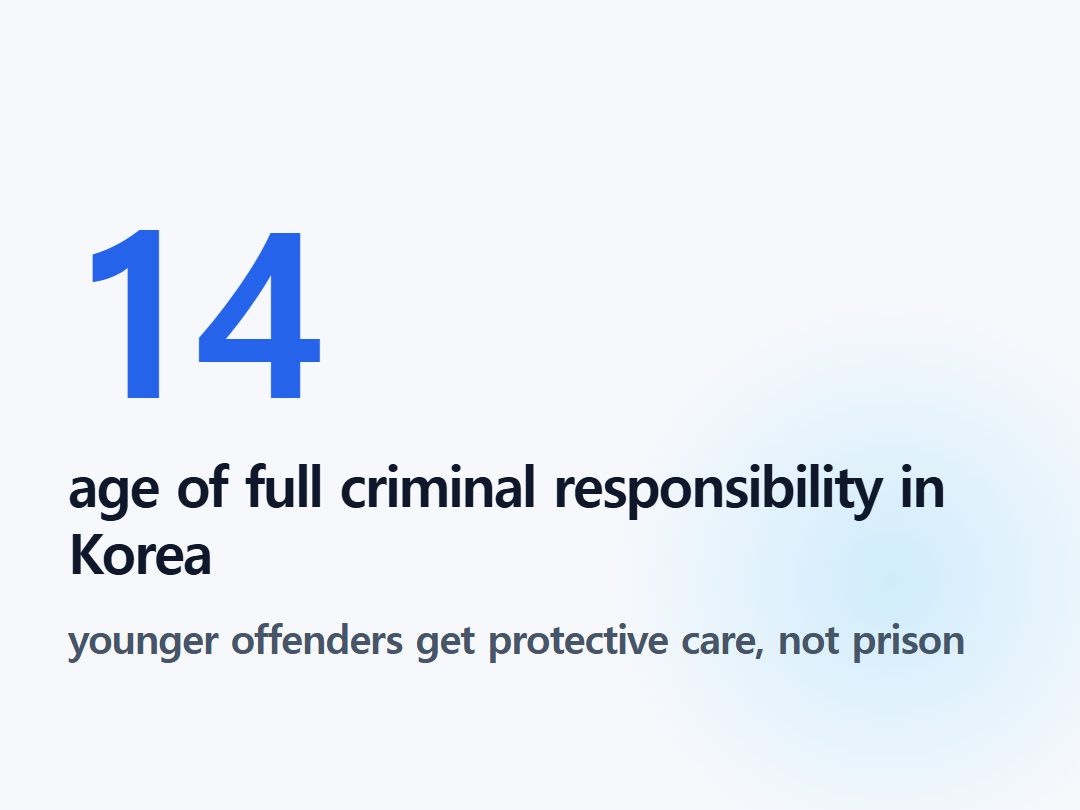
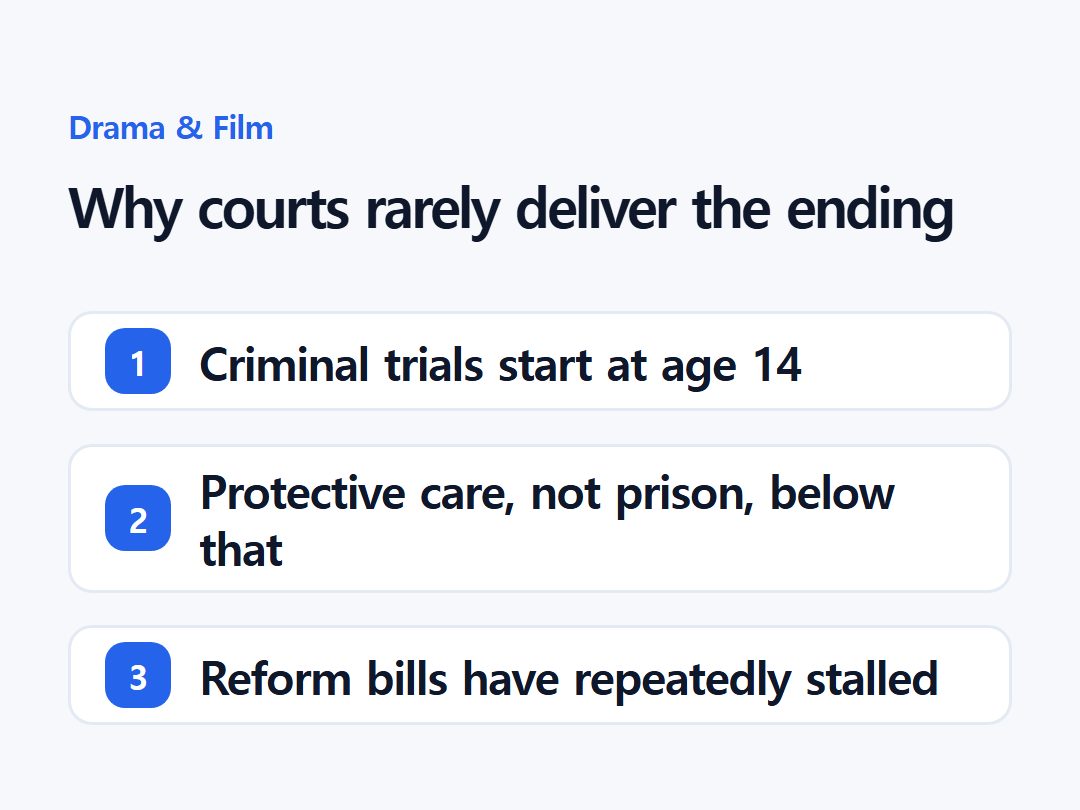
Under Korea's Juvenile Act, the age of full criminal responsibility is 14. Younger offenders — called chokbeop sonyeon, or "crime-eligible juveniles" — cannot be tried in a criminal court no matter what they did. A juvenile court can only hand down a protective disposition, ranging from probation to time in a youth facility, never a criminal record or adult prison time.
Coverage of True Education has noted that some episodes flatten this into total impunity, as if accused students simply walk free, which fact-checks say overstates the actual law. But the exaggeration lands because the underlying complaint is real: dispositions are widely seen as light relative to the harm done, and bills to lower the age of criminal responsibility have stalled in the National Assembly for years.
A webtoon built panel by panel from real news reports
The clearest example of the genre's sourcing is the webtoon True Education (참교육), published on Naver Webtoon before Netflix adapted it.
Individual story arcs were built directly from previously reported cases: an assault on a substitute teacher in Changwon, a 2011 student suicide in Daegu's Suseong district, an assault on an elderly man by students in Uijeongbu, a group beating at a high school in Incheon, and a fatal brick-throwing incident at an apartment complex in Yongin.
The first chapter reportedly drew around 40,000 likes and 7,000 comments, with top comments arguing the accused students "have no room to complain" — a reaction that reads less like sympathy for a fictional victim and more like a jury delivering the verdict readers felt the real cases never got.
What the Netflix adaptation kept, and what it changed
Netflix's True Education, released in June 2026 and directed by Hong Jong-chan, centers on a fictional Ministry of Education unit called the Teacher Rights Protection Bureau, whose officers physically confront bullies a school can't otherwise control.
Actor Lee Sung-min, who leads the cast, told press the appeal was watching real social problems get resolved in a way that felt cathartic — enough that it factored into his decision to take the role.
The production has said it deliberately toned down some of the webtoon's more inflammatory material for the screen. Reviews split along a predictable line: some praised the action and its victim-first framing, while others argued the show substitutes a violent fantasy institution for the harder work of actually reforming schools.
A teachers' union asked Netflix to cancel it before release
In May 2025, the Korean Teachers' Union asked Netflix to shelve the adaptation outright. The union argued the source material glamorizes school violence, portrays teachers as incompetent and passive, and — through its fictional "protection bureau" — legitimizes a government-backed character who assaults students under the banner of defending teachers' rights.
Its statement said the premise weakens trust in resolving school conflict through legitimate means, closing with a line that doubled as a review: "violence is not true education." Netflix released the series anyway, a year later.
From The King of Pigs to Weak Hero: how the genre found its shape
Korean webtoons about school didn't always look like this. Earlier "iljin" (일진, roughly "top delinquent") stories were often told from the bully's point of view, treating gang hierarchies and turf fights as a stylized coming-of-age backdrop rather than a subject to indict.
The 2011 series The King of Pigs is generally credited with the turn toward the victim's perspective. Each adaptation since has tried a different mechanic for delivering justice:
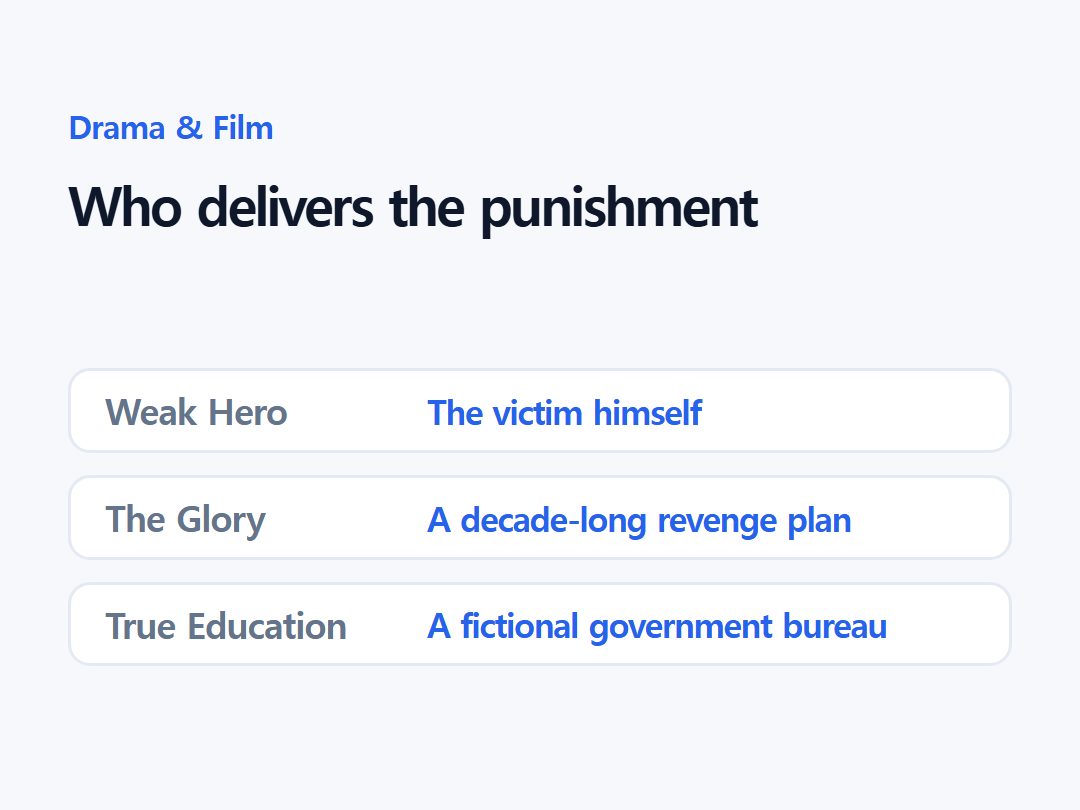
| Title (year) | Who delivers the punishment |
|---|---|
| Weak Hero (2022–2025) | The victim himself, using intelligence and improvised weapons |
| Bloodhounds (2023) | Two boxers, acting outside the law against loan sharks |
| The Glory (2022–2023) | The victim, via a revenge plan built over roughly a decade |
| True Education (2026) | A fictional government "Teacher Rights Protection Bureau" |
What stays constant is who is not trusted to deliver the ending: the actual school, and the actual court.
What the genre still can't resolve
The genre's popularity hasn't translated into the legal reform its plots imply is overdue. Bills to lower the age of criminal responsibility below 14 have been introduced repeatedly without passing, so the gap between what these dramas promise and what courts deliver is roughly where it was before The Glory aired.
The same sourcing that gives these stories their charge also carries risk. Korea's earlier problem with "digital prison" sites that misidentified alleged bullies shows how quickly real-case-based revenge fiction can blur into a real-world accusation against the wrong person.
The genre asks courts to be harsher and audiences to act as judge and jury at the same time — and so far, only one of those requests has actually happened.
How each K-drama delivers justice
| Title (year) | Who delivers the punishment |
|---|---|
| Weak Hero (2022–2025) | The victim himself, using intelligence and improvised weapons |
| Bloodhounds (2023) | Two boxers, acting outside the law against loan sharks |
| The Glory (2022–2023) | The victim, via a revenge plan built over roughly a decade |
| True Education (2026) | A fictional government "Teacher Rights Protection Bureau" |
Frequently asked
Is The Glory based on a true story?
Its most notorious scene — students burning a classmate with a curling iron — was drawn from a real 2006 case at a middle school in Cheongju.
Why don't bullies in Korea go to prison?
Under Korea's Juvenile Act, the age of full criminal responsibility is 14, so younger offenders can only receive a protective disposition, never a criminal record or adult prison time.
Why did the Korean Teachers' Union want Netflix to cancel True Education?
The union argued the source webtoon glamorizes school violence, portrays teachers as incompetent and passive, and legitimizes a fictional 'protection bureau' that assaults students.
Sources
Every factual claim above is traceable. We do not translate articles — we gather facts from multiple outlets and write them ourselves.
- How Netflix's The Glory Draws From True Stories of Bullying — TIME
- Netflix series 'The Glory' draws focus to real school bullying — The Korea Times
- School bullying history dragging down celebrities — The Korea Times
- South Korean volleyball twins Lee Jae-yeong and Lee Da-yeong dropped amid bullying scandal — CNN
- Caught in the midst of a bullying scandal, South Korean volleyball twins move to Greece — CNN
- 'True Education', dressing up a worldview hostile to the vulnerable — Kyunghyang Shinmun (English)
- Korean Teachers' Union Calls for Cancellation of Live-Action 'Get Schooled' Adaptation — Anime News Network
- 스포츠와 연예계 휩쓴 '학폭', 웹툰은 알고 있었다 — Daum News
- 학폭 가해자에 '사이다 액션'…원작 논란 넷플릭스 '참교육' — Nate News
- A satisfying 'true education,' between fantasy and reality — Starnews Korea
- 'Weak Hero' returns, exploring raw teenage psychology of growing up — The Korea Herald
- 촉법소년은 정말 처벌 안 받을까…드라마 속 과장과 현실 — Daum News