A character survives a car crash. They wake up unable to recognize the person they loved. Years pass. They meet again, feel an inexplicable pull toward each other, and the audience knows exactly what's coming before either character does. If you've watched more than a handful of Korean dramas, you've seen this scene — or one very much like it — more than once.
The short version
- Amnesia lets K-dramas skip blame — no one has to leave or lie.
- Winter Sonata (2002) launched the trope; Love Reset (2023) played it for comedy.
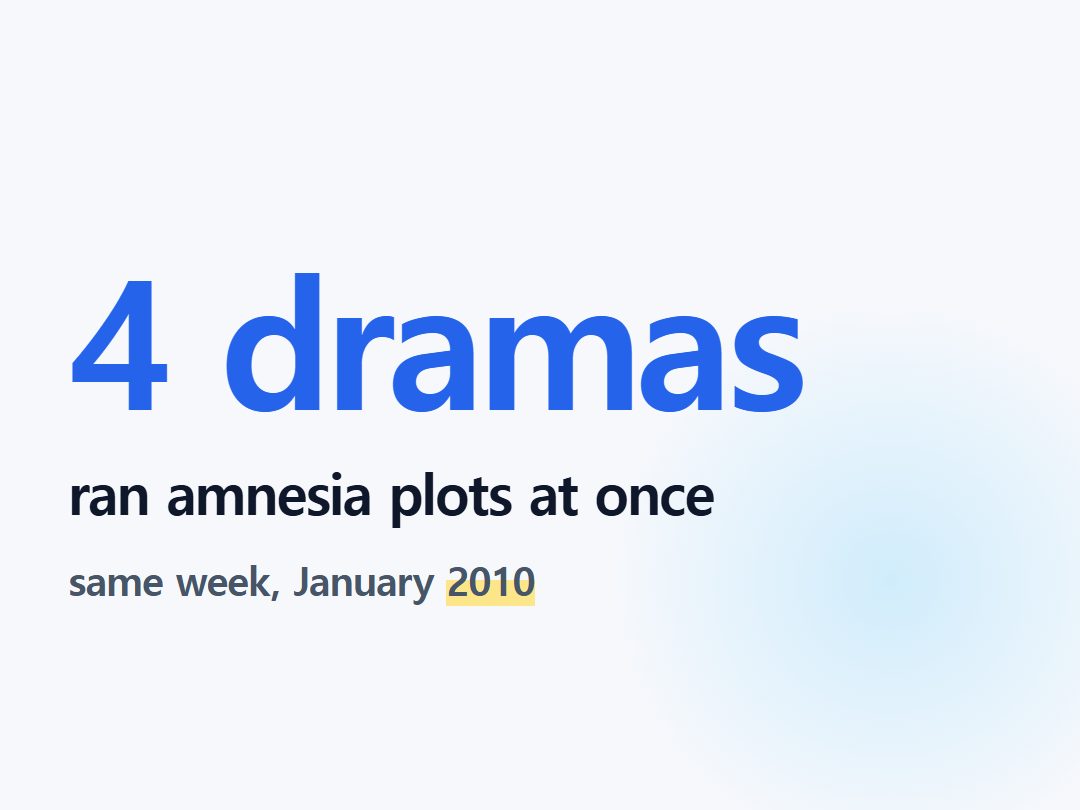
- Munhwa Ilbo counted four amnesia dramas airing at once in January 2010.
Amnesia is one of the most recognizable devices in Korean television, and it isn't limited to any one era. It powered Winter Sonata, the 2002 KBS2 series that helped launch the Korean Wave (Hallyu) across Asia.
It resurfaced in 2023 in Love Reset, a box-office hit that used the same premise for comedy instead of tragedy. It's still being used now, in current Netflix releases built around amnesiac leads.
In January 2010, the Korean newspaper Munhwa Ilbo counted four prime-time dramas running amnesia storylines at the same time — a saturation point that drew open mockery from viewers and unease from the industry itself. The trope has been criticized inside Korea for two decades as tired and medically implausible. It keeps getting used anyway.
Why do K-dramas always reach for amnesia?
To an international viewer, the amnesia plot can look like a screenwriter simply running out of ideas — a shortcut to manufacture drama when the story has nowhere else to go. That reading isn't wrong, exactly. Korean producers and critics have made the same complaint for years.
But it misses why the device became the industry's go-to shortcut in the first place, and that reason says something specific about how Korean melodrama — 멜로 ("mello"), the industry's own term for its romance genre, distinct from the deliberately outrageous soap-opera style known as 막장 ("makjang") — is built.
The core function of amnesia in a Korean melodrama isn't memory loss. It's consequence loss.
A screenwriter interviewed by the film magazine Cine21 put it directly: amnesia lets writers frame love as something that transcends memory itself — a fate stronger than circumstance — without reaching for other taboo devices Korean melodrama has historically leaned on, such as hidden family ties between former lovers or a terminal illness.
In other words, amnesia is the device writers pick specifically to avoid a messier, more morally loaded one.
That matters because Korean terrestrial broadcasting has, for most of its history, been held to unusually strict standards around depicting infidelity, divorce, and abandonment sympathetically.
It wasn't until 1996 that a Korean film first gave an extramarital affair a positive ending, and broadcast dramas have faced even tighter scrutiny than film from the country's content regulator.
In that environment, a writer who wants to separate two people who are meant to be together — and then bring them back together for a second, more deliberate love story — has a problem: someone usually has to be at fault for the separation. Someone leaves. Someone lies. Someone chooses another person.
Any of those choices makes a character less sympathetic, and in a genre built on rooting for its leads, that's a cost.
Amnesia removes the cost entirely. If a character forgets their first love rather than abandoning them, no one is to blame. The lost years aren't a betrayal, they're a tragedy that happened to both people equally.
As one critic summarized the trope's mechanics, it "acquits the characters of all crimes and consequences" — which is precisely the point. It lets a drama stage a breakup, a reunion, and the swoon of falling for the same person twice, without ever forcing the story to assign guilt.
For a genre where audience sympathy for the two leads is the entire product, that's a remarkably efficient tool, even if it isn't a realistic one.
It also solves a structural problem specific to long-running Korean series. Domestic dramas are typically written and shot on tight, near-simultaneous production schedules, with scripts often finished just weeks or days ahead of broadcast.
A plot device that can instantly change a character's relationships, values, or knowledge — without new characters, new locations, or a new setup — is simply efficient television-making.
A Korean broadcast producer quoted by Munhwa Ilbo called amnesia "the most common setup for creating conflict" in the industry, while acknowledging it's a symptom sicker shows lean on more than others.
How Winter Sonata created today's amnesia formula
The device predates modern K-drama by decades — Korean audiences have a cultural memory of real family-separation narratives from the postwar era, when relatives divided by the Korean War searched for one another for a lifetime, and some early viewers of amnesia plots explicitly compared the trope to that history, unfavorably, once it became overused.
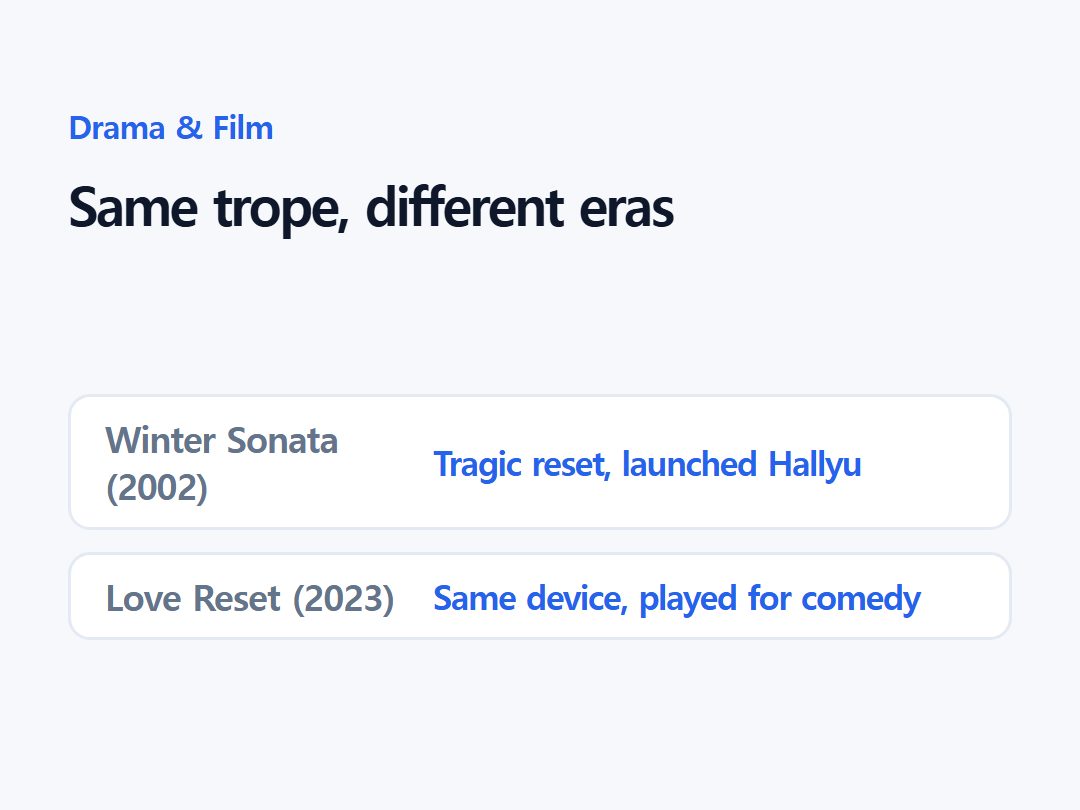
But the modern version's defining moment is Winter Sonata (2002), in which a teenage romance is cut short by a car crash that leaves one lead believing the other is dead, and the other living under a new identity with no memory of his old life.
When the two reconnect years later, the show built an entire international fandom — the so-called "Yon-sama" phenomenon in Japan, named for lead actor Bae Yong-joon — on the tension of a man falling for the same woman without knowing he'd loved her before.
That commercial success taught the industry something: amnesia wasn't just a way to avoid moral complication, it was a way to give an audience the pleasure of watching two characters fall in love from scratch, with all the excitement of a new courtship, while the audience alone holds the emotional history the characters have lost.
It's a device that lets viewers feel smarter and more invested than the characters on screen — a structural trick, not just a plot convenience.
Writers spent the next two decades reaching for that trick constantly, across genres — thrillers used amnesia to hide a character's past crimes or trauma, melodramas used it to reset romance, and daily dramas (long-running, lower-budget serials broadcast on weekday afternoons or evenings) used it as a fast, cheap way to manufacture a twist.
By the time Munhwa Ilbo tallied four simultaneous amnesia plots airing across Korean networks in January 2010, the device had gone from novel to reflexive, and Korean critics and viewers said so openly — one viewer quoted in that coverage asked how amnesia leading to a completely different life could still be plausible in the modern era, rather than a story from Korea's mid-20th-century past.
Is Korean TV finally tiring of amnesia?
The trope hasn't disappeared — it's evolved.
In 2023, the film Love Reset took the device somewhere new: instead of using amnesia to create tragic distance, it starred a married couple who lose their memories 30 days before their divorce is finalized, and used the setup for comedy about whether they'd choose each other again from zero.
The film became one of the highest-grossing Korean releases of the year, evidence that audiences aren't tired of the mechanic itself, only of it being played completely straight. Other recent titles have gone further, using fake amnesia as a twist for viewers who can now see the real thing coming from the first episode.
What remains unresolved is whether Korean television will keep finding new angles on the device or whether audience fatigue — now openly mocked in reviews and social media whenever a new series reaches for it — will eventually retire it.
Given the trope's fifty-plus-year run through Korean film and television, and its continued use in current streaming releases, betting against amnesia in K-drama has historically been a losing bet.
Amnesia trope across Korean film and TV
| Year | Title / Source | How amnesia was used |
|---|---|---|
| 2002 | Winter Sonata | Car-crash amnesia splits young lovers; launches the Hallyu wave in Asia |
| Jan. 2010 | Munhwa Ilbo count | Four prime-time dramas running amnesia plots simultaneously |
| 2023 | Love Reset | Married couple loses memory before divorce; used for comedy, not tragedy |
| Present | Current Netflix releases | Amnesiac leads still powering new K-drama plots |
Frequently asked
Why do Korean dramas use amnesia so much?
Amnesia lets writers separate and reunite two leads without assigning blame for infidelity or abandonment, which Korean broadcast standards have long discouraged showing sympathetically.
What Korean drama started the amnesia trope?
Winter Sonata (2002) is considered the trope's defining modern moment, using a car-crash amnesia plot that helped launch the Hallyu wave across Asia.
Is Love Reset the same amnesia trope as older K-dramas?
Yes — Love Reset (2023) uses the same amnesia premise as older melodramas but plays it for comedy about a divorcing couple instead of tragedy.
Sources
Every factual claim above is traceable. We do not translate articles — we gather facts from multiple outlets and write them ourselves.
- Winter Sonata — Wikipedia
- Remembering 'Winter Sonata,' the start of hallyu — The Korea Herald
- 드라마 주인공들 꼭 기억상실증에 걸린다 — Cine21
- 툭하면 '기억상실증'… "억지 설정" 눈총 — Munhwa Ilbo
- 기억상실증/창작물 — Namuwiki
- The Worst K-Drama Tropes That Make Fans Furious — CBR
- Love Reset — Wikipedia
- Amnesia hall of fame: 11 K-dramas that prove we'll never get tired of memory loss — Tatler Asia