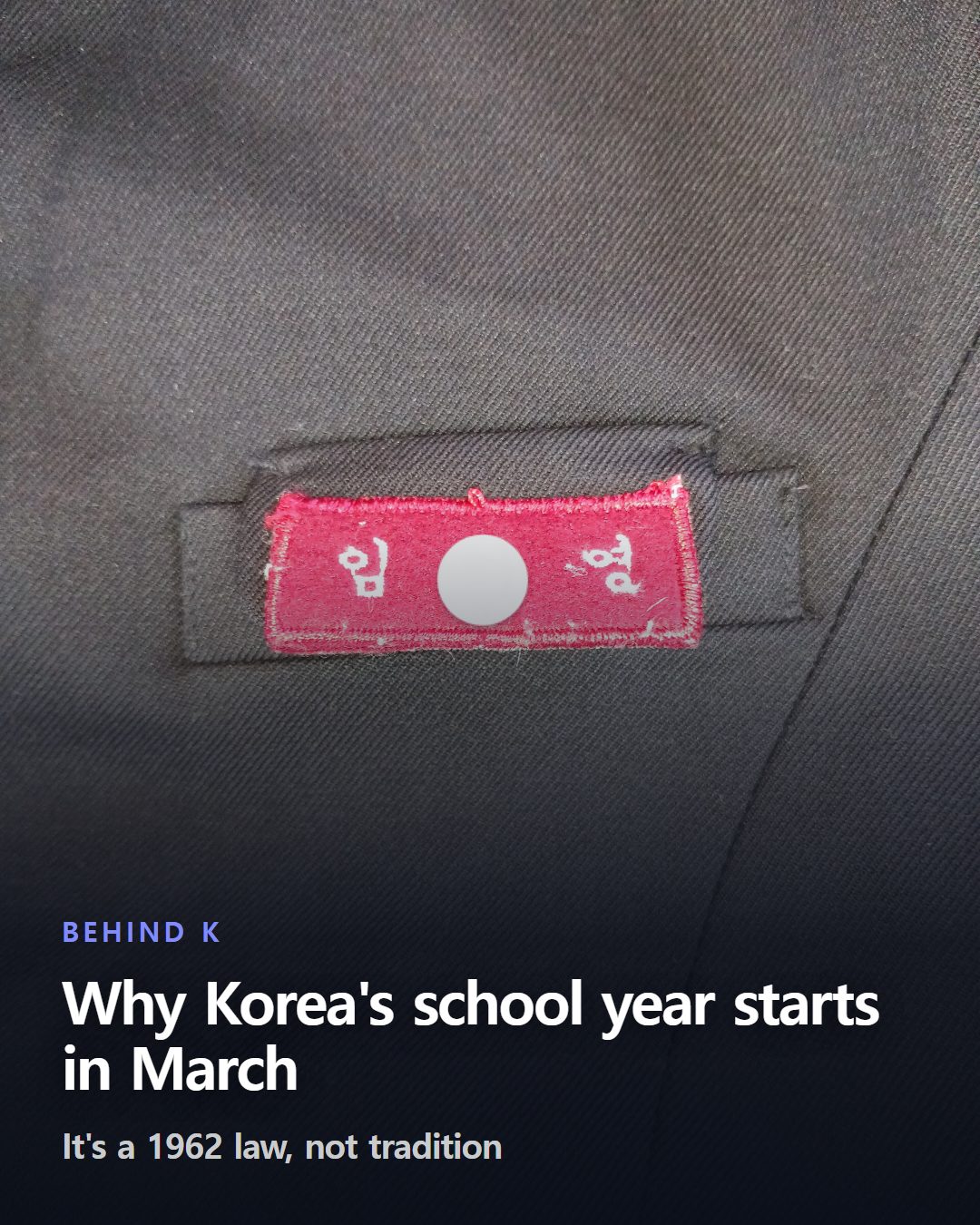
Every March, roughly six million Korean students start a new school year at once. There is no staggered September rollout like in the United States or Europe — the whole country's schools open together, in the same week, in early spring.
The short version
- Korea is one of only three OECD countries starting school in March.
- The March start comes from a 1961 law aimed at cutting winter heating costs.
- Four attempts to switch to September have failed, one citing $6–7 billion in costs.
That timing is not a cultural default. It is the end point of a policy fight that ran through colonial rule, a postwar American occupation, and a war that briefly canceled it altogether.
A calendar that runs March to February, not fall to spring
Under Korea's Elementary and Secondary Education Act, the academic year begins March 1 and ends the following February. Korea is one of only three OECD member countries where the school year opens in March — the other two, Argentina and Chile, are in the Southern Hemisphere, where March marks the end of summer.
Korea has no such seasonal excuse. It sits in the same hemisphere, and roughly the same latitude band, as the United States, China, and most of Europe — all of which start school in September. Even Japan, which colonized Korea and left the deepest mark on its school system, starts in April, not March.
Korea's spring start began as an American import
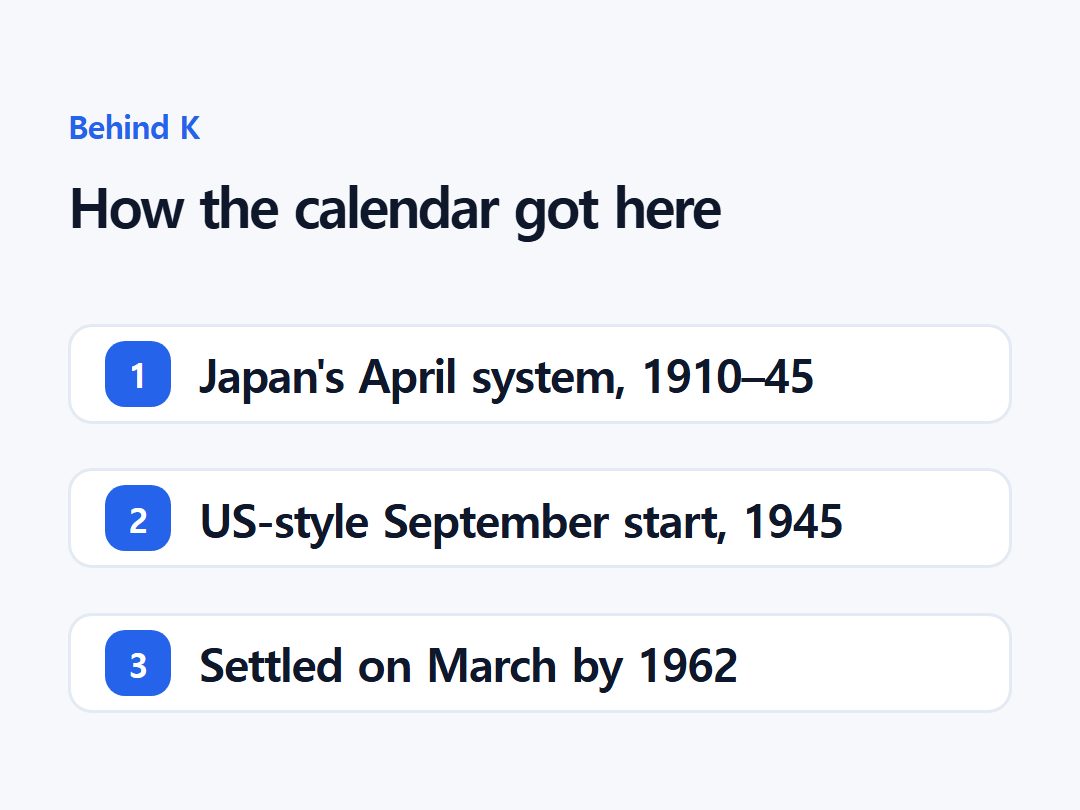
Under Japanese colonial rule (1910–1945), Korean schools followed the Japanese calendar: an April-to-March academic year, split into three terms. That system had nothing to do with Korea's own preferences — it was imposed to match Japan's.
Liberation in August 1945 didn't bring back a Korean calendar. It brought an American one.
The United States Army Military Government in Korea (USAMGIK) administered the southern half of the peninsula until 1948. On September 17, 1945, it issued General Order No. 4, ordering elementary schools to reopen September 24 and secondary schools October 1 — a September-start system modeled on US schools.
A 1949 law reversed course before the ink had dried
The American-style calendar didn't survive the new Korean government. Officials argued it didn't fit local conditions — university entrance exams, for instance, were landing in Korea's rainy season under the September system.
The Education Act of December 31, 1949 restored an April start, closer to the old colonial-era calendar, and tied it to the government's own fiscal year. To soften the switch, the law scheduled a short transitional year: the 1950 school year would begin in June, and the 1951 school year in April.
War pushed the calendar to September, then back again
That transition plan lasted about as long as it took for the Korean War to start. Fighting broke out in June 1950, days after that year's term began, and classes across the peninsula were disrupted for more than a year.
The school year that should have ended in March 1951 didn't close until August 1951. To recover, the next academic year opened in September 1951 — an accidental, temporary return to the American-style calendar Korea had abandoned two years earlier.
From 1952 through 1961, schools settled back into the April start mandated in 1949. The calendar question looked closed.
1962: winter heating bills, not tradition, fixed the date
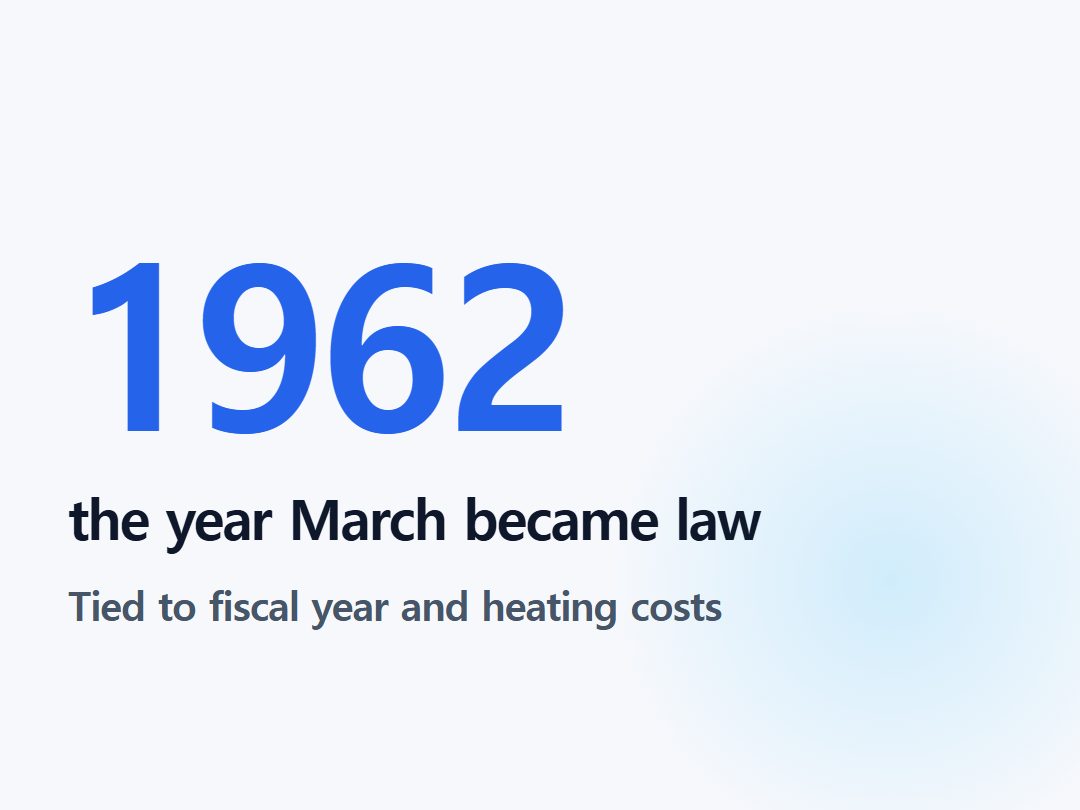
It wasn't closed. A 1961 revision to the Education Act moved the start date one more time — from April 1 to March 1 — beginning with the 1962 school year. That is the calendar Korea still uses today.
The stated reasons were practical, not symbolic:
- Matching the school year more closely to the government's fiscal and administrative calendar
- Shifting winter break into January and February, the coldest months, to cut school heating costs
- Protecting students from commuting and studying through the harshest winter weather
Spring's association with "new beginnings" is often cited informally, but the documented drivers were fiscal and practical — budget cycles and heating bills, not cherry blossoms.
Why the March start still complicates cross-border moves
For a domestic student, the March calendar is invisible — it's simply how school has always worked. It becomes visible the moment a family crosses into or out of a September-calendar country.
Because the two systems run roughly six months apart, a student moving between them rarely lands on a clean grade boundary. Placement often depends on completed coursework, not just age — and credits from one system frequently don't transfer directly into the other's requirements.
Visa and enrollment timelines compound this: US high school placements built around a September start typically need three to five months of advance processing, which leaves little room for a family relocating on short notice from a March-calendar system.
Exam season and hiring cycles are now built around March
Six decades of the March calendar have locked other institutions into the same rhythm. The CSAT — the College Scholastic Ability Test, Korea's national university entrance exam — is held every November so results are ready for March admissions.
Corporate hiring cycles, teacher assignments, and school construction budgets are all timed the same way.
That is precisely why the calendar has proven so hard to change — moving the start date isn't a school-only decision anymore. It would require resetting exam schedules, hiring calendars, and fiscal planning across the entire education system at once.
Four governments have tried to move to September — and failed
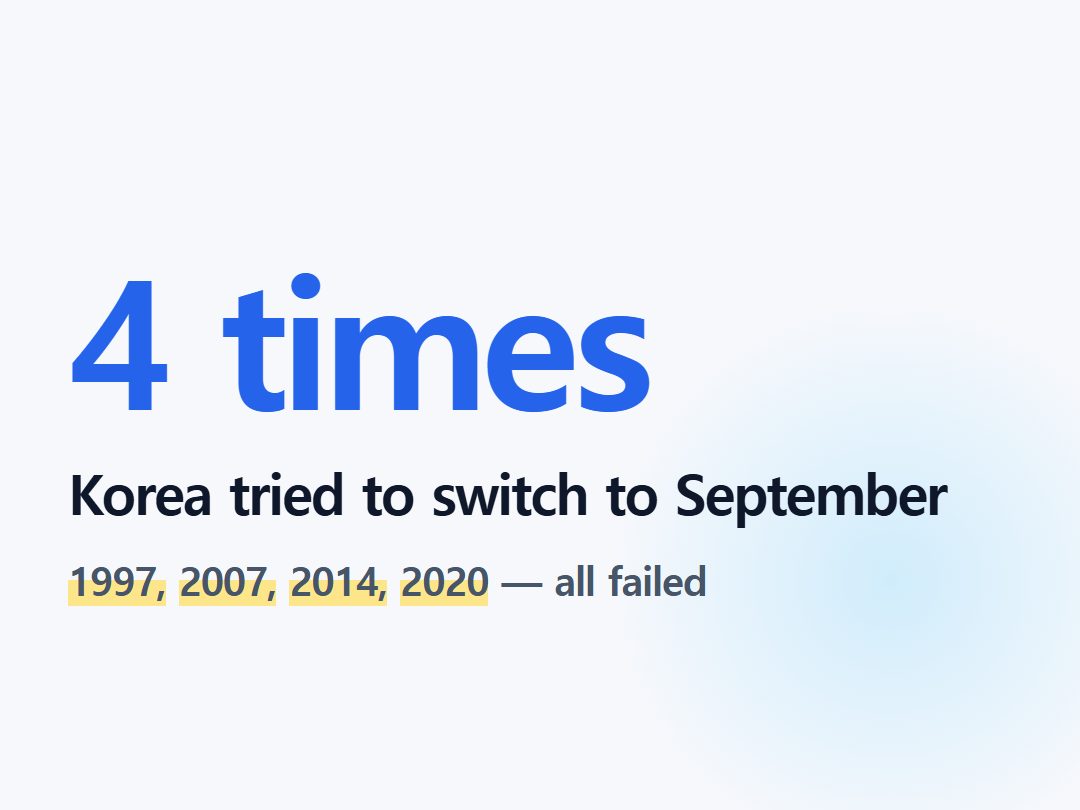
Korea has revisited the idea of switching to a September start at least four times: 1997, 2007, 2014, and 2020. Each attempt died before implementation.
The 1997 and 2007 proposals were framed around "internationalization" — aligning Korean calendars with the roughly 70% of countries worldwide, including the US and China, that already start in fall.
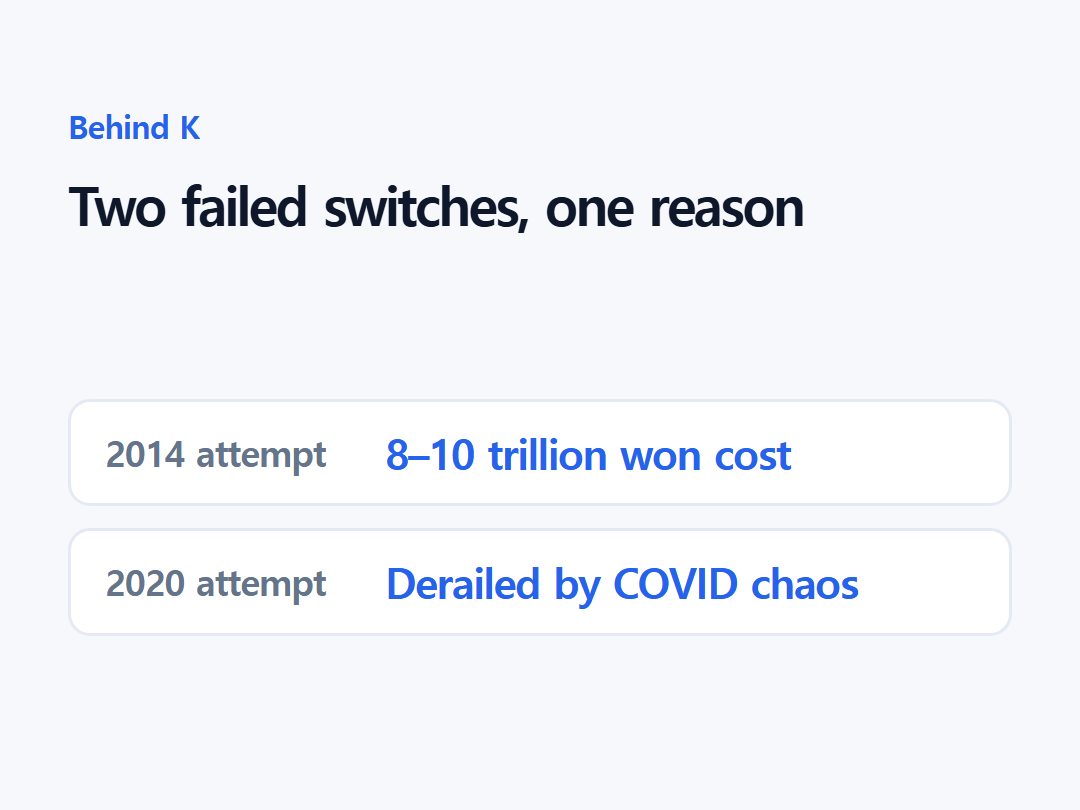
The 2014 review produced a Korean Educational Development Institute estimate of 8 to 10 trillion won — roughly USD 6–7 billion — in transition costs over 12 years, covering added teaching staff, revised university admissions, and shifted corporate recruiting calendars.
The price tag ended the discussion each time.
Why the 2020 pandemic push also collapsed
COVID-19 gave the idea its most serious airing yet. As repeated school-reopening delays stretched into May 2020, several regional officials argued for scrapping the disrupted spring term entirely.
Then–South Gyeongsang governor Kim Kyoung-soo was among those pushing to restart the school year in September instead. More than 20 public petitions reached the presidential office, one gathering roughly 15,000 signatures.
President Moon Jae-in explicitly declined to link reopening decisions to a calendar overhaul, wary of adding administrative confusion on top of a public health crisis. By August 2020, a new outbreak tied to a Daegu church cluster pushed the debate off the national agenda entirely.
Universities had already started their spring terms, and reworking the CSAT schedule on short notice proved logistically unworkable.
What is still unresolved
Nothing about the March calendar is legally permanent — it exists because of a 1961 law, not a constitutional provision, and could in theory change with a future Education Act revision. In practice, no government has found a way to absorb the transition cost or the disruption to entrance exams and hiring cycles.
One asymmetry gets little attention internationally: Korean universities, unlike K-12 schools, are free to set their own academic calendars.
A handful already run partial September or hybrid intakes for exchange and international students — even while the mandatory March start still governs every public elementary, middle, and high school in the country.
Whether that patchwork eventually forces a broader change, or simply becomes Korea's permanent workaround, is the part of the story still being written.
Korea's four failed attempts to move to a September school year
| Year | Driver | Outcome |
|---|---|---|
| 1997 | Internationalization push to align with fall-start countries | Died before implementation |
| 2007 | Internationalization push to align with fall-start countries | Died before implementation |
| 2014 | KEDI estimate: 8 to 10 trillion won over 12 years | Price tag ended the discussion |
| 2020 | COVID-19 reopening delays, regional officials, 20+ public petitions | Dropped after Daegu outbreak; CSAT reset was unworkable |
Frequently asked
Why does the Korean school year start in March instead of September?
A 1961 revision to Korea's Education Act moved the start date from April to March, mainly to shift winter break into the coldest months and cut school heating costs.
Has Korea ever tried switching to a September school year?
Yes, in 1997, 2007, 2014, and 2020, but every attempt was dropped, most recently over an estimated 8 to 10 trillion won transition cost.
What is the CSAT and how does it relate to Korea's school calendar?
The CSAT is Korea's national university entrance exam, held every November so results are ready in time for March university admissions.
Sources
Every factual claim above is traceable. We do not translate articles — we gather facts from multiple outlets and write them ourselves.
- 학년도 (School Year) — history and current system — NamuWiki
- 학년도 — 학년도 3월 시작의 역사적 배경 — NamuWiki
- 대한민국 9월 학기제 도입 논의 (Discussion of Introducing a September Semester in South Korea) — NamuWiki
- 9월 학기제 A to Z — Naeil Edu
- Korean School Year vs US School Year: Timing Your Child's Transition — Amerigo Education