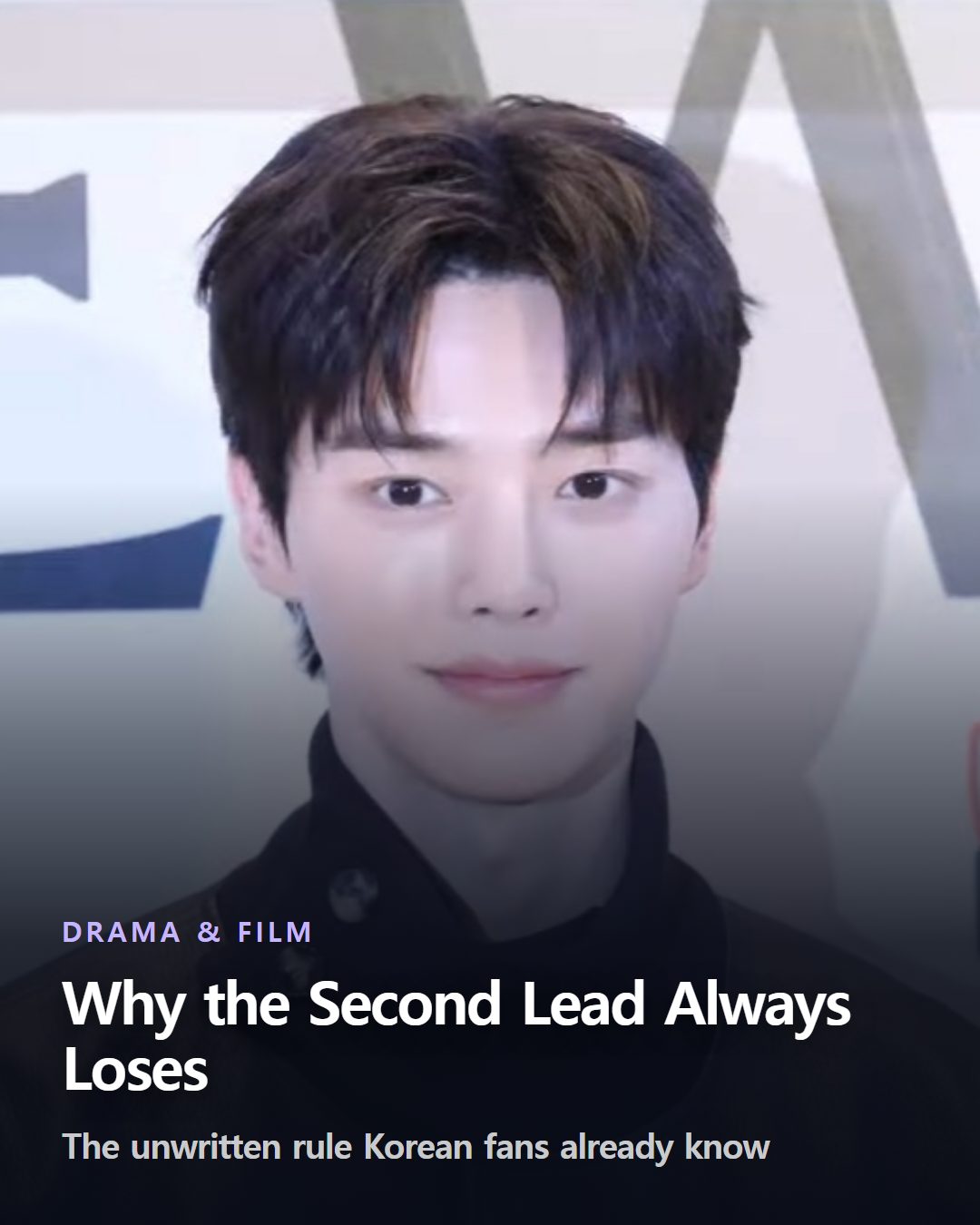
Three episodes into almost any Korean romance drama, a predictable thing happens: viewers start rooting for the wrong guy. Not the male lead, but the second lead — the rival who is warmer, funnier, and more emotionally available from the very first scene. And with near-mechanical consistency, that character loses.
Korean fandom named this pattern so long ago that it now has a fixed English label used across recap sites and fan forums: second lead syndrome (SLS), the experience of falling for a character you already know, by genre convention, cannot end up with the heroine.
The short version
- Second lead syndrome: fans fall for a rival who's written to lose.
- Korean dramas fix the central couple before a script is finalized.
- Han Ji-pyeong sparked #TeamJipyeong in Start-Up (2020) — and still lost.
The reference site TV Tropes states the rule in blunt terms in its entry on Korean drama conventions: no matter how much better suited to the heroine he is, or how genuine his feelings, the second male lead "always 'loses' to [the first lead] in the end." It is such a reliable outcome that fan wikis catalogue it as its own trope category, and English-language recap outlets like Dramabeans and Soompi regularly publish standalone pieces just about second leads and the love triangles built around them.
That much is visible to any first-time viewer. What is not obvious — and what Korean audiences already understand walking in — is why this rule almost never breaks, and why viewers keep watching a story whose ending they can already predict.
Why does the second lead always lose?
The gap for international readers is not the existence of the trope. English-language fan culture has clearly noticed it and given it a name. The gap is understanding that the outcome is not a coincidence of chemistry or actor charisma — it is a structural rule of how the genre is written and produced, and Korean viewers watch with that rule already priced in.
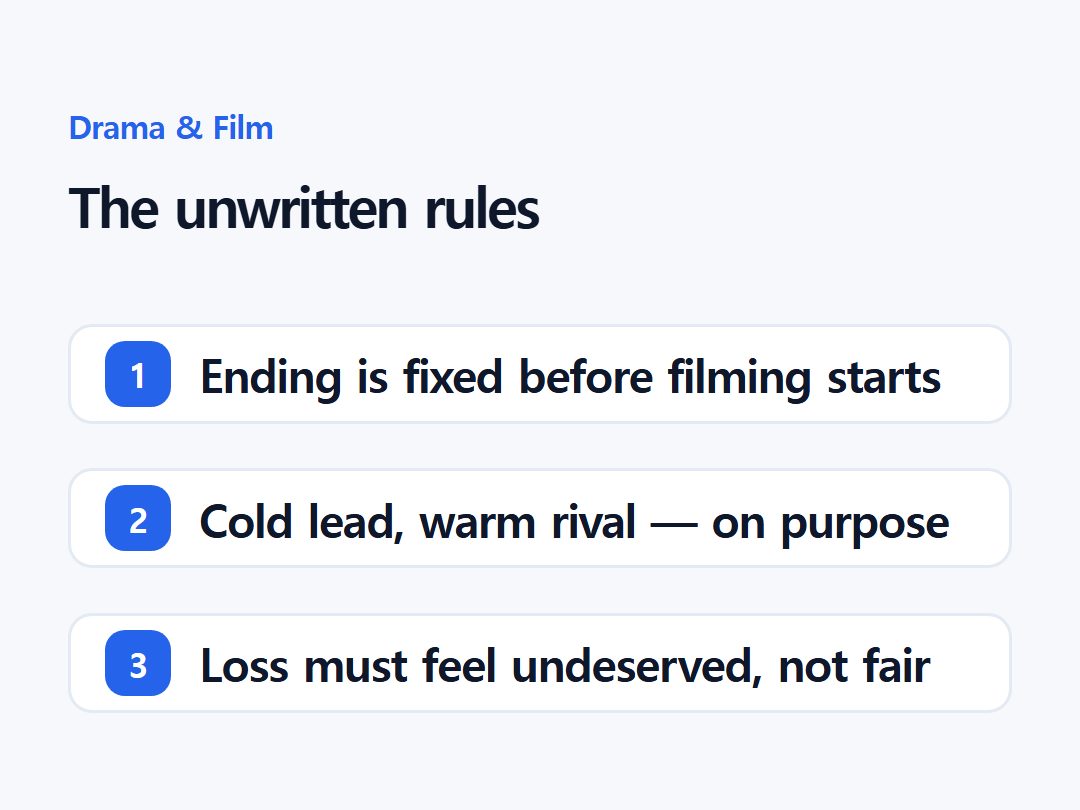
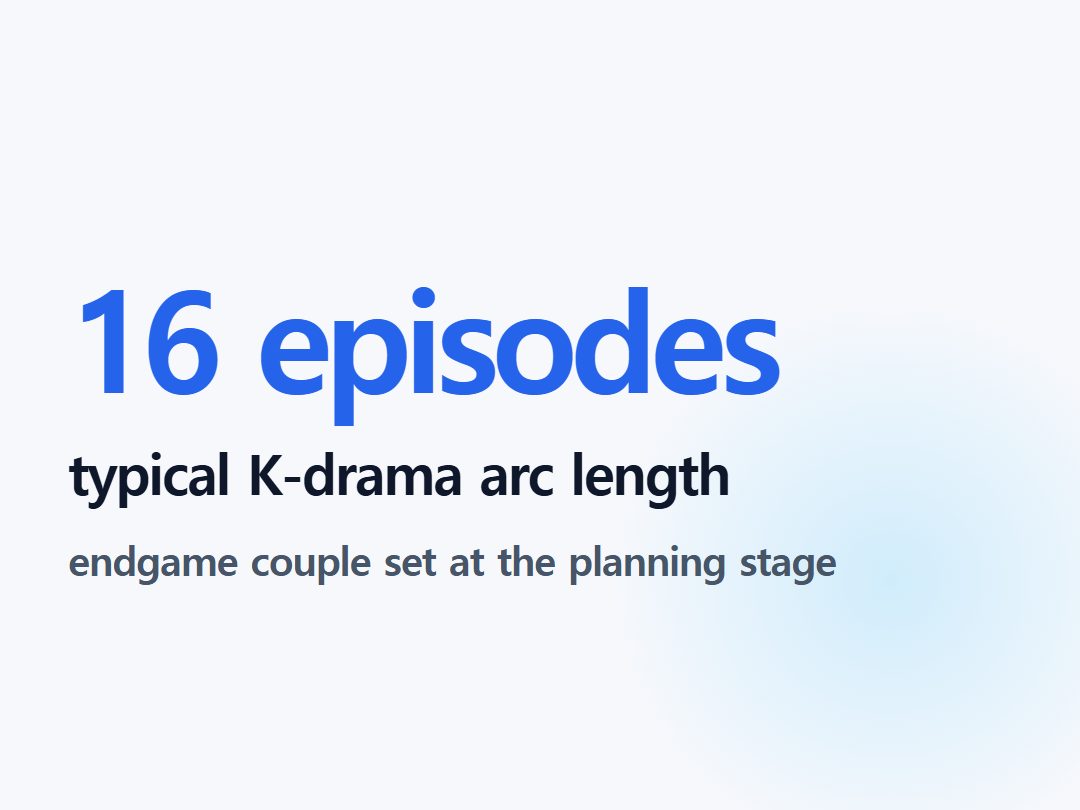
Most Korean dramas are commissioned as a fixed run, typically around 16 episodes, with the central couple — often called the "endgame" pairing in fan shorthand — decided at the planning stage, before a single episode airs.
The love triangle exists to generate tension around an outcome that is already settled internally, not to stage an open contest between two equally viable options.
A recap by the Korean-drama site Dramabeans put it directly: the second lead "was written to lose without coming across as a loser, and set up to fail without being a failure." He has to be appealing enough to make viewers doubt the ending, without ever being written as genuinely interchangeable with the lead.
The specific writing trick that makes this work is a deliberate contrast in character temperature.
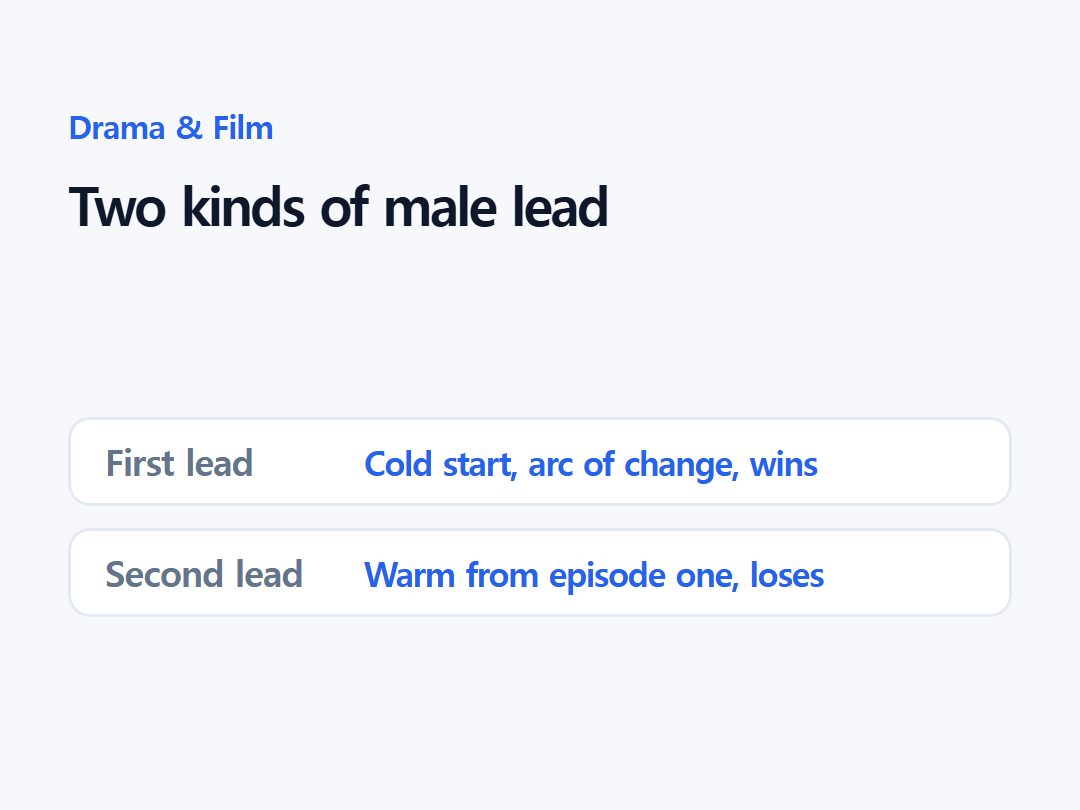
The first lead is frequently introduced as cold, arrogant, or emotionally closed off — the standoffish chaebol heir, the prickly genius, the guarded loner — while the second lead is kind and steady from his very first scene.
Multiple drama-culture write-ups converge on this same observation: audiences are drawn to the second lead precisely because they don't have to wait through an entire redemption arc to see him treat the heroine well. He is already the version of the male lead that viewers wish the male lead would become.
That asymmetry is not an accident of casting; it is the mechanism the genre uses to manufacture doubt in a story whose actual ending was never in question.
There is also a psychological reason Korean audiences accept — and even prefer — a resolution they can see coming. Commentary on the trope consistently frames the second lead's loss as the emotional product being sold, not a flaw in the storytelling.
If the second lead actually won, the argument goes, the tension that keeps viewers watching would simply disappear: a satisfying outcome with no ambiguity is, for this genre, a less compelling one. The heartbreak is not incidental to the format; for many viewers, it is the reason they tuned in.
Korean fans typically go into a drama already budgeting for this emotionally, treating the second lead's loss as a known cost of the genre rather than a surprise ending — which is precisely the context international viewers, arriving without that shared vocabulary, tend to miss.
The clearest illustration of how deliberately this is engineered is the case of Han Ji-pyeong, the second lead played by Kim Seon-ho in the 2020 tvN and Netflix series Start-Up.
Han Ji-pyeong is introduced as a curt, sharp-tongued investor, but the show reveals early on that he was quietly fostered by the female lead's grandmother as a teenager and has spent years supporting the heroine from the sidelines without asking for anything in return.
As the South China Morning Post reported at the time, the character's mix of restraint and hidden devotion resonated so strongly with viewers that a "#TeamJipyeong" campaign spread across social media, with fans openly advocating for the second lead over the actual romantic lead — even though the show's central pairing was never genuinely in doubt.
Kim Seon-ho's performance did not change the outcome; it became a case study in how effectively the trope works when executed well, and it turned him into a breakout star regardless of the character's loss.
Second leads have followed this script for decades
Love triangles are not a Korean invention — they are a staple of melodrama worldwide. What is specific to Korean television is how thoroughly the industry formalized the second lead's doomed role into a recurring production convention, repeated across decades of hit dramas.
In You're Beautiful (2009), Kang Shin-woo's quiet devotion to the heroine became an early, widely cited template for the trope.
In School 2015, Gong Tae-kwang's arc followed the same pattern against a teen-drama backdrop. Cheese in the Trap built its entire second half around whether Baek In-ho could unseat the male lead; he could not.
The government-run portal Korea.net used the historical drama The Forbidden Marriage as a case study of the same structure, noting that the king's best friend, Lee Shin-won, was presented as a genuinely viable love interest for the heroine despite fans knowing from the outset that the crown would claim her.
Not every version of the trope is treated as pure heartbreak filler.
Recap commentary singles out the historical epic Empress Ki as a rare case where the doomed second-lead romance carried real narrative weight, functioning as a metaphor for the political stakes of the story rather than existing purely to generate fan anguish.
These exceptions are notable precisely because they are exceptions; they confirm, rather than overturn, how rigid the general rule has been.
By the time Start-Up aired in 2020, "second lead syndrome" had become so established a piece of fandom vocabulary that English-language outlets used the term without needing to explain it, treating it as a known feature of the genre rather than a phenomenon that needed introducing.
Is second lead syndrome finally starting to change?
What remains unresolved is whether the convention itself is starting to lose its grip on the genre.
A 2026 Dramabeans piece, bluntly titled "The death of Second Lead Syndrome in dramaland," argues that the love-triangle structure has grown formulaic regardless of how well individual second leads are written, and calls for the industry to lean instead toward "secondary romances" — storylines that give supporting characters their own resolutions rather than positioning them purely to lose.
The same piece concedes that Korean dramaland has "vowed to hold onto triangles till its dying breath," suggesting any shift will be gradual rather than a clean break from the format.
For now, the underlying rule holds in the vast majority of new releases: the central pairing is fixed before a script is finalized, and the second lead's function remains to make that fixed outcome feel, briefly, uncertain.
What is changing is how self-aware both writers and viewers have become about the mechanism — and whether that awareness eventually pushes the genre to write endings that break the pattern on purpose, rather than reinforcing it one more time.
The same losing pattern, drama by drama
| Drama | Year | Second Lead | Note |
|---|---|---|---|
| You're Beautiful | 2009 | Kang Shin-woo | Early, widely cited template for the trope |
| School 2015 | 2015 | Gong Tae-kwang | Same pattern against a teen-drama backdrop |
| Cheese in the Trap | — | Baek In-ho | Second half built around whether he could unseat the lead; he could not |
| The Forbidden Marriage | — | Lee Shin-won | King's best friend, presented as a genuinely viable love interest who still loses |
| Start-Up | 2020 | Han Ji-pyeong | Sparked the #TeamJipyeong campaign; still lost |
| Empress Ki | — | — | Rare exception: the loss carried real narrative and political weight |
Frequently asked
What is second lead syndrome?
It's when viewers fall for a Korean drama's second male lead, who is typically warmer and more emotionally available, even though genre convention guarantees he won't end up with the heroine.
Does the second lead ever win in a Korean drama?
Almost never — the central 'endgame' couple is usually decided at the planning stage before any episode airs, though recaps cite rare exceptions like Empress Ki where the doomed romance carried real narrative weight.
Who played Han Ji-pyeong in Start-Up?
Kim Seon-ho played Han Ji-pyeong, the second lead whose hidden devotion sparked the #TeamJipyeong fan campaign even though the show's central pairing was never genuinely in doubt.
Sources
Every factual claim above is traceable. We do not translate articles — we gather facts from multiple outlets and write them ourselves.
- Dramaland justice: What about the second lead? — Dramabeans
- The death of Second Lead Syndrome in dramaland — Dramabeans
- 10 K-Drama Love Triangles That Made It Impossible To Pick Between Leads — Soompi
- She Was Supposed to Marry the Second Lead: The Forbidden Marriage's Love Triangle — Korea.net
- Netflix's Start-Up: who is Kim Seon-ho, the hot Korean actor giving us serious second lead syndrome in the K-drama hit? — South China Morning Post
- Korean Drama — TV Tropes