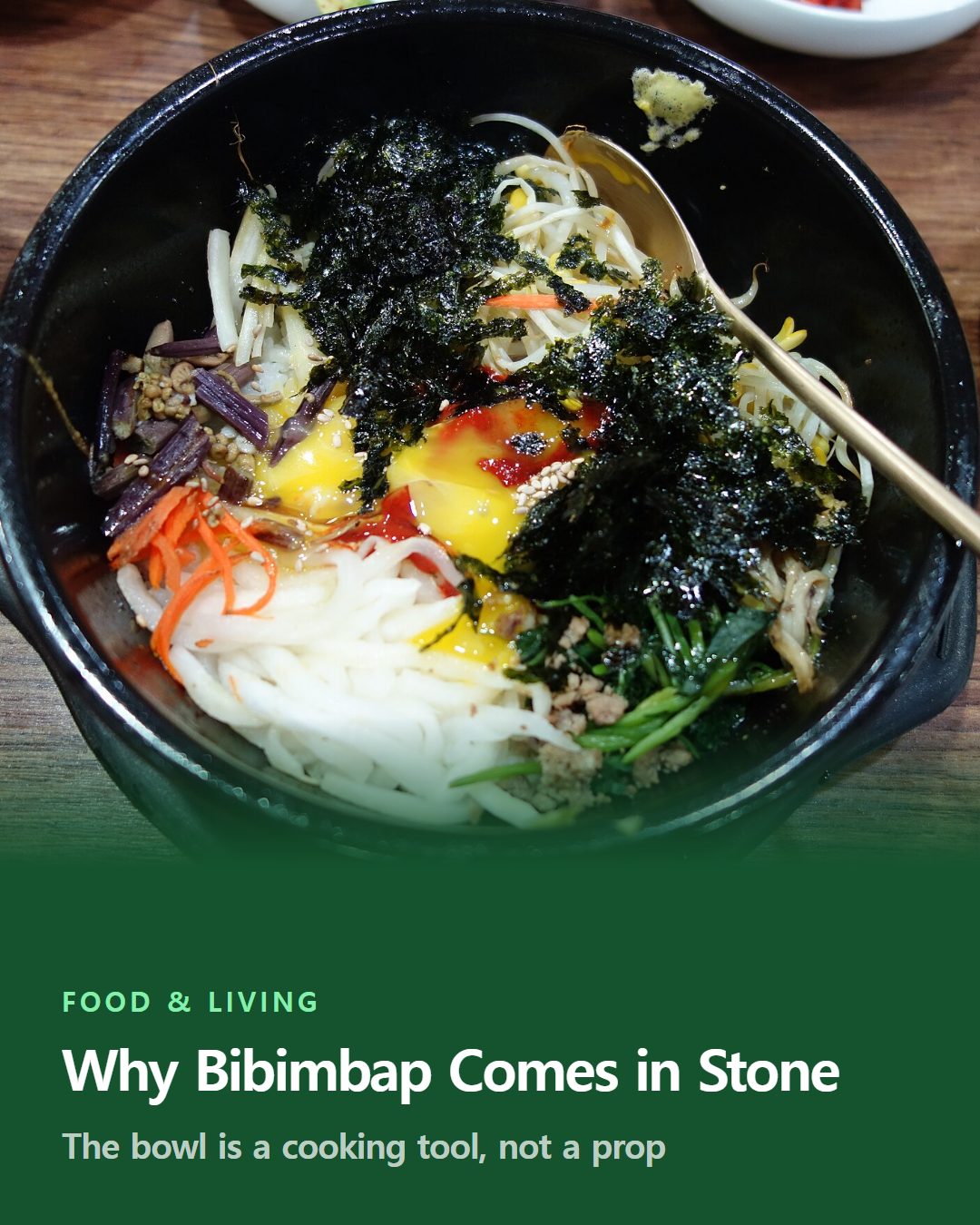
Bibimbap is usually introduced to new eaters as "Korean mixed rice": a bowl of rice topped with seasoned vegetables, meat, chili paste and often an egg, stirred together just before eating. The version that circulates most widely online, though, is not served in an ordinary bowl.
It arrives in a heavy, blackened stone pot called a dolsot (돌솥, literally "stone pot"), audibly sizzling, with a layer of toasted rice — nurungji (누룽지) — forming along the bottom as the dish is eaten.
Outside Korea, the stone pot is often assumed to be a plating choice, a way to make a rice bowl look more dramatic for a photo. In Korea, it is understood the opposite way: the pot is still cooking the food after it reaches the table, and the crust it produces is the reason to order it, not an accident of serving.
The short version
- A preheated stone dolsot keeps cooking bibimbap after it reaches the table.
- The crispy bottom layer, nurungji, is the point, not a mistake.
- China listed the dish as its own heritage in 2021, sparking dispute.
How does a stone bowl keep rice cooking?
A dolsot is traditionally carved from gopdol (곱돌), a dense, soft stone related to soapstone and chlorite schist that is quarried in only a few places in Korea.
Many stone bowls sold today, in Korea and abroad, are made from granite instead, which is harder to carve but easier to mass-produce; both materials are chosen for the same property, a high resistance to temperature change.
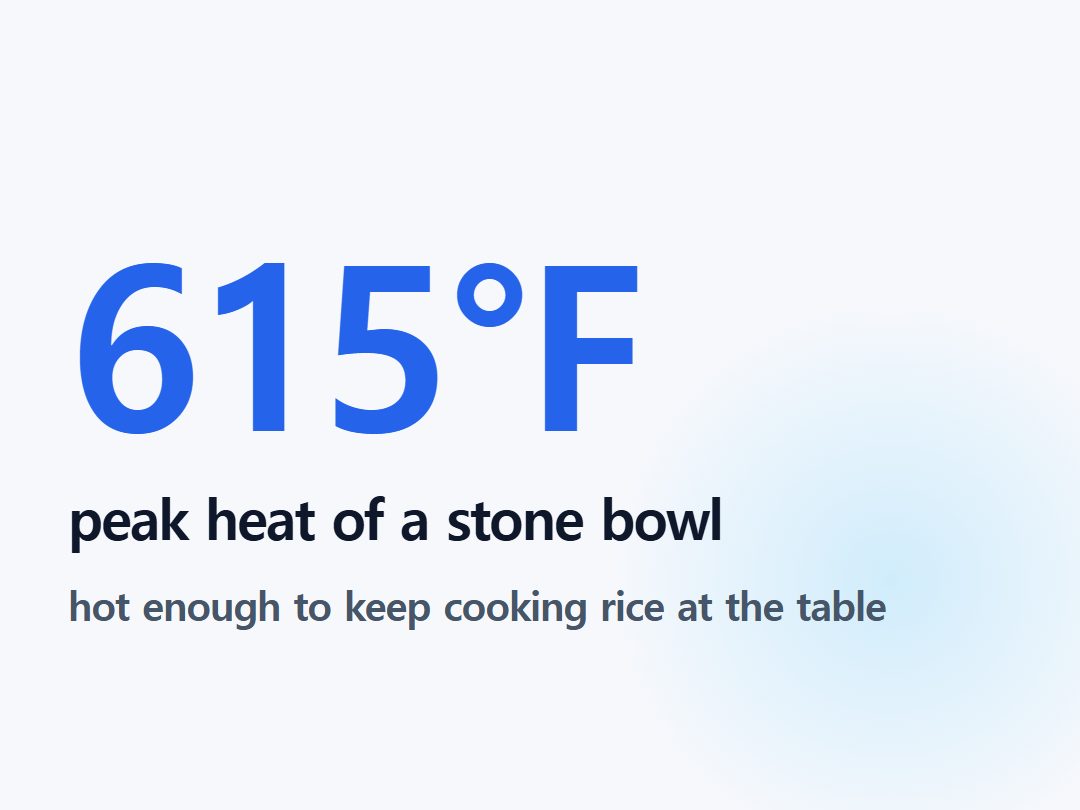
A dolsot is heated on a stove or over a flame before use, and because stone loses heat far more slowly than metal or ceramic, it keeps radiating that heat back into the food for the length of the meal — some reports on granite versions put the peak temperature as high as 615°F.
With repeated use, the stone also gradually absorbs a small amount of oil from the food, which restaurant cooks say adds a faint depth of flavor to later servings — one reason a well-seasoned, older dolsot is considered better than a brand-new one.
That matters because ordinary bibimbap has a built-in temperature problem. The rice comes hot from the cooker, but the vegetables, meat and sauce are typically prepared separately and served at room temperature or cooler; by the time everything is combined, the dish is lukewarm.
A preheated dolsot solves this by continuing to cook the assembled dish at the table. The rice in direct contact with the stone toasts and crisps into nurungji, especially when a thin layer is left undisturbed against the stone while the rest is stirred with the toppings.
Because the pot stays so hot, some restaurants place a raw egg yolk on top instead of a fried one; it finishes cooking from residual heat as the dish is mixed, rather than being fried in advance.
The sizzle that greets a dolsot bibimbap at the table is not garnish, either — it is a functional signal that the pot has been heated properly and will keep working once the food is stirred. And the scorched layer at the bottom is not a byproduct to be scraped off and discarded.
Nurungji has its own established use in Korean home cooking, separate from bibimbap: it is traditionally soaked in hot water or tea after a meal to make a light, toasted-rice drink or porridge, treated as a kind of natural digestif.
A dolsot, in other words, is not a novelty prop borrowed for effect; it is one application of a much older Korean habit of cooking and serving rice in heavy stone or earthenware vessels, chosen because it changes what happens to the food after it leaves the kitchen.
Care of the pot reflects that it is treated as functional cookware rather than disposable tableware. A new dolsot is typically seasoned with oil before its first use, and washed with hot water only — never soap, which the porous stone can absorb and later release into food.

From ancient stone pots to a 1960s Jeonju invention
Cooking rice and porridge in stone pots has a long history in Korea that predates bibimbap itself.
Household manuals from the Joseon dynasty (1392–1910), including works such as Gyuhapchongseo and Imwongyeongjeji, recommended stone pots as the best vessel for cooking rice and porridge, and some Korean food histories trace gopdol cookware back further still, to use among elite households of the Baekje kingdom.
Cooking with stone pots more broadly is sometimes traced to Korea's Three Kingdoms period, though the practice nearly disappeared during Japanese colonial rule (1910–1945) and only returned to wide use after Korean restaurants revived it in the 1960s.
Plain bibimbap — rice topped with vegetables and meat, then mixed — has a separate and more contested history.
Food historians point to several overlapping theories: that it descended from goldongban, a year-end dish for using up a household's remaining food; that it grew out of jesa, the Korean rite of offering food to deceased ancestors, whose leftovers were then eaten by the family; or that it developed among farmers feeding large groups at harvest time.
The earliest known written recipe appears in the late Joseon-era cookbook Siuijeonseo. No single account is considered definitive, and most historians treat the dish as something that developed gradually rather than being invented at one point.
Dolsot bibimbap — the specific pairing of bibimbap with a heated stone pot — has a much more precise, and much more recent, origin.
It is generally credited to a restaurant called Jungang Hoegwan in Jeonju, in the late 1960s, in a stretch of the city near the old Jeonju post office where several bibimbap restaurants competed for the same customers, an area later nicknamed "bibimbap alley." Serving the dish in a preheated stone pot directly addressed the hot-rice, cold-vegetable problem described above and gave the restaurant a way to stand out from its rivals.
The style spread from Jeonju to the rest of the country over the following decades.
It later became one of the dishes most associated with Korean food abroad, particularly in Japan from the early 2000s onward, during the first wave of what became known internationally as Hallyu (한류), the export of Korean pop culture and, alongside it, Korean food.

China's heritage claim meets Jeonju's quiet response
Because dolsot bibimbap is tied to a specific city and a specific era rather than to a single ancient tradition, its ownership has become a live issue.
In September 2024, South Korean media reported that the government of Jilin province in northeastern China had listed the method of making dolsot bibimbap as a regional intangible cultural heritage item in December 2021, describing it as a technique developed by Joseonjok (조선족), the ethnic Korean minority living in northeastern China.
The listing was first publicized in Korea by a Sungshin Women's University professor, and drew criticism as an example of a broader pattern in which Chinese regional governments have registered dishes and traditions closely associated with the Korean peninsula, including kimchi and the farmers' dance Nongak, as heritage belonging to China's own ethnic Korean population.
South Korea's Ministry of Foreign Affairs said it continues to raise cultural-heritage issues of this kind with Beijing.
Inside Korea, the response has focused on documentation rather than diplomacy. Jeonju city has certified a small number of long-established restaurants as official purveyors of standardized Jeonju bibimbap, an effort to keep the recipe consistent as tourism around the dish grows.
None of this changes how a dolsot actually works in the kitchen — the cooking method itself is settled and well documented. What remains unresolved is a broader argument, playing out beyond any single restaurant, over who gets credit for it.
A timeline from stone pots to dolsot bibimbap
| Period | Development |
|---|---|
| Three Kingdoms period | Cooking with stone pots is sometimes traced back to this era |
| Baekje kingdom | Some food histories trace gopdol stone cookware to elite households |
| Joseon dynasty (1392–1910) | Manuals like Gyuhapchongseo recommend stone pots for rice and porridge |
| 1910–1945 | Japanese colonial rule; stone-pot cooking nearly disappears |
| 1960s | Korean restaurants revive stone-pot cooking |
| Late 1960s | Jungang Hoegwan in Jeonju credited with inventing dolsot bibimbap |
| Early 2000s | Dish spreads abroad, especially Japan, during first wave of Hallyu |
| December 2021 | Jilin province, China lists the method as its own regional heritage |
Frequently asked
Why is bibimbap served in a hot stone bowl?
The preheated stone dolsot keeps cooking the rice and toppings after they reach the table, fixing bibimbap's usual problem of hot rice mixed with room-temperature vegetables, and it toasts a crisp rice layer called nurungji along the bottom.
Who invented dolsot bibimbap?
It's generally credited to the restaurant Jungang Hoegwan in Jeonju's 'bibimbap alley' in the late 1960s, which used a preheated stone pot to solve the dish's hot-rice, cold-vegetable problem.
Why did China claim dolsot bibimbap as its own heritage?
In December 2021, Jilin province in northeastern China listed the method of making dolsot bibimbap as a regional intangible cultural heritage item, crediting it to the Joseonjok ethnic Korean minority, a move Korean media reported on in 2024 and criticized as part of a broader pattern of claiming Korean-linked dishes as Chinese heritage.
Sources
Every factual claim above is traceable. We do not translate articles — we gather facts from multiple outlets and write them ourselves.
- Everything you need to know about bibimbap, Korea's famous rice dish — National Geographic
- Dolsot — Wikipedia
- 돌솥비빔밥 — Namuwiki
- 비빔밥(돌솥비빔밥) — Korean Food Foundation (한식문화사전)
- Korean Rice Bowl (Dolsot Bibimbap) — America's Test Kitchen
- Bibimbap vs Dolsot Bibimbap: Key Differences — KimEcopak
- Koreans angered by China's cultural claim to bibimbap — The Korea Times
- Controversy Erupts as Traditional Korean Dish Is Classified as Chinese Cultural Heritage — KoreaBizWire


