
Search any K-pop fan forum for "debuted at 24" and the responses split into two camps: some call it impressively late for a trainee to break through, others ask why 24 — an age most industries consider early-career — gets treated as a deadline at all.
The short version
- K-pop's 24 threshold merges three systems: training pipelines, military law, and contracts.
- Men can defer military enlistment only until age 30, not skip it.
- Idol contracts are capped at seven years, compressing each group's peak.
Both reactions are talking about the same number, but neither explains where it comes from. The threshold is not about looks. It is the byproduct of three separate systems — training pipelines, conscription law, and contract regulation — that happen to compress around the same age.

A pipeline built to start before adulthood
In Korea's agency system, companies scout and sign "trainees" — unpaid or stipend-only recruits who live under company supervision while they learn singing, dancing, and stagecraft, sometimes for years before a debut is even planned. Trainee is a formal status, not a casual label: it comes with dorm rules, curfews, and regular skill evaluations that decide who keeps a spot.
According to Korea Creative Content Agency data reported by The Korea Times, agencies treat training runway as a resource to be maximized, not a formality to get through quickly. They budget for years, not months, of development.
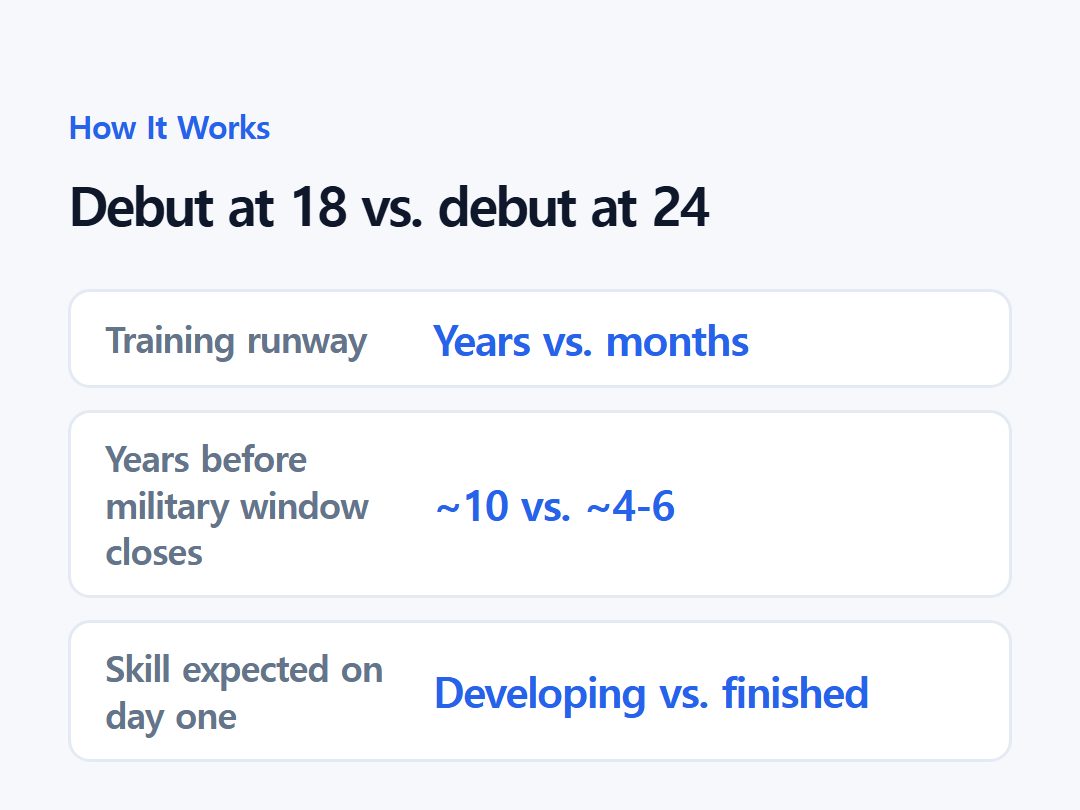
That budget shrinks the older a recruit is. A 15-year-old signed today can be shaped, paired with labelmates, and slotted into a group over several development cycles. A 22-year-old has far less time before an agency needs to see a return, so the training window compresses and the margin for error disappears.
Male idols are racing a clock that female idols don't face
South Korea requires able-bodied men to complete military service, a legal obligation that has no equivalent for women. Under the Military Service Act, enlistment is compulsory, and even the most successful acts only get a deferral — not an exemption.
In December 2020, lawmakers amended the act to let recognized pop-culture artists postpone enlistment until age 30 instead of 28, a change passed just before BTS member Jin turned 28, according to NPR's reporting at the time. It was a deferral, not a way out: Jin enlisted in December 2022, and every other member followed.
For an ordinary rookie without that kind of government recognition, the practical cutoff still sits closer to the high 20s. A man who debuts at 24 is not just starting a career — he is starting it with roughly half the runway a man who debuted at 18 would have before the same legal wall.
A seven-year contract makes every year of runway count
In 2009, three members of TVXQ sued SM Entertainment to void a 13-year contract, a case that ended in a private settlement but pushed South Korea's Fair Trade Commission to act. The commission introduced a standard contract capping exclusive idol deals at seven years, a rule still cited in nearly every major K-pop contract dispute since.
The seven-year ceiling turned into what industry writers now call the "seven-year itch": 2NE1, Sistar, and Miss A all effectively ended activities around their seventh anniversary, as reported by The Korea Herald. A group's entire commercially protected life, in other words, is a fixed seven-year block — so a later debut simply means a later, and often more compressed, peak.
Which "24" — a number that used to mean something different
Age itself became legally slippery in Korea until recently. Koreans traditionally used "Korean age," which counts a newborn as already one year old and adds a year every January 1, alongside the international system used almost everywhere else.
On June 28, 2023, the country abolished Korean age for legal and administrative purposes and standardized on international age, a change CNN covered as citizens becoming a year or two "younger" overnight. Officials framed the reform as a way to cut down on everyday confusion, not a cosmetic tweak.
Because older profiles, interviews, and fan wikis were often written in Korean age, some idols long described as debuting at 24 or 25 were, by international count, actually 22 or 23. That gap is part of why the exact threshold quoted for a "late" debut varies from source to source.
Debuting past 24 used to be unremarkable
The current anxiety around 24 is also relatively recent. In K-pop's first and second generations, later debuts barely registered as noteworthy.
- After School's Kahi debuted in 2009 at 29
- 2NE1's Park Bom debuted in 2009 at 26
- 2NE1's Dara debuted in 2009 at 25, after building a separate career in the Philippines
None of those debuts drew the scrutiny a similar-age debut draws today. The shift tracks the industrialization of the trainee system itself: as agencies formalized scouting, survival shows, and global auditions through the 2010s, the "ideal" intake age quietly dropped year by year.
Idols who debuted past 24 anyway
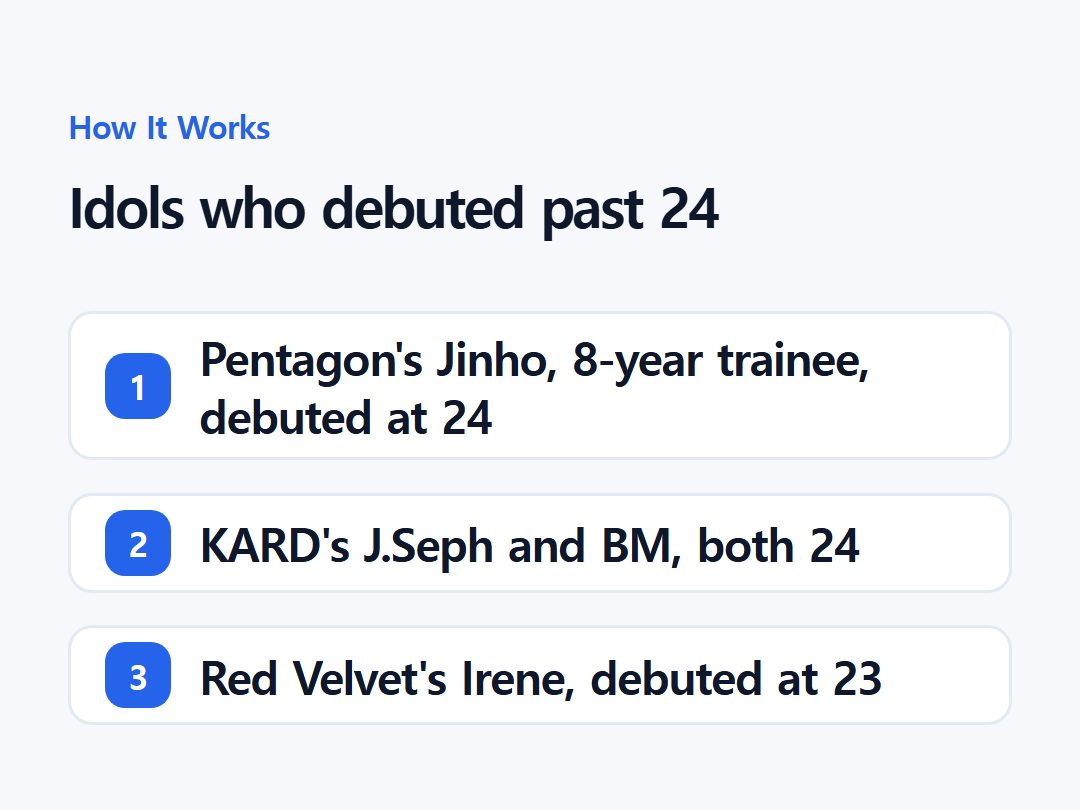
The threshold is a norm, not a rule, and plenty of working idols have crossed it. Pentagon's Jinho spent roughly eight years as a trainee — first at SM Entertainment, then at Cube Entertainment — before debuting in October 2016 at 24, a path Soompi covered when his move to Cube was first announced.
- KARD's J.Seph and BM both debuted at 24 in 2017, after four to five years as DSP Media trainees
- Red Velvet's Irene debuted at 23 in 2014, after five years of training at SM
- MAMAMOO's Solar debuted at 23 in 2014, having joined her agency at 20
None of these careers stalled because of age. What changed for them was the calculation agencies made going in — later recruits typically need a more finished skill set on day one, since there is less time to develop one in-house.
What agencies say when asked directly
Agencies rarely publish an explicit age cutoff, but their own audition calls function as one. For its 2026 global audition cycle, SM Entertainment's general call accepted applicants born between 2007 and 2015 — meaning entrants were no older than about 19. JYP Entertainment's 2026 cycle similarly targeted applicants born from 2006 to 2016.
Industry guides aimed at prospective trainees describe the practical "sweet spot" as 13 to 17, noting that applicants in their twenties are still eligible at most companies but are judged on finished skill rather than potential — the same trade-off that shapes every late debut on the list above.
Fewer recruits are willing to pay the price of starting early
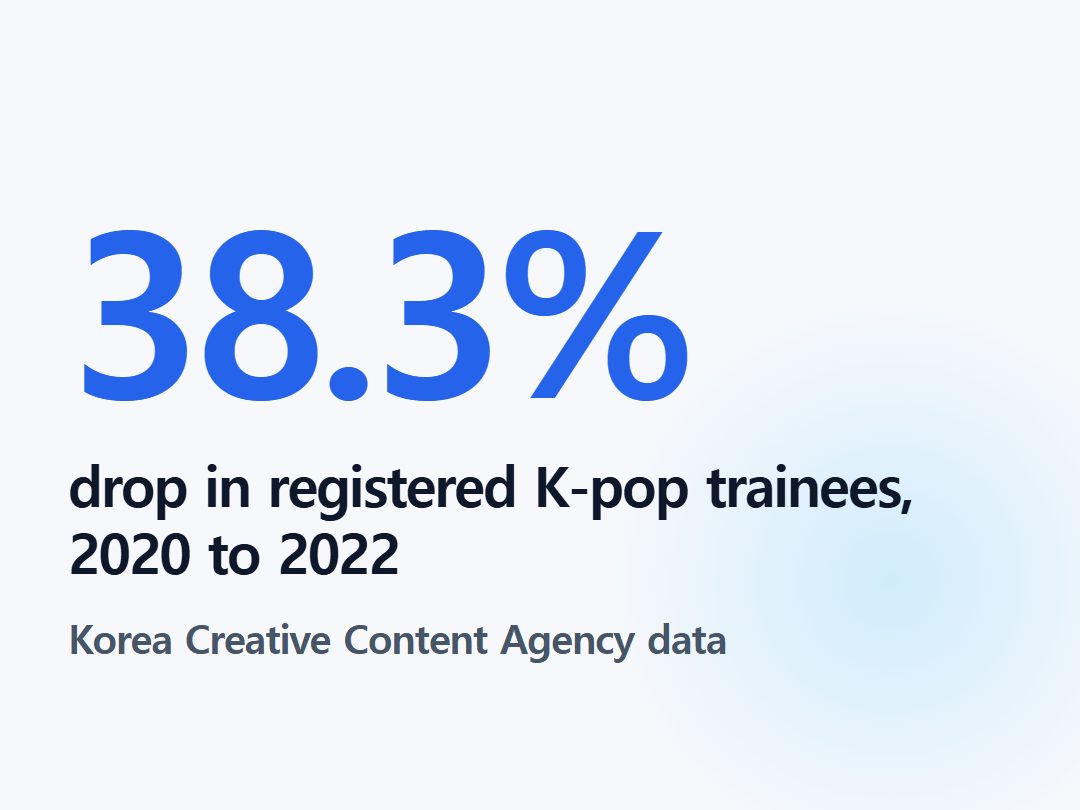
The system's own math is becoming harder to sustain. Korea Creative Content Agency figures reported by The Korea Times show the number of registered trainees fell from 1,895 in 2020 to 1,170 in 2022 — a 38.3% drop in two years, even as K-pop's global revenue kept climbing.
Two numbers explain why families are more hesitant to commit a child to years of training with no guaranteed debut:
- Voluntary trainee dropout rose to 34.4% by 2022
- The share of trainees who eventually debut fell from about 80% in 2016 to about 65% in 2022
The same reporting noted a growing tilt toward trainees from wealthier families, who can better absorb years of unpaid training with no guaranteed payoff — a dynamic that raises its own questions about who gets to attempt a debut at all, regardless of age.
What remains unresolved is whether the industry's answer to a shrinking, pickier trainee pool will be to relax the age math that created the 24-year-old cutoff in the first place, or to double down on recruiting even younger.
Idols who debuted at or after 23 — path and timing
| Idol | Debut Year | Age at Debut | Training Path |
|---|---|---|---|
| Kahi (After School) | 2009 | 29 | — |
| Park Bom (2NE1) | 2009 | 26 | — |
| Dara (2NE1) | 2009 | 25 | Built career in Philippines first |
| Jinho (Pentagon) | 2016 | 24 | ~8 years, trained at SM then Cube |
| J.Seph / BM (KARD) | 2017 | 24 | 4–5 years at DSP Media |
| Irene (Red Velvet) | 2014 | 23 | 5 years training at SM |
| Solar (MAMAMOO) | 2014 | 23 | Joined agency at 20 |
Frequently asked
Why do K-pop idols debut so young?
Agencies budget years of training and prefer signing trainees before adulthood, so the training window shrinks the older a recruit is.
Why can't K-pop idols avoid military service?
South Korean law requires able-bodied men to serve; even top idols like BTS's Jin only got a deferral to age 30, not an exemption.
How long do K-pop idol contracts last?
South Korea's Fair Trade Commission caps standard exclusive idol contracts at seven years, a limit set after TVXQ's 2009 lawsuit against SM Entertainment.
Sources
Every factual claim above is traceable. We do not translate articles — we gather facts from multiple outlets and write them ourselves.
- Why teen K-pop trainee numbers are dropping despite greater investment — The Korea Times
- Is the '7-year itch' a thing of the past? — The Korea Herald
- South Korea Allows K-Pop Artists To Defer Mandatory Military Service — NPR
- South Koreans become younger overnight after country scraps 'Korean age' — CNN
- Former SM the Ballad Member Jino To Debut In Cube's New Boy Group Pentagon — Soompi
- 13 K-Pop Idols Who Debuted At A Later Age Than Usual — Koreaboo