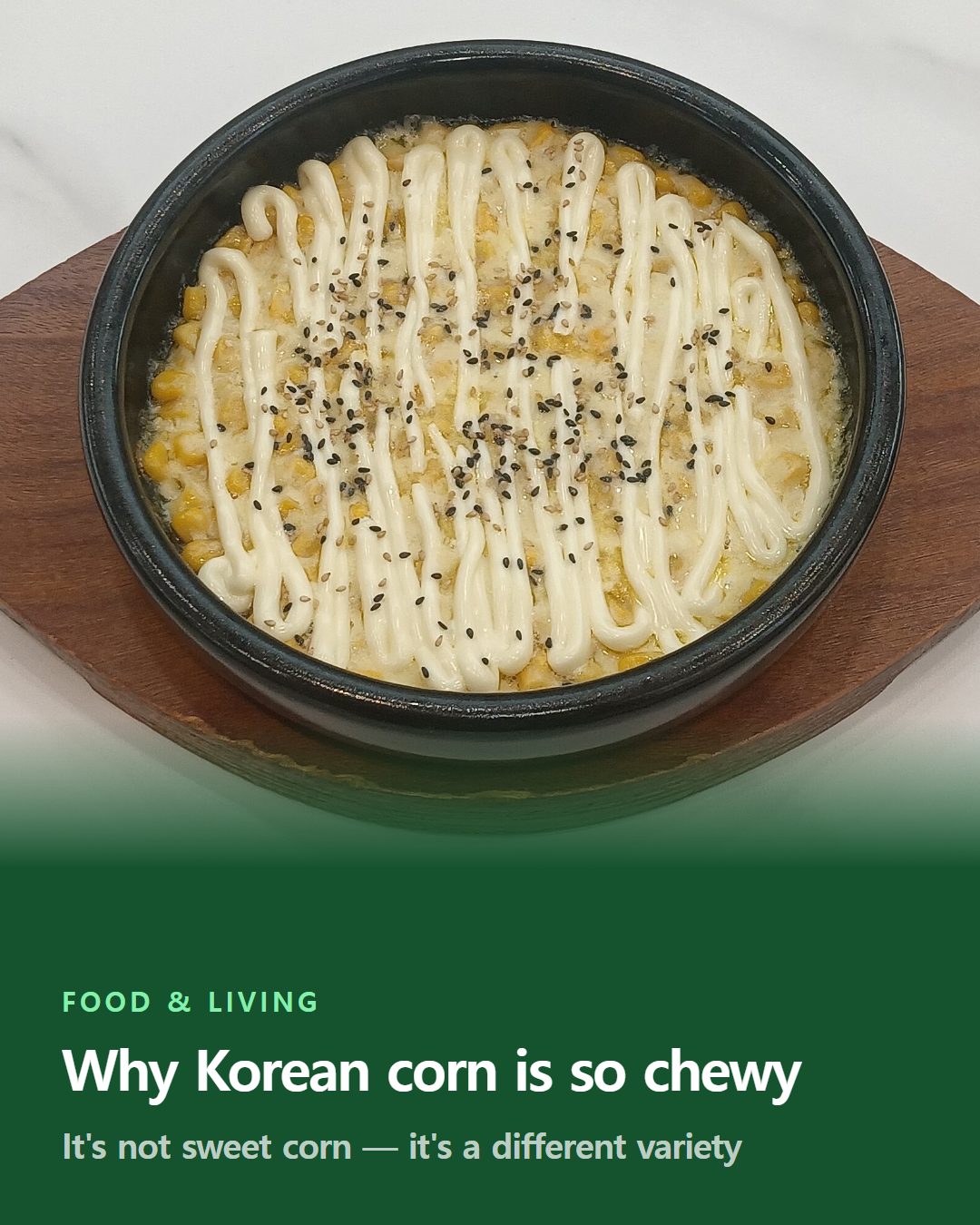
Walk through a Korean market, a highway rest stop, or a street stall in summer, and steamed corn is usually piled next to the barley tea and rice cakes. Bite in, and if you grew up on American or European corn, the texture is disorienting: dense, sticky, almost chewy like a rice cake rather than crisp and juicy.
The short version
- Korean corn is usually glutinous waxy corn, not unripe sweet corn.
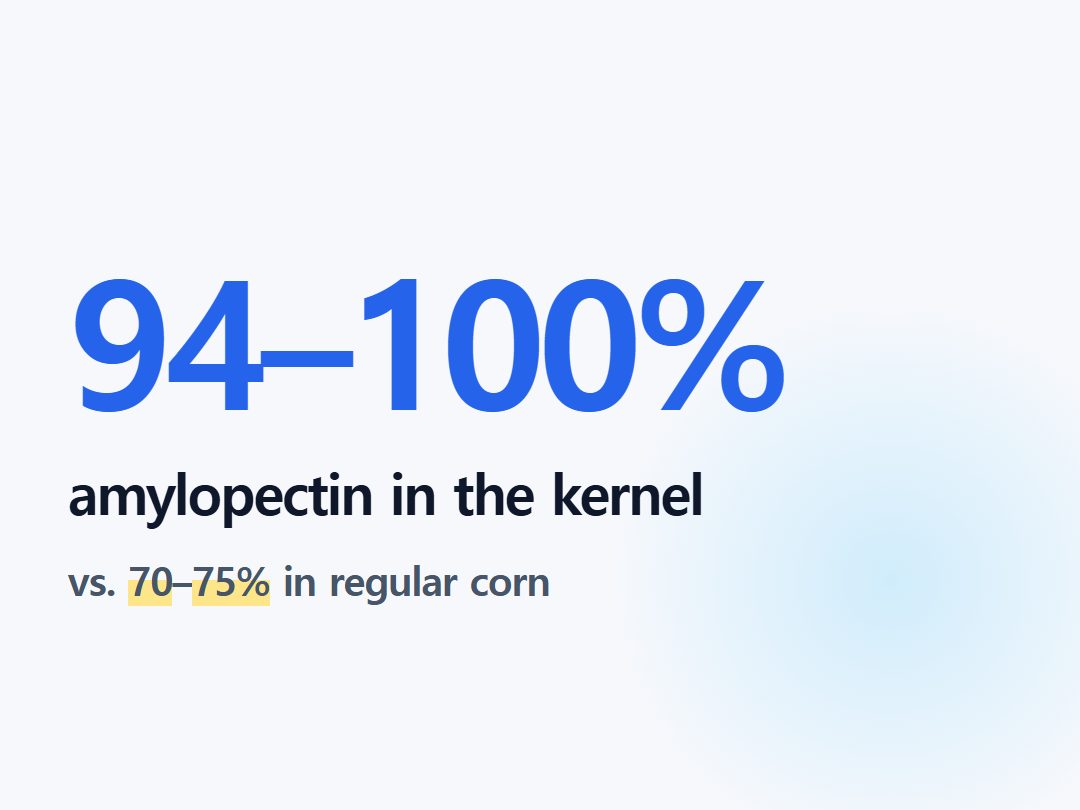
- A mutated gene makes kernels 94–100% amylopectin, causing the chewy texture.
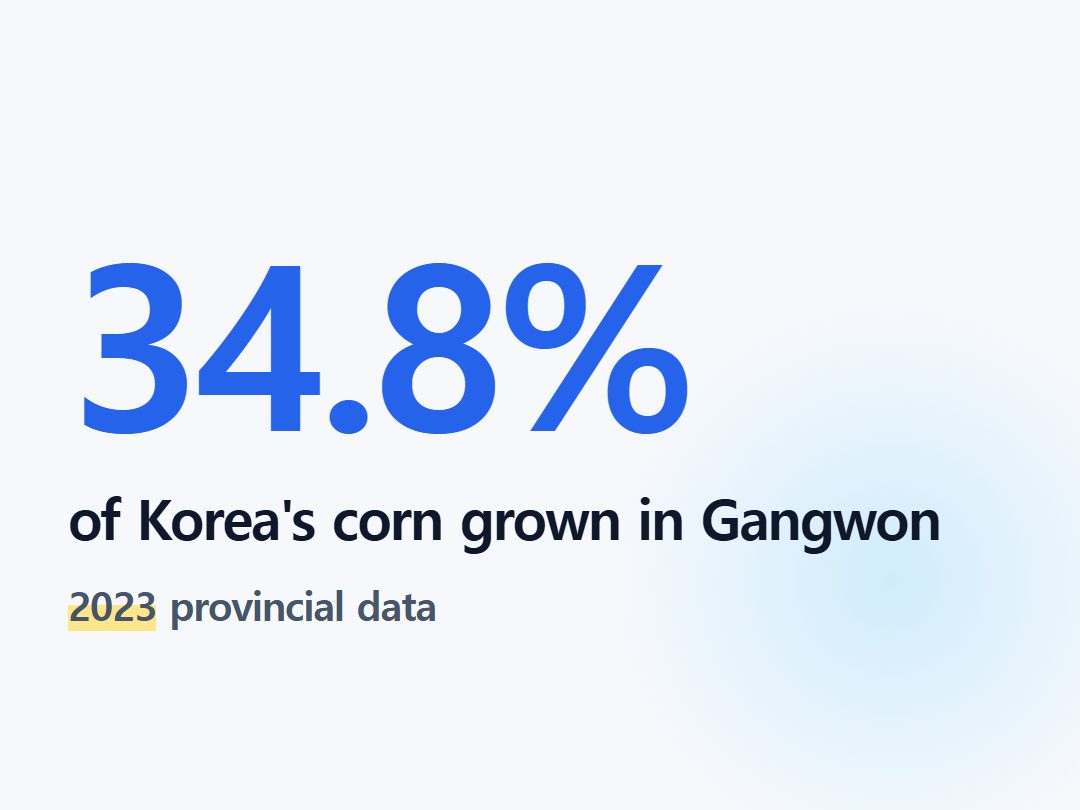
- Gangwon province grows about 34.8% of Korea's total corn.
That is not a bad batch. It is a different variety of corn entirely — one bred specifically for that texture, and eaten almost nowhere outside East Asia.
Korea's Everyday Corn Isn't the Corn Visitors Expect
The corn sold at most Korean markets is chal-oksusu (찰옥수수), literally "glutinous corn." In English it is usually called waxy corn, a name that describes the slightly translucent, waxy look of the cooked kernel, not any coating on it.
Botanically it is a distinct type, Zea mays var. ceratina, separate from the dent corn grown for feed and syrup, and separate from the sweet corn sold on the cob at farm stands in the West. In South Korea, waxy corn — not sweet corn — has long been the default.
The prefix chal- (찰) is not unique to corn. It marks "sticky" or "glutinous" across dozens of Korean food words going back to at least the 15th century, including chapssal (glutinous rice) and chaltteok (glutinous rice cake). Chal-oksusu simply applies that same old label to a New World crop after it arrived in Korea.
One Broken Gene Makes the Kernel Sticky
The chewiness has a specific biochemical cause. Corn starch is normally a mix of two molecules: amylose, which forms straight chains, and amylopectin, which is branched. Ordinary corn runs about 70–75% amylopectin.
Waxy corn's kernels run 94–100% amylopectin, with almost no amylose. That shift traces to a mutation in a single gene, called Wx, which normally produces an enzyme needed to build amylose inside the kernel. When the gene is disabled, the enzyme disappears, and the kernel fills almost entirely with the branched starch that also makes cooked rice cakes sticky.
The result eats closer to a corn-flavored rice cake than to standard sweet corn: dense and springy rather than crisp and watery.
Why Visitors Call It "the Wrong Corn"
This is the part international readers usually miss: Koreans are not eating an unripe or spoiled version of familiar corn. They are eating a variety bred for a completely different quality — texture, not sugar.
Forums for foreign residents in Korea repeat the same complaint: the corn tastes starchy or bland next to the sweet corn sold back home. To most Koreans, that reaction runs backwards. Sweet, watery corn is the less interesting version, and glutinous corn is closer to what corn is supposed to taste like.
Korean food culture already prizes this exact texture elsewhere — in glutinous rice, rice cakes, and glutinous barley bread. Chewy corn slots into an existing preference rather than standing out as unusual.
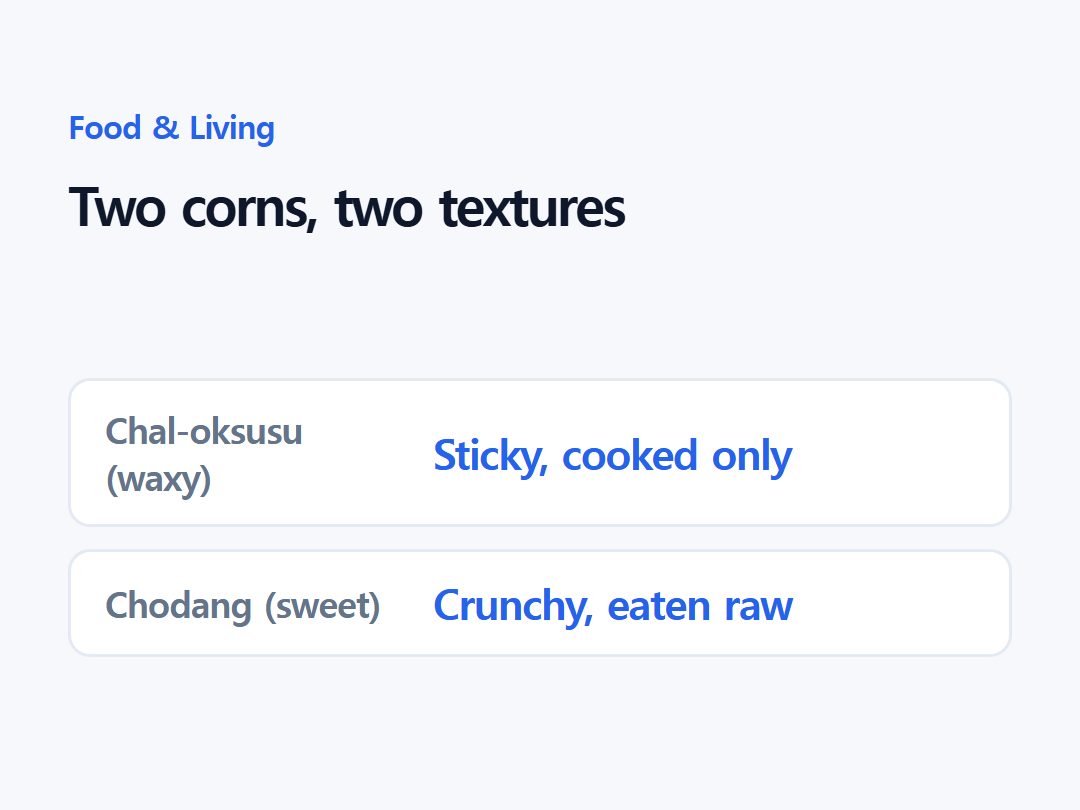
The kernels also cannot be eaten raw. Uncooked, they are filled with a milky, starchy liquid, so the corn is always sold pre-steamed or boiled, never fresh off the stalk like an apple.
Once cooked, waxy corn also shows up well beyond the corn-on-the-cob stall. Its starch is milled into corn rice, popped into a puffed snack called ppeong-twigi, dried for corn tea, and folded into corn ice cream — so a visitor can run into the same chewy variety several times without realizing it is one crop.
The Mutation Didn't Happen in the Americas
Corn itself originated in the Americas and reached Asia only after the Columbian Exchange. But waxy corn is not a New World trait — it does not exist in any indigenous American corn variety.
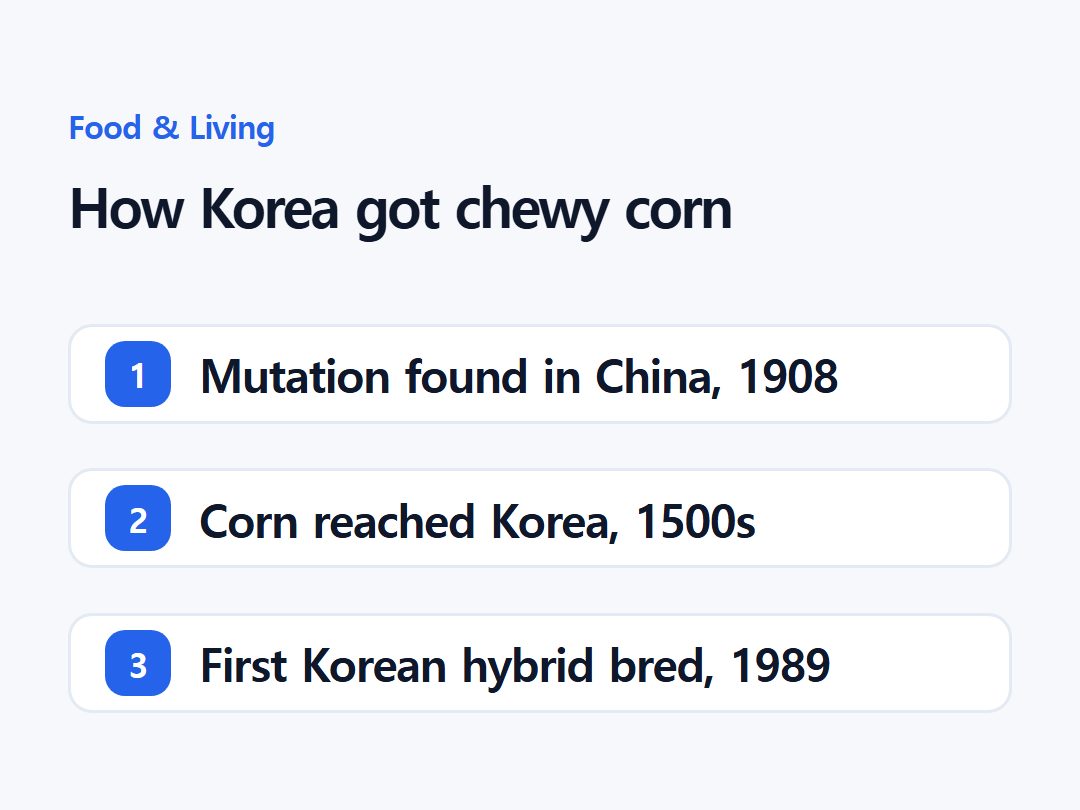
Genetic studies trace its origin to southwestern China, in the Yunnan–Guangxi region, where the mutation was first documented in cultivated corn in 1908. Researchers believe it appeared spontaneously in ordinary flint corn sometime after corn's arrival in Asia, then spread because farmers and cooks favored the resulting texture.
How the Trait Reached the Korean Peninsula
Corn is believed to have entered Korea in the mid-16th century, during the Joseon dynasty, carried along the same trade routes that brought it from the Americas through China. It took root especially in Korea's mountainous northern and central regions, where the climate suited it better than paddy rice.
Waxy corn's short cycle — about 85 to 110 days from planting to harvest — let farmers fit it in alongside other crops, which helped cement it as an everyday snack rather than a festival rarity.
Breeders Turned One Trait Into a Rainbow of Varieties
South Korea's modern waxy corn industry is the product of deliberate breeding, not accident. Systematic breeding programs began in the late 1980s, and the first domestically developed hybrid, Chalok 1, was released in 1989.
Since then, national and provincial research institutes, particularly in Gangwon province, have released dozens of hybrids selected for color, yield, and nutritional content. Today's kernels come in several distinct types:
- White (mibaek), the most widely grown
- Yellow (hwangchal), bred for higher carotenoid content
- Black or dark purple (heukchal), rich in anthocyanins
- Red-kernel hybrids bred more recently for antioxidant marketing
One purple hybrid developed by Gangwon's agricultural research institute, Cheongchunchal, measured 18,809 mg/kg of anthocyanin — far above older black varieties. It reflects a newer breeding focus on health claims rather than texture alone.
New releases keep arriving almost every year, but a handful of older workhorse hybrids still cover most fields. Farmers weigh flavor scores against yield and disease resistance before switching seed.
One Province Grows a Third of the Country's Corn
Gangwon, Korea's mountainous northeastern province, dominates domestic production. According to the provincial government's own 2023 figures, Gangwon farmed 5,393 hectares of corn, 34.8% of the national total, and produced 30,334 tons, or 32.9% of the country's output.
Hongcheon County, inside Gangwon, has built local identity around the crop with an annual Waxy Corn Festival that has run for decades. County tourism materials describe it as the only regional festival built around a single vegetable, where visitors eat freshly steamed ears at an urban forest park.
A Sweeter Rival Is Catching On
Waxy corn's dominance is no longer unchallenged. In the 1990s, breeders developed chodang oksusu ("super-sweet corn"), a genuinely sweet, crunchy variety that, unlike glutinous corn, can be eaten raw off the cob.
Chodang corn has grown rapidly in popularity and now competes with waxy corn at markets and even in corn rice, a dish that once used only the glutinous kind. For younger, more Western-influenced palates, it offers something closer to the sweet corn international readers already know.
What Isn't Settled Yet
How much ground sweet corn has actually taken from waxy corn nationally is not tracked in any single public dataset, and older heirloom varieties may be paying the price. The Slow Food Foundation lists Gangwon Yellow Corn, a traditional local waxy variety grown around Inje, as at risk of disappearing as farmers switch to higher-yield modern hybrids.
Whether Korea's newer high-anthocyanin and high-carotenoid waxy hybrids can find a market beyond domestic snacking, or whether chodang's raw-eating convenience eventually displaces the glutinous tradition, remains an open question for Korean agriculture.
Waxy corn kernel types and their traits
| Type | Korean name | Distinguishing trait |
|---|---|---|
| White | mibaek | Most widely grown |
| Yellow | hwangchal | Bred for higher carotenoid content |
| Black / dark purple | heukchal | Rich in anthocyanins |
| Red | — | Bred more recently for antioxidant marketing |
Frequently asked
Why is Korean corn chewy instead of sweet?
Most Korean corn is chal-oksusu (waxy corn), a variety whose kernels run 94–100% amylopectin because of a mutated Wx gene, giving it a dense, sticky texture instead of the crisp sweetness of American sweet corn.
Can you eat Korean waxy corn raw?
No — raw kernels are filled with a milky, starchy liquid, so waxy corn is always sold pre-steamed or boiled, never eaten fresh off the stalk.
Where is most of Korea's corn grown?
Gangwon province dominates domestic production, farming 34.8% of the national corn area and producing 32.9% of the country's output as of 2023.
Sources
Every factual claim above is traceable. We do not translate articles — we gather facts from multiple outlets and write them ourselves.
- Waxy corn — Wikipedia
- Genetic Diversity and Molecular Evolution of Chinese Waxy Maize Germplasm — PLOS ONE
- 'Hwanggeummatchal', a Single Cross Hybrid Waxy Corn with High Carotenoid Content and Good Eating Quality — Korean Journal of Breeding Science
- Anthocyanin-rich Purple Waxy Corn Single Cross Hybrid 'Cheongchunchal' — Korean Journal of Breeding Science
- Gangwon Yellow Corn — Slow Food Foundation, Ark of Taste
- 옥수수 생산 (Corn Production Statistics) — Gangwon Special Self-Governing Province
- Hongcheon Waxy Corn Festival — Hongcheon County (official)
- 찰- — Wiktionary


