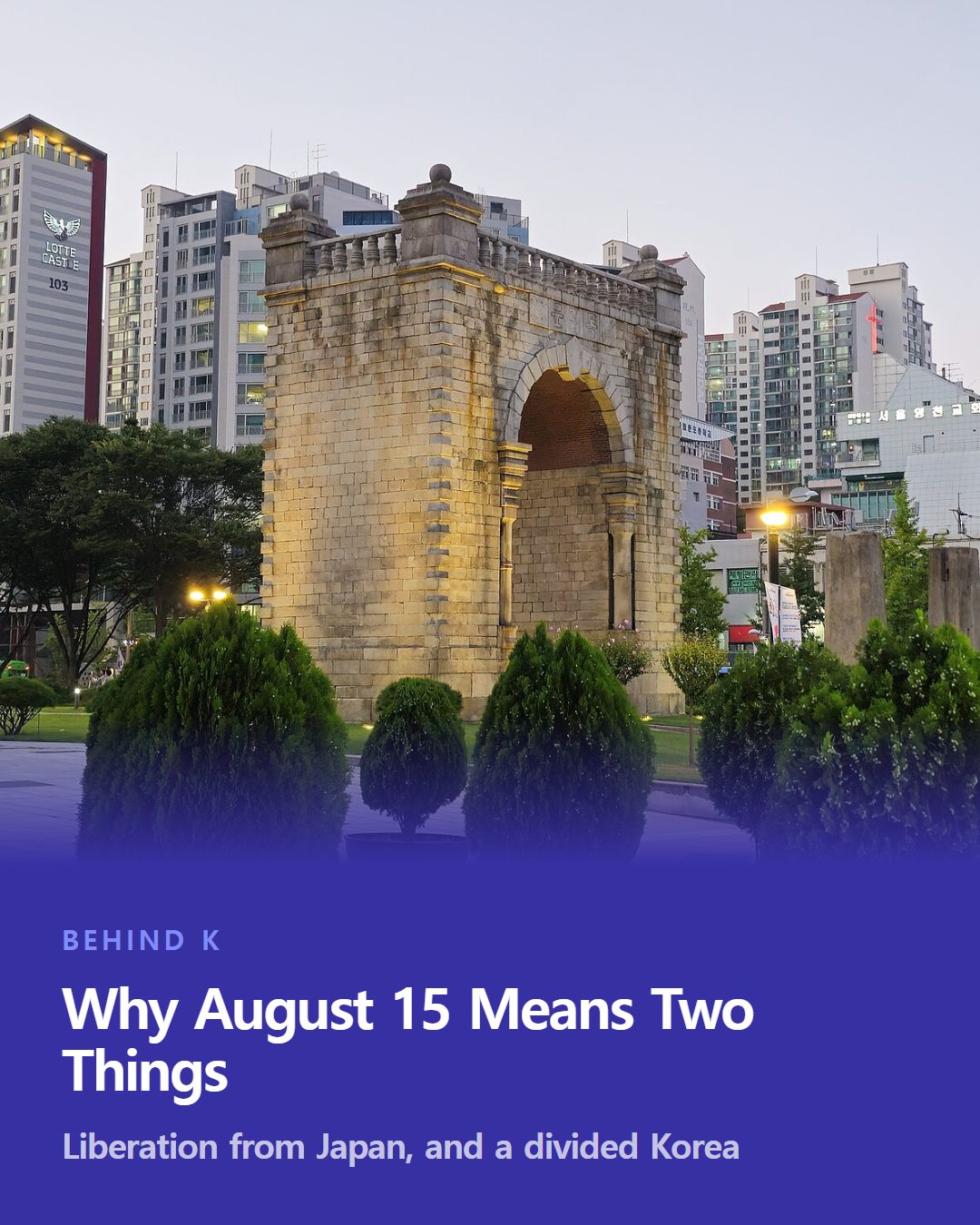
Every August 15, Taegeukgi flags cover apartment balconies, streetlights, and car windows across South Korea in a density seen no other day of the year. The holiday is Gwangbokjeol, and in 2026 it marks the 81st anniversary of the event it commemorates.
The short version
- August 15 marks both Japan's 1945 surrender and Korea's 1948 founding.
- Koreans still debate whether the nation began in 1919 or 1948.
- Comfort women and Sado mine disputes with Japan remain unresolved today.
To an outside observer it can look like a straightforward independence day, Korea's answer to the Fourth of July. It is not that simple. The same date carries two separate historical anniversaries, feeds an ongoing political argument about a third, and remains tangled in disputes with Japan that made headlines again in 2026.
A name that means "the light's return," not independence
Gwangbokjeol (광복절) combines three characters: gwang (light), bok (return), and jeol (holiday). Together they describe light returning to a nation, not a nation being created.
The word choice is deliberate. Korean uses "restoration" rather than "independence" because the premise is that sovereignty was taken back, not invented for the first time — Korea existed as a unified kingdom for centuries before Japan's 1910 annexation.
One date, two founding moments: 1945 and 1948
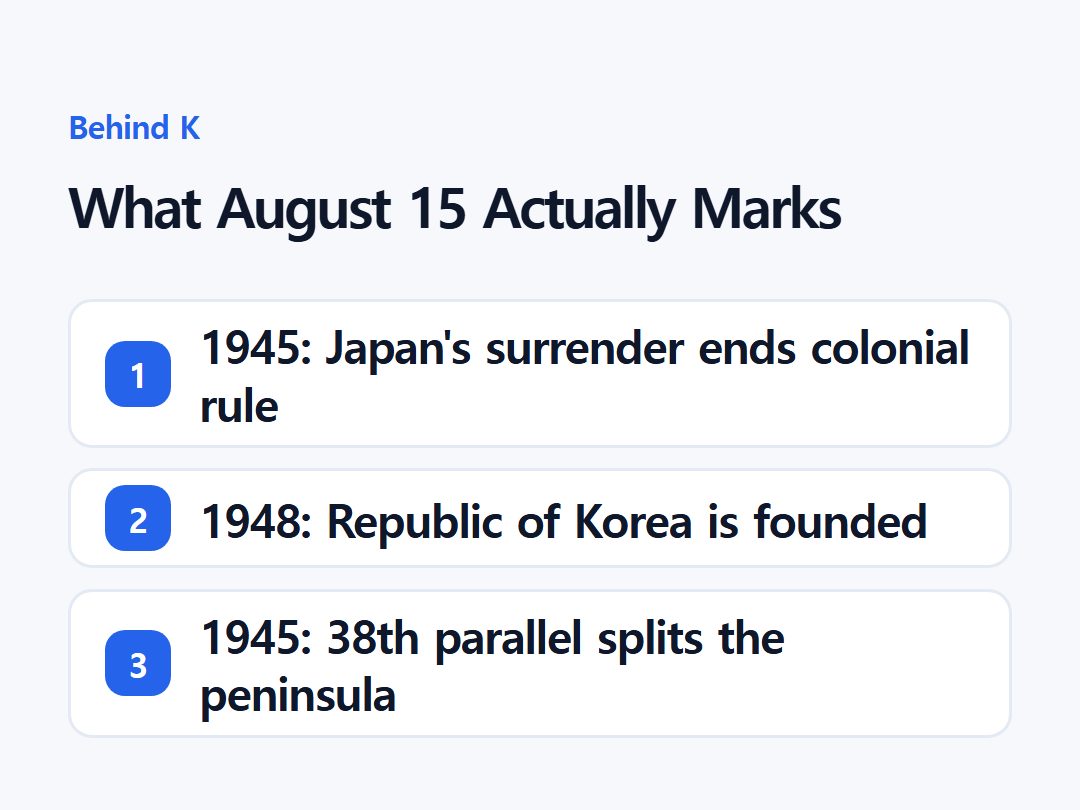
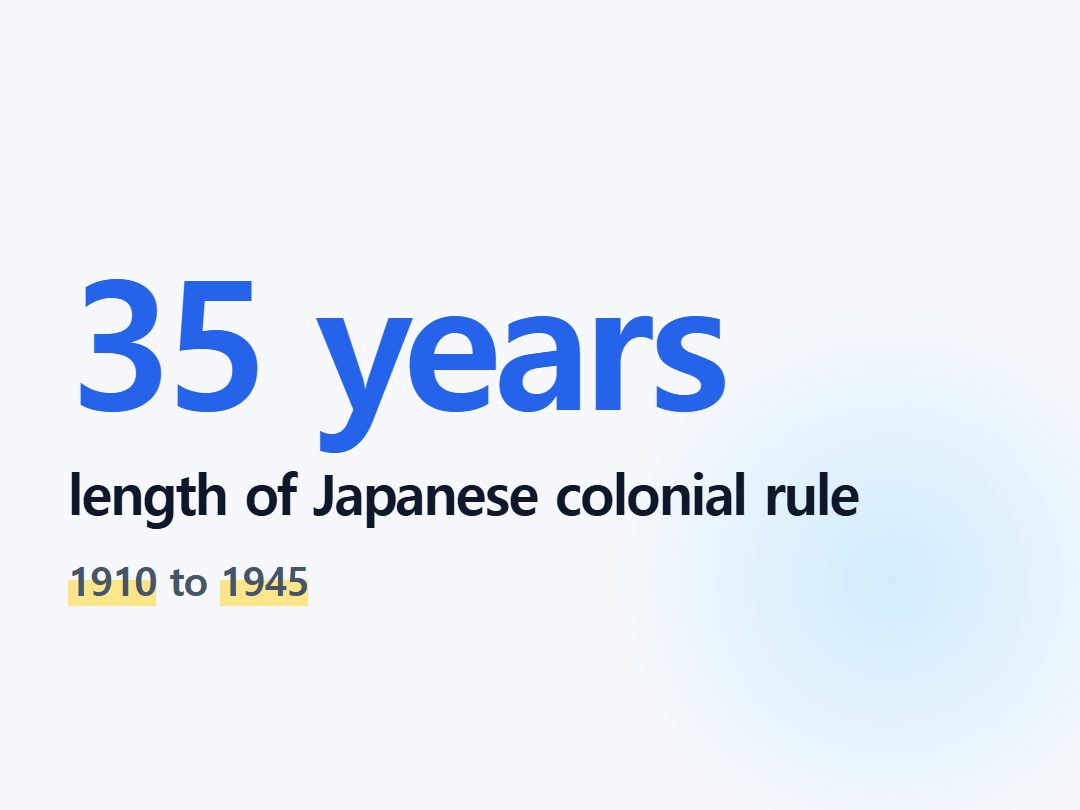
On August 15, 1945, Japan announced its surrender to the Allied powers, ending World War II and 35 years of Japanese colonial rule over the Korean Peninsula.
Exactly three years later, on August 15, 1948, the Republic of Korea was formally established as a state, with Syngman Rhee inaugurated as its first president. The date was chosen deliberately, to fuse liberation and statehood into one anniversary.
That double meaning is why the holiday sits somewhere between an independence day and a founding day — and why Korea's national holiday, unlike most countries', doesn't map onto a single event.
Thirty-five years of colonial rule that explain the emotion
Japan's 1910-1945 administration went beyond political control. Korean public memory returns to three specific practices every year:
- Korean-language instruction was restricted in schools in favor of Japanese
- Koreans were conscripted into forced labor at mines and factories, including Japan's Sado gold mine
- Tens of thousands of Korean women were forced into Japan's wartime "comfort women" system of sexual slavery
None of these are closed chapters in the sense of being settled. As later sections show, at least two remain active diplomatic disputes between Seoul and Tokyo, eight decades on.
The 1919 uprising that Liberation Day quietly honors
Liberation Day's backstory starts 26 years earlier. On March 1, 1919, thirty-three Korean religious and cultural leaders read a declaration of independence in Seoul, triggering nationwide demonstrations that Korean history calls the March First Movement.
Japanese colonial police answered with a violent crackdown. Korean history remembers it as the largest anti-colonial demonstration in the country's history, with participation estimated in the hundreds of thousands.
The movement failed to win independence, but it produced the Provisional Government of the Republic of Korea, a government-in-exile founded in Shanghai on April 11, 1919. That government operated in exile — later relocating to Chongqing — until Japan's surrender in 1945, and its constitutional legitimacy was later written into South Korea's own 1948 and 1988 constitutions.
Why Koreans still argue about when the country was actually founded
The Shanghai government's legacy feeds a live political dispute: was Korea "founded" in 1919, when the provisional government declared a republic, or in 1948, when the internationally recognized government took office?
The split runs along ideological lines. Progressive politicians and historians favor 1919, arguing the provisional government's diplomatic and military activity against Japan is the direct ancestor of today's state. Conservative historians, including a group known as the New Right, favor 1948, when the first constitutionally elected government took power.
The debate resurfaces almost every August. In 2024, Daegu's mayor publicly reversed his own long-held position to side with 1919 — a sign of how unsettled the question remains even among conservative politicians.
How three weeks of liberation turned into 80 years of division
When Japan surrendered, Korea was still a single, undivided territory, and it celebrated as one. The unity didn't last three weeks.
In early September 1945, U.S. Supreme Allied Commander Douglas MacArthur announced the peninsula would split at the 38th parallel, with Soviet forces accepting Japan's surrender in the north and American forces in the south. It was presented as a temporary line for processing the surrender.
It never stayed temporary. Talks between the American and Soviet military governments on unified elections collapsed, and each side backed separate governments — culminating in the two rival states proclaimed in 1948, and the Korean War two years after that.
The one holiday both Koreas keep — under different names
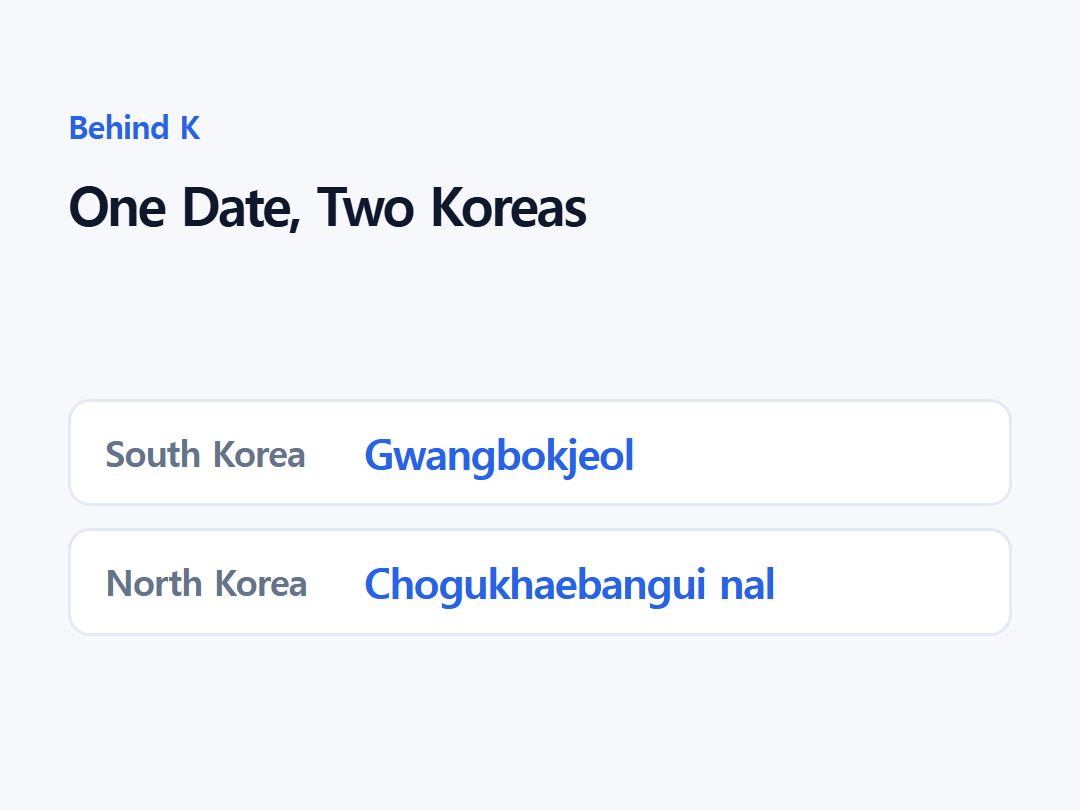
August 15 is one of the only dates on the calendar that North and South Korea both observe as a national holiday, though even here they disagree.
| Country | Holiday name | Central narrative |
|---|---|---|
| South Korea | Gwangbokjeol (return of light) | Restored sovereignty and the 1919 independence movement |
| North Korea | Chogukhaebangui nal (liberation of the fatherland) | The Soviet Union and founding leader Kim Il-sung's role |
North Korea's version credits the Soviet Union and Kim Il-sung with liberating the country, largely omitting the independence movement's own decades of activity. South Korea's narrative centers instead on the 1919 uprising and the provisional government's resistance.
Flags, pardons, and fireworks: what August 15 looks like now
Modern observance centers on the Taegeukgi. South Korea's interior ministry runs an annual campaign encouraging households to display the flag, offering window stickers for apartment residents without traditional brackets and distributing branded merchandise to reinforce the habit.
A second, older tradition is the Gwangbokjeol special pardon (광복절특사), in which the president uses constitutional clemency power to grant amnesty around the holiday. The custom is familiar enough that it inspired a 2002 comedy film, Jail Breakers, about escaped convicts who didn't know a pardon was already coming.
In 2025, President Lee Jae-myung granted his first such pardon, covering roughly 836,000 people convicted mostly of public-order offenses, including former justice minister Cho Kuk. No comparable pardon was issued for 2026 — a large-scale amnesty needs months of cabinet review that hadn't concluded in time.
The day's official events follow a set pattern:
- A state ceremony, usually at the Independence Hall of Korea in Cheonan or Seoul's Sejong Center
- A presidential address that typically addresses relations with Japan
- Evening fireworks and concerts in major cities, especially along Seoul's Han River
Why Seoul and Tokyo are still negotiating this day's meaning
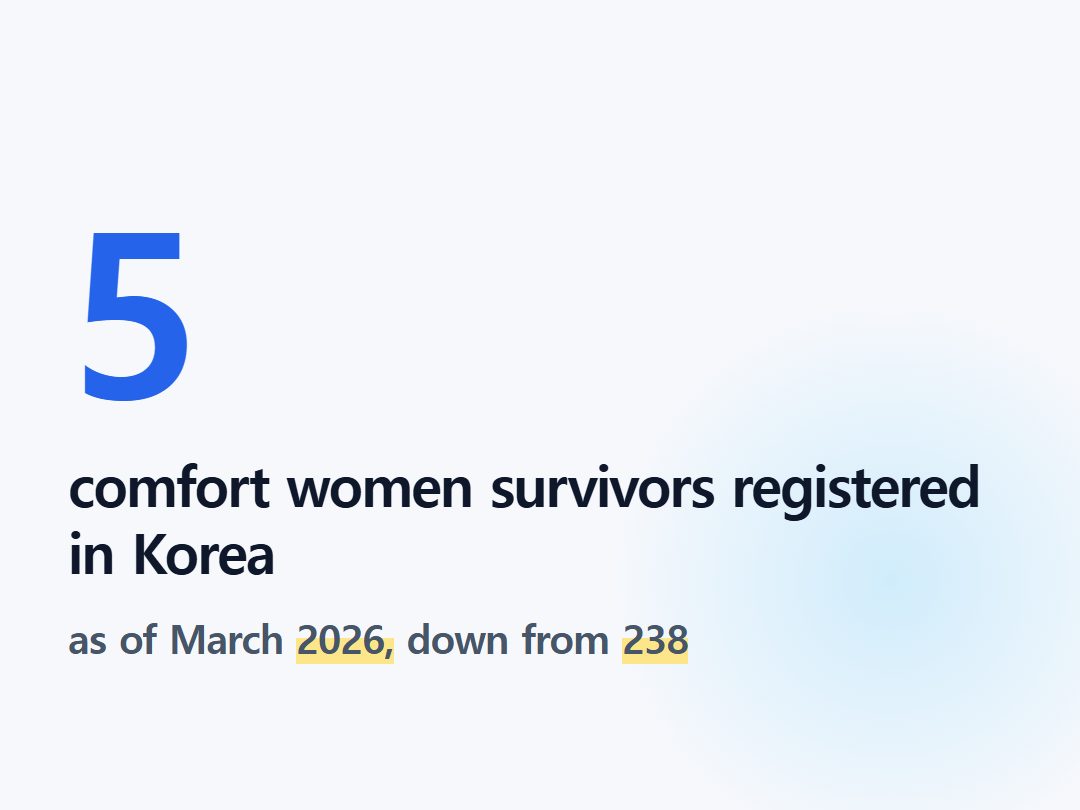
Liberation Day's unfinished business shows up in two ongoing disputes. The first concerns the comfort women system: as of March 2026, only five survivors remained on South Korea's official registry, down from 238 women who originally came forward.
UN human rights experts said in March 2026 that survivors "continue to face the denial of their right to truth, justice, reparation and memorialisation," and singled out the 2015 Japan-Korea agreement on the issue as having failed to deliver survivor-centered outcomes.
That 2015 agreement was meant to resolve the dispute with a Japanese apology and a fund for survivors, but many of the women it was meant to help rejected its terms from the start. A decade later, the UN statement suggests the diplomatic settlement and the survivors' own sense of justice were never the same thing.
The second dispute involves Japan's Sado gold mine, added to UNESCO's World Heritage list in 2024 after Tokyo pledged to fully document the forced labor of more than 1,500 Koreans there during the war. A 2026 UNESCO committee review found Japan's on-site exhibits still don't reflect that history adequately.
South Korean officials boycotted a 2024 Japanese memorial ceremony at the mine over the same complaint, holding a separate ceremony of their own the following day instead.
None of this has stopped diplomatic engagement. In his 2026 Liberation Day address, President Lee called for "future-oriented" ties with Japan, citing a year of expanded cooperation on supply chains and energy.
He also cautioned that those gains "would not endure without firm trust between the two countries." That line captures where Liberation Day sits today: a holiday built on a settled fact of history, still negotiating what comes after it.
Gwangbokjeol vs. North Korea's Liberation Day
| Country | Holiday Name | Central Narrative |
|---|---|---|
| South Korea | Gwangbokjeol (return of light) | Restored sovereignty and the 1919 independence movement |
| North Korea | Chogukhaebangui nal (liberation of the fatherland) | The Soviet Union and founding leader Kim Il-sung's role |
Frequently asked
What does Gwangbokjeol mean?
Gwangbokjeol means 'the light's return,' reflecting the idea that Korea's 1945 liberation restored sovereignty rather than created a new nation.
Why do North and South Korea celebrate Liberation Day differently?
South Korea calls it Gwangbokjeol and centers its narrative on the 1919 independence movement, while North Korea calls it Chogukhaebangui nal and credits the Soviet Union and Kim Il-sung.
Was Korea founded in 1919 or 1948?
Progressives favor 1919, when the provisional government declared a republic in Shanghai, while conservatives favor 1948, when the first constitutionally elected government took power.
Sources
Every factual claim above is traceable. We do not translate articles — we gather facts from multiple outlets and write them ourselves.
- Gwangbokjeol — Asia Society
- A Peninsula Is Liberated, a Nation Is Born: The Making of the Republic of Korea — Gwangju News
- 1919 vs 1948: Controversy rekindled over Korea's founding year — The Korea Times
- March First Movement — Britannica
- Provisional Government of the Republic of Korea — Wikipedia
- Another victim of Japan's wartime sexual slavery dies; 5 survivors left — The Korea Times
- Justice, truth and reparations long overdue for survivors of so-called 'comfort women' system: UN experts — OHCHR
- UNESCO review finds Japan's Sado mines follow-up still falls short — The Korea Times
- Japan's Sado gold mine gains UNESCO status after Tokyo pledges to exhibit dark WWII history — NBC News
- S. Korea's Lee Seeks Future-Oriented Ties with Japan — Nippon.com
- To honor Liberation Day, Korea brings its flag to everyday life — The Korea Times
- Ex-justice minister Cho Kuk freed in Lee's Liberation Day pardon — Aju Press
- No special pardon expected for Liberation Day next week — Aju Press