In Korean romance dramas, one image recurs so often that fans stopped counting: a man crouches down, a woman climbs onto his back, and he carries her — usually at night, usually because she is too drunk or too exhausted to walk.
The scene is called 업어주기 (eop-eo-juki), literally "to carry someone on your back." It shows up in decades of hit dramas, across genres, and it is not a coincidence.
It is a piece of visual grammar with a specific job: to let two characters touch, fully and at length, without either of them having to say what the touch means.
The short version
- The piggyback trope lets K-drama leads touch without confessing feelings out loud.
- Broadcast content rules keep passionate kissing rare, so bodies do the talking instead.
- Streaming's looser rules may turn the piggyback into a nostalgic wink, not a workaround.
The trope is common enough that in 2024 a hit drama turned it into its own title.
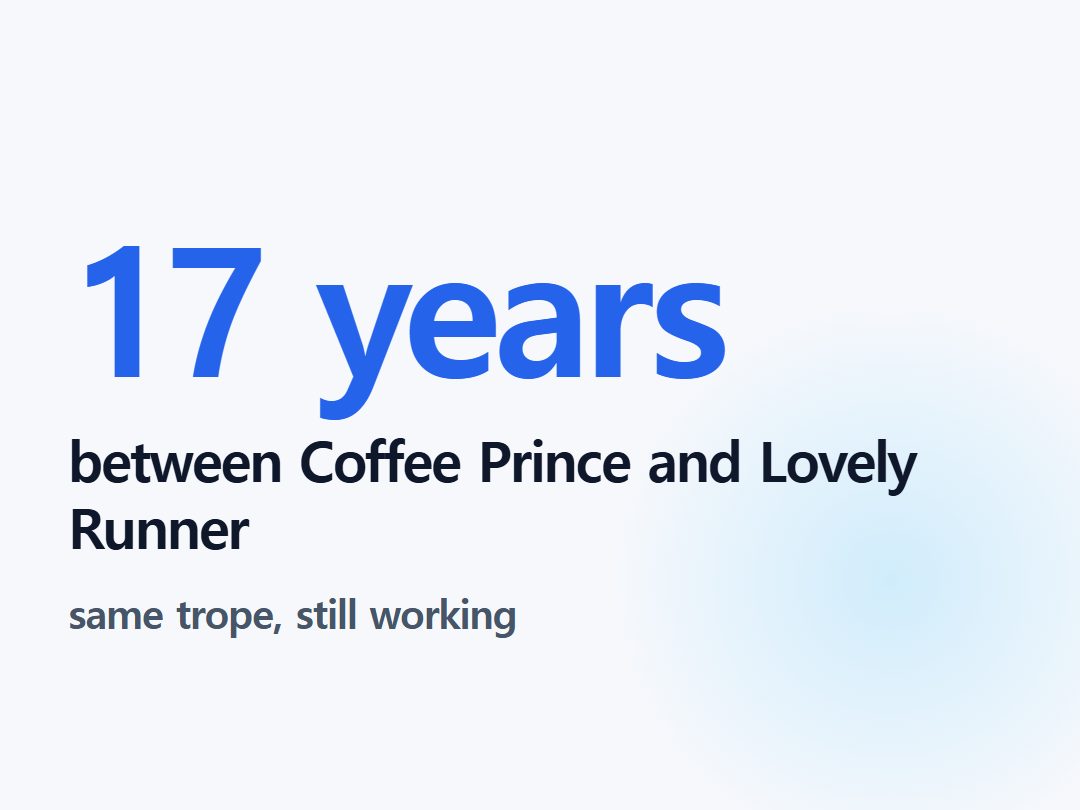
The Korean name of Lovely Runner is 선재 업고 튀어 (Seonjae eopgo twieo), which translates literally to "run away with Sun-jae on your back." The piggyback is not a scene in that show — it is the premise, spelled out for Korean audiences before a single episode aired.
That a production team could use the trope as shorthand marketing, confident viewers would immediately know what kind of story they were signing up for, says something about how deeply the gesture is embedded in the genre.
Why is the piggyback coded as rescue, not romance?
To understand why the piggyback carries so much weight, you have to understand skinship — a term borrowed into Korean (via Japanese English) to describe physical affection between people who care about each other, from hand-holding to hugs.
In everyday Korean-pop-culture writing, "how much skinship" a drama allows has become shorthand for how physically expressive its romance is permitted to be. And for most of Korean television's history, the answer has been: not much, not quickly, and not without a reason.
Korean terrestrial broadcasters have long operated under content standards enforced by the Korea Communications Standards Commission (KCSC), the government-linked body that rates programs and can penalize stations for content it judges inappropriate for the assigned age rating.
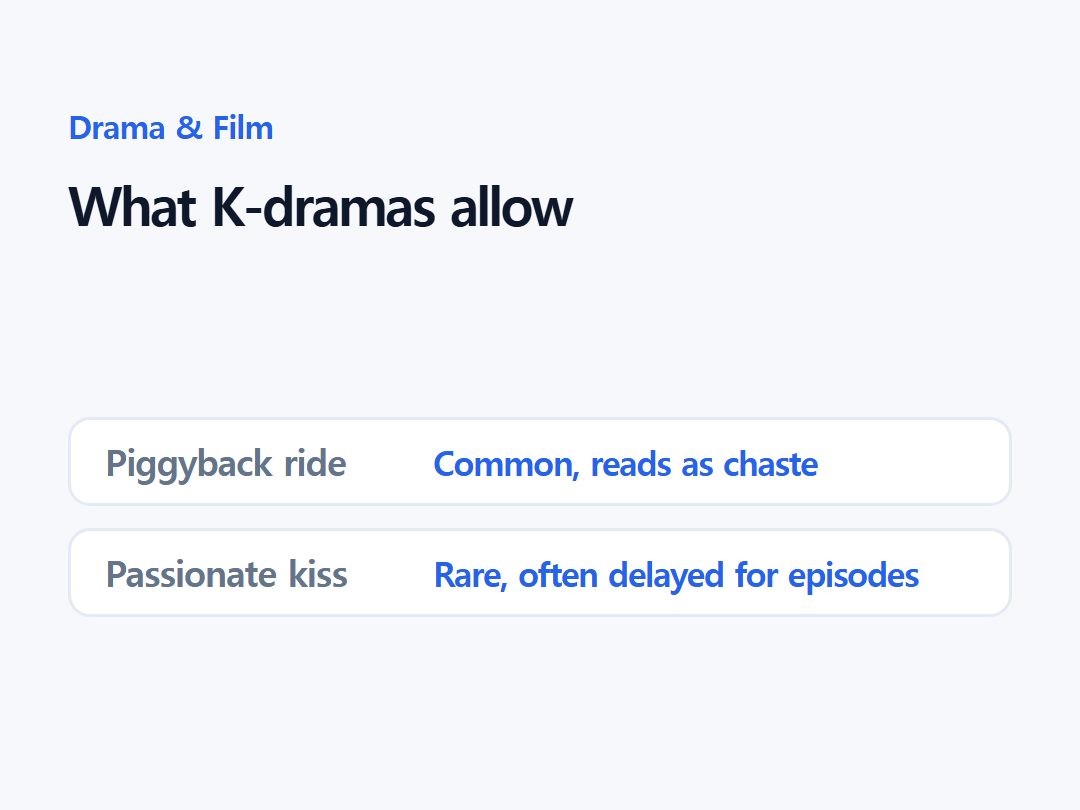
Most primetime romance dramas are made to sit comfortably within general-audience ratings, which keeps passionate kissing rare and usually delayed for many episodes, and keeps anything more explicit off the table entirely.
Hand-holding is not a throwaway gesture in this system — it is frequently staged as a plot milestone, the kind of moment recap writers dedicate entire posts to.
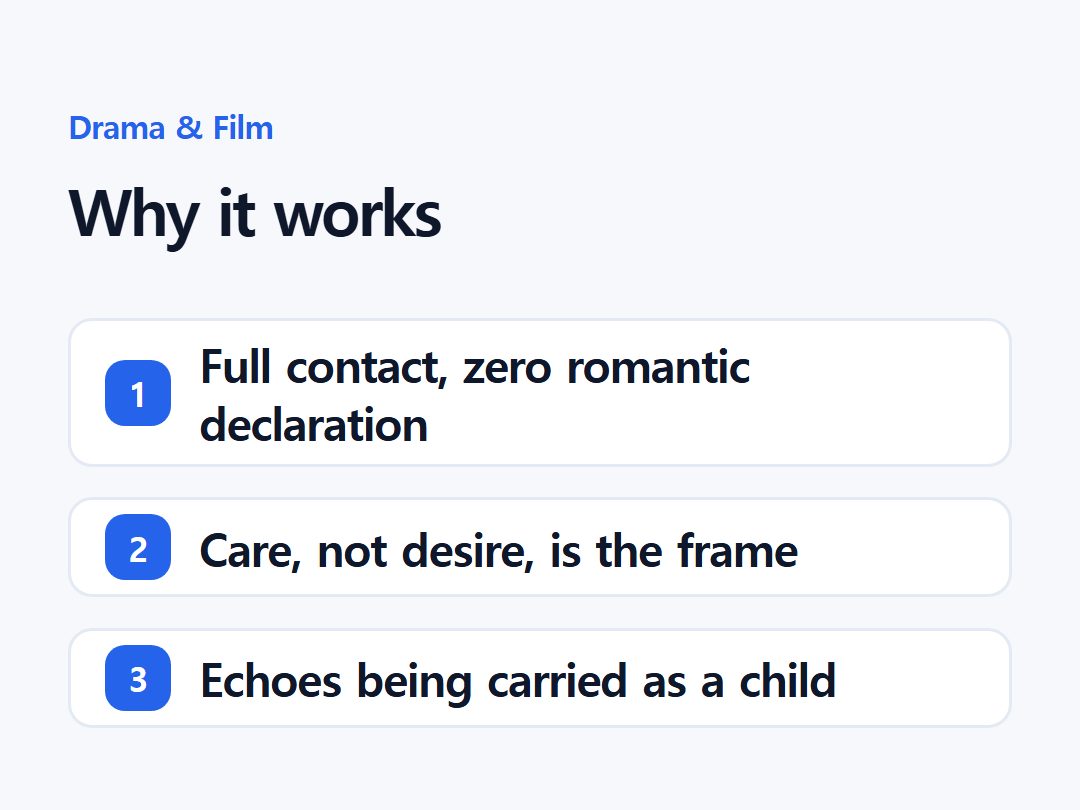
This is where the piggyback does its work. Physically, it is one of the most intimate things two characters can do on screen: full torso contact, arms locked around a neck, legs held at the waist, sustained for the length of a walk rather than the second or two of a hug.
But narratively, it is coded as rescue, not romance. The lead is not confessing feelings — he is getting a drunk or exhausted friend home safely. That framing gives both characters, and the audience, deniability. Nobody has crossed a line, because nobody meant anything by it. The scene lets bodies do what words in a slow-burn K-drama are not yet allowed to do.
That deniability is compounded by an older association: being carried on someone's back is, for most Korean viewers, first a childhood memory — a parent giving a piggyback ride, an older sibling carrying a tired younger one home.
Writers and fans alike point to this echo as part of why the gesture reads as tender rather than charged even as it is filmed with unmistakable intimacy; it borrows the safety of a familial gesture and repurposes it for romantic tension.
The trope also sits inside a wider vocabulary of age-inflected care in Korean relationships. Oppa — originally what a younger woman calls an older brother — has become a common, affectionate term for a boyfriend, carrying an expectation that the older or stronger partner takes a protective, leading role.
The piggyback literalizes that expectation: one person becomes, briefly, the other's support in the most physical sense possible. The reverse dynamic exists too.
In the drama Yumi's Cells, the shift from an ordinary honorific to the intimate noona (used by a younger man for an older woman) is itself staged as a heart-racing moment — evidence that in K-drama grammar, small linguistic and physical gestures are asked to carry the emotional load that dialogue is not.
None of this happens in a culture that treats dating casually.
Korean dating norms have historically kept public affection understated — hand-holding is normal, but overt physical intimacy in public is not — and relationship milestones such as meeting a partner's family are typically reserved for serious, marriage-track relationships rather than early dating.
Against that backdrop, a scripted moment of full-body contact that can still be described afterward as "nothing happened" is not a loophole so much as a release valve built into the system.
How Coffee Prince's twist became a genre staple
Fans and recap sites regularly trace the trope's modern popularity back to Coffee Prince (2007), and the most cited example there is a deliberate twist on the formula.
Because the female lead, Eun-chan, spends much of the show disguised as a man, it is she who piggybacks the male lead, Han-kyul, home after he gets drunk — a reversal of the usual gender roles that recap writers still point to as one of the drama's more memorable choices.
Later in the same series, once the truth about Eun-chan's gender is out, the dynamic flips back: he carries her, and the gesture is read very differently the second time, precisely because the audience now understands it as wanting rather than merely helping.
Through the following decade, the device turns up across otherwise unrelated shows and settings: a sleepy lead carried home in Pasta, a drunk confession delivered mid-piggyback in You're Beautiful, and further variations in Heartstrings, the historical drama Hwarang, Love Forecast, and Tempted.
The spread across modern-day office romances, campus dramas, and period pieces set centuries apart is itself telling: this is not one writer's signature move, but a shared convention that Korean drama writers reach for as a known, trusted tool — a way to signal a turning point in a relationship without having to write the confession scene yet.
The trope's visibility has also travelled well beyond Korea.
English-language fan wikis such as TV Tropes and Tropedia catalog it under names like "Piggyback Cute," and international recap and culture sites have written about it as a recognizable K-drama signature for well over a decade — evidence that overseas audiences noticed the pattern long before most of them understood the broadcast and social norms that produced it.
Is streaming making the piggyback trope obsolete?
What is less settled is whether the trope survives the platform shift now reshaping Korean television.
As more romance series move to streaming, where KCSC-style terrestrial ratings apply less strictly and writers have more room for direct physical and verbal intimacy, the piggyback's core function — a maximum-intimacy, minimum-risk workaround — becomes less necessary.
Some newer shows already lean into faster, more explicit skinship, which raises the question of whether the piggyback ride stays a sincere convention or increasingly turns into a knowing, nostalgic reference to an older style of drama.
Not every viewer is charmed by it in the first place. Recap and listicle writers regularly include the piggyback among tropes they find repetitive or implausible, joking about whether the average K-drama lead's back could really survive the workout.
Whether the next generation of writers keeps reaching for it, retires it, or plays it for irony — as Lovely Runner arguably already did by putting it in the title — is the open question for a device that has outlasted almost every other K-drama cliché of the past two decades.
The piggyback scene across K-drama history
| Drama | How the piggyback plays out |
|---|---|
| Coffee Prince (2007) | Eun-chan, disguised as a man, piggybacks a drunk Han-kyul — a reversal of the usual gender roles |
| Pasta | A sleepy lead is carried home |
| You're Beautiful | A drunk confession is delivered mid-piggyback |
| Lovely Runner (2024) | The Korean title translates to "run away with Sun-jae on your back" — the piggyback is the show's premise |
Frequently asked
Why do K-drama couples always piggyback?
Because it's coded as a rescue rather than romance, it lets two characters have sustained full-body contact without either one admitting their feelings — a way around strict broadcast content rules on kissing and intimacy.
What does 업어주기 (eopeojuki) mean?
It's the Korean term for the piggyback-carry scene, literally 'to carry someone on your back,' usually shown at night when one character is too drunk or exhausted to walk.
What drama started the K-drama piggyback trope?
Fans and recap sites trace its modern popularity to 2007's Coffee Prince, where the disguised female lead piggybacks the drunk male lead home, then the gesture is reversed later once her gender is revealed.
Sources
Every factual claim above is traceable. We do not translate articles — we gather facts from multiple outlets and write them ourselves.
- Pop Culture: Piggyback Rides — Dramabeans
- Piggyback Cute — TV Tropes
- Piggyback Cute — Tropedia
- From piggybacks to head pats: 9 K-drama tropes that make us roll our eyes — Rappler
- Skinship secrets: ways K-dramas portray intimacy — Tatler Asia
- Korea Communications Standards Commission — Wikipedia
- Lovely Runner — Wikipedia
- 'Noona' relationships gain popularity both on small screens and in real life — Korea JoongAng Daily
- K-Drama Romance Tropes: The Iconic Love Plot Devices — Daebak