In South Korea, there is an unwritten rule that trips up almost every foreign teacher, exchange student, or visitor at some point: never write a living person's name in red ink. Not on a birthday card, not on a nametag, not on a school worksheet.
When it happens, the reaction is immediate — a wince, a quick correction, sometimes an anxious explanation that it was an accident. This is not a fringe belief held only by grandparents.
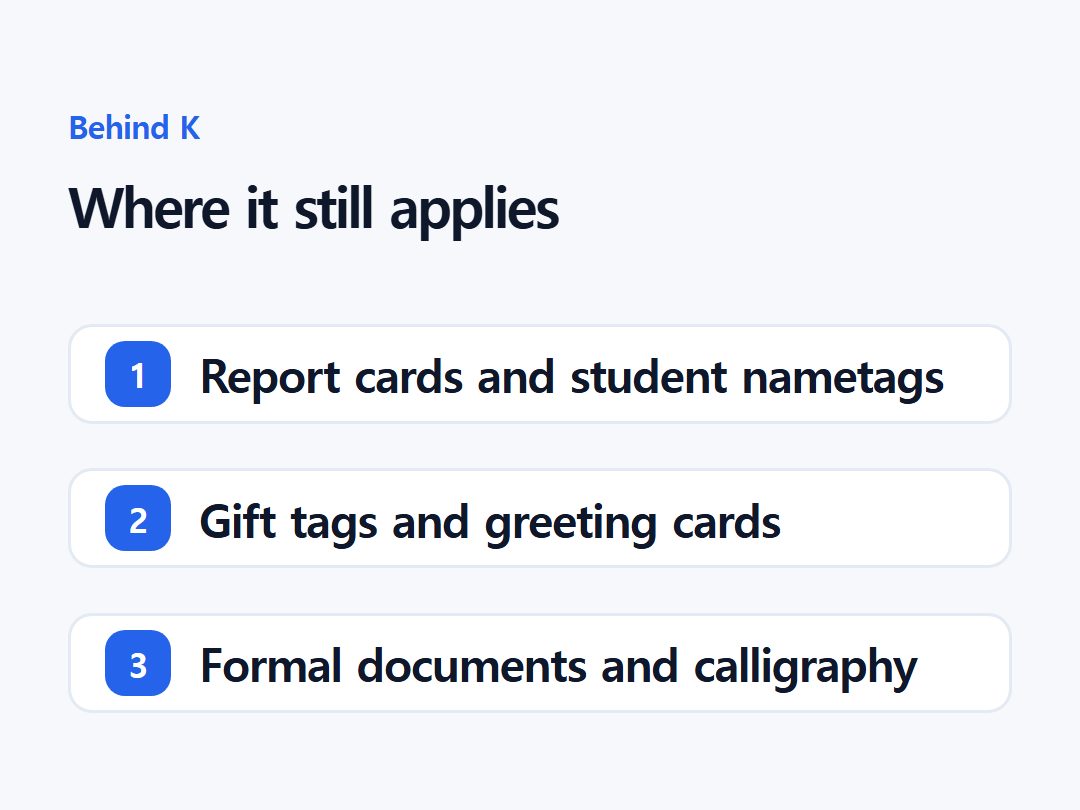
Teachers avoid it when labeling report cards, office workers avoid it on documents that include someone's name, and stationery packaging in Korea sometimes even carries a small warning about it. The rule is specific: it is not red in general that is avoided, but red ink applied to a person's name.
The short version
- Koreans avoid writing a living person's name in red ink.
- Red ink traditionally marked death in family records and funeral banners.
- The Korean War hardened this taboo into a near-national rule.

Why doesn't Korea consider red unlucky?
For readers outside Korea, the natural assumption is that red must simply be an unlucky color. That assumption is wrong, and the correction is the useful part. Red is one of the most auspicious colors in traditional Korean culture.
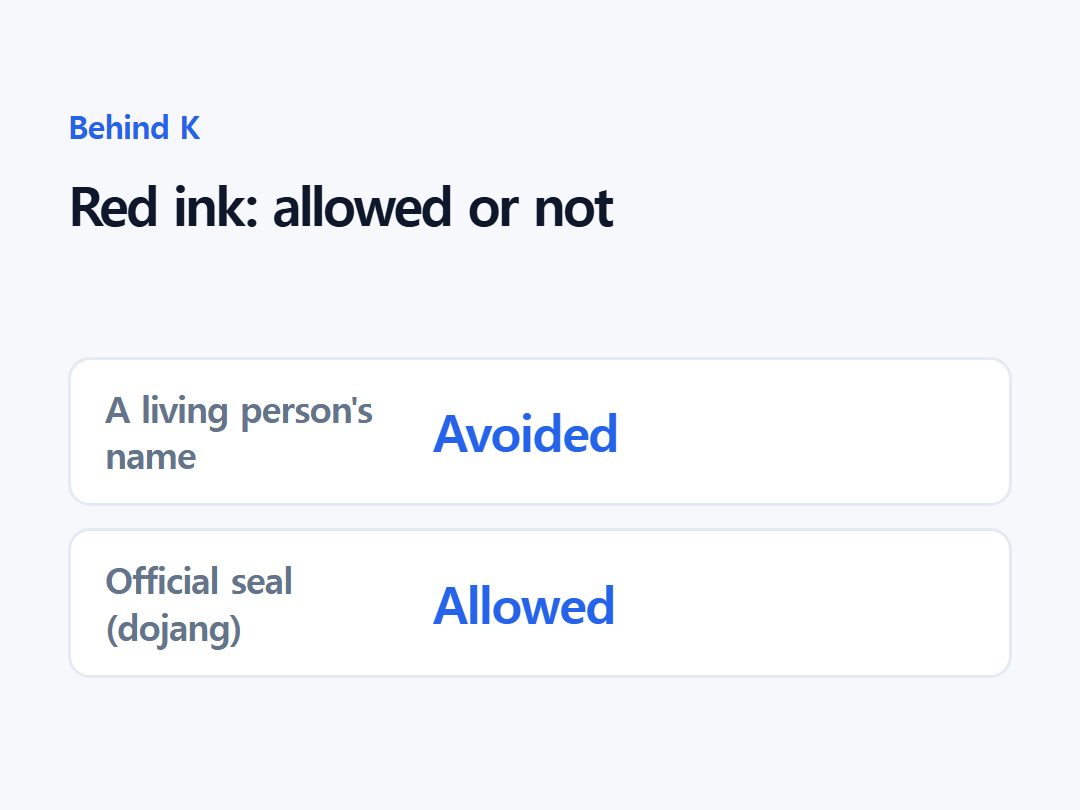
Red bean porridge is eaten and scattered at the door on the winter solstice to drive away evil spirits. A dojang, the personal name seal Koreans have traditionally used in place of a signature, is stamped in red ink on contracts, bank documents, and official paperwork without any hesitation.
Historically, red also marked royal authority. None of that is taboo. What is taboo is a very narrow combination: red ink plus a living person's name, written by hand.
That narrowness is exactly what makes the custom hard for outsiders to predict. A foreign teacher who grades multiple-choice answers in red pen is doing nothing wrong — marking a wrong answer, circling a score, or writing comments in red is standard practice in Korean classrooms, just as it is elsewhere.
The problem arises only if that same red pen is used to write the student's name at the top of the paper or on a nametag. The same split applies to gifts: a red ribbon or red wrapping paper is fine, but writing the recipient's name on the card in red is not.
Understanding this distinction matters because it explains behavior that would otherwise look inconsistent or arbitrary — Koreans are not avoiding a color, they are avoiding a specific act that has, for generations, been associated with marking someone as dead.
The taboo is also generational, which is itself informative. Many Koreans in their twenties and thirties will use a red pen without thinking twice, and some actively push back on the superstition as outdated.
But even people who call it old-fashioned often still hesitate before writing a name in red, describing it as something that simply feels wrong, independent of whether they believe it causes harm.
That gap between conscious disbelief and instinctive avoidance is common with deep-rooted taboos, and it is a useful signal for how embedded this particular one is in everyday Korean life, appearing in classrooms, offices, and family gatherings well outside any explicitly religious or superstitious context.
The taboo also stands out regionally. Red is treated as a lucky, celebratory color across much of East Asia — red envelopes carrying cash gifts at Lunar New Year, red wedding decorations, red banners for store openings. Korea shares much of that symbolism.
What it does not share with neighboring countries, according to Korean folklore writers, is the specific ban on red-ink names: the custom is described as distinctly Korean, with commentators noting that China and Japan do not carry the same restriction today, even though one origin theory traces the idea back to China.
That regional mismatch is part of what makes the taboo worth explaining rather than assuming — a visitor who has learned that red is lucky in one East Asian context can still walk straight into this specific exception in Korea.
Where did the red-ink taboo come from?
Korean folklore researchers and cultural writers do not point to a single confirmed origin for the red-ink taboo. Instead, several historical practices appear to have reinforced one another over time, all sharing the same underlying logic: red ink was used to mark death, danger, or a formal severing of ties, and that association eventually made it dangerous to apply to the living.
The most frequently cited root is record-keeping around death. In the family register system, known as hojeok, a household's members were formally listed by name; when someone died, older custom held that their name was marked or recorded in red, visually separating them from the living members of the family.
Funeral banners called manjang, tall cloth streamers inscribed with the deceased's name and carried in traditional funeral processions, were also written in red characters.
Writing a name in red, in other words, was literally what you did once someone had died — which is why doing it to someone still living carried the uncomfortable implication of wishing, or predicting, their death.
Some accounts connect this further to the idea of severing a relationship (jeolyeon) or formally removing someone from the family register, framing red-ink names as a symbol of a broken bond as much as a literal death marker.
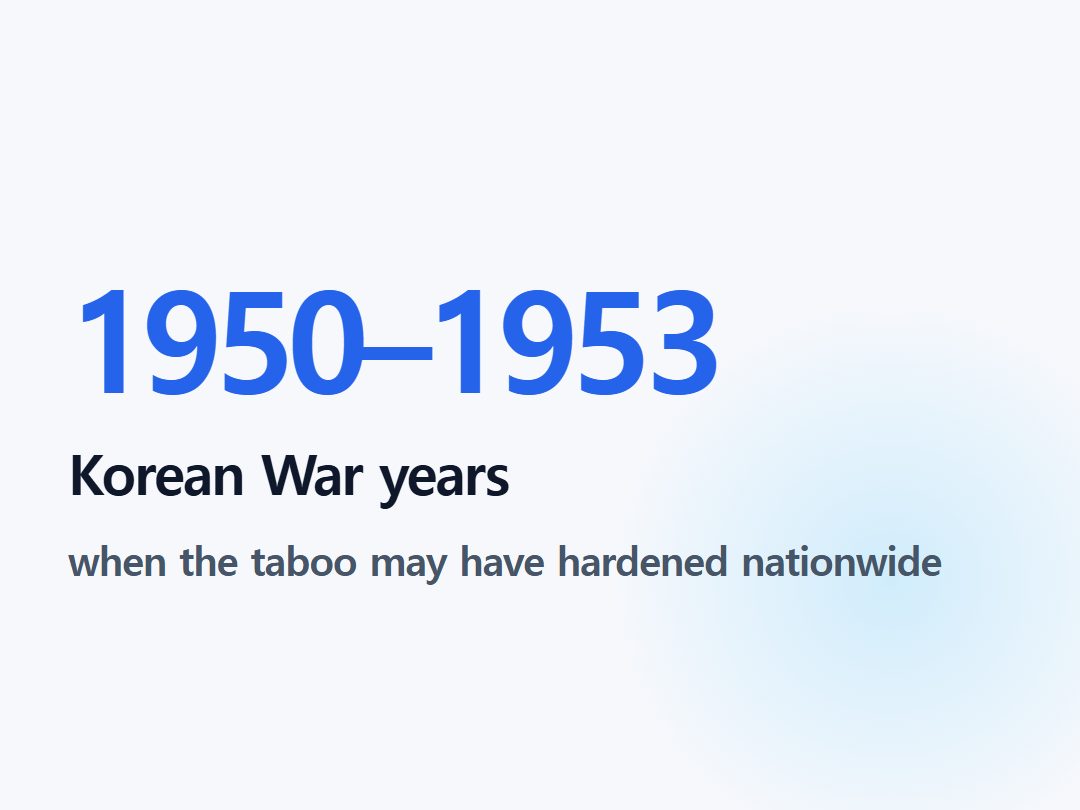
A second widely discussed theory ties the taboo to the Korean War (1950–1953). Military casualty lists reportedly marked fallen soldiers by striking their names with a red line, and official notices informing families of a soldier's death are said to have listed the soldier's name in red ink.
Because the war touched nearly every Korean family within living memory, some researchers argue this period is what hardened the custom into something close to a national rule, rather than a regional or class-specific folk belief.
This theory gets circumstantial support from an odd fact: North Korea does not share the same strength of taboo around red-ink names, which suggests the practice may have calcified specifically in the South during and after the war, layered on top of older, looser associations rather than descending unbroken from ancient tradition.
Older, competing theories exist as well. One traces the custom to a 15th-century political purge in the Joseon Dynasty, when the names of political rivals were reportedly marked in red on a court record ahead of their removal from power.
Another points further back to imperial China, where red ink and vermilion seal-ink were reserved for the emperor, and death warrants for condemned prisoners were said to have been written in red — a practice some accounts suggest reached Korea through centuries of close cultural and political exchange with China.
Korean folklore compilations generally present these as parallel, unverified theories rather than settled history, and that lack of a single clean origin story is itself a reminder that long-running taboos are usually the product of several overlapping practices, not one traceable event.
Whether the taboo survives as red ink fades
The open question is less about the origin, which may never be settled with certainty, and more about how long the taboo persists as material habits change.
Red ink itself is becoming less common in daily life as grading moves onto digital platforms, documents are signed electronically, and handwriting in general declines.
Whether the taboo survives that shift, gets treated as a quaint fact people mention rather than a rule people follow, or keeps its grip in the specific settings where it is still strongest — schools, funerals, and formal gift-giving — is something Korean cultural commentators continue to note without a clear answer.
For now, the safest approach for anyone writing a Korean name by hand is simple: any color but red.
Five theories on where this taboo began
| Theory | Period | Key Detail |
|---|---|---|
| Family register (hojeok) | Traditional/pre-modern | A deceased person's name was marked or recorded in red in the household register |
| Funeral banners (manjang) | Traditional/pre-modern | Funeral streamers carried the deceased's name written in red characters |
| Korean War casualty notices | 1950–1953 | Fallen soldiers' names were reportedly struck with a red line or listed in red on death notices |
| Joseon political purge | 15th century | Names of political rivals were marked in red on a court record before their removal from power |
| Imperial China precedent | Ancient China | Red and vermilion ink were reserved for the emperor; death warrants for condemned prisoners were said to be written in red |
Frequently asked
Why can't you write a Korean's name in red ink?
Red ink was traditionally used to mark a person's name after death, in family registers and on funeral banners, so writing a living person's name in red carries an unwanted implication of death.
Is red considered an unlucky color in Korea?
No, red is generally seen as lucky and celebratory in Korea, used for things like red bean porridge and red dojang seals; only the specific act of writing a person's name in red ink is taboo.
Do Japan and China share this red-ink name taboo?
No, Korean folklore writers describe the ban on red-ink names as distinctly Korean, noting that China and Japan do not carry the same restriction today even though one origin theory traces back to China.
Sources
Every factual claim above is traceable. We do not translate articles — we gather facts from multiple outlets and write them ourselves.
- 11 Korean superstitions that persist to this day — Korea.net (Republic of Korea)
- Behind the Myth: The Red Pen — Gwangju News
- 빨간색으로 이름을 쓰면 죽는다고? (Do you die if you write your name in red?) — National Folk Museum of Korea
- 이름에 대한 금기 (Taboos about names) — Namuwiki