International viewers who follow Korean dramas on Netflix often notice the same pattern: two new episodes appear each week, on the same two days, until the story wraps around episode 16. It looks like a stylistic choice. It is actually a broadcast rule, inherited from Korean terrestrial television, that Netflix is only now starting to break.
The short version
- Korean networks air 16-episode dramas twice weekly; Netflix just distributes that schedule.
- Netflix Originals like Kingdom and Sweet Home are pre-produced and drop all at once.
- Descendants of the Sun's 2016 success made full pre-production commercially viable in Korea.
The 16-episode twice-weekly format isn't the only one now
Most Korean dramas that reach international audiences were not made by Netflix. They were made by a Korean network — SBS, MBC, KBS, tvN, or JTBC — and licensed to Netflix for overseas streaming.
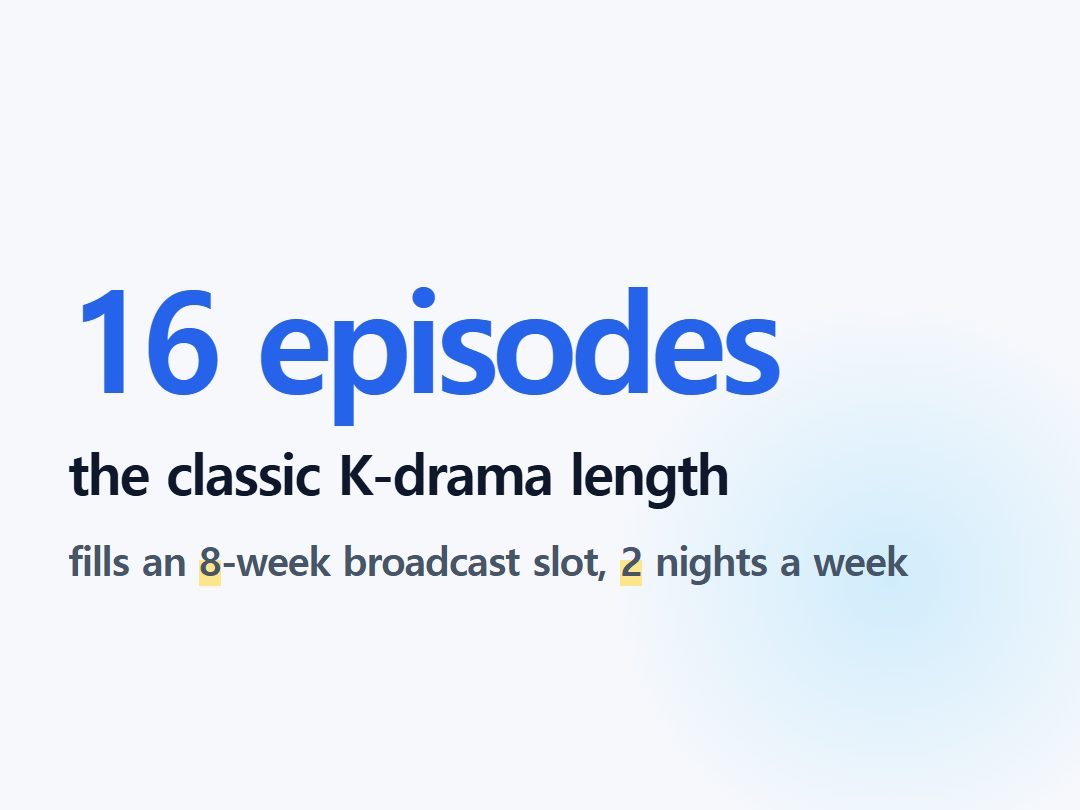
When Netflix uploads an episode, it is following the same release calendar the drama already has on Korean television: two episodes a week, usually on a fixed pair of nights, for about eight weeks, totaling 16 episodes.
That is why a Netflix subtitle drop can feel like appointment television even though nothing about Netflix’s own platform requires a weekly schedule.
This is only half the current picture, though. A growing share of Korean dramas — especially ones Netflix commissions directly as Netflix Originals, and increasingly ones made for domestic broadcast too — now run 12, 10, or even 8 episodes, and some drop in a single batch rather than twice a week.
The 16-episode, twice-weekly format has not disappeared, but it is no longer the only format. It is one of several standards now competing inside the same industry.
Why do Korean dramas stick to a twice-weekly schedule?
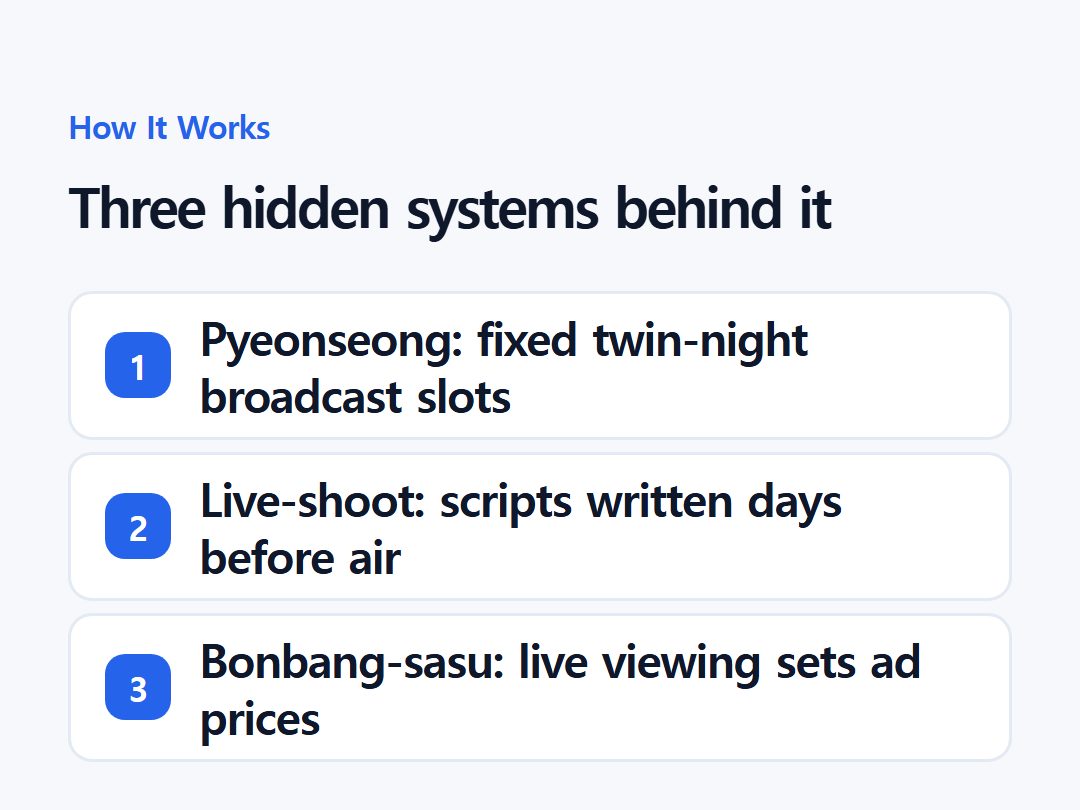
To understand why the twice-a-week rhythm exists at all, you need three pieces of infrastructure that Korean audiences take for granted and international viewers never see.
The first is pyeonseong (편성), the broadcast grid. Korean terrestrial and cable networks divide their prime-time schedule into fixed twin-night slots — Monday-Tuesday, Wednesday-Thursday, or the weekend pair — each running around 10 p.m.
A new drama is assigned to one of these slots and occupies it for its entire run, one episode per night, two nights a week. A standard drama built for this system runs 16 episodes because that fills the slot for roughly eight weeks before the next show rotates in. The schedule is not a marketing decision; it is a piece of network real estate.
The second piece is the live-shoot production system, sometimes called “semi-live shooting.” For most of Korean TV history, dramas have been filmed only days, or even hours, ahead of broadcast, with scripts arriving on set just before shooting and final editing finishing right before air.
Actors have described the toll publicly: actress Park Ye-jin recalled projects where she was “clenching my teeth to get through shoots, with no idea what I’m doing,” and in 2015 actor Jung Woong-in called the set of SBS’s Yong-pal exhausting, with crew running on almost no sleep.
The system persisted because it let writers and producers watch overnight ratings and adjust the story in real time — expanding a popular character’s role, cutting a subplot that tested badly — something a fully finished season cannot do.
It sometimes failed badly: MBC’s 2007 epic The Legend, despite a three-year, $38 million production, still could not finish editing one episode in time and had to pad the broadcast slot with extended news coverage.
The third piece is bonbang-sasu (본방사수, literally “defending the live broadcast”) — the cultural habit of watching a show live rather than later on-demand, because live viewership is what Korea’s ratings meters (시청률) actually count.
Overnight ratings set advertising prices, function as a public scorecard for the writer and cast, and drive next-day conversation. A hit drama becomes a twice-weekly national event with real-time reactions online.
This is the demand side of the same system that the live-shoot production model serves on the supply side: both exist because Korean television, until recently, was built around the idea that everyone should watch the same episode at the same moment.
None of this was designed with a global streaming audience in mind, which is exactly why it surprises international viewers. Netflix did not redesign the release pattern for licensed Korean dramas because it does not own the production pipeline behind them — it is simply distributing what a Korean broadcaster already scheduled.
A Chinese licensing deal was the real turning point
The format has roots in scarcity. Korean television dates to 1962, when KBS aired the country’s first drama series, and for decades afterward, tight production budgets meant studios could realistically produce only one or two drama episodes a week.
When color broadcasting arrived in the 1980s and production capacity grew, the twice-weekly slot survived anyway, and through the 1990s the industry converged on a season length of roughly 16 episodes for a standard drama, or 20 for a more ambitious one — long enough to justify the investment, short enough to fit inside a single broadcast quarter.
The live-shoot system that filled those slots came under pressure well before Netflix arrived.
In 2015, JTBC’s Last tried a rare full pre-production approach — filming the entire series before broadcast, rather than week by week — with producer Park Joon-seo arguing that “quality is what lasts” in an era of growing overseas and online sales.
But pre-produced dramas had a poor ratings track record at the time: MBC’s 2010 series Road No. 1, also filmed in advance, averaged around 6% in domestic ratings against competitors clearing 30%, reinforcing the industry’s belief that only week-to-week production could hold a live audience.
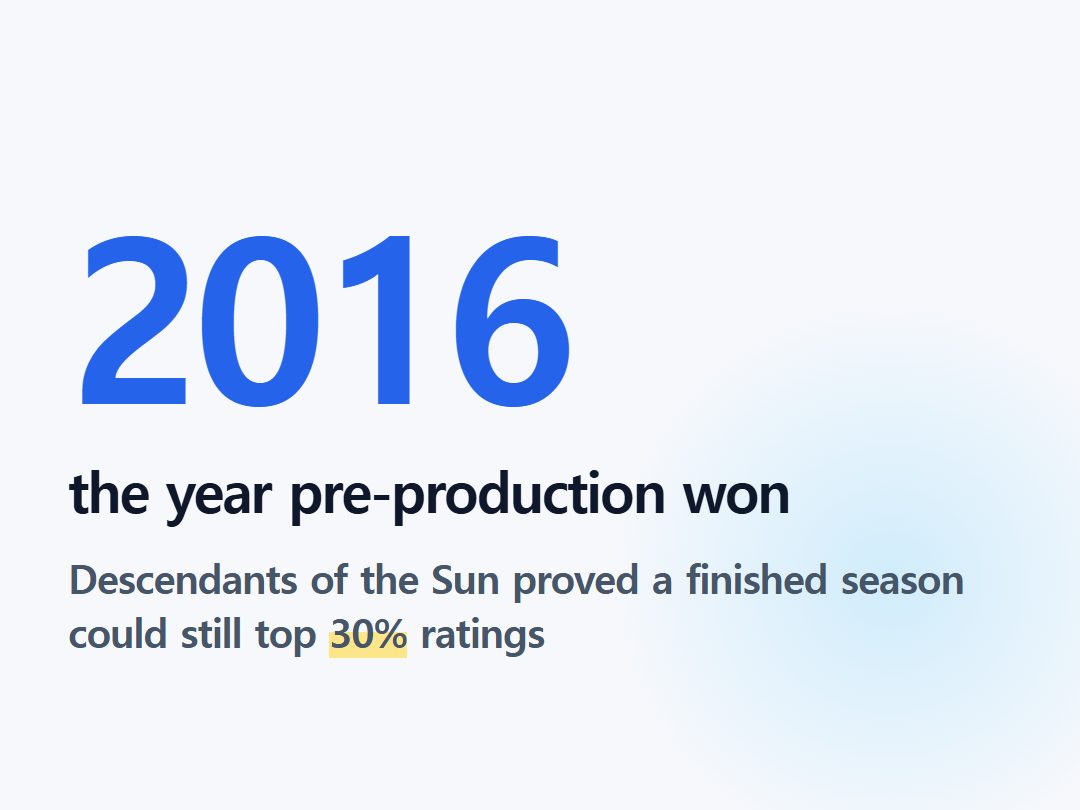
The turning point was sajeon-jejak (사전제작), or full pre-production, and the drama that made it commercially credible was KBS’s 2016 hit Descendants of the Sun. It was filmed entirely — all 16 episodes plus specials — before a single episode aired, wrapping production in December 2015 for a February 2016 premiere.
The reason was not creative preference but a Chinese licensing deal: streaming platform iQiyi paid roughly a third of the drama’s 13-billion-won budget for a simultaneous China-Korea release, and Chinese broadcast regulations at the time required full censorship review before any episode could air, which was only possible if the whole series already existed.
The gamble paid off. Descendants of the Sun became the first Korean miniseries since 2012 to top 30% in domestic ratings, and it drew roughly 120 million views on iQiyi within its first few episodes, exported to 32 countries.
For the first time, a fully pre-produced drama had out-performed the live-shoot model it was supposed to be too rigid to compete with — and the industry took notice.
Netflix’s entry deepened the shift for a different reason: its own commissioned Korean Originals had to be complete before release, because Netflix’s whole model depends on dropping a season at once for global, time-zone-agnostic viewing.
Titles like Kingdom (six episodes per season) and Sweet Home (ten episodes in its first season, narrowing to eight by its final season) were built as complete, non-live-shoot seasons from the start, exposing international audiences to a shorter, binge-ready format that never touched Korean broadcast television’s twice-weekly grid at all.
Will the twice-weekly broadcast slot survive streaming?
The industry has not settled into a single new standard — it has split into a hybrid.
Traditional broadcasters still use the twice-weekly grid, and it can still dominate global charts: in July 2026, SBS’s Agent Kim Reactivated averaged 18.8% domestically for its third episode while simultaneously becoming Netflix’s most-watched non-English series worldwide that week, ranking No. 1 in eleven countries.
At the same time, reporting from early 2025 shows the 16-episode format itself is fading even on broadcast television, with new titles increasingly running 12, 10, or 8 episodes — Netflix’s The Trauma Code, for instance, was restructured mid-development from a planned ten 60-minute episodes into eight 45-minute episodes purely to tighten pacing.
What remains unresolved is whether the twice-a-week broadcast slot itself survives as a business model as terrestrial advertising revenue keeps shrinking and streaming habits keep training audiences to expect a full season on day one.
For now, both systems run in parallel: watch for whether a title is a Korean broadcaster’s drama (still likely twice-weekly, still built around the 16-episode grid) or a Netflix-commissioned Original (already complete, already shorter, and dropped all at once).
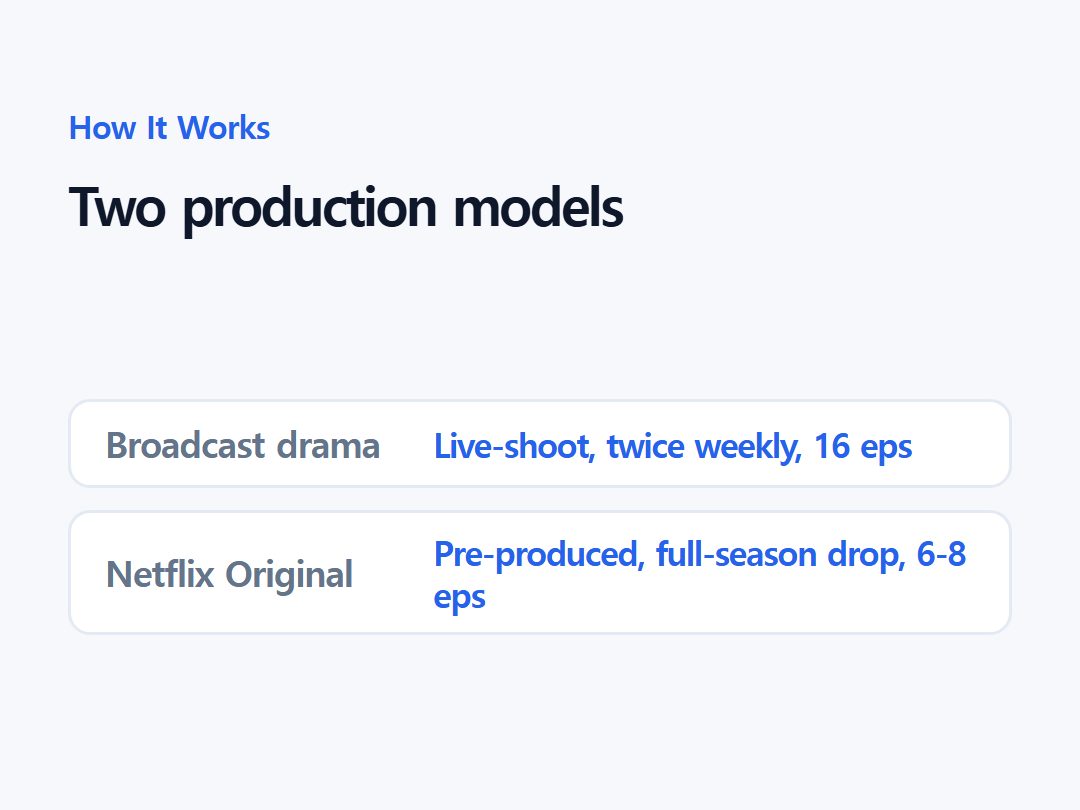
Two release models now running in parallel
| Traditional Broadcast Drama | Netflix-Commissioned Original | |
|---|---|---|
| Episode count | 16 (sometimes 20) | 6–10 (e.g., Kingdom: 6, Sweet Home: 10 to 8) |
| Release schedule | Twice a week, fixed nights | Entire season at once |
| Production method | Live-shoot, filmed days before air | Fully pre-produced before release |
| Example | Descendants of the Sun, Agent Kim Reactivated | Kingdom, Sweet Home, The Trauma Code |
Frequently asked
Why do Korean dramas only have 16 episodes?
Korean broadcasters divide prime time into fixed twice-weekly slots (pyeonseong), and a 16-episode season fills that slot for about eight weeks before the next show rotates in.
Why do Korean dramas air two episodes a week?
Dramas are assigned to a twin-night broadcast slot — Monday-Tuesday, Wednesday-Thursday, or the weekend — one episode per night, because Korean TV scheduling, not Netflix, sets the release pattern.
Are all Korean dramas on Netflix released weekly?
No — Netflix-commissioned Originals like Kingdom and Sweet Home, plus a growing number of shorter 12-, 10-, or 8-episode titles, are fully produced in advance and released all at once.
Sources
Every factual claim above is traceable. We do not translate articles — we gather facts from multiple outlets and write them ourselves.
- K-dramas shift to shorter seasons as 16-episode format fades — The Korea Times
- Why Do K-Dramas Release Only Two Episodes a Week? — What the Korea
- How Has the Korean Drama Production System Changed Since the Rise of Netflix? — Hello Korea Daily
- Will Korean dramas break away from ‘live-shoot’ system? — The Korea Herald
- Korean Dramas Adopt Pre-Produced Format to Mixed Results — Variety
- ‘Descendants of the Sun’ rewrites K-drama history — The Korea Times
- Kingdom (TV series) — Wikipedia
- Sweet Home (TV series) — Wikipedia