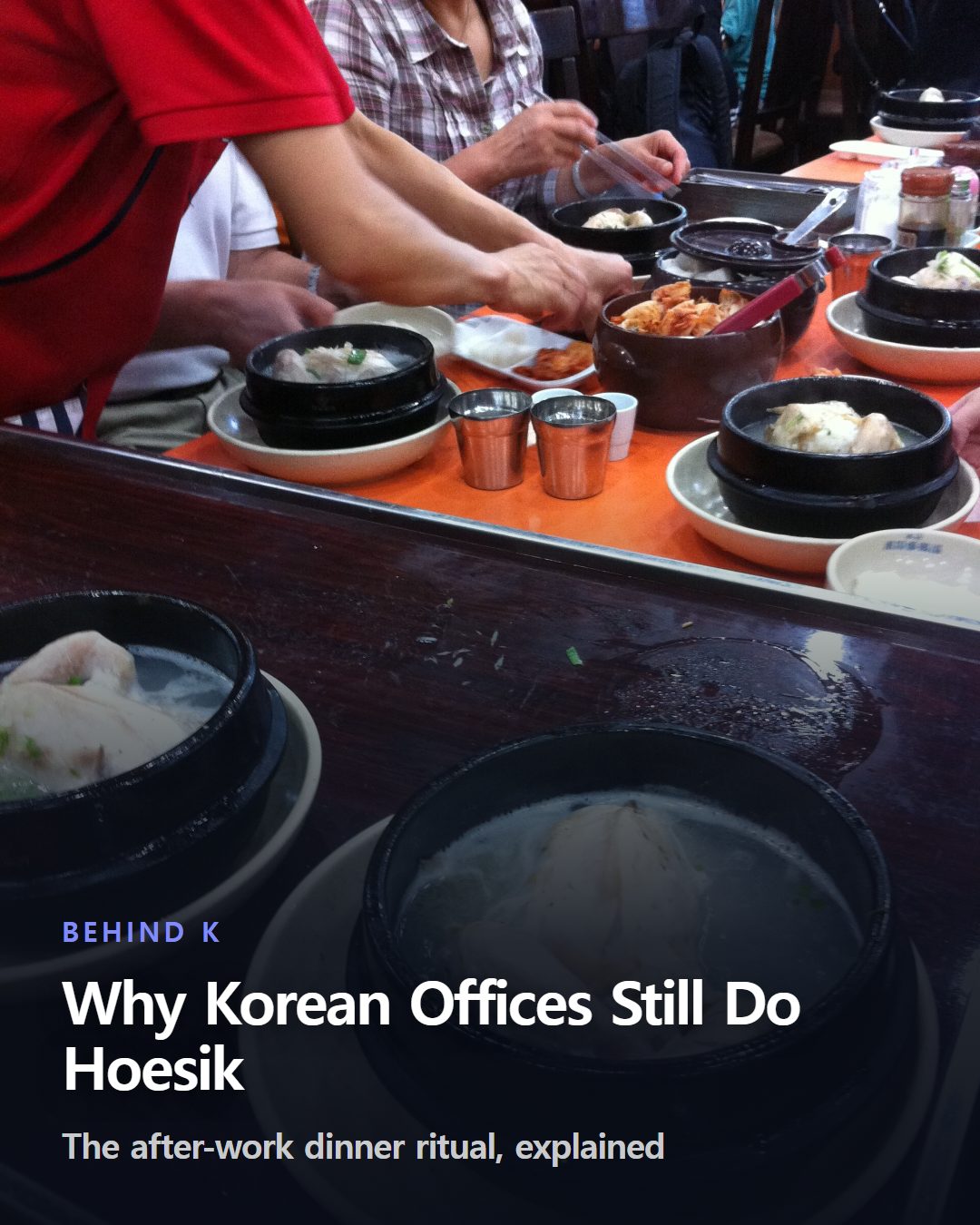
In Korean office dramas and workplace variety shows, one scene repeats so often it barely needs setup: colleagues crowded around a grill table, bottles of soju lined up, a junior employee pouring a drink for a boss with both hands out of respect.
This is hoesik (회식) — literally "gathering to eat" — the after-hours company dinner that has worked as an unofficial extension of the Korean workday for more than half a century. It has not disappeared, but it has changed shape.
Survey data, drinking statistics, and a decade of labor-law reform all point the same direction: hoesik has gotten shorter, moved earlier, and become more optional than it used to be, even as the ritual itself remains a fixture of how Korean workplace stories get told on screen.
The short version
- Hoesik has shrunk under 2018 labor law, Covid, and generational pushback.
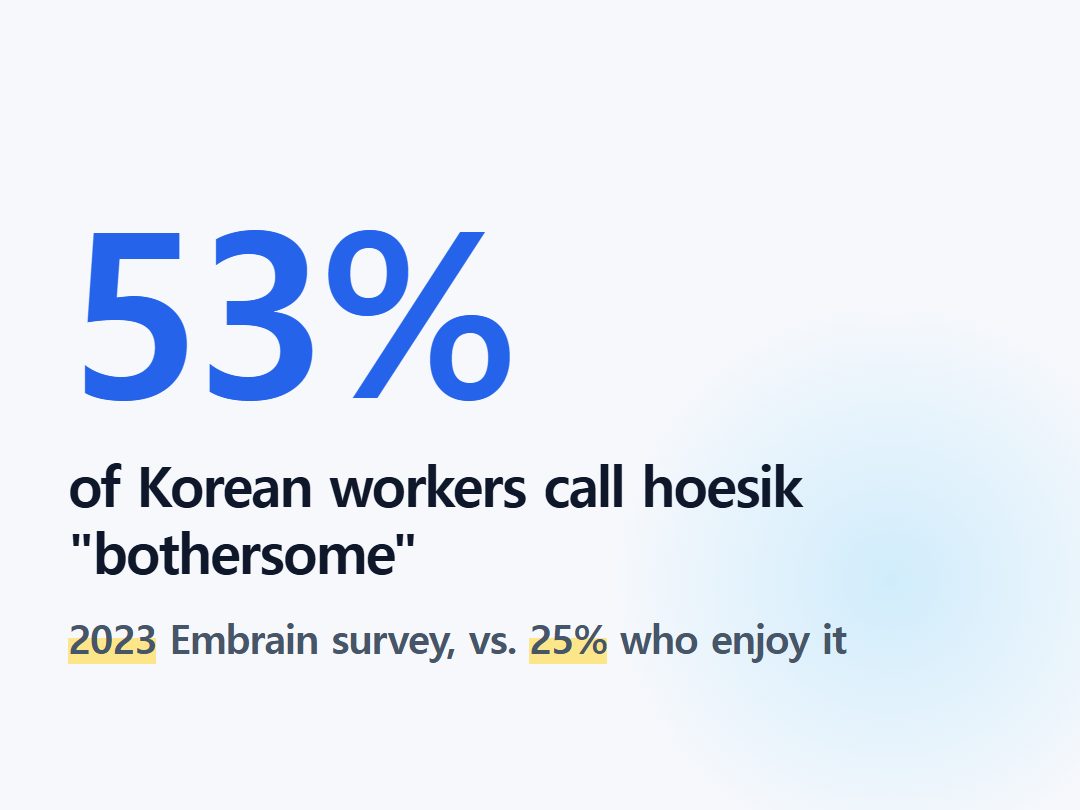
- 53% of workers call hoesik bothersome; only 24.7% enjoy it.
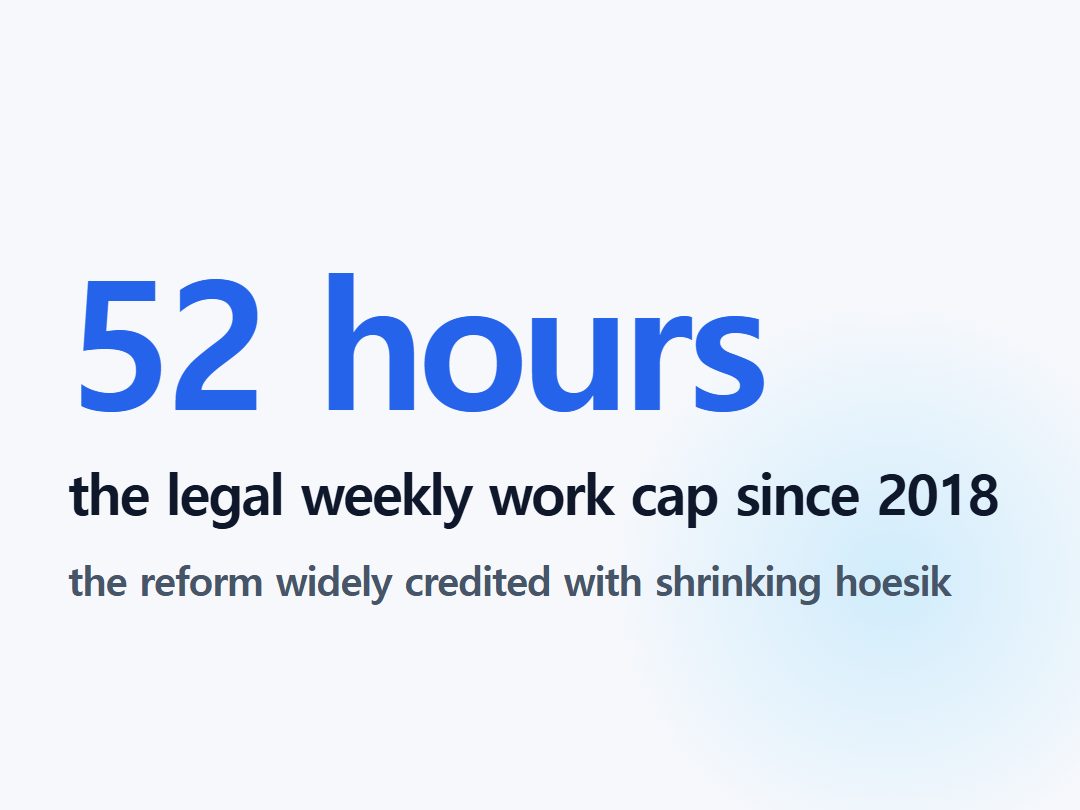
- 2018 law capped the workweek at 52 hours, curbing late-night drinking sessions.
A 2023 survey by market research firm Embrain found that 53.2% of Korean office workers described hoesik as "bothersome," against 24.7% who called it enjoyable.
A separate 2022 survey by Hankook Research found only about 39–40% of workers under 40 considered hoesik necessary, compared with 63% of workers over 60 — a generational split that shows up again and again in how the practice is discussed in Korea today.
Why did skipping hoesik hurt your career?
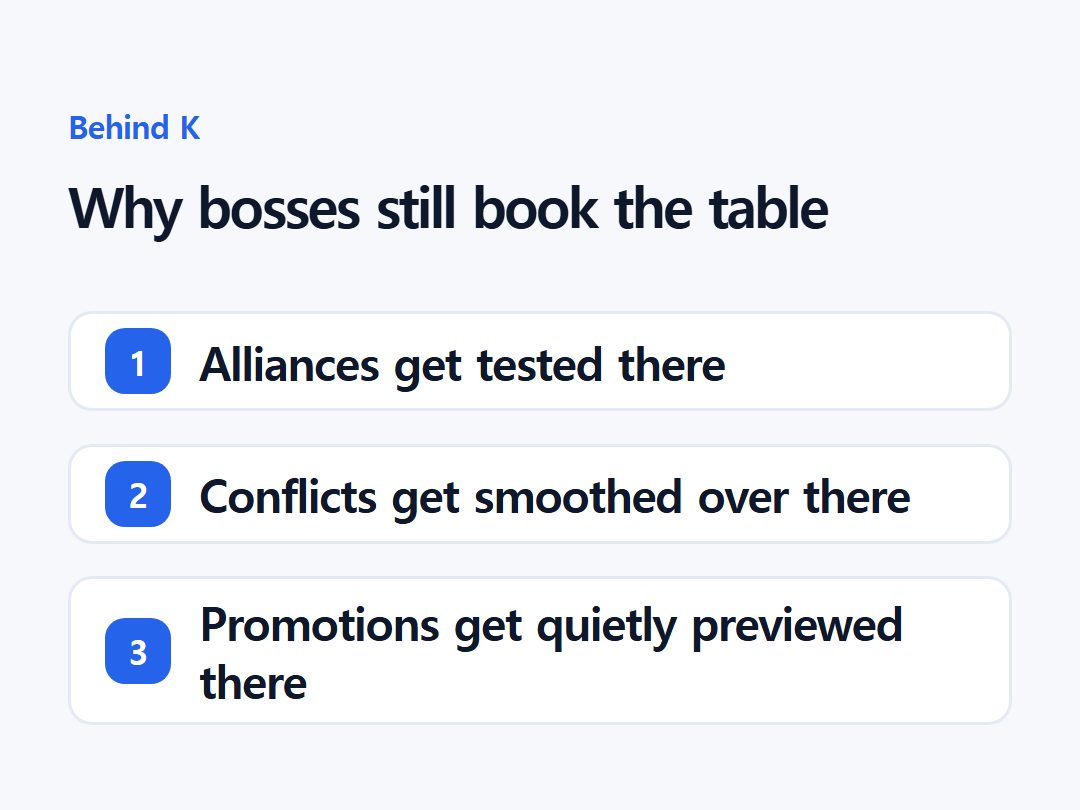
To an outside viewer, hoesik can look like an office happy hour. It is not. For decades, hoesik functioned as an informal extension of the human-resources system inside Korean companies, particularly the large conglomerates known as chaebol that dominate the economy. Promotions were quietly previewed there.
Alliances were tested there. Conflicts that couldn't be raised inside the rigid hierarchy of the office got smoothed over there, because alcohol was understood to let people, in the words of one business-culture expert cited by Korea JoongAng Daily, "put their guard down and harmonize with others, even bosses."
That function explains why declining an invitation carried real weight.
Korean workplaces are built around a formal rank system, jikgeup (직급) — a ladder running from new graduate up through staff, assistant manager, manager, and director — layered on top of a seniority culture where sunbae (senior colleagues) are owed a specific kind of deference by hoobae (juniors).
Hoesik was one of the few spaces where that hierarchy loosened just enough to let people read the room, or use nunchi (눈치) — the skill of sensing unspoken social dynamics — and reposition themselves within it. Skipping it didn't just mean missing a meal. It meant missing the meeting.
This is also why the scene recurs so often in K-dramas and variety shows.
When a show wants to establish who actually holds power on a team, who is being frozen out, or who is currying favor, it doesn't need a boardroom scene — a hoesik table does the job faster, because Korean audiences already know the grammar: who pours for whom, who sits where, who can leave first.
International viewers usually register the scene as "people going out for drinks together" and miss that it is doing narrative work about status.
Shows like What's Wrong with Secretary Kim and A Business Proposal use hoesik scenes this way, and the workplace variety show Boss in the Mirror has built entire episodes around executives confronting how their own staff actually experience these dinners.
That gap between the ritual's old function and how younger employees now experience it is the real story.
The generation entering the workforce over the past decade, often labeled the MZ generation (a Korean-coined shorthand blending millennials and Gen Z), tends to treat hoesik less as an obligation and more as a negotiation.
Alongside that shift is a broader decline in drinking itself: South Korea's Disease Control and Prevention Agency has tracked falling binge-drinking rates for two consecutive years, and high-risk drinking among men in their 20s dropped 37% to 9.7% in 2024 alone.
Bars and pubs nationwide fell roughly 30% over five years, from about 40,000 in February 2021 to 28,443 in February 2026. A culture built partly on alcohol as a social lubricant is running up against a generation that increasingly doesn't drink much at all.
How Korea's 52-hour workweek law curbed hoesik
Hoesik traces back to South Korea's rapid industrialization in the 1960s, when the country's major conglomerates were being built essentially from scratch and needed fast, informal ways to build loyalty and cooperation among employees who often worked brutal hours.
Business-administration researchers have described hoesik from that period as an effective "sub-communication channel" — a way to strengthen team bonds that the formal, hierarchical office structure didn't allow for.
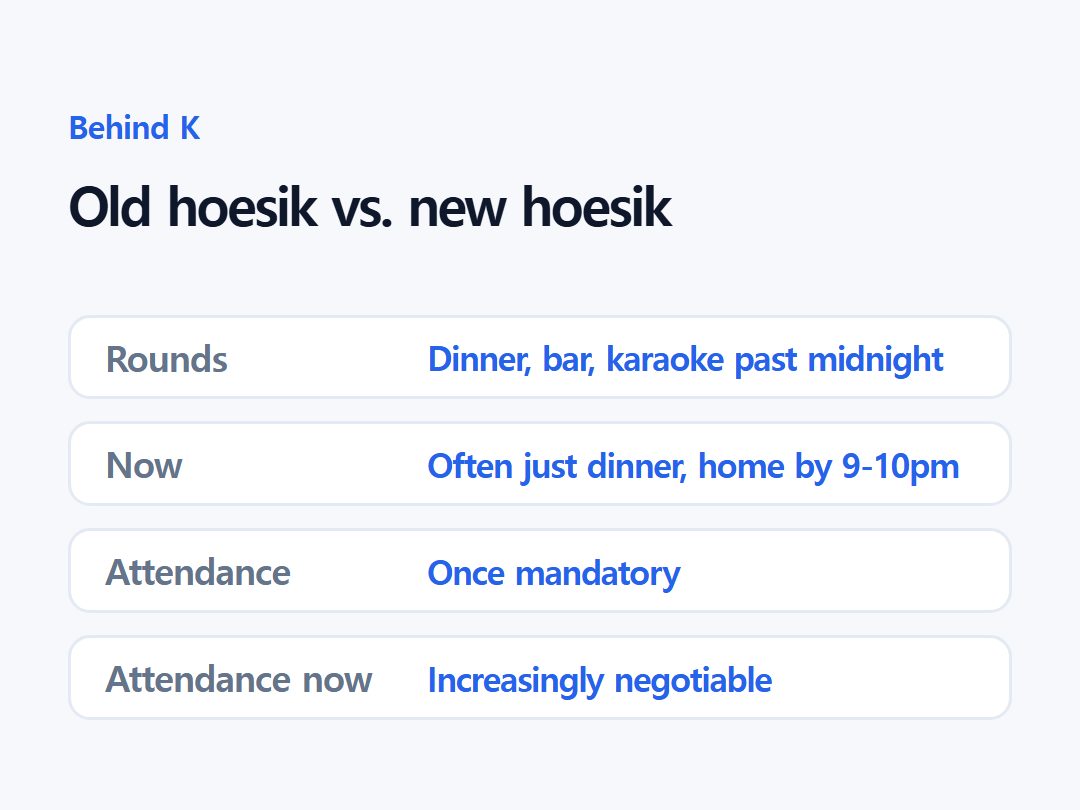
The ritual usually unfolded in rounds: 1cha (일차), a formal dinner; 2cha (이차), drinks or karaoke at a second venue; sometimes a 3cha (삼차) stretching past midnight.
For decades, this pattern was simply how Korean companies operated, and refusing to drink when a superior offered a glass was, as one account put it, socially "unacceptable."
The turn came from labor law, not culture alone. In 2018, under President Moon Jae-in, South Korea passed a landmark reform capping the standard workweek at 52 hours — 40 regular hours plus a maximum of 12 hours of overtime — down from a previous ceiling of 68 hours.
The law was rolled out in phases, starting with large companies and public agencies in 2018 and eventually reaching workplaces with as few as five employees by 2021. Violating employers faced penalties of up to two years in prison or a fine of roughly 20 million won (about $17,000).
The reform was explicitly aimed at Korea's overwork culture, of which late-night, alcohol-heavy hoesik was considered a core symptom: long hours followed by mandatory drinking sessions with the boss had long been treated as simply how "Korea Inc." operated, even as it became viewed as unhealthy and increasingly unproductive.
The pandemic accelerated what the law started. Gatherings were banned outright for extended stretches, and when restrictions lifted, many companies never fully reinstated the old rhythm of frequent, late-running dinners. What has emerged instead is described by longtime observers as hoesik becoming "more negotiable, more watched, and more dependent on the manager's judgment" — not gone, but no longer automatic.
Could Korea's 4.5-day workweek shrink hoesik further?
The transition is still unsettled. Some companies, particularly at large conglomerates, have simply compressed the old format: dinner without the second or third round, wrapped up by 9 or 10 p.m. instead of stretching past midnight.
Others have tried replacing alcohol-centered dinners with what's been called "lunch hoesik" — team meals during work hours instead of after — or "cultural hoesik," swapping the grill table for a movie screening or a pottery class.
Tech firms and startups in hubs like Pangyo and Gangnam have moved furthest in this direction, in part because their flatter management structures never depended as heavily on hierarchy-based bonding rituals in the first place.
Policy is still pushing in the same direction. Since President Lee Jae-myung took office in June 2025, his administration has promoted a shift toward a 4.5-day workweek, including government subsidies for small and mid-sized businesses adopting shortened schedules starting in January 2026.
Whether that translates into hoesik shrinking further, or simply relocating to daytime hours, is one of the things worth watching.
So is the drama and variety-show trope itself: as fewer young employees experience the traditional late-night version firsthand, it remains to be seen whether the hoesik scene keeps its current shorthand meaning for Korean audiences — or becomes, like rotary phones in period pieces, a marker of a workplace culture that's already receding into the past.
The traditional hoesik rounds
| Round | Korean term | What happens |
|---|---|---|
| 1st round (1cha) | 일차 | Formal dinner |
| 2nd round (2cha) | 이차 | Drinks or karaoke at a second venue |
| 3rd round (3cha) | 삼차 | Optional continuation stretching past midnight |
Frequently asked
What is hoesik in Korean workplace culture?
Hoesik (회식) is the after-hours company dinner that has functioned as an informal extension of the Korean workday for decades, used for team bonding and reading office hierarchy.
Why are Korean hoesik dinners getting shorter?
A 2018 law capping the workweek at 52 hours, the pandemic, and younger workers' declining interest in drinking have combined to shrink hoesik to shorter, earlier gatherings.
Do young Korean employees still have to attend hoesik?
Attendance has become more negotiable: only about 39-40% of workers under 40 consider hoesik necessary, compared with 63% of workers over 60.
Sources
Every factual claim above is traceable. We do not translate articles — we gather facts from multiple outlets and write them ourselves.
- [WHY] What's with all these booze-fueled after-work dinners? — Korea JoongAng Daily
- Sober Korea 2026: Inside the Death of Soju Culture and the Quiet Collapse of the Hoesik — Seoulz
- Korean Office Hierarchy and What's Actually Changing (2026) — Seoulstart
- South Korea's Work Culture: 9 Key Insights for 2026 — Edstellar
- Korea to maintain 52-hour workweek — The Korea Times
- 'Hoesik' aka Office Dinners in K-Drama: A Culture You Need to Know — Rolling Stone India