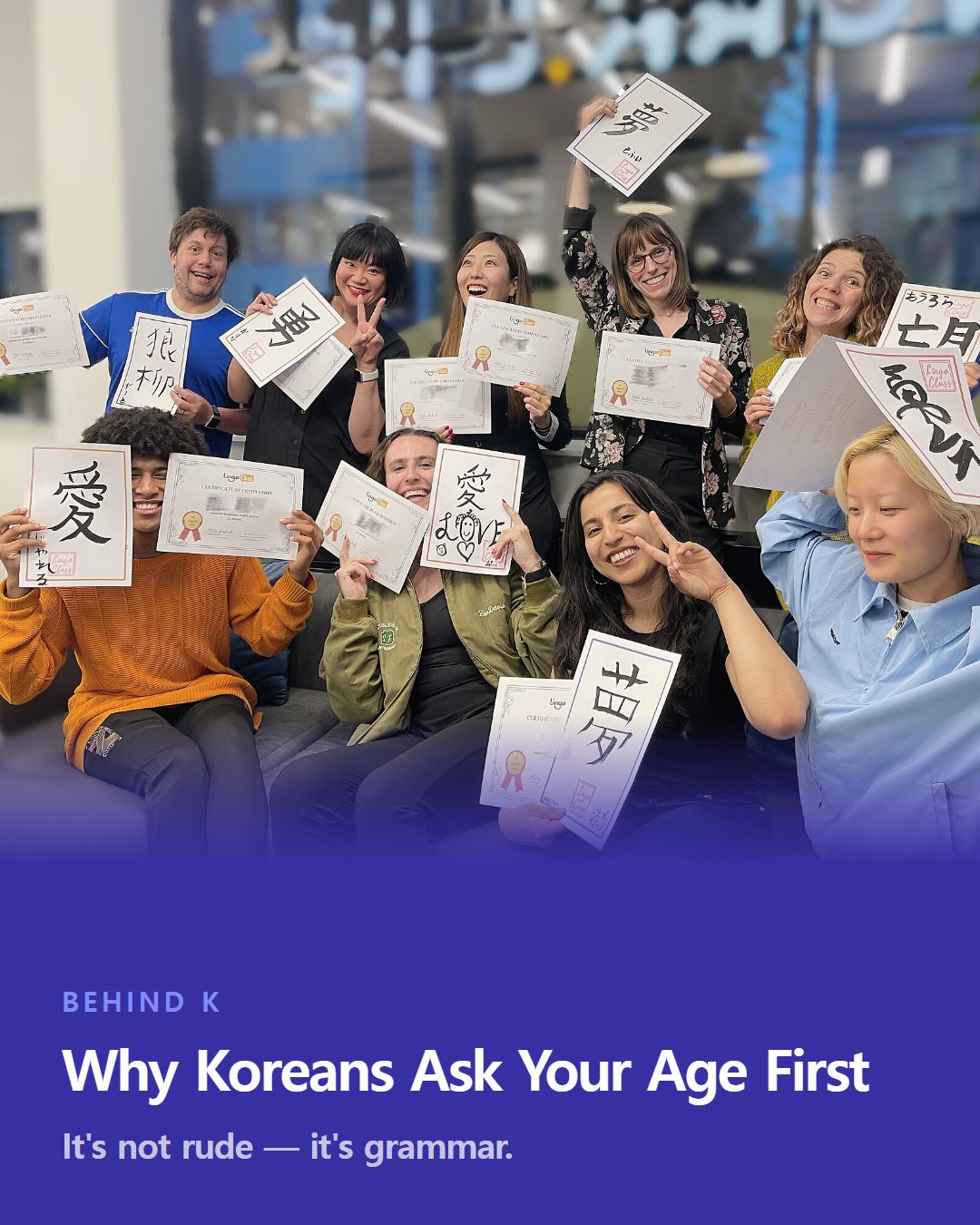
International fans who watch K-pop interviews or K-dramas often notice the same beat repeating: two people meet, and within a few exchanges, one asks the other's age. It can look blunt in translation. It is not. It is the fastest way for two Korean speakers to figure out which version of the language to use with each other.
The short version
- Korean grammar changes based on who's older, so age comes up immediately.
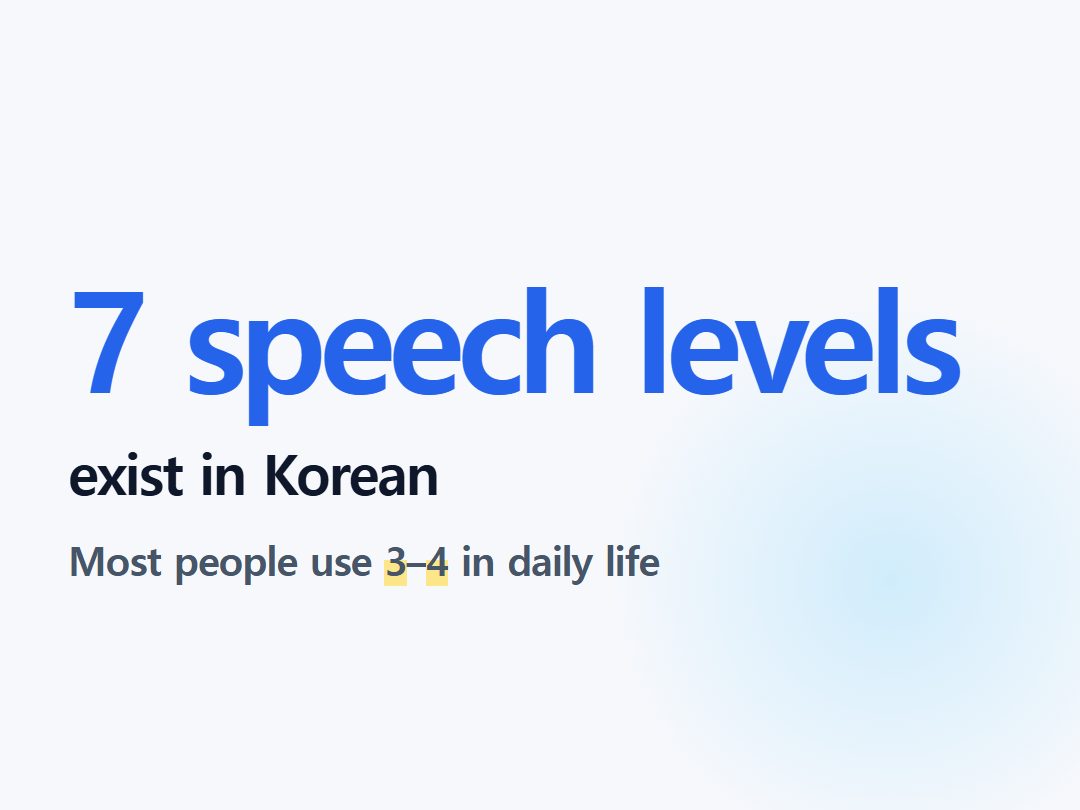
- The language has up to seven speech levels; most Koreans use three or four.
- South Korea scrapped its confusing official age-counting system as of June 2023.
Korean has no neutral way to say you
Korean is a language with built-in honorifics — grammatical markers that change verb endings, vocabulary, and pronouns depending on the relationship between speakers. Which set a person uses is decided largely by relative age and social position.
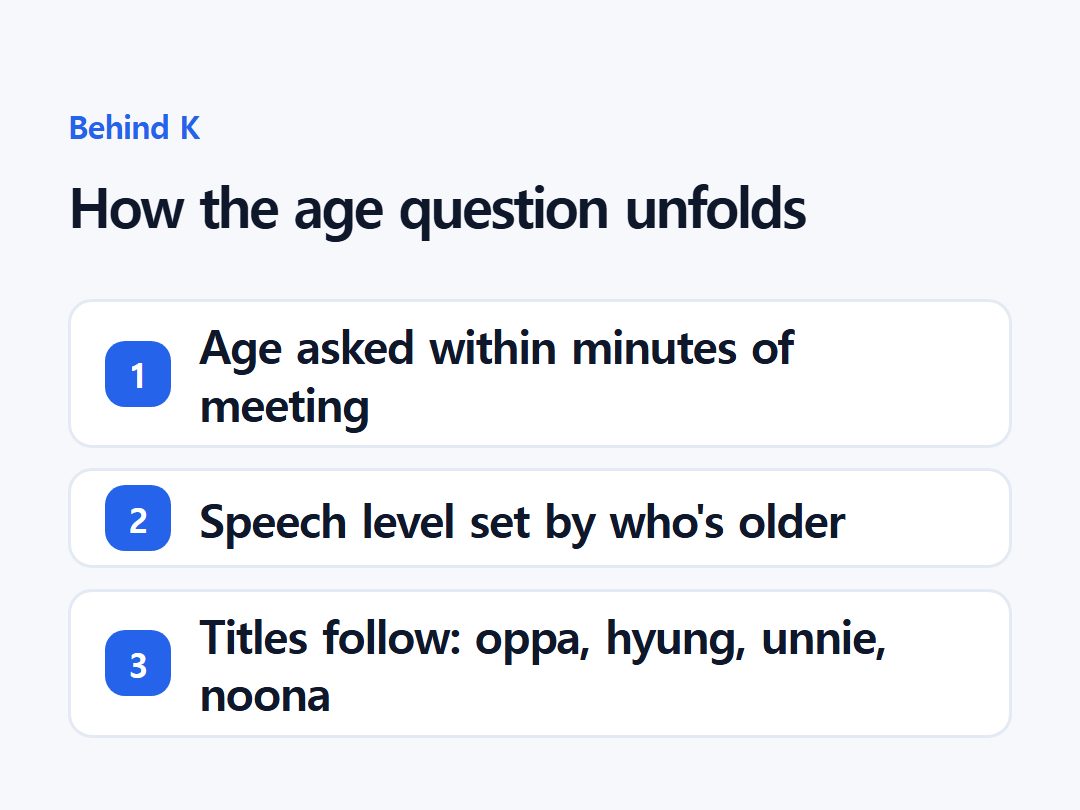
Because of this, Koreans routinely ask a new acquaintance's age, school year, or birth year almost as soon as they meet, not to judge them but to select the correct speech level before the conversation can comfortably continue.
Linguists and Korean-language educators describe this as functional, not intrusive: two people who don't know who is older literally cannot speak naturally to each other yet, because the language has no fully neutral default.
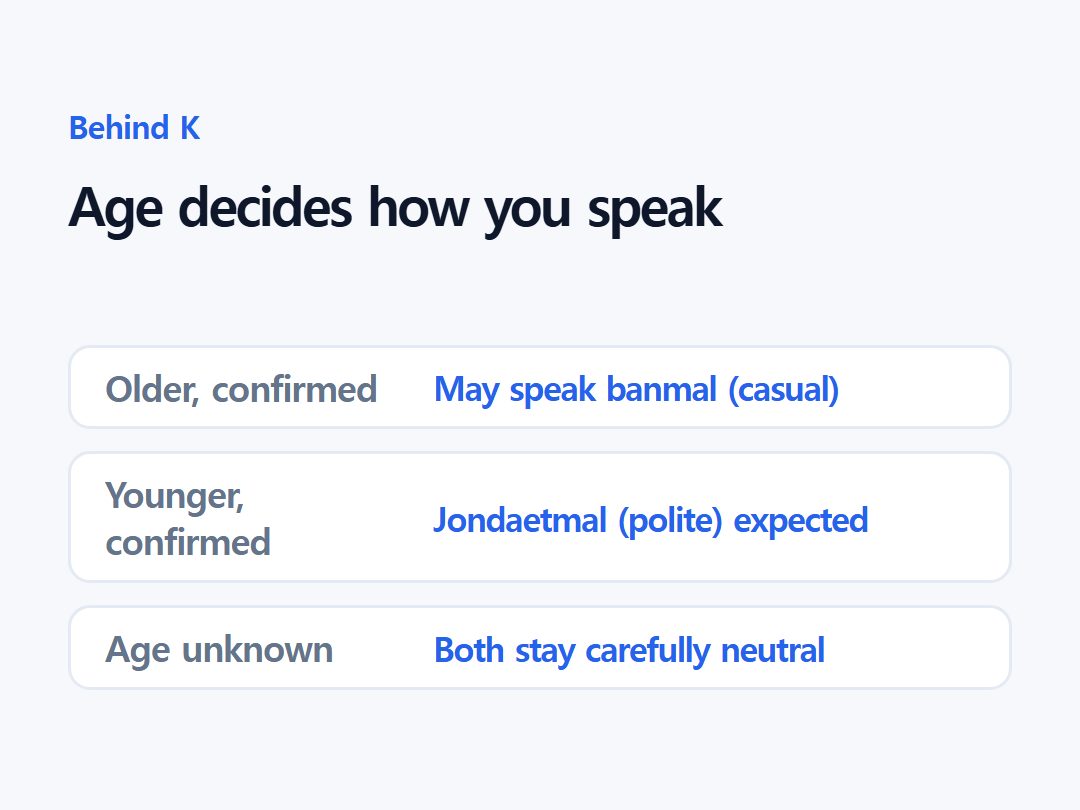
What happens when you pick the wrong speech level?
Korean commonly uses two broad registers: 존댓말 (jondaetmal), the polite/formal form, and 반말 (banmal), the casual form used between close friends or from an older speaker to a clearly younger one.
Formally, the language has up to seven distinct speech levels, though most Koreans rely on three or four of them in daily life.
Choosing wrong isn't a minor slip — using banmal with someone older, or a stranger, can read as disrespectful or presumptuous, while staying in stiff jondaetmal with someone who wants to be close can read as cold or distant.
Age is the single fastest variable for solving that equation, which is why it comes up almost immediately, often alongside school year or graduation year, since those are treated as more precise proxies than raw birth year.
The consequences go beyond grammar. Once relative age is settled, Koreans frequently adopt kinship-style titles that extend far beyond biological family.
A woman might be called 언니 (unnie) by a younger woman, or 누나 (noona) by a younger man; an older man might be 오빠 (oppa) to a younger woman or 형 (hyung) to a younger man.
These terms signal warmth and closeness once used, but they also lock in who speaks banmal and who continues in more polite forms — the younger party typically keeps some politeness even in an otherwise casual relationship, while the older party has more freedom to drop it.
Titles and suffixes like -님 (nim) or -씨 (ssi) attached to names or job titles do similar work in more formal or workplace settings, where using someone's bare first name can itself feel too familiar.
For international readers, this explains a lot of what looks like odd small talk in Korean media: idols and cast members on variety shows — unscripted reality/talk programs that are a staple of Korean entertainment — routinely state their birth year on introduction, and interviewers ask trainees or new cast members their age almost as a formality, because the answer determines how the rest of the segment is spoken and addressed.
Inside K-pop groups specifically, members are often publicly ranked by age, with the youngest labeled the maknae (막내) and the oldest treated as the natural hyung or unnie of the group — a hierarchy fans track closely because it visibly shapes who calls whom what, and who is expected to defer to whom, both on and off camera.
The same logic applies off-screen.
A tourist or exchange student who gets asked their age within the first few minutes of a conversation with a Korean stranger — at a café, in a taxi, or at a language exchange meetup — is not being interrogated; the question is doing the same grammatical work it does between two Koreans.
Getting a rough answer lets the other person default to polite jondaetmal, which is almost always the safe choice with someone whose exact age is unclear, while a more specific answer might shift the conversation toward banmal or a kinship title if the age gap and context invite it.
Travel guides and language schools increasingly flag this upfront precisely because visitors who don't expect the question can misread it as rude curiosity rather than the practical first step it actually is.
Why did Korea have three ways to count age?
The roots go back to Confucian social philosophy, which was adopted in the Korean peninsula as far back as the Three Kingdoms period (57 BCE–668 CE) and became deeply embedded in Joseon-era (1392–1897) education and etiquette, according to Korea's official government portal Korea.net.
Confucian tradition placed heavy emphasis on hierarchical relationships — ruler and subject, parent and child, older and younger — and on using language and behavior to visibly mark one's place in that order rather than treating everyone as interchangeable equals.
Korean grammar essentially built that philosophy into its sentence endings: rather than a single word for “you,” or one neutral way to say “eat” or “go,” the language offers a menu of options whose “correct” choice depends on who is senior.
That history is also why the concept of “Korean age” existed for so long: traditionally, a person was considered one year old at birth, then gained a year every January 1 regardless of their actual birthday — a system that made a person's cohort, not their exact birthdate, the socially relevant number.
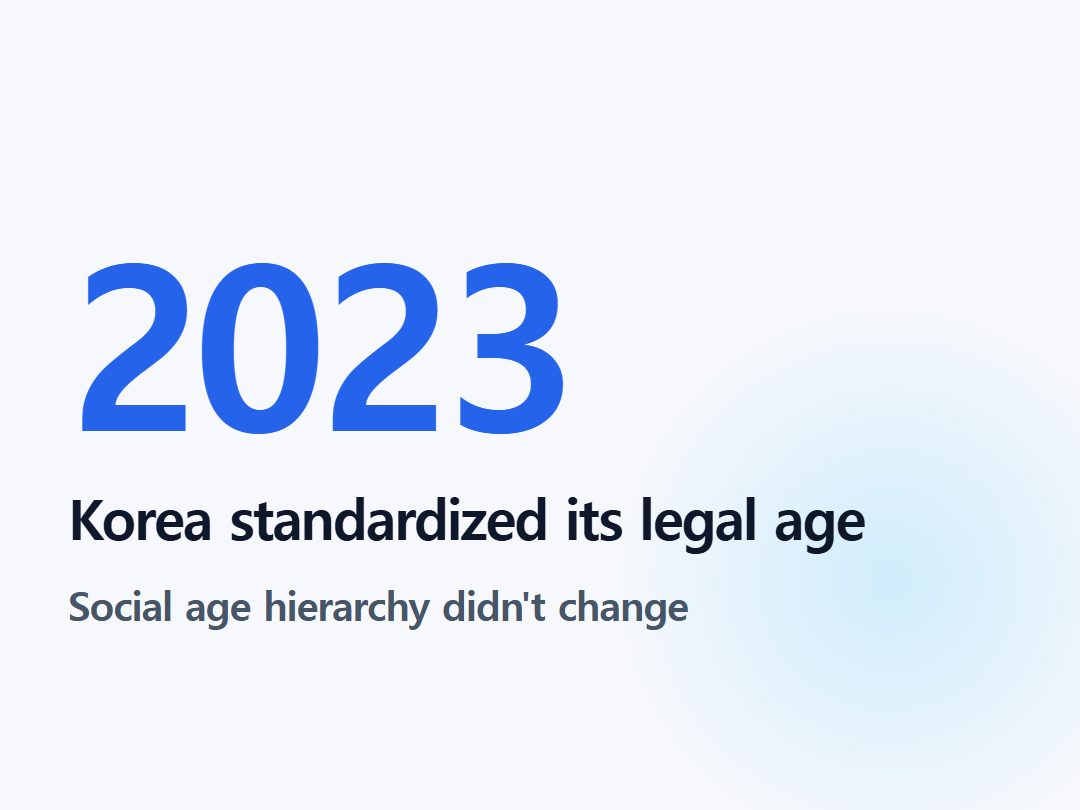
In December 2022, South Korea's National Assembly passed legislation to abolish this and other overlapping age-counting methods for official purposes, and the law took effect on June 28, 2023, standardizing government documents to the international age system used in most of the world, according to reporting from CBS News and NBC News.
Lawmaker Yoo Sang-bum, who backed the bill, said the change was meant to cut down on the legal and social confusion caused by Korea having, at one point, three different ways to calculate a single person's age simultaneously.
The reform changed paperwork, not conversation.
Even after 2023, the school-year-based “counting age” was explicitly kept in place for things like compulsory military service eligibility and the legal drinking age, and Koreans continued using birth-year-based age informally to sort out who is senior in a friendship or workplace, exactly as before.
In other words, the law solved a bureaucratic problem — how old are you on a form — without touching the social one — how do I talk to you — because the second question was never really about a number on paper. It was always about where the two speakers stood relative to each other.
Some Korean workplaces are dropping age-based titles
The honorific system itself isn't static.
Some Korean workplaces, particularly at younger tech and startup companies, have experimented with flattening hierarchy by having employees address each other with English names or ability-neutral titles instead of age-based terms, specifically to reduce the friction the age question can create in professional settings.
Whether that spreads beyond a handful of companies, or stays a niche experiment, is still an open question.
It's also worth watching how the practice plays out for the growing number of foreign residents, exchange students, and international fans interacting directly with Koreans: many report that a foreigner using jondaetmal correctly, unprompted, gets a noticeably warm reaction — a small signal that the visitor understands the system is functional rather than nosy.
As Korean pop culture continues to travel, the age question is likely to keep showing up in fan interactions, subtitled interviews, and even fan-idol exchanges at events, making it one of the more practical pieces of context for anyone engaging with Korean media beyond the screen.
Kinship-style titles based on speaker's age and gender
| Speaker | Term for older person | Applies to |
|---|---|---|
| Younger woman | 언니 (unnie) | Older woman |
| Younger man | 누나 (noona) | Older woman |
| Younger woman | 오빠 (oppa) | Older man |
| Younger man | 형 (hyung) | Older man |
Frequently asked
Why do Koreans ask your age when they first meet?
Korean grammar requires speakers to pick honorific speech levels based on relative age, so asking age lets two people choose the correct polite or casual form before talking further.
What is Korean age and did it change?
Traditionally Koreans turned one at birth and gained a year every January 1, but South Korea's National Assembly abolished this for official purposes effective June 28, 2023, though it's still used informally to sort out seniority.
What does maknae mean in K-pop?
Maknae (막내) is the youngest member of a K-pop group, a label tied to the same age-based hierarchy that decides who calls whom what and who defers to whom.
Sources
Every factual claim above is traceable. We do not translate articles — we gather facts from multiple outlets and write them ourselves.
- South Koreans set to become younger as traditional way of counting age is scrapped — NBC News
- South Korea adopts international practice for calculating age, reducing citizens' ages by 1 to 2 years — CBS News
- 4 key points to remember when learning Korean — Korea.net (Republic of Korea government portal)
- The long history of Confucian tradition — Korea.net (Republic of Korea government portal)