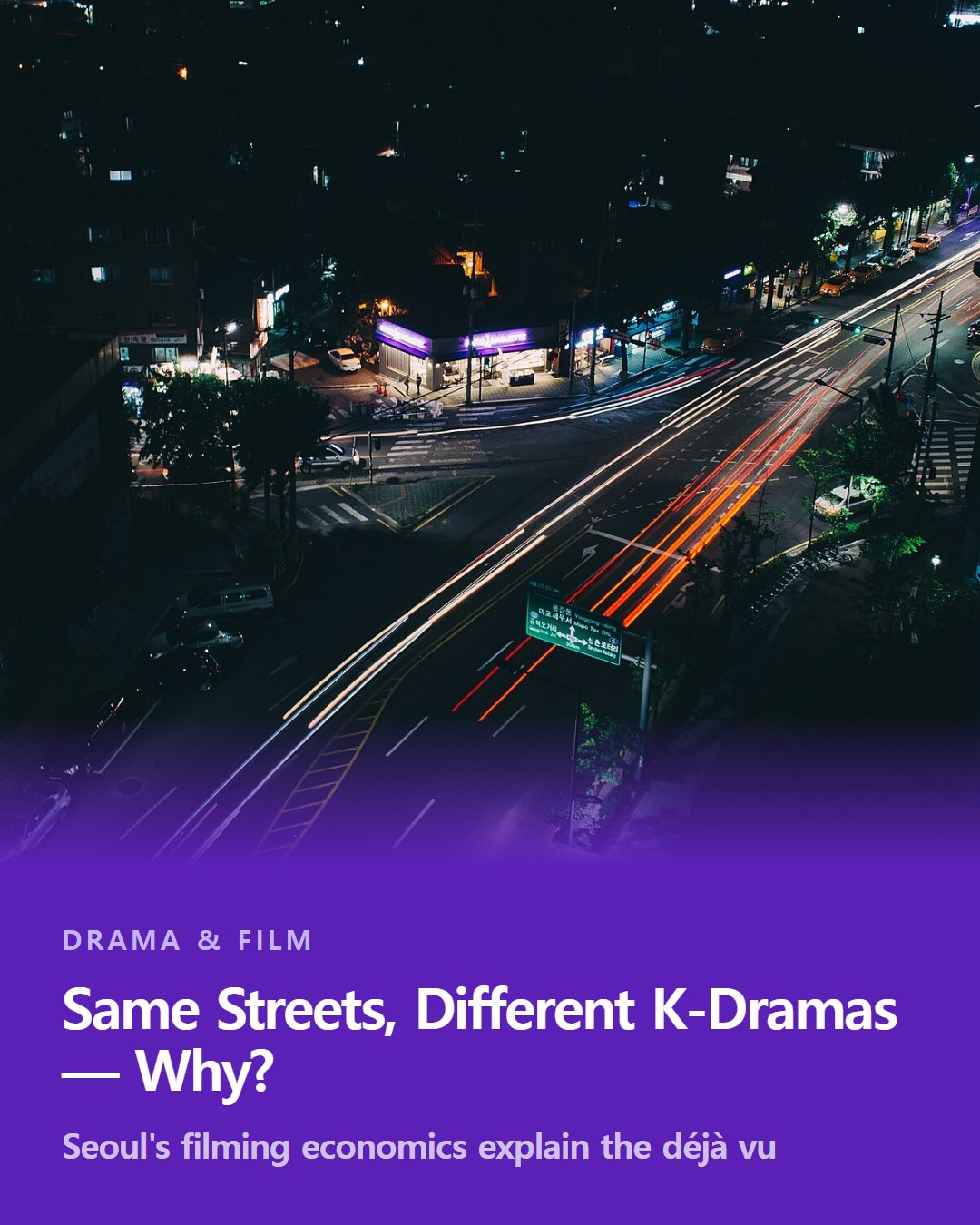
Watch a handful of Korean dramas back to back and a strange sense of déjà vu sets in: the same stone-walled alley on a hillside, the same hanok rooftop with the same skyline view, the same tree-lined street outside a café.
International viewers who binge shows made years apart often do not realize they are looking at the same six or seven Seoul neighborhoods, redressed for a new story.
Bukchon Hanok Village, Ihwa-dong, Yeonnam-dong, Seongsu-dong and Itaewon show up again and again across period pieces, office romances and youth dramas alike — sometimes within the same broadcast season.
The short version
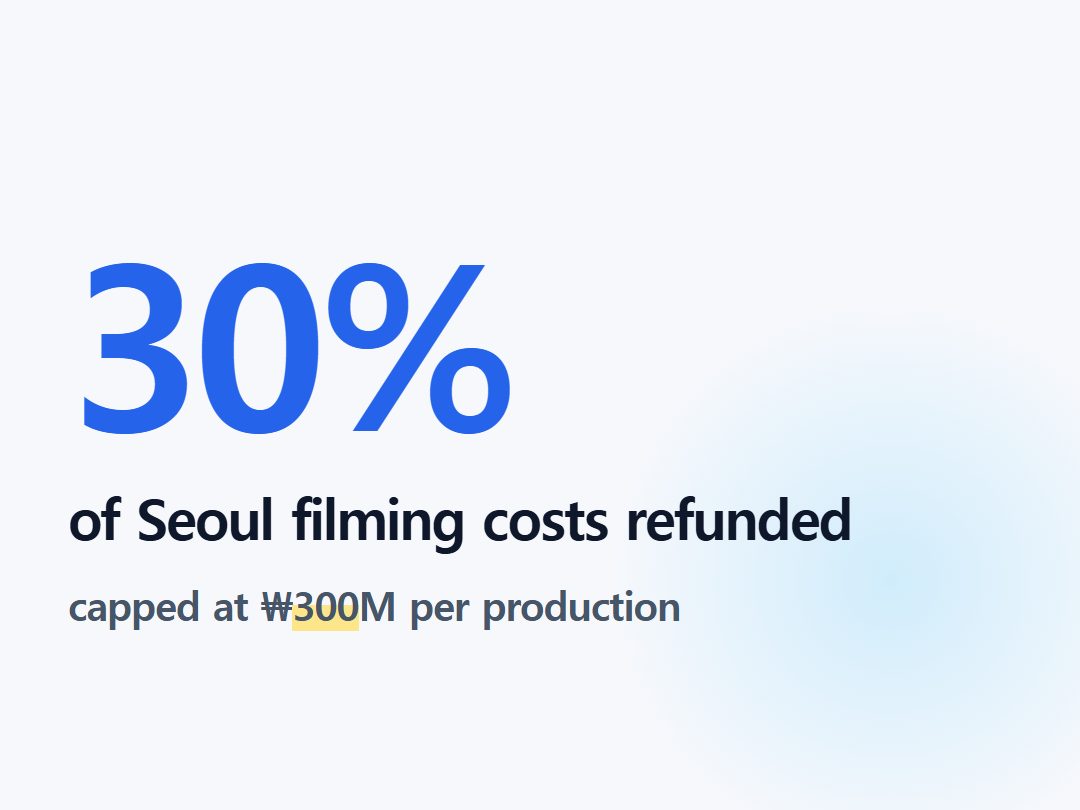
- Seoul's rebate refunds up to 30% of production costs, capped at 300 million won.
- Crews return to alleys where residents already know them — no permit required.
- Districts market drama fame even when filming happened elsewhere, like Reply 1988's set.
This is not a lack of imagination on the part of directors. It is the visible output of how Seoul funds, permits and promotes location filming: a subsidy that rewards shooting inside the city, an informal permitting culture that rewards returning to streets a crew already knows, and district governments that have learned to treat "drama filming location" as a tourism asset worth competing for.
Why do the same neighborhoods keep appearing?
A subsidy that keeps productions inside city limits
Since 2002, the Seoul Film Commission (SFC) has run a cash-rebate program that reimburses productions for a share of what they spend inside Seoul — up to 30 percent of Seoul-based production costs, capped at 300 million won (roughly $220,000) per project.
Productions that spend more than 3 billion won in the city, shoot more than half their footage there, or have signed distribution deals in five or more countries can have that cap lifted entirely.
To qualify at all, a production generally needs at least four filming days and about 100 million won in Seoul-based spending. The rebate does not care which neighborhood a crew chooses, only that the money is spent inside Seoul.
But that single rule already explains why so much Korean television is visibly set in the capital rather than scattered across the country: the incentive structure rewards staying, not exploring.
Permission is negotiated door to door, not at city hall
Once a production has committed to Seoul, choosing exactly which alley to film in is a far more informal process than viewers might assume. Shooting in a narrow residential lane is not typically something a dong (neighborhood administrative unit) or gu (district) office issues a formal permit for.
Public streets and parks generally require no permit at all in Korea; only private buildings, government facilities and corporate properties do. In practice, location managers go door to door, explain the shoot to each household along the block, and get informal consent directly from residents.
That means the easiest, cheapest alley to film in is often the one a crew has already used before, where residents recognize the production company and know roughly what to expect.
Familiarity is a cost saving, which is one reason the same alleys in Ihwa-dong or Bukchon keep reappearing rather than a scout finding a visually similar but untested street two blocks over.
Each neighborhood carries a shorthand
The repetition is also aesthetic shorthand.
Bukchon Hanok Village's preserved wooden houses, wedged between Gyeongbokgung and Changdeokgung palaces, read instantly as tradition and family weight, which is why the same rooftop-and-skyline shot turns up whenever a drama needs to signal that a character is rooted in an older Korea.
Ihwa-dong's hillside alleys — originally painted with murals under a 2006 government beautification project — read as a life that stalled: not poor enough to have given up, not successful enough to have moved on.
Newer favorites like Yeonnam-dong, a quiet grid of streets near Hongdae built around a converted rail line, and Seongsu-dong, a former shoe- and metal-workshop district now dense with converted cafés, read as contemporary, aspirational city life.
Because a single establishing shot has to communicate a mood without dialogue, productions default to locations the audience already reads fluently — and through repetition, international viewers absorb that visual vocabulary too, even without knowing the Korean concept of nunchi (눈치), reading the unspoken mood of a space, that underlies it.
Districts compete for the "pilgrimage" effect after the fact
Once a drama makes a neighborhood recognizable, the local district government often treats that recognition as an asset to build on — sometimes independent of where filming actually happened.
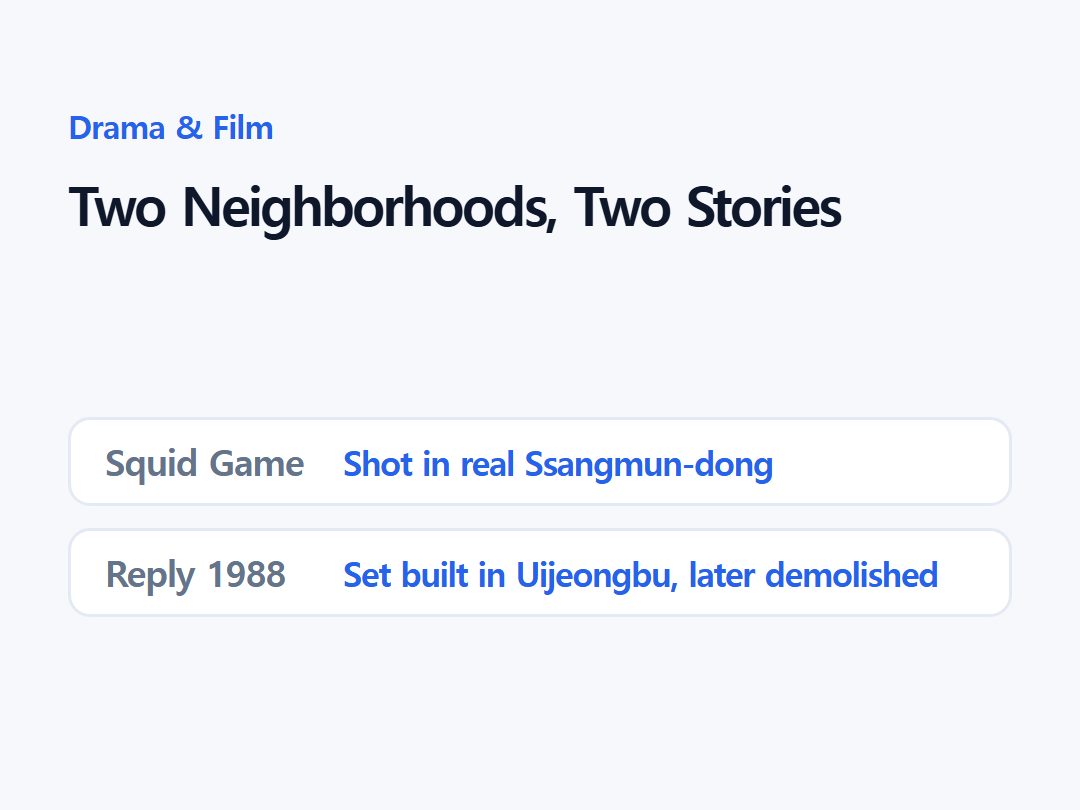
Dobong-gu, the district that contains Ssangmun-dong, installed a walking course with drama-themed signage after both Reply 1988 (2015) and Squid Game (2021) became associated with the neighborhood.
Squid Game's scenes tied to its lead character were shot in the real Ssangmun-dong, and the convenience store and half-basement house used in the show have since become visitable landmarks.
Reply 1988's street, however, was a set built in neighboring Uijeongbu and demolished after filming ended, meaning Dobong-gu is promoting a nostalgia association the show created rather than an original filming site.
Itaewon Class shows the opposite pattern: Yongsan-gu's real Itaewon saw a documented commercial lift after the 2020 drama aired, with cafés and guesthouses reporting a jump in bookings and the show's fictional bar living on today as an actual restaurant trading on the association.
Both cases show district offices actively marketing whichever "K-drama pilgrimage" identity a neighborhood has acquired, whether or not the cameras were literally there.
How one drama's fame became a national rebate
The idea of a filming location as a tourism strategy predates the current incentive system by roughly two decades. When Winter Sonata aired in 2002, Japanese fans began traveling to Nami Island in Gapyeong, Gyeonggi Province, to see the tree-lined path where the leads filmed their first kiss.
Visitor numbers there climbed from roughly 270,000 in 2001 to over 3 million annually within about a decade — a scale of drama-driven tourism no Korean tourism body had planned for, but one that officials took note of.
That lesson fed into policy over the following years. The Seoul Film Commission's rebate program, running since 2002, was joined in 2011 by a national counterpart: the Korean Film Council's Location Incentive, which offers productions, including foreign ones, up to a 30 percent cash rebate on Korean production spending.
The program is framed around more than direct production spend.
Marvel's Avengers: Age of Ultron, shot partly in Seoul in 2014, was projected to generate around $23 million in local economic benefit through tourism and jobs, a case regularly cited by Korean officials as proof that a single high-profile shoot can pay for itself many times over.
As Korean television and film exports grew through the 2010s and accelerated internationally in the 2020s, more productions chased the same rebate, and, for the reasons above, many of them gravitated toward the same easy-to-permit, visually legible neighborhoods.

Will these filming-favorite blocks survive their own fame?
The neighborhoods that make the best backdrops are also, for the same reasons, some of the most vulnerable to their own popularity.
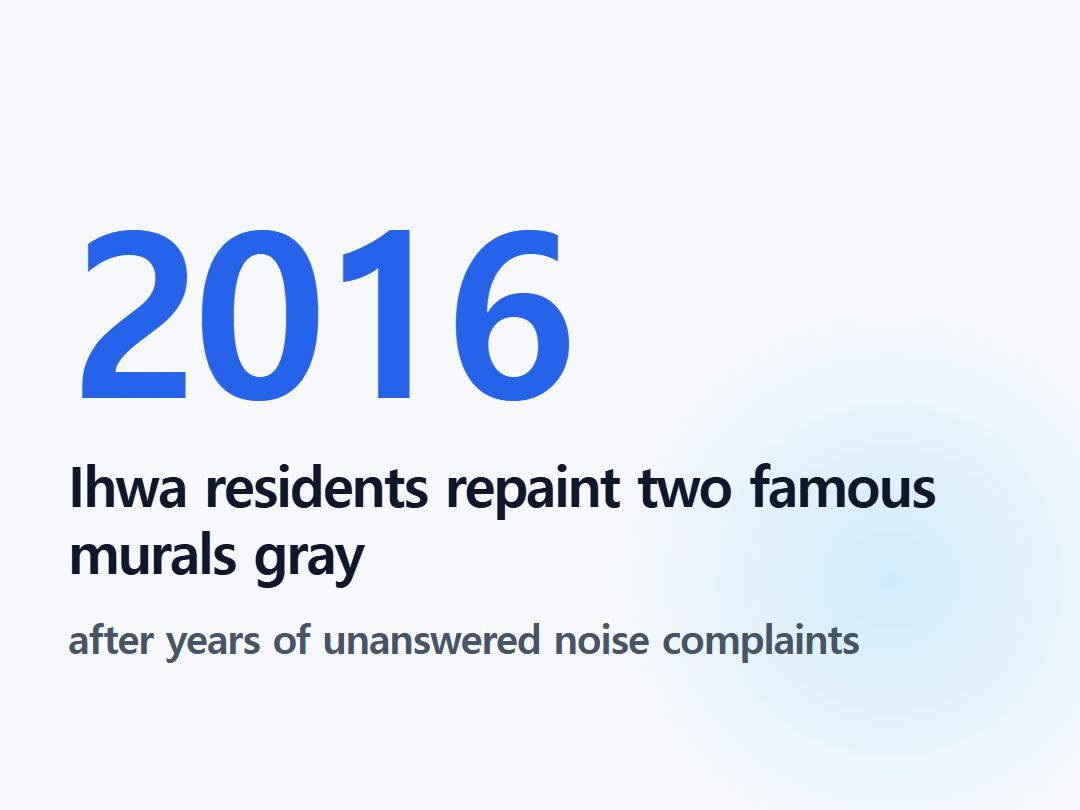
Ihwa-dong's murals have already been through two rounds of conflict: residents had roughly half the original artwork removed in 2007 after an influx of visitors following the initial mural project, and in 2016 a group of residents poured gray paint over two of the district's best-known staircase murals after years of noise and littering complaints to the Jongno district office went, in their account, unanswered.
Bukchon's most photographed alley, Gahoe-dong 31, now has resident-posted signs asking visitors to keep quiet before 8 a.m.
Neither neighborhood has stopped appearing in dramas, but both illustrate a limit on how far the current pattern can stretch before local governments have to choose between promoting filming tourism and protecting the people who still live in these largely residential streets.
Seoul officials appear to be hedging against that limit already.
The city has floated a roughly 3.3-square-kilometer content production hub, targeted for the mid-2030s, that would include purpose-built replica sets, including full-scale Joseon-dynasty palace structures, designed specifically so productions no longer need to occupy real neighborhoods for every period or heritage scene.
Whether that shifts filming away from Bukchon and Ihwa-dong, or simply adds capacity for the productions those neighborhoods can no longer absorb, is still unresolved.
So is the fate of newer filming favorites like Seongsu-dong, whose industrial-turned-hip aesthetic is itself a product of the property-value increases that drama and café tourism helped drive — the same forces that could eventually price out the workshops and low-rise streets that made it camera-ready in the first place.
What each recurring neighborhood signals on screen
| Neighborhood | Look | Meaning conveyed |
|---|---|---|
| Bukchon Hanok Village | Preserved hanok rooftops between Gyeongbokgung and Changdeokgung palaces | Tradition and family weight |
| Ihwa-dong | Hillside alleys painted under a 2006 beautification project | A life that stalled |
| Yeonnam-dong | Quiet grid near Hongdae built around a converted rail line | Contemporary, aspirational city life |
| Seongsu-dong | Former shoe- and metal-workshop district now dense with cafés | Contemporary, aspirational city life |
Frequently asked
Why do so many K-dramas film in the same Seoul neighborhoods?
Seoul's cash-rebate program only requires spending inside city limits, and location managers favor alleys where residents already recognize the crew, so productions keep returning to the same six or seven neighborhoods instead of scouting new ones.
Was Reply 1988 actually filmed in Ssangmun-dong?
No — Reply 1988's street was a set built in neighboring Uijeongbu and demolished after filming ended, though Dobong-gu still promotes a Ssangmun-dong association built on the show's fame.
How much can productions get back for filming in Seoul?
The Seoul Film Commission rebates up to 30 percent of Seoul-based production costs, capped at 300 million won (about $220,000), with the cap lifted entirely for big-budget or widely distributed projects.
Sources
Every factual claim above is traceable. We do not translate articles — we gather facts from multiple outlets and write them ourselves.
- Seoul Film Commission Incentives Overview — Seoul Film Commission
- KOFIC Location Incentive — Wikipedia
- Hallyu Fame Plus Incentives Make Seoul An Attractive Location For Foreign Shoots — Forbes
- 6 Things to Know About Filming in South Korea — Moktan Productions
- Ihwa Mural Village continues its struggle with noisy tourists — The Korea Herald
- Ihwa residents want to remove murals — The Korea Times
- "Itaewon Class" Filming Locations — Visit Korea (Korea Tourism Organization)
- Ssangmun-dong, the Hood That Defined Squid Game and Reply 1988 — Campus.sg
- Nami Island Tourism: How One Island Survived China's Ban — Seoulz
- South Korea to build a 'Hollywood' to woo K-pop and K-drama fans — Gulf News