
Watch any Korean idol group backstage at a music show and you'll see a strange ritual: a newly debuted group lines up, bows at a sharp 90 degrees, and introduces itself to a group that debuted a few years earlier — even if the "junior" members are visibly older. This isn't a fluke of etiquette.
It's sunbae-hoobae (선배-후배), the senior-junior system that structures nearly every relationship in Korean schools, offices, and entertainment.
The short version
- Korean seniority is set by entry order, not age or birth year.
- Sunbaes mentor and pay; hoobaes owe honorific speech and public respect.
- The system's rigid modern form traces partly to Japanese colonial-era institutions.
For international fans, the confusion usually starts with a simple observation: seniority in Korea often has nothing to do with age. Understanding why is one of the fastest ways to understand how Korean social life — and the K-pop industry specifically — actually works.

Why a 30-year-old rookie can be a hoobae
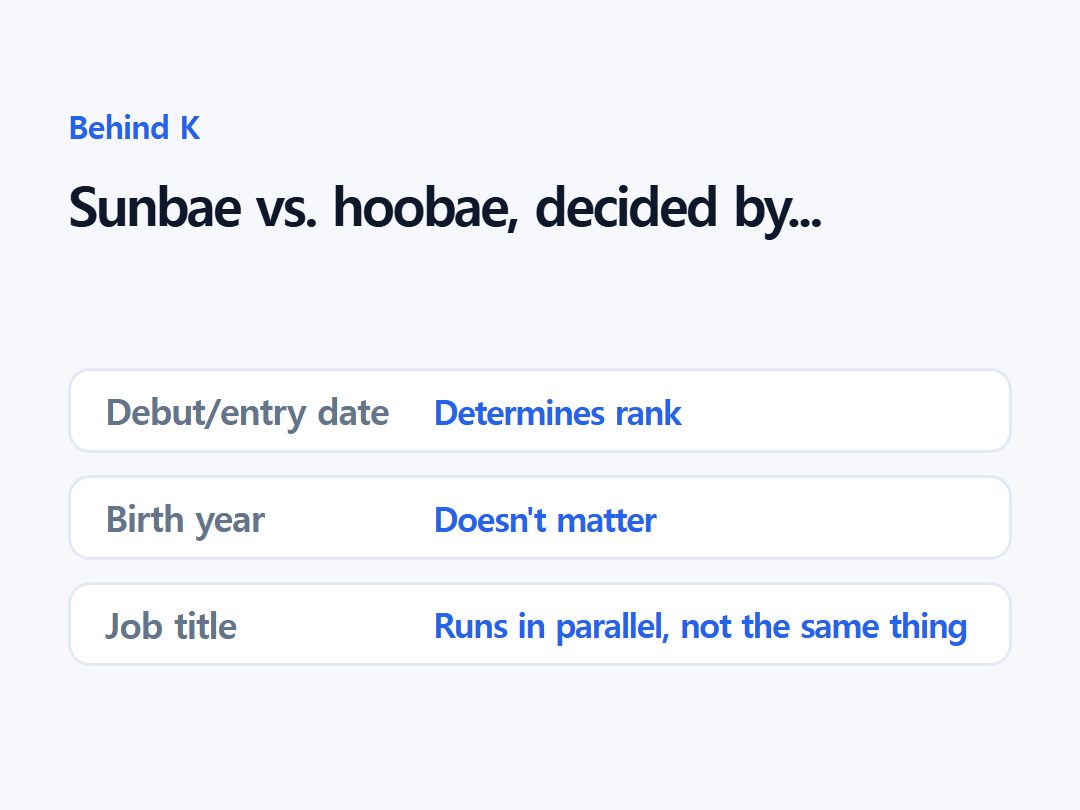
Sunbae (선배) means "senior" — someone who started before you, whether at a school, a company, or a debut. Hoobae (후배) means "junior," the person who came after. The pairing shows up everywhere: a university student one year ahead is a sunbae; an employee hired two years earlier is a sunbae; an idol group that debuted first is a sunbae group, full stop.
The rule that trips up outsiders is that this ranking is set by entry order, not by birth year. A 30-year-old rookie is still a hoobae to a 20-year-old who debuted earlier.
That single fact explains a huge amount of behavior that otherwise looks bizarre to viewers unfamiliar with Korean social norms: the deep bows, the careful language, the deference shown by artists who are, on paper, the more experienced person in the room.
Why do idols bow to senior groups backstage?
This is the piece of context most international fans are missing: sunbae-hoobae isn't a one-off custom for idols to perform on camera. It's the same social operating system used in Korean schools and workplaces, simply transplanted into the entertainment industry — and it carries real consequences when someone gets it wrong.
How the ranking is decided. In a Korean company, the employee hired first is the sunbae, regardless of who's older or who technically outranks whom on the org chart — a sunbae could be a peer with no formal authority at all, but their institutional knowledge still commands deference.
In school, the student who enrolled a year earlier is sunbae, even to a classmate who happens to be the same age or older. In K-pop, the same logic applies to debut date: BIGBANG are sunbae to BTS; BTS are sunbae to TXT, who debuted under the same label, HYBE, in 2019. None of this tracks with birth year — it tracks with who arrived first.
What sunbae status actually requires. The system isn't pure top-down authority; it's presented as a reciprocal arrangement. A sunbae is expected to mentor, look out for, and often pay for a hoobae — the stereotype of a senior buying a junior's meal is a real, widely observed norm, not just a trope.
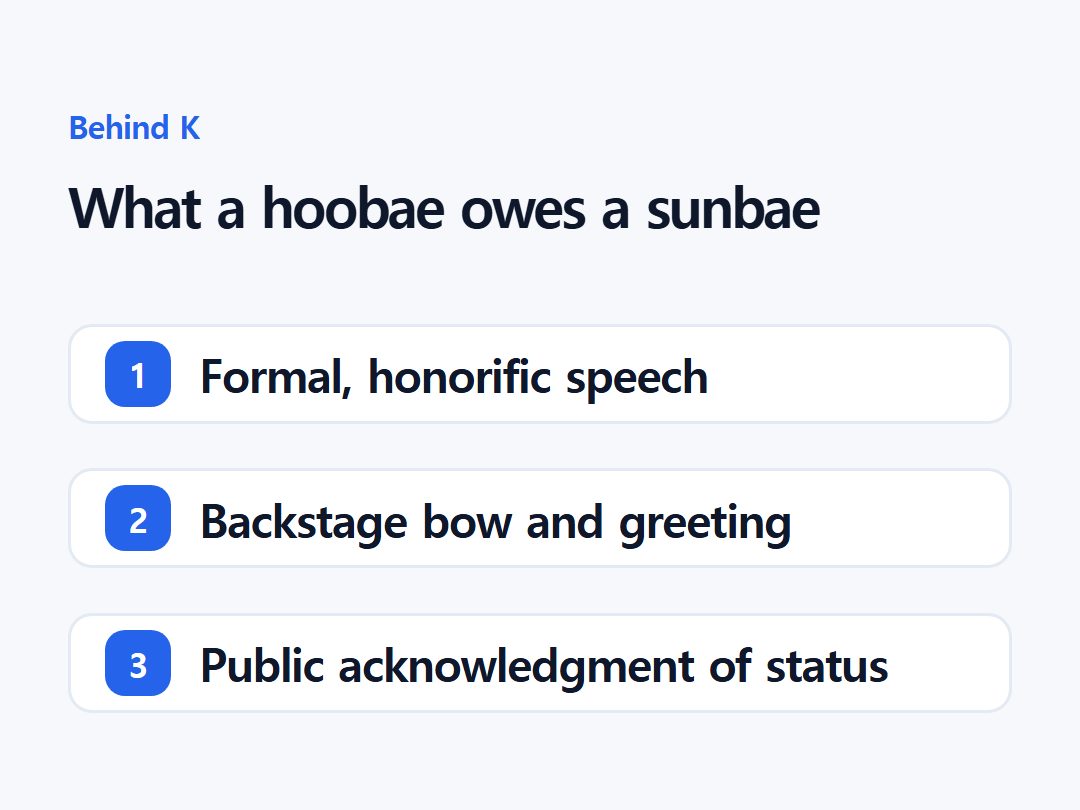
In return, a hoobae owes formal respect: honorific speech (jondaetmal), proper greetings, and public acknowledgment of the senior's status.
When a new employee joins a Korean company, they are frequently assigned a specific senior colleague as an informal mentor — not just for job training, but for the unwritten rules of the workplace.
Where it becomes visible in K-pop. The clearest place to see the system in action is backstage at Korean music shows, where newly debuted groups are expected to visit the waiting rooms of senior groups, bow deeply, and introduce themselves — a ritual fans call "insa" (인사, greeting).
Getting this wrong is treated as a real offense, not a minor slip.
In one widely cited case, singer Ki Kwang was criticized industry-wide for addressing veteran musician Seo Taiji as "Seo-ssi" (roughly "Mr. Seo") on a television broadcast instead of using the honorific "sunbae-nim" — a lapse read as genuine disrespect toward someone who effectively pioneered the modern Korean pop industry.
An entertainment industry official later told reporters that as idol groups became more competitive, the traditionally clear line between sunbae and hoobae was "becoming less apparent and beginning to cause problems" — an acknowledgment that the system, while old, is still actively policed.
Age can complicate but doesn't override it. The system gets genuinely tangled when a group's chronological seniors keep debuting later than a company's original members.
Girl group KARA, who debuted five years before some rival groups, publicly noted that certain hoobae groups weren't offering proper greetings — even though some of those hoobae members were, in age terms, considerably older than KARA's own members.
Korea runs two hierarchies simultaneously: an age-based one and a seniority-based one, and they don't always point the same direction.
In practice, this means even a group with sunbae status is still expected to use polite language and bow to members who are older by age, while those older hoobae members must still address the earlier-debuted group with formal respect.
Girl group member Sejeong of gugudan described this balancing act on the variety show Knowing Bros: after re-debuting through a survival show, she treated some newer groups casually as her own hoobaes, while still greeting a fellow member who had debuted earlier elsewhere as a sunbae — sometimes within the same conversation.
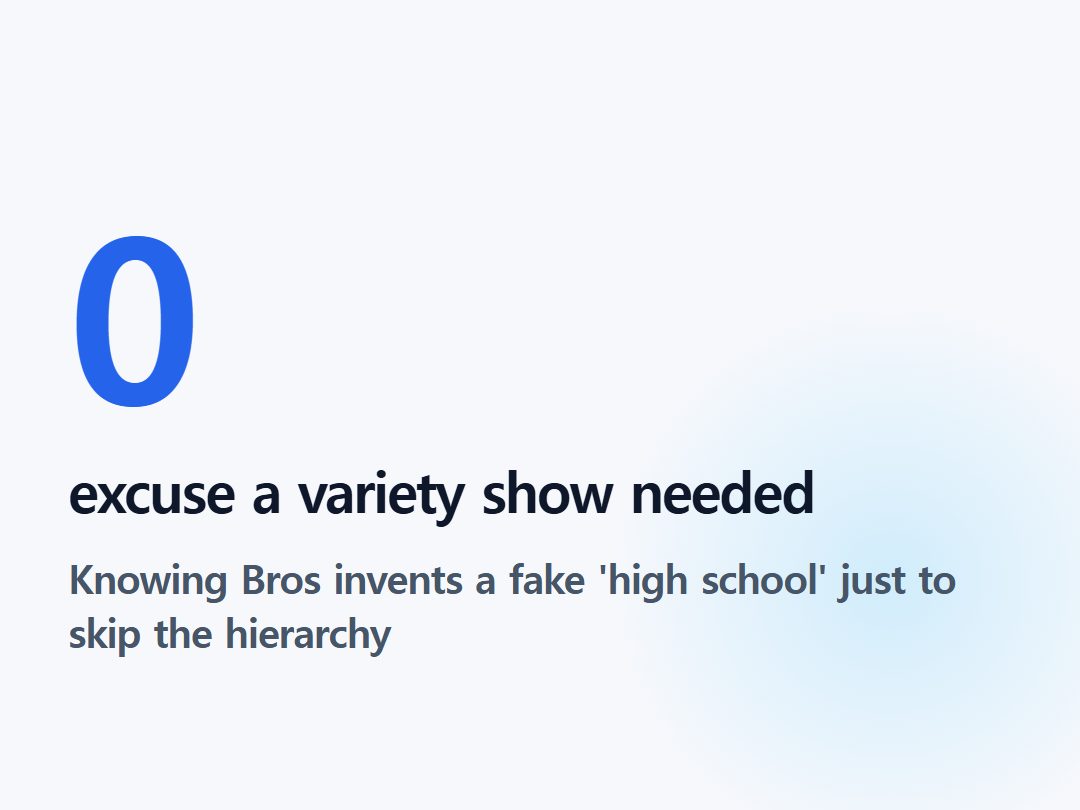
This is also why the format of a given variety show matters. Knowing Bros deliberately flattens the hierarchy by having its cast use informal banmal speech with every guest regardless of age or debut order, built around a fictional "high school" premise where normal sunbae-hoobae rules are suspended for comic effect.
That the show has to construct an artificial excuse to bypass the hierarchy is itself evidence of how binding the real-world rule normally is.
How Japanese colonial rule hardened the hierarchy
The sunbae-hoobae framework traces back to Confucian social philosophy, which structured relationships around fixed roles — younger defers to older, junior defers to senior — in exchange for the senior's protection and guidance. That base has been part of Korean social life for centuries.
Its stricter, more rigid modern form, however, is often linked to a more recent and less flattering source: Japanese colonial-era institutional culture.
Some accounts trace the harder edges of the system — strict rank enforcement, mandatory deference, and the disciplinary culture found in Korean schools and the military — to Japanese military organizational structures imposed during the 1910–1945 colonial period and later carried into the postwar Korean armed forces, whose early command structure included officers trained under Japanese and Manchukuo military systems.
Some cultural historians note that before this period, Koreans reportedly socialized more freely across a roughly five-year age range; the sharper, rank-conscious version of sunbae-hoobae culture is thought to have hardened afterward.
By the time Korea's modern entertainment industry took shape from the 1990s onward, this senior-junior framework was already the default operating logic for any organization with clear entry cohorts — schools, corporations, the military — so idol agencies simply inherited it.
A trainee who debuts first outranks a trainee who debuts later, the same way an employee hired first outranks one hired later, regardless of who is actually older or who trained longer.
Is the sunbae-hoobae hierarchy getting harder to enforce?
The system is not static.
Multiple sources note that as the idol industry has become more crowded and more commercially competitive, the traditional clarity of sunbae-hoobae lines has started to blur — with factors like a group's popularity now sometimes complicating what used to be a straightforward debut-order ranking.
Expect continued friction points: idols who debut later in life after years as trainees, survival-show contestants who re-debut and end up with confusing dual sunbae-hoobae status toward the same peers, and ongoing public callouts — like the KARA and Ki Kwang cases — when the etiquette isn't observed.
None of that changes the underlying rule. It just means international fans watching Korean variety shows or backstage clips will keep running into it, usually without realizing there's a rulebook behind the bowing at all.
How sunbae status is determined by context
| Setting | Who is the sunbae | Basis for rank |
|---|---|---|
| Company | Employee hired first | Hire date, not job title or age |
| School | Student who enrolled a year earlier | Enrollment year, not age |
| K-pop | Group that debuted first (e.g., BIGBANG over BTS) | Debut date, not age |
Frequently asked
What does sunbae and hoobae mean in Korean?
Sunbae (선배) means senior, someone who started earlier at a school, job, or debut, while hoobae (후배) means junior, the person who came after.
Is sunbae-hoobae based on age or debut date?
It's based on entry order, such as enrollment year, hire date, or debut date, not birth year, so an older rookie can still be a hoobae to a younger senior.
Why was Ki Kwang criticized for how he addressed Seo Taiji?
Ki Kwang called veteran musician Seo Taiji 'Seo-ssi' on a broadcast instead of the honorific 'sunbae-nim,' which was widely read as disrespect toward a pioneer of Korean pop.
Sources
Every factual claim above is traceable. We do not translate articles — we gather facts from multiple outlets and write them ourselves.
- How the Terms "Sunbae" and "Hoobae" Work in the K-Pop Industry — Soompi
- What Is a Hoobae and Why It Shapes Everything at Work — Franvia
- "SunHoo Culture" (Sunbae – Hoobae Culture) — Borasaekvision
- Hazing in the Republic of Korea Armed Forces — Wikipedia
- gugudan's Sejeong Bashes "Rude Hoobae" on Knowing Bros, Netizens Busy Figuring Out Who — Koreaboo
- Knowing Bros — Wikipedia
- What Does Sunbae Mean in Korean Culture? — Korean Girl Explains