International fans watching K-pop broadcasts often notice something Western award shows rarely show: idols bending sharply at the waist, sometimes holding it for several seconds, to greet people barely older than themselves.
The short version
- Bow depth in K-pop signals rank, not just politeness — debut date decides seniority.
- IVE faced backlash in 2021 for not bowing back to senior idols on air.
- Idols train for years in formal etiquette classes before they're allowed to debut.
The gesture ranges from a quick nod to a full 90-degree fold, and occasionally further, to a bow performed on both knees. None of it is random — in Korea, every angle carries a specific social meaning.
The question comes up often enough in international fan spaces that it's worth unpacking properly: who bows to whom, how deep, and why getting it wrong occasionally turns into a genuine controversy.
From a nod to a full kneeling bow
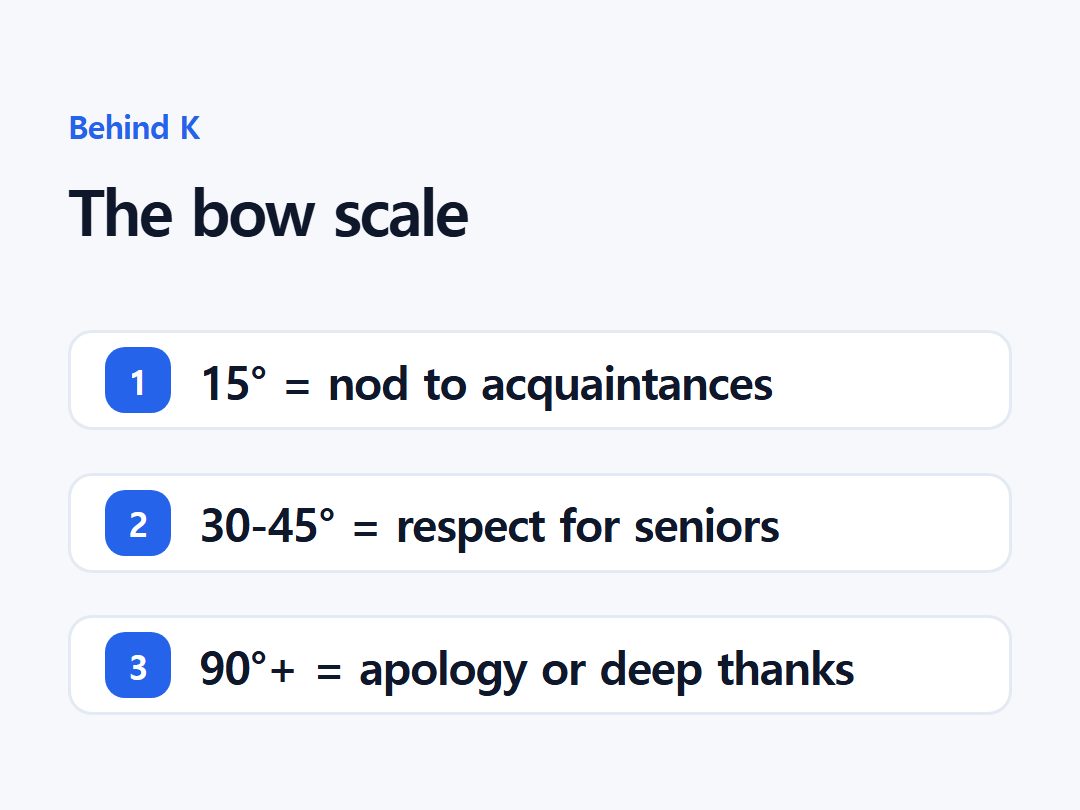
Korean bowing etiquette runs on a rough sliding scale. A 15-degree bow is barely more than a nod — Koreans call this a mokrye, or "neck bow," used for a shopkeeper or someone already greeted earlier that day.
A 30-degree bow is the default for a first meeting. From there, the depth rises with the stakes:
- 30–45 degrees for someone senior, like a boss or a partner's parents
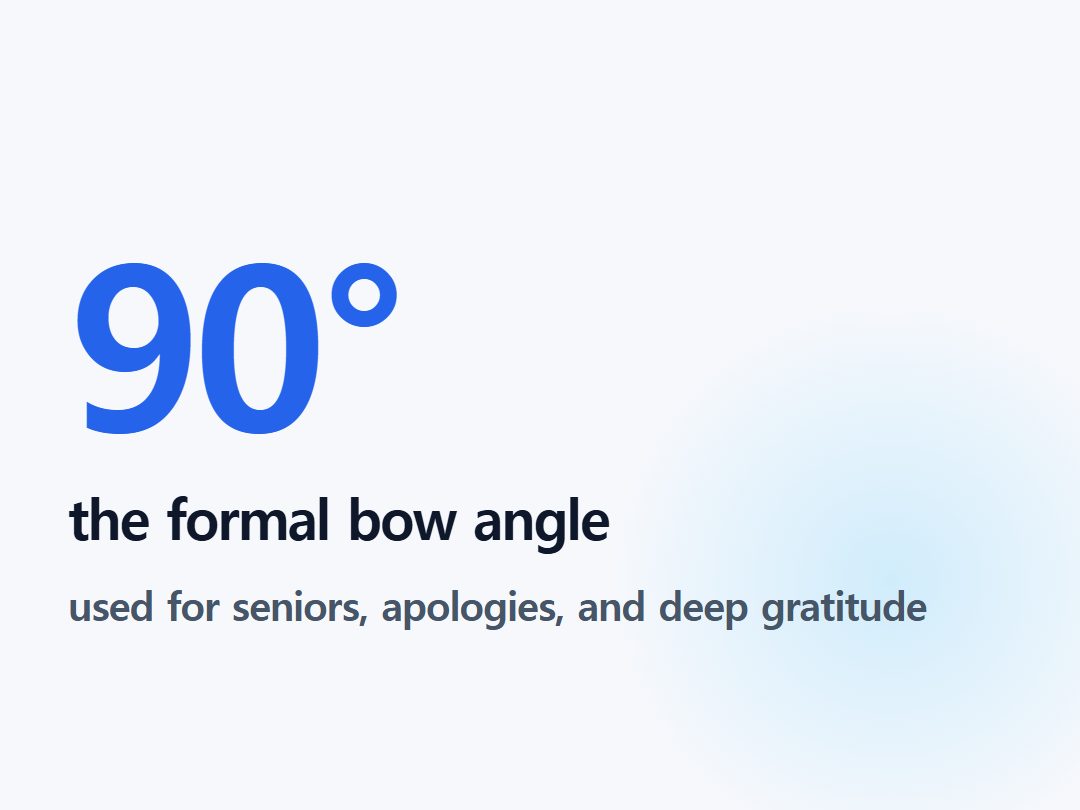
- 45–90 degrees for a formal apology or genuine gratitude
- A full kneeling bow, called jeol (절), for ancestral rites, Lunar New Year, or extreme thanks
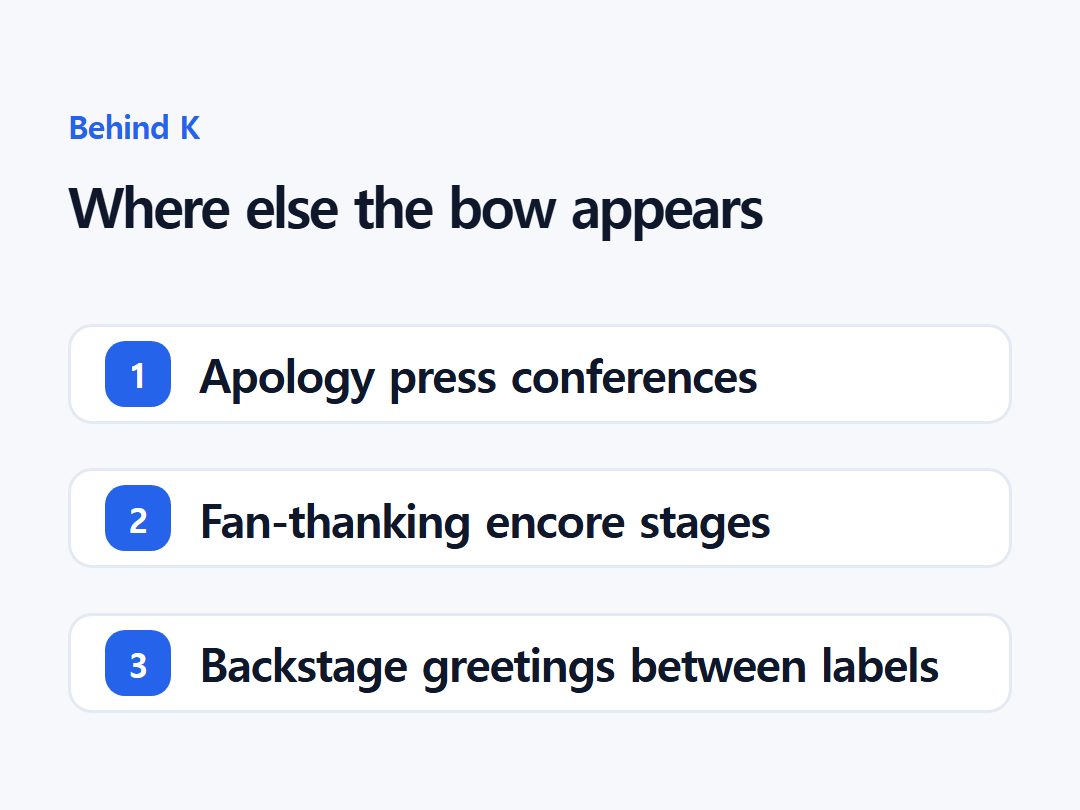
K-pop idols move through this entire range on a single broadcast: a light nod to a staff member, a 90-degree bow to a senior artist, a kneeling jeol to fans during an encore stage.
Debut order outranks age
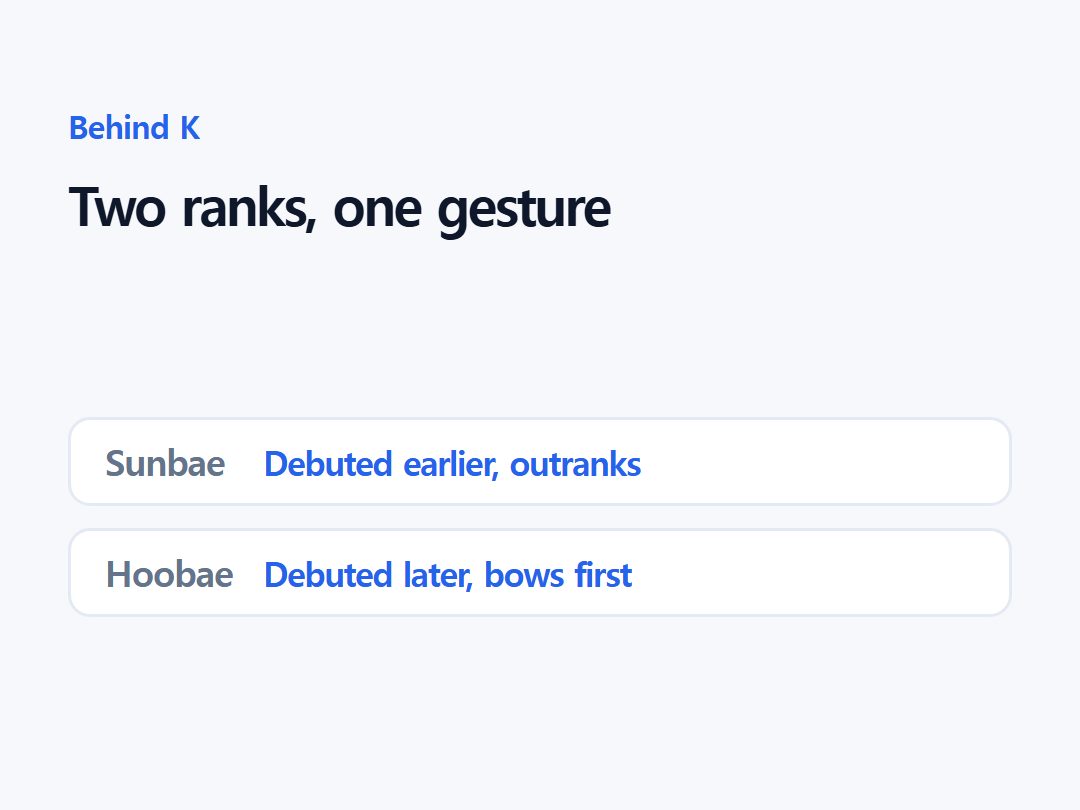
The bow's real function in K-pop is tracking a hierarchy called sunbae-hoobae (선배-후배): senior and junior. What determines rank isn't birth year — it's debut date.
A 19-year-old who debuted in 2015 outranks a 25-year-old who debuted in 2023. A group's youngest member can technically be senior to an older rookie in a different group, and is treated accordingly on set and backstage.
This is the part international fans usually miss: the bow functions as a public scoreboard of who has been in the industry longer, not a generic politeness ritual.
How idols sort rank in shared backstages
Broadcast stations film several groups from competing agencies back to back, and the artists share the same hallways and green rooms between takes. Debut order has to be sorted out fast, often between people meeting for the first time.
Getting it wrong is treated as arrogance, not an honest mistake. Around 2012, veteran group T-ara faced public criticism from a fellow musician who said the members failed to greet colleagues at events and in recording studios — a complaint specifically about skipped bows, not musical ability.
What happened when IVE didn't bow back?
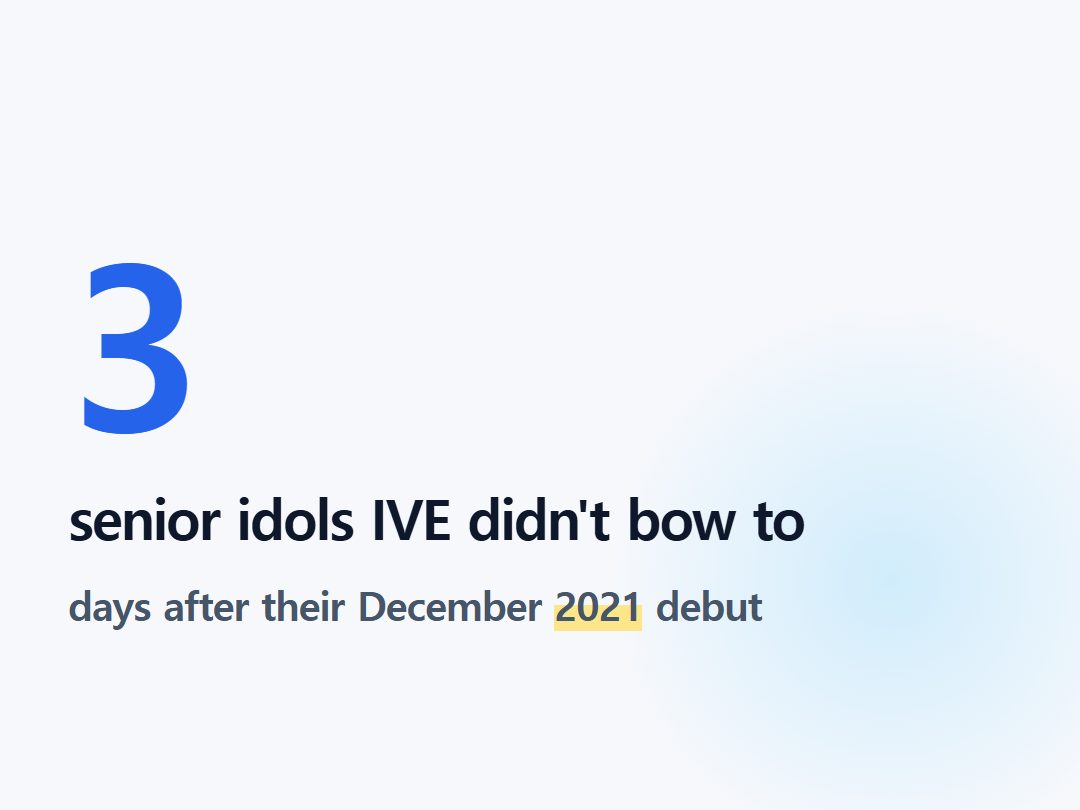
Because the gesture is legible to every Korean viewer, skipping it is legible too. In December 2021, days after their debut, girl group IVE won a trophy for "Eleven" on the show Music Core.
Three senior idols presenting the award — NCT's Jaemin, former IZ*ONE member Minju, and Stray Kids' Lee Know — bowed to congratulate them, but most of IVE did not bow back. Clips circulated within hours.
Members Jang Wonyoung and An Yujin were singled out for criticism since both had prior stage experience through IZ*ONE and, commenters argued, should have known the etiquette. IVE reportedly bowed more visibly in later appearances.
Seniors are expected to bow back too
Korean etiquette technically requires seniors to bow back, not just receive bows. Former Kara member Goo Hara once described her group bowing 90 degrees to a junior girl group, only for the juniors to respond with a mere nod — a breach read as disrespectful precisely because reciprocity is expected.
Idols who get the reciprocity right become minor viral moments themselves. BIGBANG's G-Dragon is frequently cited by fans for bowing properly at every public appearance despite his seniority, and BLACKPINK's Rosé was praised online for a bow estimated at "110 degrees" — deeper than required — when greeting an elder artist.
Idols with Chinese backgrounds face bowing backlash
The expectation runs into friction with idols who didn't grow up in Korea. Several members with Chinese backgrounds — including EVERGLOW's Yiren, aespa's Ningning, and Seventeen's Jun and The8 — have faced online criticism for bowing from the shoulders instead of the full 90-degree fold.
In Chinese etiquette, the deep bow is typically reserved for parents and ancestors, not colleagues. Korean commenters have split on this: some accept the cultural difference, others argue that working in Korea means following Korean norms regardless of where an idol grew up.
Apology bows follow their own escalating rules
Apology bows follow their own logic, and appear when a public figure is responding to criticism rather than greeting a colleague. Actor Kim Soo-hyun bowed to reporters in 2025 while addressing allegations about a past relationship, and Shinsegae Group's chairman opened a public apology over a marketing controversy with the words, "I sincerely bow my head."
The rule of thumb is straightforward: the deeper the bow and the longer it's held, the more serious the acknowledged wrongdoing. It functions as a visible, timestamped admission — Korean public life's closest equivalent to a formal apology performed on camera.
Idols are trained to bow, not born knowing how
None of this is instinctive; it's taught. Trainees at major entertainment agencies — companies that recruit, house, and train aspiring idols for years before debut, a structure known as the agency system — take formal etiquette classes alongside vocal and dance lessons.
Former trainees have described being corrected for details as small as bowing with their hands in a coat pocket. Manners are evaluated the same way singing and dancing are, through regular assessments during the training years.
Trainees typically spend two to five years in this system before debut, often practicing eight or more hours a day. Etiquette is a small slice of that schedule, but agencies treat it as inseparable from stage readiness — a trainee who can't greet a senior properly isn't considered ready to debut, regardless of vocal ability.
Bowing traces back to Confucian court ritual
The gesture predates K-pop by centuries. Korean bowing traces back to Confucian court ritual imported from China and formalized further during the Goryeo dynasty (918–1392), when bow depth marked exact rank at court.
Traditional Korean etiquette actually recognizes more than the simple degree scale used today. Older classifications describe four distinct bows, graded by who is bowing to whom:
- Ban-jeol ("half-bow") — an elder's light bow back to someone younger
- Pyong-jeol ("ordinary bow") — exchanged between people of equal status
- Keun-jeol ("deep bow") — performed at birthdays and banquets by juniors
- Bae-rye — the deepest bow, reserved for coming-of-age, weddings, funerals, and ancestral rites
The kneeling jeol that idols perform for fans during encores comes from the same lineage as the bow Koreans give grandparents at Lunar New Year. When an idol drops to both knees on stage, they're extending a gesture normally reserved for family elders to an audience of strangers.
Will K-pop bowing etiquette adapt to global idols?
The etiquette hasn't fully caught up with how international K-pop's membership has become. Groups increasingly include members who didn't grow up inside this hierarchy, and agencies haven't publicly clarified whether the rules bend for them.
Online scrutiny of idols' bows also cuts both ways. Some fans defend it as basic respect; others call the frame-by-frame criticism excessive for a gesture that lasts under two seconds.
There's also a generational undercurrent. Some younger Korean viewers have begun questioning whether debut-order hierarchy still deserves this much weight in an industry that increasingly markets itself on individuality. How agencies and fandoms settle that tension as rosters keep diversifying remains an open question.
A quick reference for every bow angle
| Angle | Name | Used for |
|---|---|---|
| ~15 degrees | Mokrye (neck bow) | A shopkeeper or someone already greeted earlier that day |
| ~30 degrees | Standard bow | A first meeting |
| 30-45 degrees | Formal bow | Someone senior, like a boss or a partner's parents |
| 45-90 degrees | Deep bow | A formal apology or genuine gratitude |
| Full kneel | Jeol | Ancestral rites, Lunar New Year, or extreme thanks |
Frequently asked
Why do K-pop idols bow to each other?
The bow tracks Korea's sunbae-hoobae hierarchy, where seniority is based on debut date rather than age.
What happened with IVE and bowing?
In December 2021, most of IVE didn't bow back after senior idols congratulated them on a show, and clips of the moment circulated widely.
How long do K-pop trainees train before debuting?
Trainees typically spend two to five years training, often eight or more hours a day, with etiquette classes assessed alongside singing and dancing.
Sources
Every factual claim above is traceable. We do not translate articles — we gather facts from multiple outlets and write them ourselves.
- Wonyoung and IVE were criticized for not bowing to seniors on a music show — Kbizoom
- The act of bowing and its importance in the Kpop industry: why some idols got into trouble for not bowing — Kbizoom
- Polite idols who are famous for their 90-degree bow habit — Kbizoom
- The importance of the 90-degree bow in K-pop — Seoulbeats
- Why Do Koreans Like To Bow? Exploring Jeol Culture In Korea — Kpopmap
- Kim Soo Hyun tearfully denies controversial claims about relationship with Kim Sae-ron at press conference — CNN
- 'All responsibility is mine,' Shinsegae chief bows in apology — The Korea Herald