
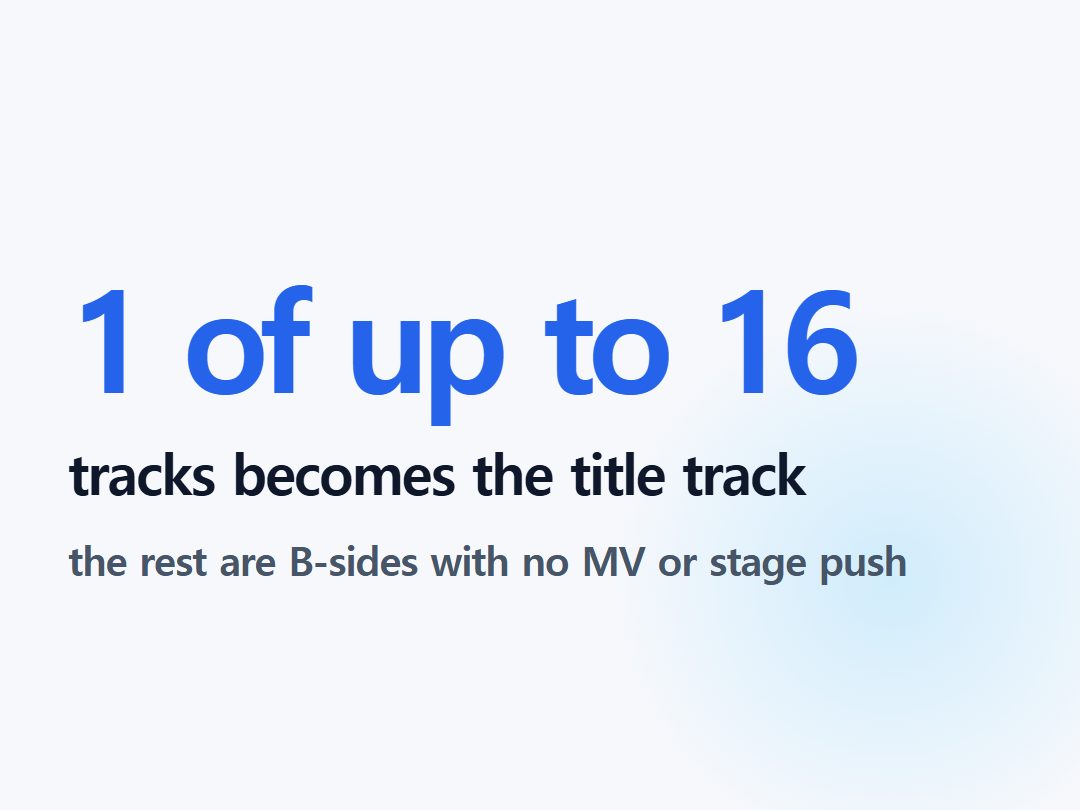
When a K-pop group "comes back" — industry shorthand for releasing new music after a promotional break — only one song from the album gets a music video, a choreography built for weekly TV performances, and a full marketing budget. That song is the title track (타이틀곡).
Everything else on the album is a "B-side," heard by fans but rarely performed live or pushed to algorithms.
For international listeners used to albums being judged as a whole, or to lead singles emerging organically from streaming and radio play, this structure — and the fact that a company decides it in advance — is one of the more distinctly Korean parts of how K-pop works.
The short version
- One song per comeback gets the video, choreography, and full marketing budget.
- Agencies usually pick the title track internally, not by fan vote.
- Mnet was later found to have manipulated some Produce 101 vote totals.
The pick happens before fans see a teaser
There is no single news event behind this explainer. It is a structural feature of how nearly every K-pop release is built, repeated every time a group announces a comeback.
Before a single teaser image is posted, the group's agency — the management company that trains, produces, and promotes the act, sometimes called the "agency system" in K-pop coverage — has already chosen which of the album's six to sixteen tracks will carry the entire promotional cycle.
According to songwriters interviewed by Koreaboo, the process usually starts earlier than fans assume: it begins when the company locks in the group's concept — the visual style, sound, and narrative theme for that era — and title-track candidates are then written or selected to fit it, rather than a finished album being scanned afterward for the best song.
Do fans actually choose the title track?
To an outsider, promoting one song instead of an album can look like an odd, restrictive choice.
It is actually the load-bearing wall of the K-pop release model, and understanding it explains a lot of the genre's surface-level oddities — why a group's discography can feel top-heavy, why some fans complain their favorite song was “just a B-side,” and why chart data outside Korea sometimes tells a different story from chart data inside it.
It is a resource decision first. A title-track cycle means an original music video, a full stage outfit and set concept, a new choreography rehearsed to broadcast standard, and paid promotion across teasers, short-form video, and weekly televised music shows such as Music Bank, Show! Music Core, and Inkigayo.
Extending that budget to every track on an album is not realistic for most agencies, so companies concentrate resources on one song engineered to work in the first fifteen seconds, hold up in a live TV performance, and read clearly on a phone screen.
B-sides are written with more freedom precisely because they don't have to do any of that.
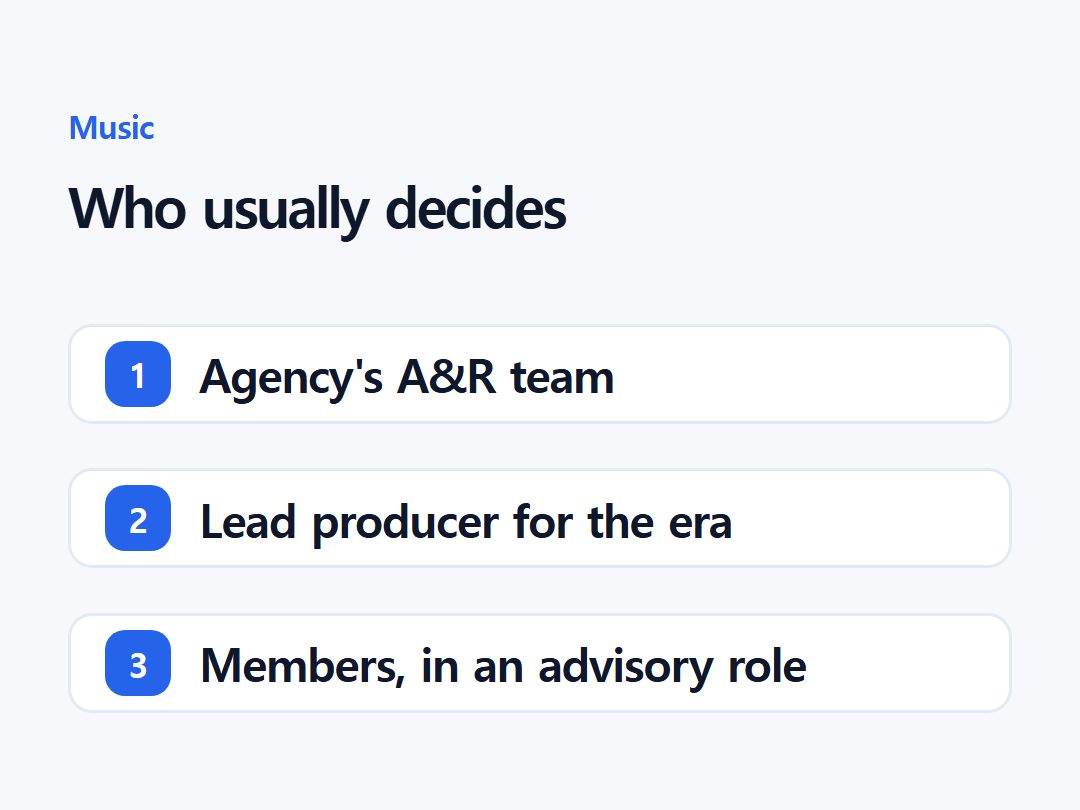
It is usually an internal call, not a fan vote. For a standard comeback, the decision sits with the agency's A&R team (the staff who commission and select songs) together with the lead producer, based on which demo best fits the group's concept and commercial goals.
Girls' Generation described this dynamic plainly when discussing their 15th-anniversary title track: producer Kenzie “customized” the song for the group at their request, telling Billboard the members chose to work with her specifically “because she knows us best.” Member input exists, but it is generally advisory within a process the company controls end to end.
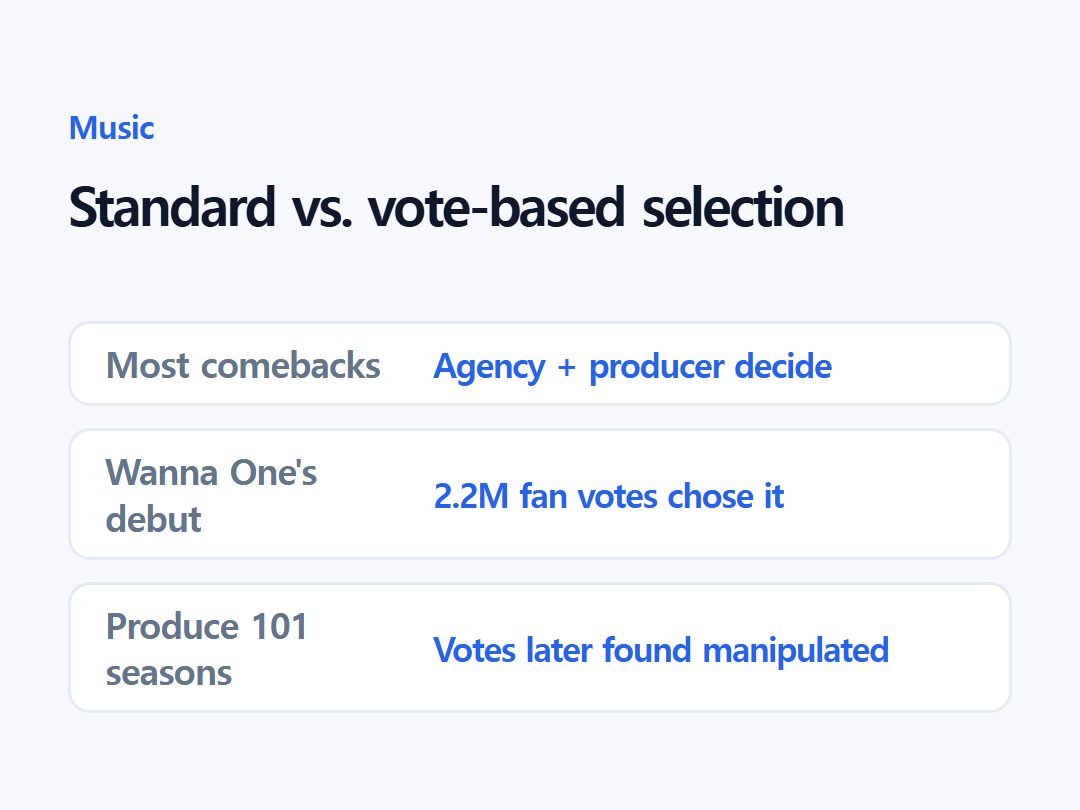
Genuine fan voting is the exception, mostly tied to survival shows. The clearest example remains 2017's Wanna One, a temporary group formed from the competition show Produce 101 Season 2.
Ahead of their debut, the group's reality series had fans vote between two finished tracks, “Energetic” and “Burn It Up,” to decide the title track; “Energetic” won with over 2.2 million votes and became the single, while the runner-up still received its own music video, Soompi reported.
Mnet's follow-up show, Produce X 101, similarly let viewer votes help decide which trainee would center the season's title track.
But this model carries real risk: Mnet producers were later found to have manipulated vote totals across multiple seasons of the Produce 101 franchise, and were prosecuted for it, according to reporting confirmed by outlets covering the scandal.
“Fan choice” on these shows was, in at least some seasons, partly staged — a caution against assuming every vote-branded selection is what it claims to be.
Even collaborative writing doesn't mean an open pitch process. BTS's “Butter” was written with an outside team led by songwriter Jenna Andrews, who told Variety her team worked through the night with the group in South Korea, giving each member roughly 20 minutes in the booth and trading voice-memo suggestions back and forth.
That is real creative input from the artists — but the song was already positioned as the group's next English-language single by their label, Big Hit Music, before that session began. The company still set the release strategy; the studio process shaped the song within it.
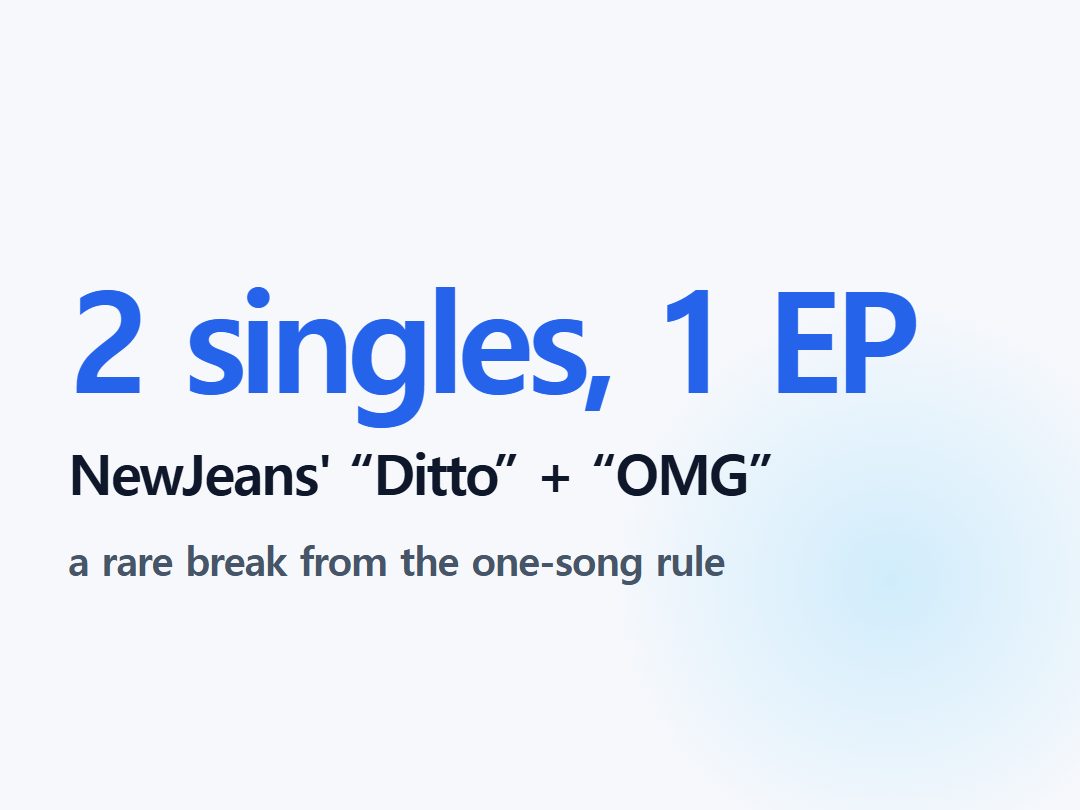
The one-song rule is also starting to bend. NewJeans' agency ADOR broke from convention with the single album “OMG”: it released “Ditto” as a pre-release track with no formal title-track push, and it topped domestic charts and reached the Billboard Hot 100 anyway, according to Korea Herald coverage of the rollout.
The official title track “OMG” then charted separately, giving the group two hit singles from one release cycle instead of one designated winner.
It is still the exception rather than the rule, but it shows agencies experimenting with the model once digital streaming, rather than TV broadcast, became the primary way songs reach listeners.
Built for the TV era, bent by streaming
The title-track system grew out of a broadcast-era music industry built around a small number of weekly TV music shows, where a group could realistically prepare and perform only one polished stage per comeback.
Concentrating a full production budget, choreography, and media rollout on a single song made sense when television exposure decided a release's fate.
Some Korean commentary has called it an example of “Galapagos syndrome” — a system that evolved a distinct shape in isolation from the album-oriented or single-driven models used elsewhere.
The rise of trainee survival shows in the 2010s, particularly the Produce 101 franchise, briefly opened part of that process to public voting, letting viewers pick a debut single or a performance center.
That experiment showed both the appeal and the danger of outsourcing the decision: fan investment surged when audiences felt they had a say, but the manipulation scandal that followed showed how easily a “vote” could be presented as more open than it really was.
Streaming and short-form video have since added new pressure on the model, since a song now has to work as a 15-second clip as much as a three-minute broadcast stage — one reason agencies increasingly test multiple candidate tracks, and occasionally, as with NewJeans, promote more than one.
Will more agencies promote two songs at once?
Two things remain unsettled. First, whether more agencies follow ADOR's lead and formally promote two songs instead of one — a shift that would spread production budgets differently and could change how music shows, which are still generally structured around a single “title stage” per group, adapt their formats.
Second, whether member input in title-track selection keeps expanding.
Fourth-generation idols are more frequently credited as co-writers and consulted earlier in concept planning than in previous eras, but the final call — which song gets the video, the choreography, and the marketing spend — still sits with the agency.
Until that changes structurally, the title track will remain the clearest example of a K-pop release being a company's strategic bet as much as an artist's musical statement.
Four different ways agencies have picked a title track
| Model | Who decided | Example |
|---|---|---|
| Standard comeback | Agency A&R team + lead producer | Girls' Generation's Kenzie-produced anniversary title track |
| Survival-show vote | Fan vote (later shown to be partly manipulated) | Wanna One's "Energetic" beat "Burn It Up," 2.2M+ votes |
| Collaborative writing | Outside songwriters, but label set the strategy first | BTS's "Butter" with Jenna Andrews' team |
| Two-track experiment | Agency promoted two songs instead of one | NewJeans' "Ditto" (pre-release) and "OMG" (title track) |
Frequently asked
What is a title track in K-pop?
It's the single song from an album that gets a music video, broadcast choreography, and the full promotional budget, while other tracks ("B-sides") get little or none.
Who picks the title track, the group or the company?
Normally the agency's A&R team and lead producer choose it based on the group's concept; member input is usually advisory, not final.
Was the Produce 101 fan vote rigged?
Yes — Mnet producers were found to have manipulated vote totals across multiple seasons of the Produce 101 franchise and were prosecuted for it.
Sources
Every factual claim above is traceable. We do not translate articles — we gather facts from multiple outlets and write them ourselves.
- Here's How A K-Pop Title Track Is Picked, According To Professional Songwriters — Koreaboo
- Girls' Generation Reunion Interview: 'Forever 1' Album & K-Pop Growth — Billboard
- Watch: Wanna One Makes "Energetic" Debut With MV For First Title Track — Soompi
- 'Produce 101' K-pop Boy Band Wanna One Debuts With 'Energetic' — Billboard
- "Produce X 101" To Commence Viewer Voting As Factor For Choosing Title Track Center — Hello Kpop
- Mnet vote manipulation investigation — Wikipedia
- BTS Talks Behind The Scenes On "Butter" As It Spreads Up The Charts — Variety
- The Players Behind BTS' 'Butter': See the Full Credits — Billboard
- NewJeans' new title track "OMG" follows success of "Ditto" while MV draws controversy — The Korea Herald