
Scroll through any K-pop group's profile and you will find one member labeled the "maknae" (막내). It is not a stage role like lead vocalist or dancer. It is a fact of birth: whoever was born last is the maknae, whether the group has two members or thirteen.
The title cannot be auditioned for, trained into, or earned through skill. It simply arrives with a birth certificate, and it never goes away, even after the member turns 30.
The short version
- Maknae is assigned by birth order, not talent, skill, or audition.
- The youngest must use honorifics like hyung or noona; older members don't.
- This hierarchy traces back to Confucian tradition roughly two thousand years old.
To international fans, "maknae" often reads as a cute nickname, shorthand for "the baby of the group." That is not wrong, but it undersells what the word is doing. Maknae is a position inside a strict, language-encoded age hierarchy that governs how every member of a Korean idol group is allowed to speak to, and about, every other member.

It's an ordinary Korean word, not K-pop slang
Maknae (막내) is not K-pop slang. It is ordinary Korean, used for the youngest child in a family, the newest and youngest hire at a company, or the youngest person in any tight-knit group, as The Korea Herald has noted in its coverage of Korean vocabulary adopted by international K-pop fans.
K-pop did not invent the term; it borrowed a household word and applied it to manufactured groups of trainees who, in many cases, met each other for the first time only months before debut.
Because the label is assigned by birth date rather than performance, it sits differently from other K-pop "positions" like center, visual, or main dancer. A maknae is expected to prove they belong on stage just as much as anyone else. But off stage, their age places them at the bottom of a ladder that has almost nothing to do with talent and everything to do with how Korean is spoken.
The honorific system that ranks every member by age
Korean has a grammar of respect. Verb endings, vocabulary, and even which pronoun (if any) you use to address someone shift depending on whether that person is older or younger than you.
This formal, respectful register is called jondaemal (존댓말); the casual, familiar version, used only between close peers or with explicit permission from an elder, is banmal (반말). Age is not a minor detail in this system. It is the input that decides which register two people default to the moment they meet.
Inside a group, that grammar gets a family-style vocabulary layered on top of it.
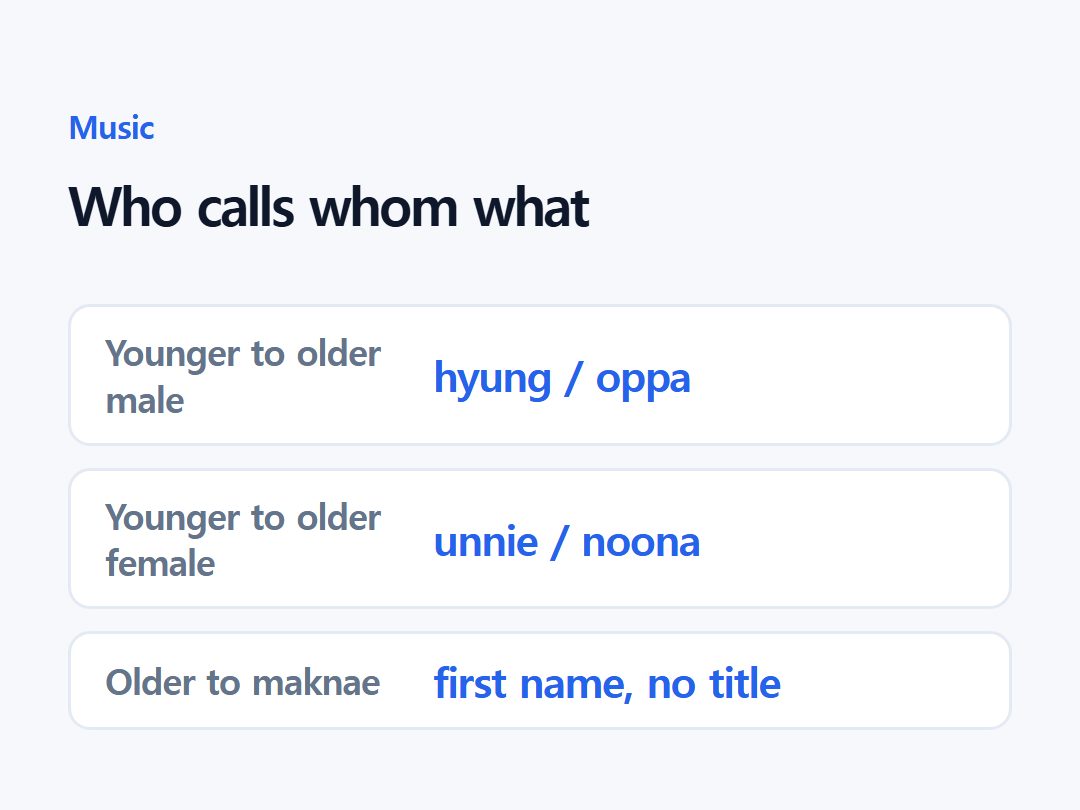
A younger member addresses an older bandmate as hyung (형, used by a male toward an older male), oppa (오빠, used by a female toward an older male), unnie (언니, used by a female toward an older female), or noona (누나, used by a male toward an older female).
None of these require blood relation, and Korean speakers generally do not use an older person's given name without one of these terms attached, or without the honorific suffix -nim.
The maknae, by definition, uses these terms toward everyone else in the group and receives none of them in return; older members can call the maknae by name, plain and unadorned.
This is why fans also talk about a "maknae line" and a "hyung line" or "unnie line" — informal groupings of the youngest and oldest members respectively. It is a way of mapping who defers to whom before a single word of banmal is exchanged.
The maknae's real-world experience of this system, in idols' own words, is a mix of privilege and pressure.
In interviews collected by the K-pop outlet Soompi with members of TWICE, SEVENTEEN, Stray Kids, THE BOYZ, Oh My Girl, and (G)I-DLE, TWICE's Chaeyoung named the upside plainly: "the rest of the members look after her a little more." Stray Kids' I.N agreed that "being young is the best," while THE BOYZ's Eric said he enjoys "receiving lots of love from the hyungs," adding that even his pranks get forgiven more easily.
But the same interviews surfaced the friction.
SEVENTEEN's Dino said he likes having his hyungs close by, and in the same breath said it is "difficult to be a maknae because his hyungs are by his side too much." Oh My Girl's Arin pointed to a more specific burden: the expectation that she perform aegyo, a deliberately cute, high-pitched display of charm, because she is the group's youngest.
(G)I-DLE's Shuhua, who is Taiwanese, described the added difficulty of being the maknae "in a foreign country," navigating a hierarchy she did not grow up speaking.
That last point matters. The honorific system is not just about manners; it is social infrastructure. It tells a group of near-strangers, thrown together by a company rather than by friendship, exactly how to talk to each other from day one. For a maknae who is also a non-Korean trainee, that infrastructure has to be learned as a second system on top of a second language.
A maknae who is unusually skilled across singing, dancing, and visuals despite being the youngest earns the nickname "golden maknae," a title widely applied to BTS's Jungkook, who debuted in 2013 at 15 and was still expected, as the youngest, to speak last and defer first.
The flip side is "maknae on top," used for a younger member who teases elders back, flipping the hierarchy for comic effect precisely because it is understood to be an exception, not the rule.
Where does this age hierarchy actually come from?
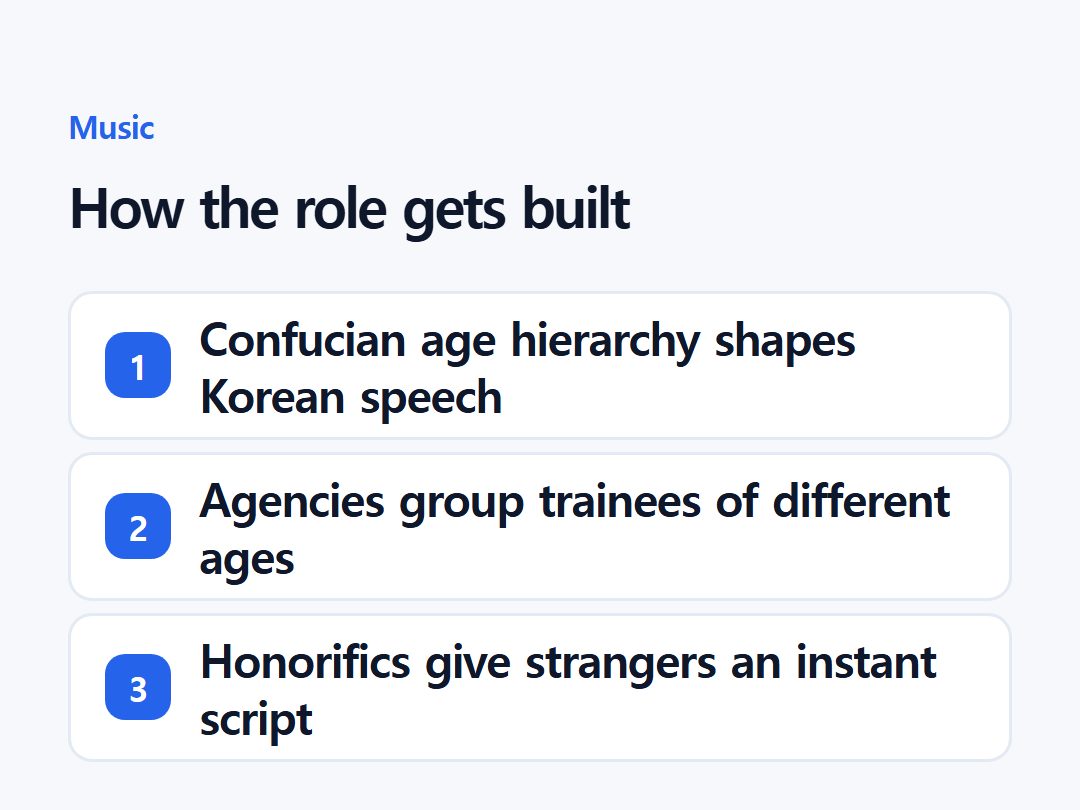
The roots of this system predate K-pop by centuries. Confucian thought, imported to Korea roughly two thousand years ago, built social order around hierarchy and deference, including deference based on age, according to the Stanford Encyclopedia of Philosophy's entry on Korean Confucianism.
That framework still visibly shapes daily Korean life and language, a point underscored in NPR's reporting on how Confucian tradition continues to structure Korean social relations today.
In ordinary Korean society, this is why people meeting for the first time often ask each other's age early on: it is not nosiness, it is the information needed to know how to speak to one another.
K-pop's production system made this hierarchy sharper, not softer. Idol groups are not bands that formed organically among childhood friends; they are assembled by entertainment agencies out of trainees recruited separately, sometimes years apart, sometimes as young as their early teens.
According to reporting by The Korea Times on the industry's trainee pipeline, agencies have continued increasing spending on trainee development even as the overall national trainee pool has shrunk, underscoring how central and formalized this pre-debut training period remains to how groups are built.
When a company puts five, seven, or a dozen trainees of different ages, and increasingly different nationalities, into a group and tells them to become a unit within months, the existing Korean hierarchy of hyung, unnie, and maknae gives them an instant, pre-written script for how to relate to one another, before personal friendship has had time to develop on its own.
In that context, the maknae role is not incidental. It is one of the few pieces of social structure a newly formed group does not have to invent from scratch.

Is this hierarchy starting to change?
What remains unsettled is how much of this hierarchy survives as groups age.
Members who debut as teenagers and stay together for a decade often report gradually dropping into banmal privately, even while maintaining hyung and unnie titles in public and on camera; K-pop coverage rarely captures exactly when or how that shift happens inside a given group, since it is a private, negotiated change rather than an announced one.
There is also open debate, visible in idols' own comments like Arin's, about whether maknae-specific expectations, particularly aegyo performances, are an affectionate tradition or a gendered burden that younger members are increasingly pushing back on.
Finally, as agencies recruit more non-Korean trainees, the maknae system is being tested by members who did not grow up speaking a hierarchy into existence with every sentence. How groups and companies handle that gap, through language training, through flexibility, or through simply expecting foreign-born maknaes to adapt, is likely to keep shaping how the role is discussed in the years ahead.
How members address older bandmates, by gender
| Term | Used By | Used Toward |
|---|---|---|
| Hyung (형) | Younger male | Older male |
| Oppa (오빠) | Younger female | Older male |
| Unnie (언니) | Younger female | Older female |
| Noona (누나) | Younger male | Older female |
Frequently asked
What does maknae mean in K-pop?
Maknae (막내) is ordinary Korean for the youngest person in a family or group; in K-pop it names the youngest member of an idol group, decided strictly by birth date rather than role or skill.
What is a golden maknae?
A golden maknae is a group's youngest member who is also unusually skilled across singing, dancing, and visuals, a nickname widely applied to BTS's Jungkook, who debuted in 2013 at 15.
Why do K-pop idols call each other oppa, unnie, or hyung instead of their name?
Korean's honorific system requires younger members to address older ones with age-based titles like hyung, oppa, unnie, or noona, while older members can call the maknae by name, plain and unadorned.
Sources
Every factual claim above is traceable. We do not translate articles — we gather facts from multiple outlets and write them ourselves.
- 'Aegyo,' 'maknae': How Korean words make up the unique vocabulary of K-pop fans — The Korea Herald
- Leaders And Maknaes Of TWICE, SEVENTEEN, MONSTA X, Stray Kids, And More Discuss Pros And Cons Of Each Position — Soompi
- A woman takes a lead role in Confucian ceremonies, breaking a new path in South Korea — NPR
- Korean Confucianism — Stanford Encyclopedia of Philosophy
- Why teen K-pop trainee numbers are dropping despite greater investment — The Korea Times
- K-pop Maknaes who have earned special titles: BTS' Jungkook, BLACKPINK's Lisa, and more — Sportskeeda