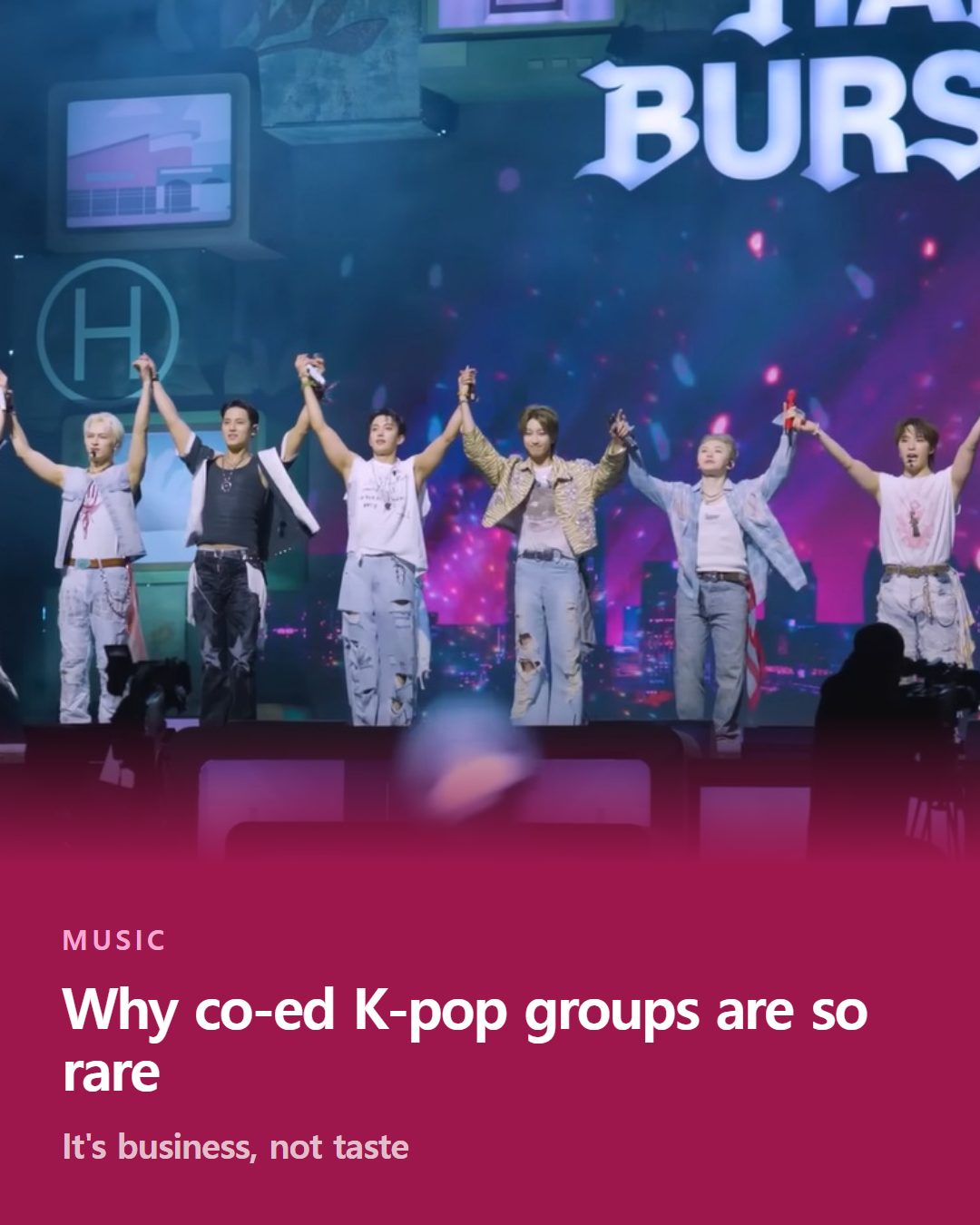
Scroll through any K-pop lineup and you'll eventually hit a name that isn't quite the group and isn't quite a solo act: NCT 127, Super Junior-M, MiSaMo. These are sub-units — smaller teams pulled from a larger group's existing members, releasing music under a new name while the parent group keeps operating.
The short version
- Sub-unit members stay under the same contract as the main group.
- Super Junior's 2006 K.R.Y. debut is credited as K-pop's first sub-unit.
- TWICE's 2022 contract renewal made unit and solo rights explicit, not optional.
To an outsider, it can look like a spin-off or a breakup rumor. It's neither. It's one of the most ordinary tools in the K-pop business model, and understanding it explains a lot about how idol contracts actually work.

What a sub-unit actually is
A sub-unit takes two or more members from an existing group and gives them a separate name, a separate concept, and usually their own release schedule. Super Junior-K.R.Y., made up of vocalists Kyuhyun, Ryeowook, and Yesung, is generally credited as the first official sub-unit in K-pop, debuting in November 2006 with a drama soundtrack.
Since then, nearly every major agency has built at least one. Girls' Generation split off TaeTiSeo in 2012. SEVENTEEN was built around three built-in units — vocal, hip-hop, and performance — from its 2015 debut. TWICE launched MiSaMo, its three Japanese members, as a standalone act in 2023.
Do sub-unit members sign a new contract?
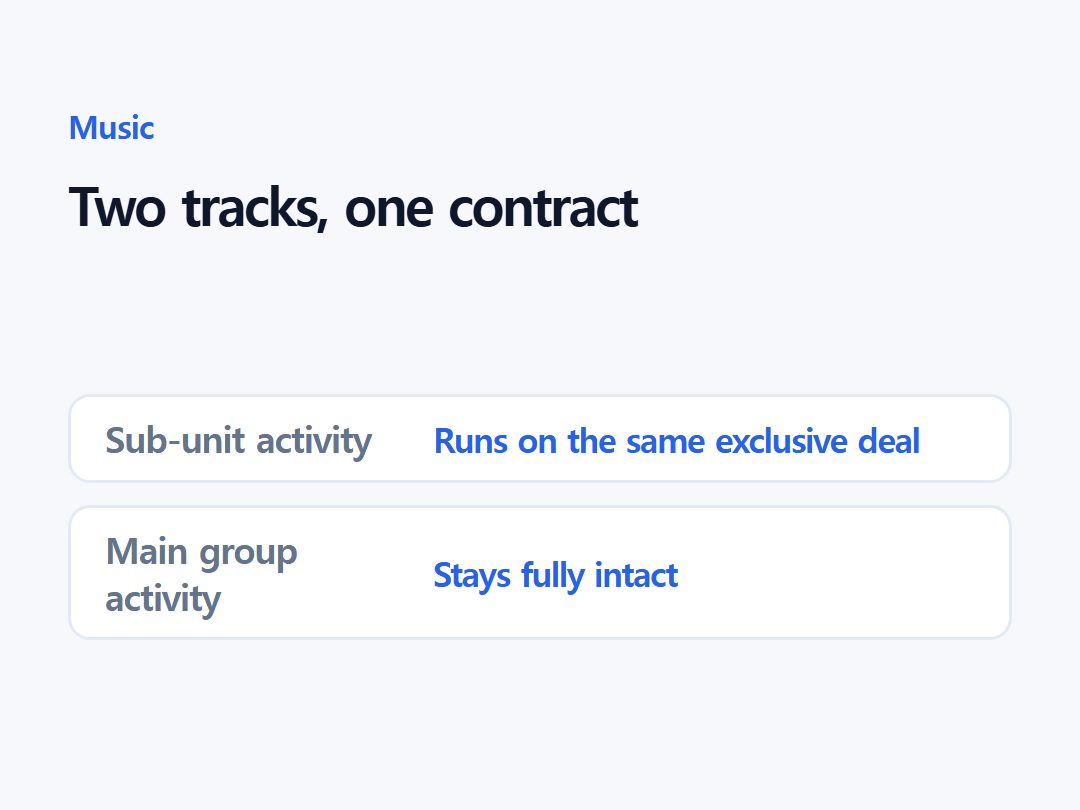
Here is the part that international fans usually miss: a sub-unit is not a new business relationship. The members don't sign anything new with a different company. They are still bound by the same exclusive contract — called a jeonsok gyeyak in Korea — that they signed as part of the main group.
That single contract is what makes a sub-unit different from a member simply leaving to go solo elsewhere. The agency still owns the schedule, still takes its standard cut, and still controls when the parent group reconvenes. A sub-unit is an addendum to an existing deal, not a replacement for it.
This is why agencies treat sub-units so casually compared to, say, a member's exit. A group can send three members off to release a mini-album under a new name for six months and then reassemble the full lineup, because legally nothing about the underlying contract changed. The members never stopped being, contractually, members of the original group.
It also explains why sub-unit announcements rarely come with the kind of anxious fan speculation that surrounds an actual member departure. Longtime followers of the agency system read a unit debut correctly on sight: more content, same group, same company, no change to the underlying deal.
How agencies run two acts without renegotiating
Agencies describe this as running two activity tracks at once without renegotiating either one. The sub-unit exposes a member's individual voice, dance style, or rap ability — the parts of their talent that get compressed when they're one of nine or thirteen people on a stage.
Meanwhile, the main group's brand, schedule, and comeback cycle stay untouched. Fans get variety; the agency gets more content from the same roster without the legal or financial complexity of a real spin-off company.
That combination is the actual answer to why agencies form sub-units. It is less about creative freedom for its own sake and more about a licensing efficiency: one signed roster, multiple monetizable configurations.
Sub-units solve three different business problems
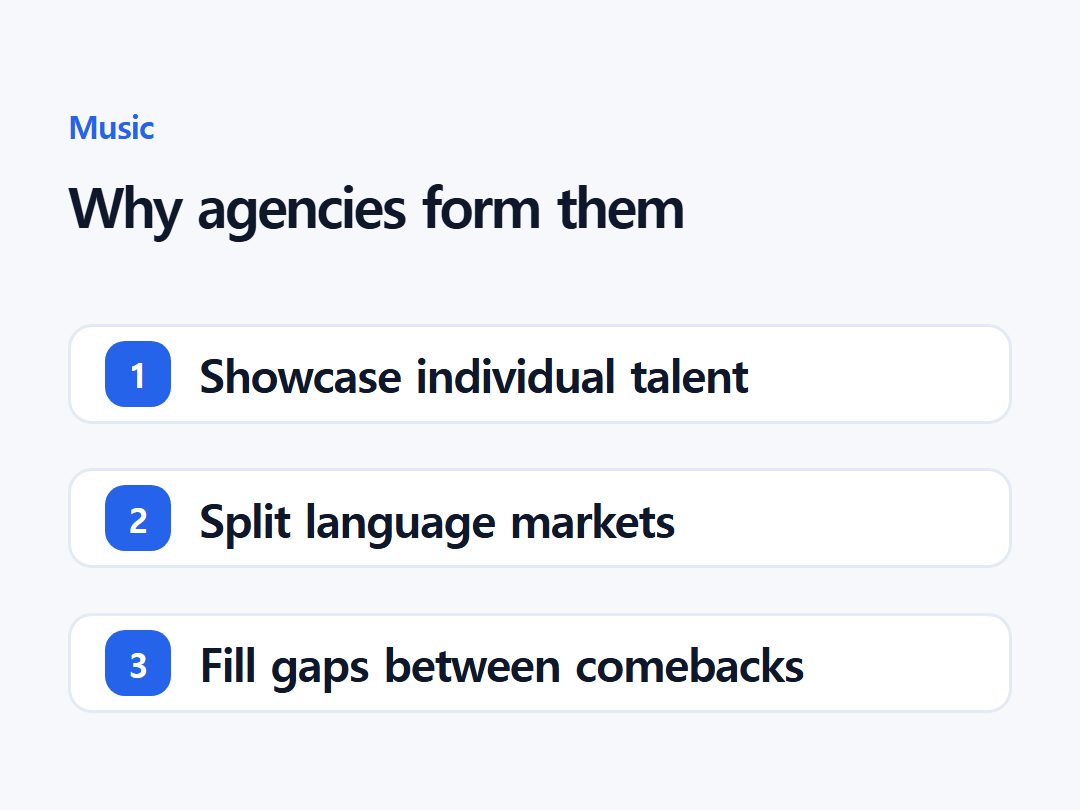
Agencies use the format for several distinct problems, not just one:
- Showcasing individual skill — vocal-line or rap-line units built around who can carry a different sound
- Splitting language markets — releasing Mandarin or Japanese-language material without waiting for a full-group comeback
- Filling schedule gaps — giving fans new releases while other members are on hiatus, in the military, or filming
SM Entertainment leaned hardest into the market-segmentation use case. Super Junior-M and EXO-M were built specifically to release Mandarin-language material for the Chinese market, using slightly different member lineups than the Korean-language teams.
The creative-freedom case shows up differently. EXO-CBX and EXO-SC, both drawn from EXO, let individual members chase pop and R&B sounds the main group's concept doesn't cover, without touching EXO's own release calendar.
What makes a sub-unit different from a collab?
Not every small grouping of idols is a sub-unit. Award shows and variety specials regularly pair members for a single stage or a one-time song, and that's a collaboration, not a unit.
The dividing line is repeatability and naming. If an agency gives the pairing its own name, logo, and at least the intent of a follow-up release, it's treated as a formal unit debut. A cross-company example is Toheart, which paired SHINee's Key with Infinite's Woohyun for a full single release in 2014, coordinated between SM Entertainment and Woollim Entertainment.
SM Entertainment invented the sub-unit playbook
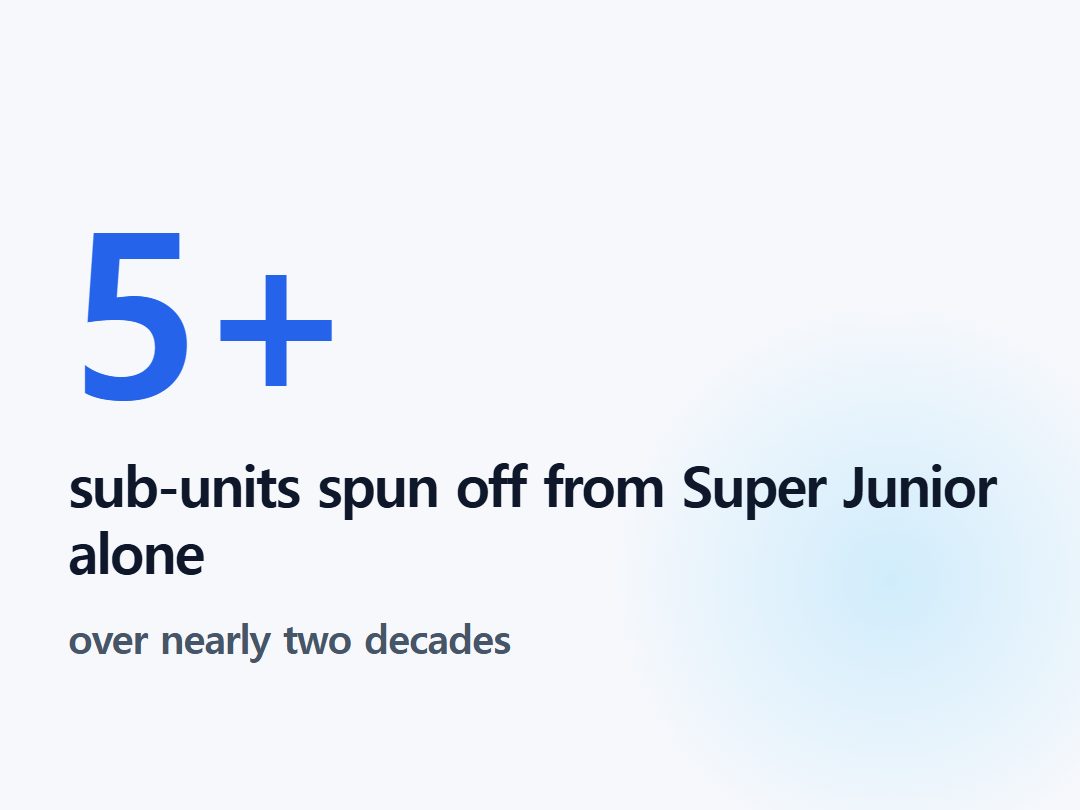
The sub-unit model traces back almost entirely to SM Entertainment's four flagship 2000s-era groups: TVXQ, Super Junior, SHINee, and EXO. Super Junior alone spun off at least five official sub-units over nearly two decades, including Super Junior-T (trot music), Super Junior-H, and Super Junior-L.S.S., which debuted as recently as 2023.
Other agencies adopted the format more selectively. JYP Entertainment kept TWICE and 2PM as unified acts for years before finally authorizing MiSaMo in 2023, once TWICE's members had renewed their contracts on stronger terms. Pledis built SEVENTEEN's three units into the group's identity from day one — the name itself stands for 13 members plus 3 units plus 1 team.
Other companies took a lighter-touch version of the same idea, pairing two members for a shorter run rather than building a standing team — YG's BIGBANG produced GD&TOP and JYP's GOT7 produced JUS2, both two-member configurations that released music and then went quiet, without becoming a permanent fixture like Super Junior-M or NCT 127.
NCT pushed the format to its limit
SM's NCT project, launched in 2016, turned the sub-unit into the entire architecture of a group. Rather than one fixed lineup, NCT was designed from the start as an unlimited roster distributed across regional and rotating units: NCT U (rotating lineup by song), NCT 127 (Seoul-based, fixed), NCT Dream (originally age-restricted, later made permanent), WayV (China-based), and NCT Wish (Japan-based).
Every one of those teams operates under the same NCT contract umbrella. SM has since said the expansion has an end point, with NCT Tokyo cited as the project's final planned subgroup.
Members are winning contract leverage over units
The open question isn't whether sub-units will keep existing — they clearly will — but how much leverage members gain over when and how they happen. TWICE's contract renewal in 2022 is the clearest public example: members secured explicit solo and unit rights, including MiSaMo, as negotiated terms rather than one-off favors from the agency.
That's a shift from the earlier era, when sub-unit formation was announced by the agency with little visible member input. As more veteran groups hit renewal windows, watch whether unit and solo clauses become standard, spelled-out terms rather than something the company decides unilaterally.
The other unresolved case is what happens when a sub-unit outlasts interest in the parent group, or when members eventually leave the shared contract altogether — as happened when several BLACKPINK members didn't renew with YG Entertainment and set up separate, individual labels.
At that point, the same-contract logic that defines a sub-unit no longer applies, and any joint activity has to be renegotiated between separate companies.
For international readers, the practical takeaway is simple: a sub-unit announcement is not a break-up signal and rarely deserves the alarm it sometimes gets online. It is closer to a company scheduling a second product line under one roof — worth watching for what it reveals about a member's individual pull, but not a sign that the group itself is in trouble.
Why agencies build sub-units
| Reason | Example |
|---|---|
| Showcasing individual skill | EXO-CBX, EXO-SC |
| Splitting language markets | Super Junior-M, EXO-M (Mandarin) |
| Filling schedule gaps | Releases during hiatus, military service, or filming |
Frequently asked
Is a K-pop sub-unit the same as a member going solo?
No — sub-unit members stay under the same exclusive contract (jeonsok gyeyak) as the main group, unlike a solo deal with a different company.
What was the first K-pop sub-unit?
Super Junior-K.R.Y., made up of Kyuhyun, Ryeowook, and Yesung, is generally credited as the first, debuting in November 2006 with a drama soundtrack.
Does a sub-unit mean a group is breaking up?
No — it's a normal business tool letting the agency release more content from the same signed roster without changing the underlying contract.
Sources
Every factual claim above is traceable. We do not translate articles — we gather facts from multiple outlets and write them ourselves.
- Super Junior-K.R.Y. — Wikipedia
- Super Junior-M — Wikipedia
- Super Junior-T — Wikipedia
- Super Junior-L.S.S. — Wikipedia
- Girls' Generation-TTS — Wikipedia
- MiSaMo — Wikipedia
- Masterpiece (EP) — Wikipedia
- Examining NCT and Its Various K-Pop Units — Billboard
- Breaking Down The NCT System, From The Rotational NCT U To The Upcoming NCT Tokyo — Grammy.com
- SM Entertainment — Wikipedia
- Toheart — Wikipedia