
Every K-pop group that debuts is preceded by a much larger, invisible group: the trainees who didn't make it. Before an idol steps on stage, they typically spend years inside an agency's training program — a status that looks like a job from the outside but, under Korean law, is closer to an unpaid internship with no guarantee of ever becoming a real contract.
The short version
- Registered trainees dropped from 1,895 in 2020 to 1,170 in 2022.
- Korean law treats trainees as contractors, not employees, with no guaranteed wage.
- New 2026 rules cap trainee contracts at three years, still unenforceable by law.
The 9-to-10 grind is shrinking trainee ranks
"Trainee" (연습생, yeonseupsaeng) is the term for a person signed to a Korean entertainment agency to be trained — in singing, dancing, language, and media presence — with the possibility, not the promise, of debuting as an idol.
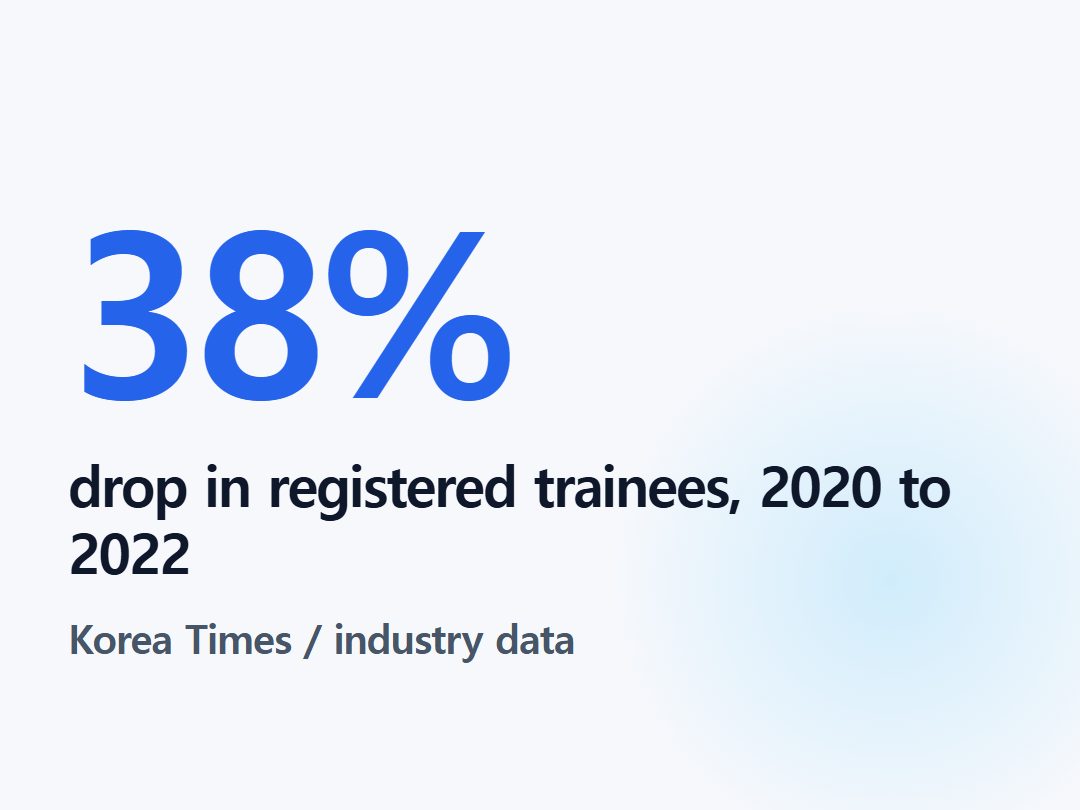
According to data reported by The Korea Times, the number of registered trainees at Korean agencies fell from 1,895 in 2020 to 1,170 in 2022, a drop of roughly 38%, even as agencies invested more per trainee. Most companies keep a roster of around 20 trainees at a time; JYP Entertainment has run closer to 30.
The same reporting found that 34.4% of trainees quit voluntarily before their training ends, up from 31% in 2020.
Training itself follows a well-documented daily rhythm sometimes called the "nine-to-ten" system: trainees arrive around 9 a.m., often hand in their phones, and cycle through school or language study, vocal and dance lessons, and group practice until roughly 10 p.m., six days a week.
Progress is tracked through monthly or quarterly evaluations in front of instructors and executives, and trainees who plateau can be dropped from the program at any point — with no severance and, in most cases, no public announcement.
Do K-pop trainees get paid during training?
The detail international fans most often miss is that a trainee contract is not an employment contract in the way Western labor law would recognize it.
Trainees are generally classified as something closer to independent contractors or unpaid trainees rather than employees, which means they typically fall outside standard workplace protections such as minimum wage and guaranteed rest hours. The Korea Herald reported that South Korea's Ministry of Employment and Labor has denied entertainers, including trainees, the working-hour protections of the Labor Standards Act since 2010 — a gap that lawmakers have repeatedly tried, and mostly failed, to close through separate entertainment-industry legislation instead.
That legal ambiguity is the reason the popular shorthand — "trainees are basically employees" — doesn't hold up.
In practice, a trainee's status is closer to a fixed-term contractor on probation: the agency covers (or, at smaller companies, sometimes charges for) training costs, housing, and lessons, but it owes the trainee no debut, no salary, and no explanation if the contract simply lapses.
South Korea does address this through a separate framework, the Popular Culture and Arts Industry Development Act (2014), which sets rules specifically for entertainment agencies — limiting working hours for minors, requiring continued schooling, and banning abuse — but multiple outlets, including a 2025 Boston University Pre-Law Review analysis, note that enforcement is complaint-driven and inconsistent, since the law does not create automatic penalties for agencies that ignore it.
How long does this uncertain status actually last?
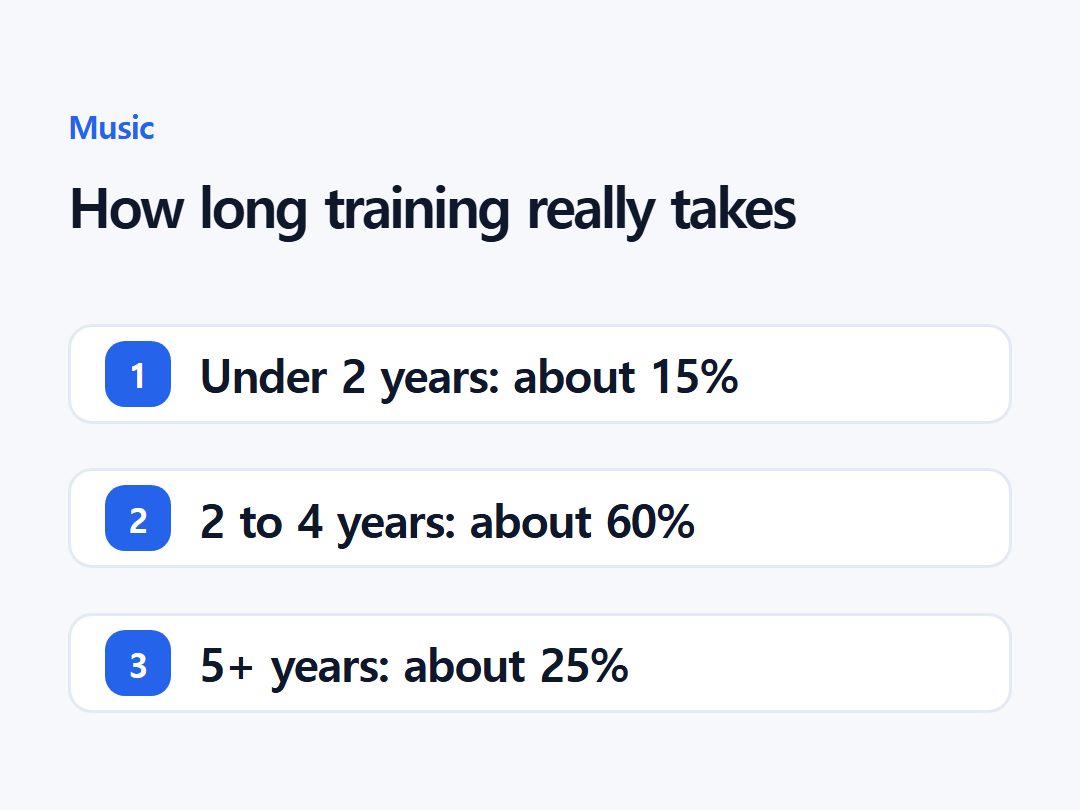
There is no single official figure, because no government body publishes a complete trainee registry, but the ranges reported by industry researchers cluster consistently: roughly 15% of trainees who eventually debut trained for under two years, about 60% trained two to four years, and around 25% trained five years or longer, according to industry data cited from the Korea Creative Content Agency (KOCCA).
Multiple entertainment-industry outlets converge on the same rough average of two to five years, with training at the largest agencies — SM, JYP, YG, HYBE — sometimes stretching to seven or eight years for individual trainees the company keeps re-evaluating rather than releasing.
Crucially, those figures only describe people who debuted. They say nothing about the far larger number who trained for years and were quietly dropped — the outcome the system is built around, not the exception to it.
The clearest documented case of this is EJAE, the Korean-American singer who joined SM Entertainment's trainee program in 2003 at age 11 and trained for twelve years alongside future members of Girls' Generation, SHINee, and f(x), according to reporting by CNN Business and Forbes.
She was never placed in a group or offered a solo debut, and her contract was allowed to lapse in 2015.
EJAE has since become one of K-pop's most sought-after songwriters — she co-wrote Red Velvet's "Psycho" and, two decades after joining SM as a child, co-wrote and voiced the Netflix film KPop Demon Hunters' song "Golden," which spent eight weeks at No. 1 on the Billboard Hot 100 and won a Golden Globe.
Her career shows both how long a trainee period can run and how completely a debut can fail to materialize regardless.
Scandals forced reform, but caps stay optional
The seven-year cap now associated with idol contracts traces back to a single, closely watched legal fight.
In 2009, three members of the group TVXQ — Kim Jaejoong, Park Yoochun, and Kim Junsu — filed suit against SM Entertainment seeking to void their 13-year exclusive contract, arguing it gave the agency excessive control over their schedules, earnings, and personal decisions.
Korean media dubbed these "slave contracts." The case took three years to resolve, ending in a 2012 settlement rather than a definitive ruling, and the three members went on to form JYJ independently while SM continued TVXQ with its remaining two members.
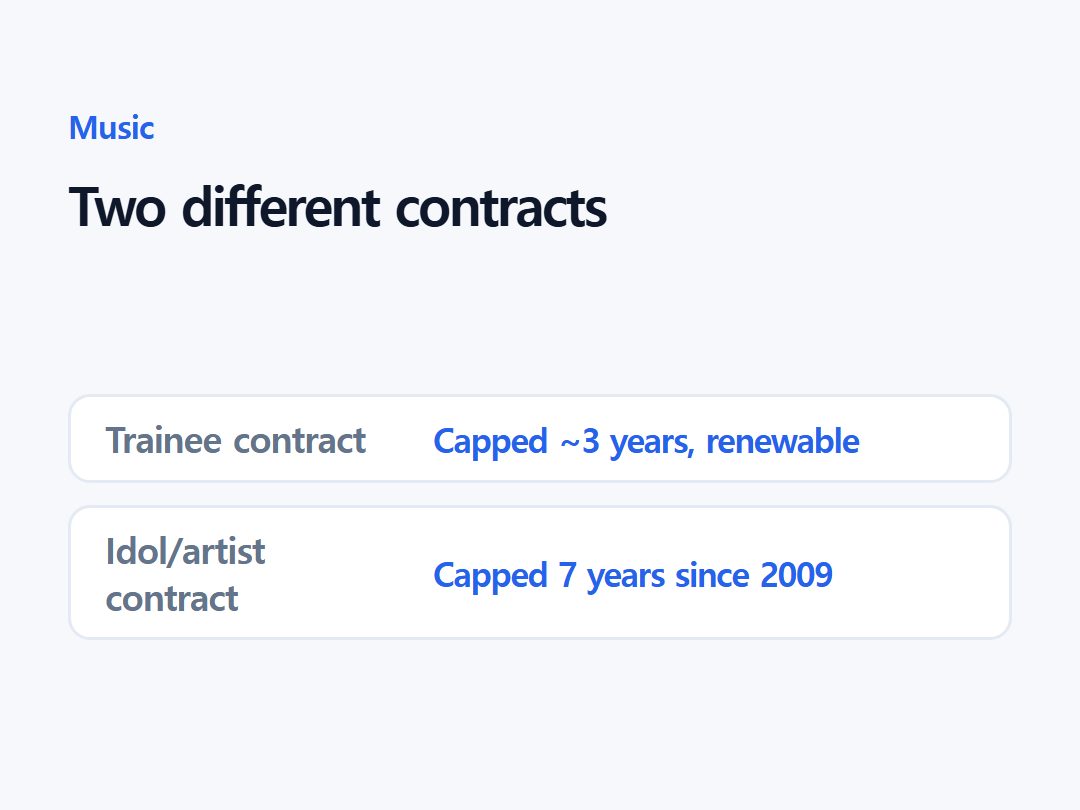
The lawsuit's broader effect arrived faster than its own resolution: in 2009, South Korea's Fair Trade Commission introduced a standardized exclusive contract template recommending that artist contract periods be capped at seven years, down from the 13-year norm that had triggered the dispute. The Korea Times reported in 2014, however, that only about 40% of agencies actually used the FTC's standard contract, with many opting for their own versions to sidestep it — underlining that the template was a recommendation, not a binding law.
Separately, in 2014, lawmakers passed the Popular Culture and Arts Industry Development Act to regulate agencies directly, including provisions for minors' working hours and education.
It was amended again in 2023 after singer Lee Seung-gi alleged his agency had withheld royalty payments for 18 years — a case that pushed through new rules requiring agencies to disclose earnings to artists at least once a year.
Most recently, the government's standard trainee contract (a separate template from the artist contract, this one covering the training period itself) was revised effective January 1, 2026, capping trainee agreements at three years in principle, mandating a dedicated protection officer for underage trainees, and explicitly banning verbal abuse, coercion, and interference with a trainee's schooling.
As with the 2009 version, the trainee contract remains a recommended template rather than a law with automatic penalties for non-compliance.

Foreign trainees and child-labor protections still left out
The 2026 revision closes some gaps but leaves others open by design.
Legal commentary on the update, including analysis from industry outlet KCL, notes that the standard trainee contract is still published only in Korean, with no official English, Japanese, or Mandarin translation despite agencies actively recruiting trainees from Japan, China, Thailand, and the United States.
It also still offers no guidance on visa costs or return airfare for foreign trainees who are dropped from a program, even as the government promotes a dedicated K-Culture Training Visa to bring more of them to Korea.
Separately, a bill to bring entertainment minors under the same working-hour limits as other child workers — capping hours by age bracket rather than leaving entertainers under a looser standard — has been introduced in the National Assembly before, failed once already in 2022 amid industry pushback, and remains unresolved.
Whether it passes will determine if trainee status moves any closer to genuine legal employment, or stays what it has been for most of the industry's history: a probationary, largely unregulated audition that can last a decade and still end with nothing.
How long trainees who eventually debut typically train (KOCCA data)
| Training Duration | Share of Debuted Trainees |
|---|---|
| Under 2 years | ~15% |
| 2–4 years | ~60% |
| 5+ years | ~25% |
Frequently asked
How long do K-pop trainees train before debuting?
Most trainees who debut train two to five years, though some idols at major agencies train seven or eight years, according to industry data cited from KOCCA.
Do K-pop trainees get paid?
Generally no — trainees are classified as something closer to independent contractors or unpaid trainees rather than employees, so they typically fall outside minimum wage and guaranteed rest-hour protections.
What is the trainee contract length limit in Korea?
The government's revised standard trainee contract, effective January 1, 2026, caps agreements at three years in principle, though it remains a recommended template rather than a binding law.
Sources
Every factual claim above is traceable. We do not translate articles — we gather facts from multiple outlets and write them ourselves.
- Why teen K-pop trainee numbers are dropping despite greater investment — The Korea Times
- Bill proposes stricter limits on work hours for child idols, actors — The Korea Herald
- K-pop stars punished by unfair contracts — The Korea Times
- Korea Changed Its Trainee Contract Rules — 3 Traps Foreign Trainees Still Fall Into — KCL (K-pop Company League)
- Idol Protection in the South Korean Entertainment Industry — Boston University Pre-Law Review
- How EJAE reinvented herself after her agency crushed her K-pop idol dreams — CNN Business
- 'KPop Demon Hunters' Star EJAE Missed A K-Pop Debut — Now She's A Breakthrough Golden Globe Winner — Forbes