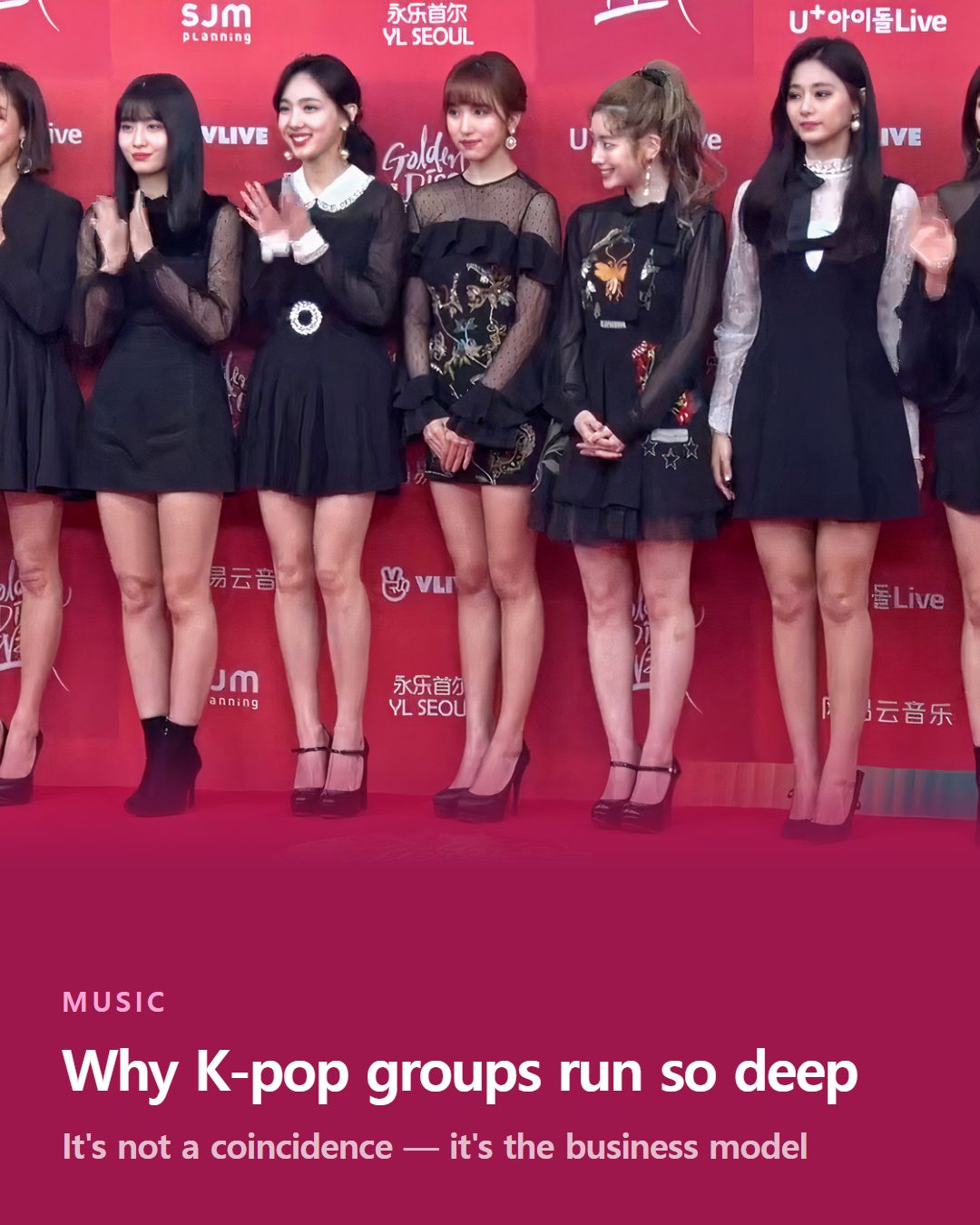
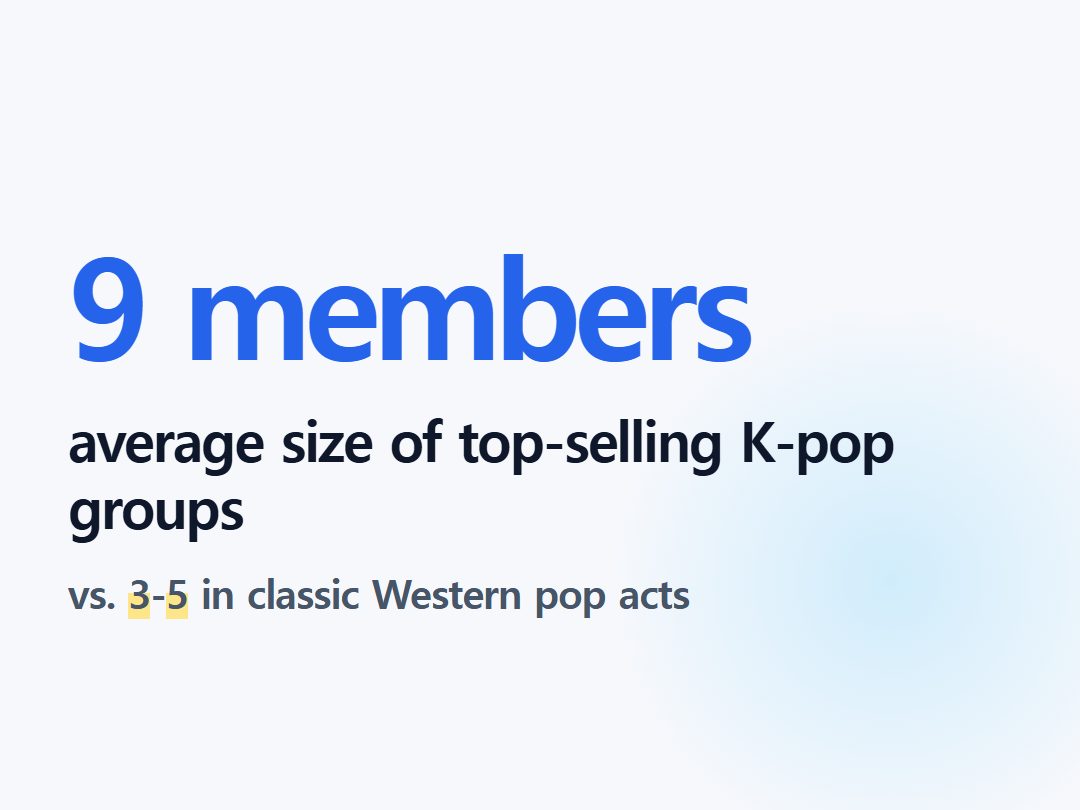
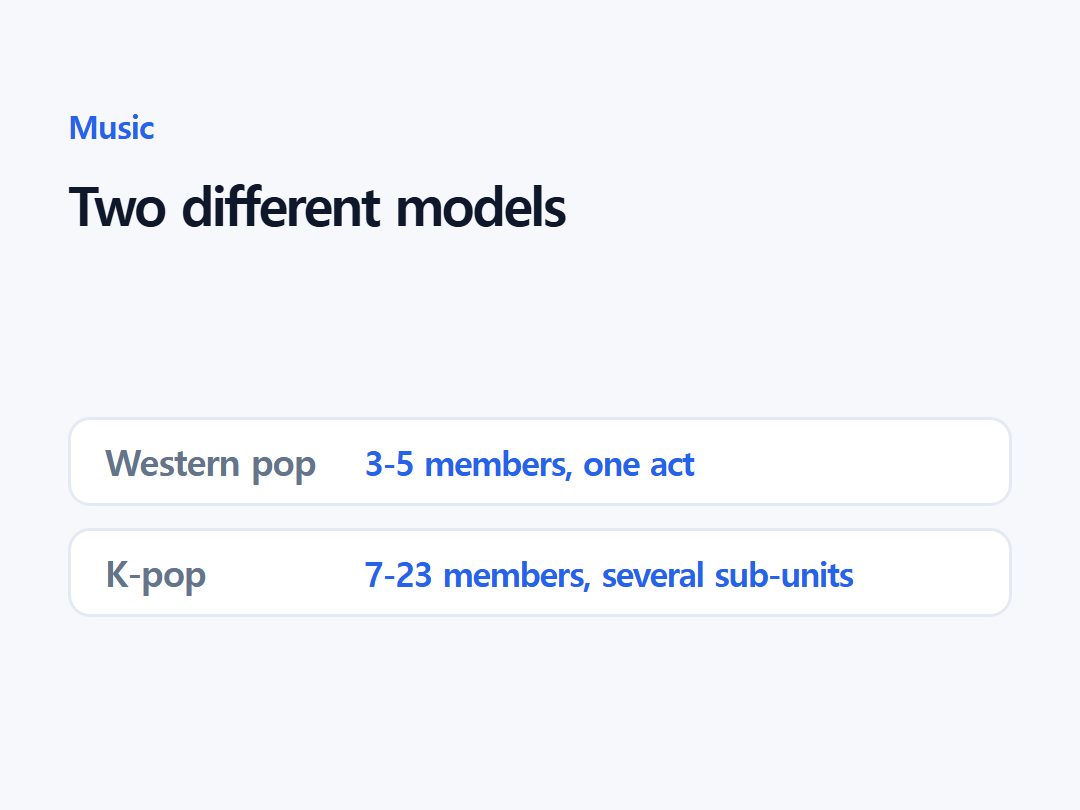
Seventeen has 13 members. NCT, at its widest count, has spread across 23. Even a relatively compact act like BTS has seven. Compare that to the classic Western pop lineup — the Backstreet Boys and One Direction had five, the Spice Girls and Little Mix had four or five, Destiny's Child had three.
International fans who start following K-pop often ask a version of the same question: why does one industry keep building 10-, 13-, even 20-plus-member groups, while another has settled on four or five as the norm?
The short version
- K-pop agencies size groups deliberately, for roles, subunits, and global markets.
- Scholar Michelle Cho says seven to nine members is the most workable size.
- NCT's units alone have sold more than 45 million albums in South Korea.
The gap isn't a matter of taste or coincidence. It reflects a structural difference in how the two industries build acts in the first place.
In Korea, idol groups are not friends who formed a band — they are products assembled by an entertainment agency (a company that recruits, trains, and manages artists under long-term exclusive contracts, sometimes called the agency system) from a pool of trainees who have often spent years preparing for a debut that isn't guaranteed. Group size, in that system, is a design choice with clear commercial logic behind it.
Why do agencies build such oversized rosters?
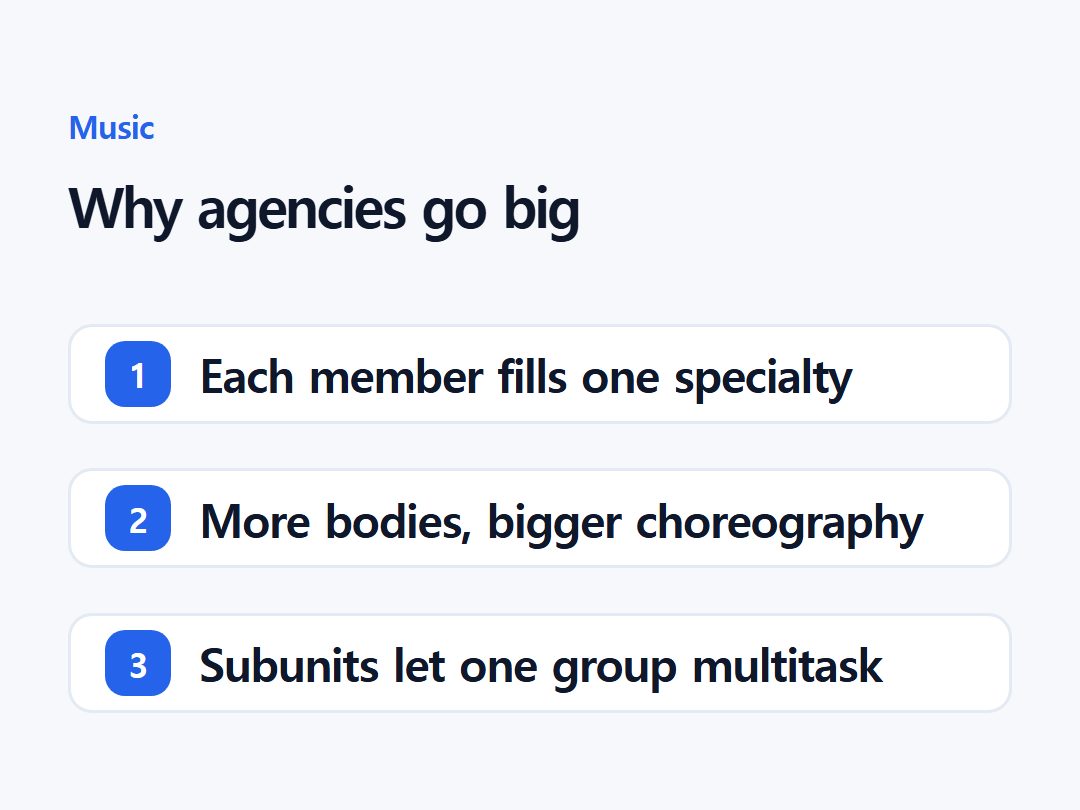
The most visible reason is role specialization. K-pop groups are typically built around fixed in-group positions — main vocalist, lead rapper, main dancer, visual, leader, and the maknae (youngest member) — rather than every member singing and dancing interchangeably.
Seventeen, for instance, is formally split into three units by function: a five-member vocal team, a four-member hip-hop team, and a four-member performance team, each releasing its own material in addition to full-group work.
With defined positions to fill, a five-person minimum starts to feel restrictive; a nine- or thirteen-person lineup gives an agency room to cast a specialist for nearly every function a modern idol act needs.
Michelle Cho, a scholar of Korean popular culture at the University of Toronto, has pointed to choreography as a second driver: more bodies on stage make it possible to build the kind of intricate, tightly synchronized formations that became a signature of K-pop in the mid-to-late 2000s, when groups first began regularly exceeding nine members.
Cho has also suggested that a range of roughly seven to nine members tends to be the most workable size — large enough for subunits and visual complexity, small enough that individual members don't disappear into the crowd.
Above that range, agencies increasingly rely on subdividing the group itself to keep every member visible.
That subdivision is the third and arguably most calculated layer of the strategy: the subunit system.
Rather than launching an entirely new act — a process that requires years of trainee development and financial investment with no guaranteed return, as one industry insider told The Korea Times — agencies instead peel off a handful of members from an existing large group and promote them as a smaller unit with its own sound and concept.
Seventeen has run several such units (BSS among them); SM Entertainment built NCT around the idea from the start, launching it in 2016 as an explicitly "unlimited" group whose members are distributed across city- and function-based units — NCT U, NCT 127, NCT Dream, and the China-facing WayV — that can promote on separate schedules in separate markets.
According to The Korea Times, agencies are now planning these subunit rollouts from before a group even debuts, treating them as a built-in feature of the business model rather than an afterthought. The payoff is real: NCT's combined units have sold more than 45 million albums in South Korea alone.
Subunits also solve a scheduling problem unique to very large groups: coordinating comeback promotions (a K-pop term for a new single or album cycle, typically accompanied by television performances and press activity) for 12 or more people at once is logistically difficult, so a rotating subunit can keep the group's name active in the market during the gaps.
The fourth piece of the calculus is global reach. Agencies increasingly recruit trainees from outside South Korea specifically to seed built-in access to other markets — Mandarin-speaking members for China, Japanese-speaking members for Japan, English-speaking members for the United States.
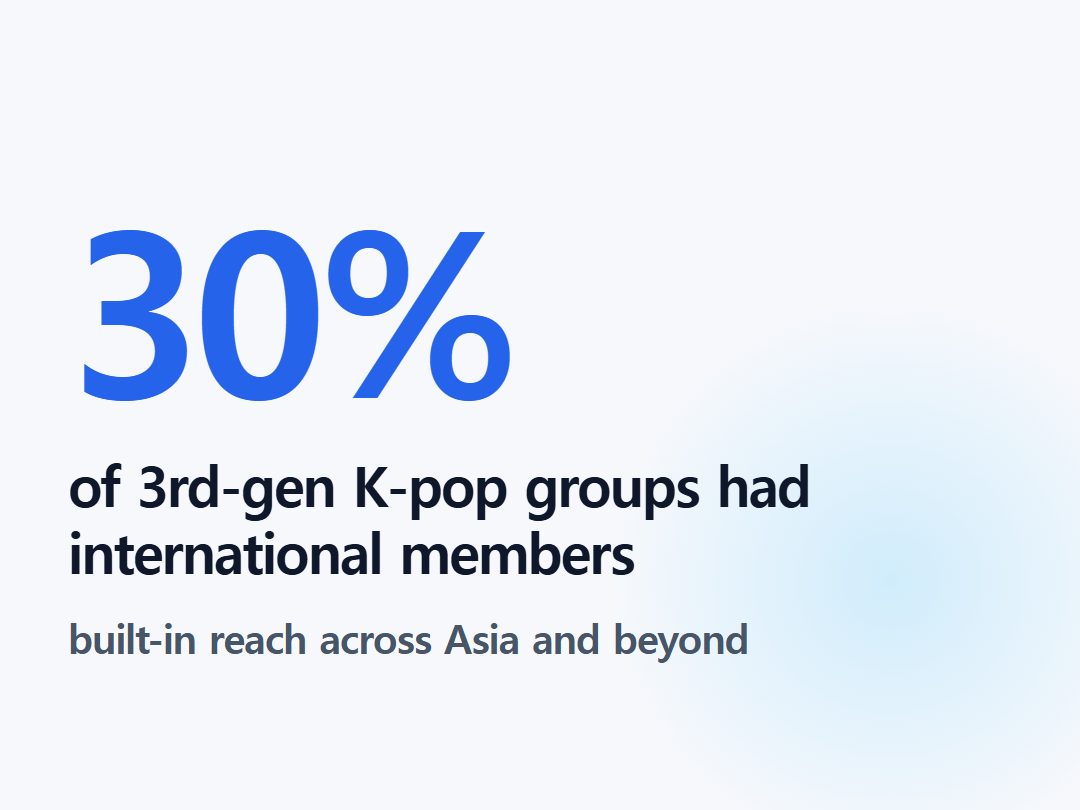
Data compiled by the design-journalism outlet The Pudding shows that roughly 30% of groups from K-pop's third generation (roughly 2010–2020) included at least one international member, up from about 13–15% in the two generations before it.
A larger lineup makes room for that kind of market-specific casting without displacing the Korean core of the group.
It has a second, more practical benefit too: because able-bodied South Korean men are legally required to complete military service, typically enlisting in their twenties and pausing group activities for roughly a year and a half to two years, a bigger roster — especially one that includes members exempt from Korean conscription — gives an agency a way to keep a group promotable even while some members are away.
None of this means every large group is a cynical spreadsheet exercise; chemistry, timing, and individual careers still shape how groups evolve. But the underlying pattern — specialize roles, build subunits, cast internationally, hedge against gaps in the schedule — is consistent enough across agencies that it functions as an industry-wide playbook rather than a one-off choice by any single company.
How did K-pop groups get so big?
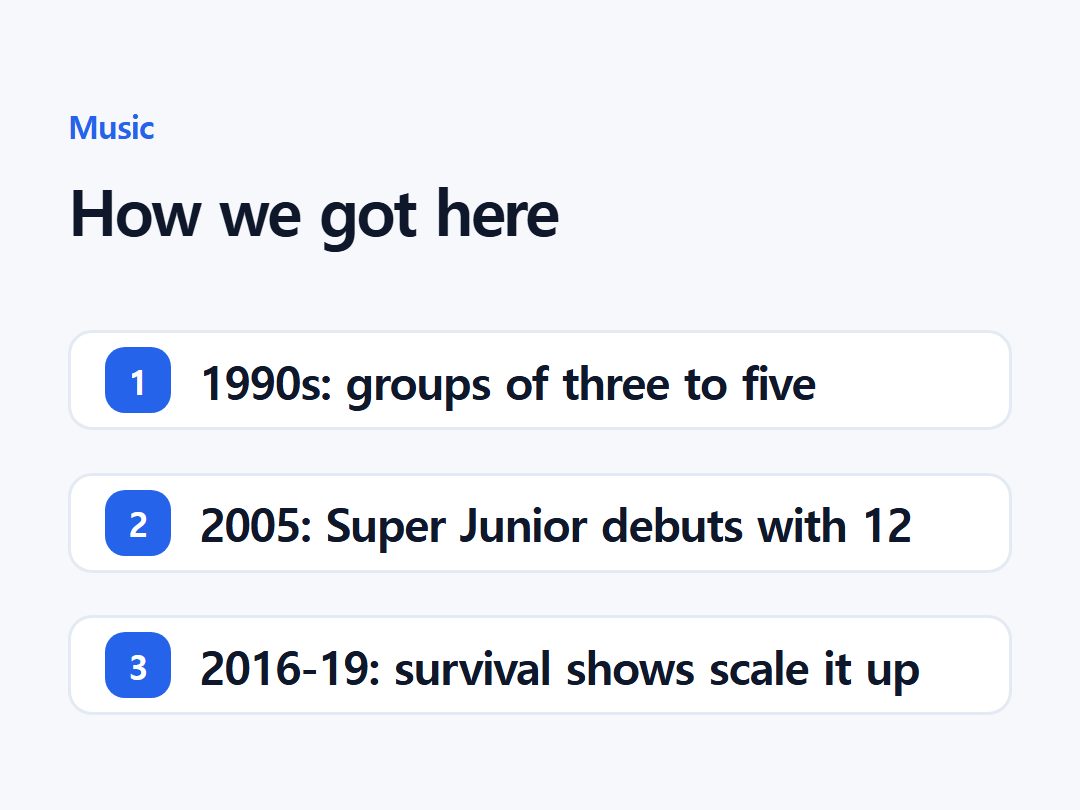
The modern group-building system traces back to SM Entertainment founder Lee Soo-man, who in the mid-1990s adapted the Japanese idol-training model into a formal pipeline: scout young hopefuls through auditions, put them through years of vocal, dance, and language training as trainees, then select a lineup from that pool when the company judges a debut is ready.
Groups from this first generation, following pioneers like Seo Taiji and Boys, stayed relatively small — three to five members was standard, not unlike the Western boy-band and girl-group format of the same decade.
The shift toward oversized lineups began in the 2000s. SM's 12-member Super Junior (2005) and 9-member Girls' Generation (2007) were outliers when they debuted, testing whether audiences would accept — and agencies could manage — a much bigger cast.
They did, and by K-pop's third generation, roughly 2010 to 2020, super-sized lineups had become close to the industry default, with acts like the 13-member Seventeen and the ever-expanding NCT normalizing double-digit rosters.
Competition-based television added fuel to this trend: Mnet's Produce 101 franchise, which ran four seasons between 2016 and 2019, had trainees from dozens of agencies compete for viewer votes to win a spot in a temporary debut group, and it specifically produced 11- and 12-member acts (I.O.I, Wanna One, X1, and IZ*ONE) — sizes that would have been unusual for a Western format built around soloists or small bands.
Big rosters face saturation as smaller formats emerge
The strategy has limits.
Researchers who track the industry have flagged market oversaturation as a real risk: as more agencies chase the same large-group, multi-unit formula, the number of new debuts has climbed while total fan attention and revenue haven't grown at the same rate, squeezing mid-tier and rookie groups in particular.
There are also early signs that some agencies are experimenting with a different model altogether.
HYBE's partnership with Geffen Records produced Katseye, a multinational group built through a global audition process rather than a Korea-based trainee system, and JYP's tie-up with Republic Records launched VCHA on similar lines — both smaller, non-Korean-based lineups that test whether the specialization-and-subunit logic still holds outside the agency system that created it.
Whether that experiment scales, or whether the double-digit Korean lineup remains the industry's default answer to "how many members should a group have," is still an open question.
How K-pop group sizes compare to Western pop acts
| Act | Members |
|---|---|
| Destiny's Child | 3 |
| Backstreet Boys | 5 |
| One Direction | 5 |
| Spice Girls / Little Mix | 4–5 |
| BTS | 7 |
| Seventeen | 13 |
| NCT (widest count) | 23 |
Frequently asked
Why do K-pop groups have so many members?
Agencies design larger lineups to fill fixed roles like main vocalist, rapper, dancer, and visual, and to support subunits, global market casting, and military-service gaps.
What is the ideal size for a K-pop group?
Scholar Michelle Cho has suggested roughly seven to nine members works best — enough for subunits and visual complexity, but small enough that no member gets lost in the crowd.
Why does NCT have so many members?
SM Entertainment launched NCT in 2016 as an explicitly 'unlimited' group, splitting members into city- and function-based units like NCT U, NCT 127, NCT Dream, and WayV that promote on separate schedules in separate markets.
Sources
Every factual claim above is traceable. We do not translate articles — we gather facts from multiple outlets and write them ourselves.
- Why do K-pop groups like The Boyz, Loona and NCT have so many members? — South China Morning Post
- Why are K-pop groups so big? — The Pudding
- Why K-pop groups turn to subunits for new creative chemistry — The Korea Times
- The Economics of K-pop – Part 10: The Integrated Marketing Strategy of K-pop — Music Business Research
- Why Do K-Pop Groups Have So Many Members? — Cheat Sheet