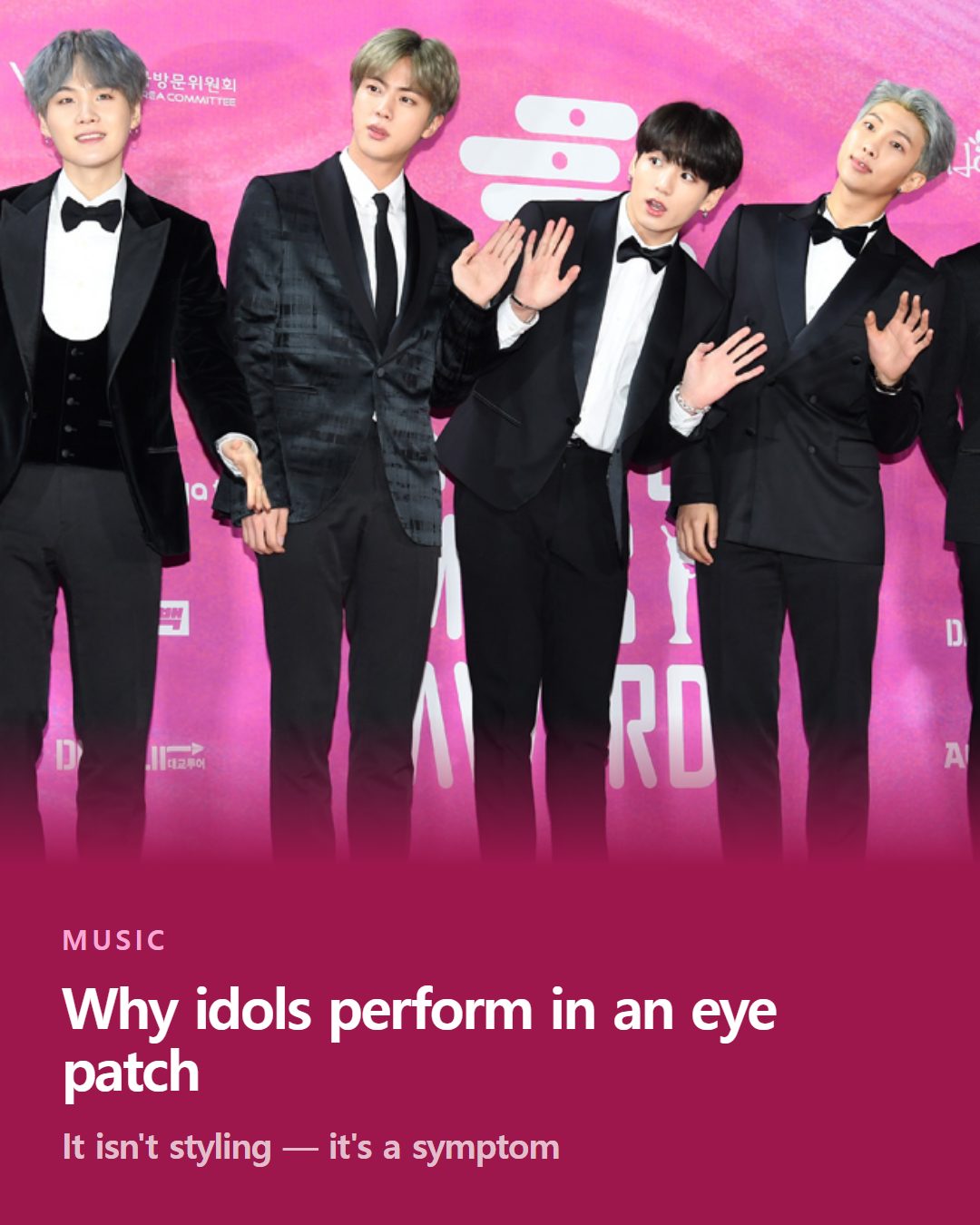
Scroll through enough K-pop fancams and you will eventually see it: a member on a comeback stage, choreography sharp, one eye covered by a small white patch. Fan sites often frame it as an accessory, a moment idols "pull off" well.
The short version
- Idol eye patches usually mean an untreated infection, not a fashion choice.
- Comeback schedules and chart rules leave little room for sick days.
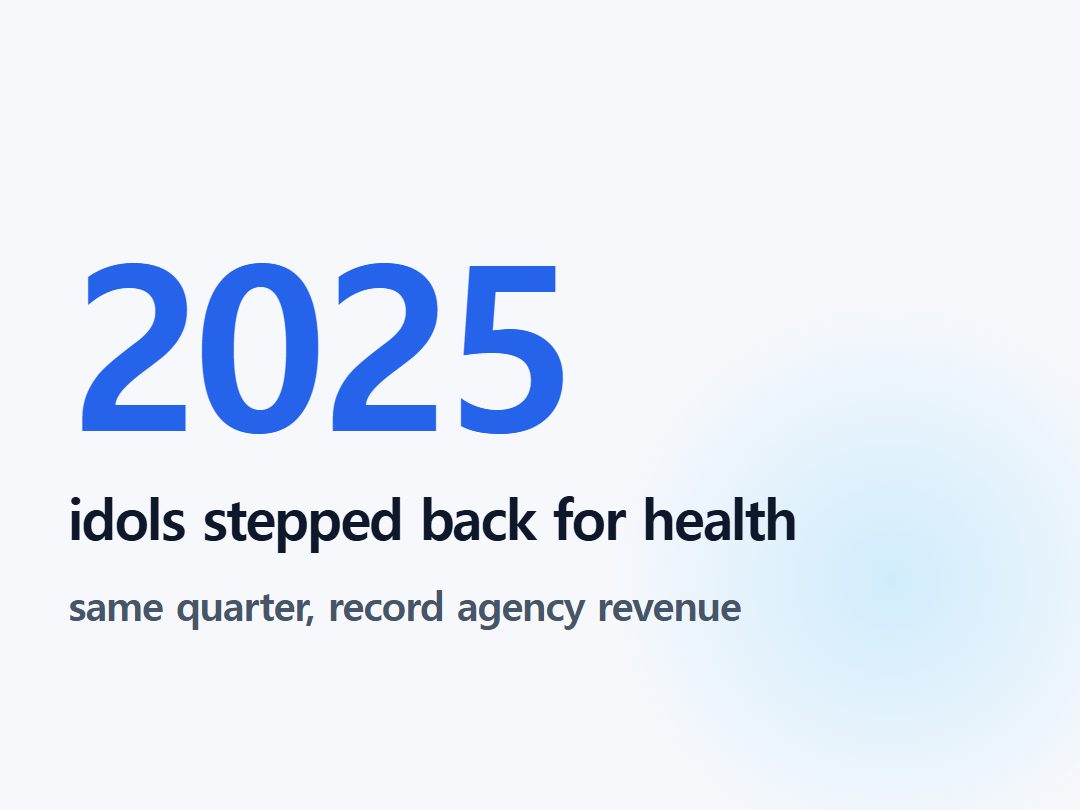
- 2025 saw multiple idols pause careers as agencies posted record revenue.
It usually isn't styling. In nearly every documented case, the patch marks an eye infection or a stye that appeared mid-promotion — and the idol performed anyway, patch and all, instead of sitting the schedule out.
The pattern behind the styes and infections
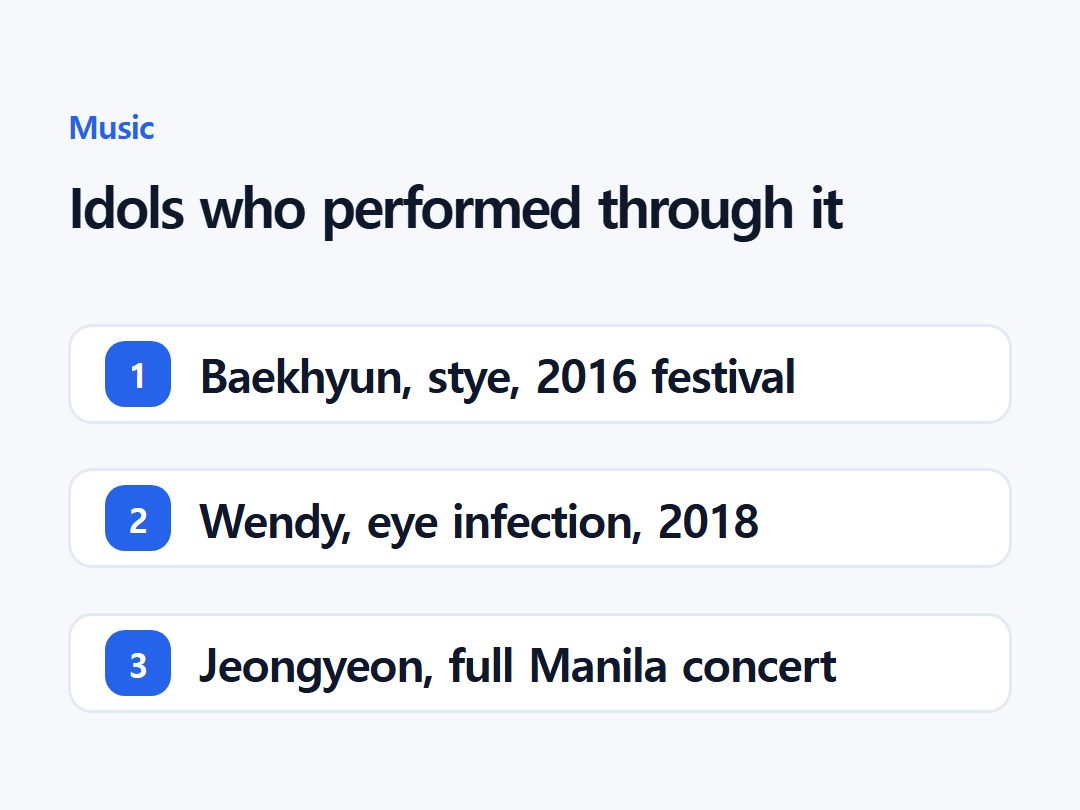
This is not one isolated incident. It is a recurring, well-documented pattern across agencies, generations, and group sizes.
- EXO's Baekhyun performed at the Lotte Family Festival in October 2016 with a stye covering his right eye
- Red Velvet's Wendy wore a patch through the group's "Power Up" promotion in August 2018, later explaining the infection on a radio show
- TWICE's Jeongyeon wore one through an entire Manila concert in June 2019, while bandmates performed with a neck patch, ankle support, and sore knees of their own
- ATEEZ's Mingi developed an eye infection during "WIN" promotion and performed in a patch rather than pull back
Smaller, less internationally known acts show the same behavior. Boy group 82Major's Yoon Ye-chan told reporters at a comeback showcase that his patch wasn't a concept — it came from a stye caused by staying up through dawn rehearsals. That detail matters: it is an idol, unprompted, naming exhaustion as the cause on the record.
An eye patch is evidence, not a costume
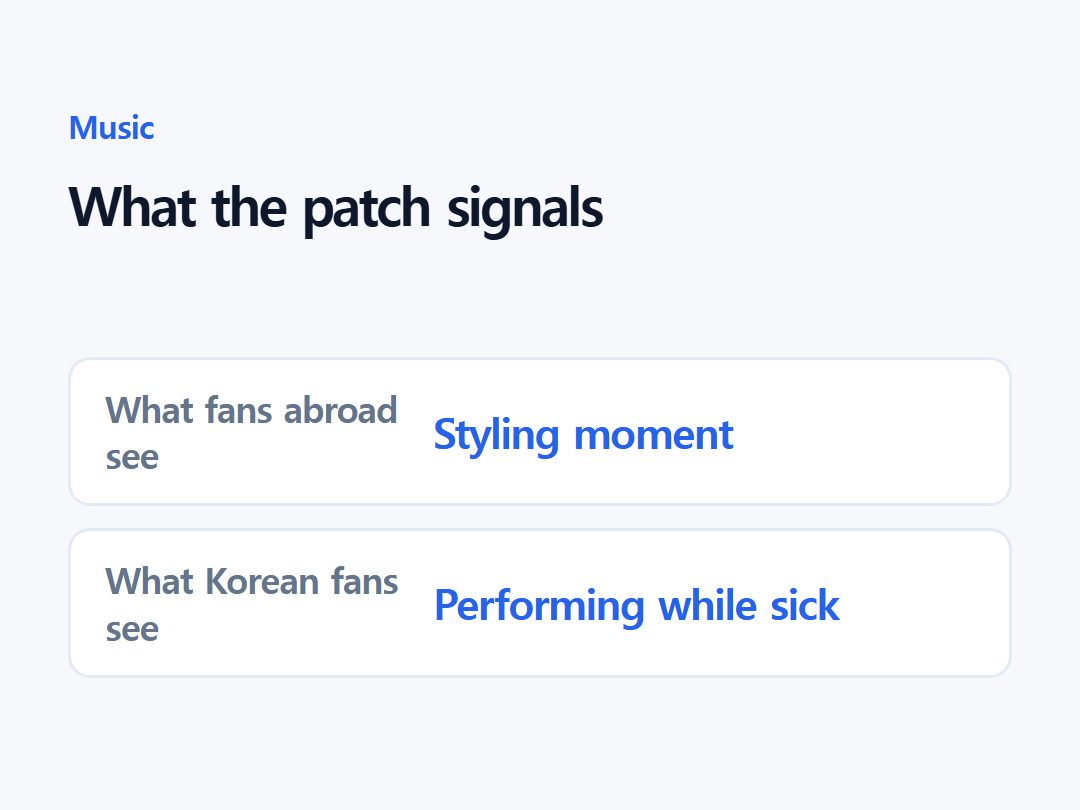
This is the part international coverage usually misses. A limp can be hidden under wide trousers. A bruise can be covered with makeup. An infected eye cannot — so the patch is not concealment, it is the opposite: proof, broadcast live, that an idol is performing while unwell.
Korean fans read the patch instantly for what it is: an ordinary, slightly embarrassing medical condition treated in public because there was no realistic option to treat it in private.
Wendy addressed hers directly on a radio broadcast, explaining it wasn't serious. She had simply been given permission to skip her contact lenses for a while — a small, practical accommodation, not a day off.
International coverage, by contrast, has tended to turn the same image into a listicle topic — "idols who look good in an eye patch" — treating the symptom as an aesthetic rather than asking why nobody swapped the member out or postponed the taping.
That gap in framing is the real story. The patch is not newsworthy because an idol got sick; illness happens to everyone in every industry. It is notable because, case after case, getting sick did not change the schedule. The injury stayed constant; the only thing styled around it was makeup.
A comeback schedule has no built-in rest day
A "comeback" is the promotional cycle around a new release — a tightly packed run of appearances on weekly televised music-countdown programs ("music shows") such as Music Bank or Show! Music Core, layered with radio, fan-sign events, and content shoots, often several in a single week.
Chart points and several music-show trophies are calculated from performances within that exact promotional window. Missing one taping does not just cost a single appearance — it can cost the group's cumulative score for that week entirely. That is a strong disincentive to pull any member off the lineup rather than simply cover the visible symptom and continue.
Jeongyeon's Manila night illustrates the scale of this: reporting from that show described not one injured member handling a minor issue, but five — an eye stye, a neck strain, a sore knee, a sprained ankle, and general illness — performing on the same stage, the same night, because the tour date itself could not move.
Contracts didn't used to include a way to call in sick
The pressure is not only cultural — for years it was written into the paperwork. Under Korea's "agency system," idols are legally employees of a management company that controls scheduling, styling, and public activity for the length of a multi-year contract, in exchange for training, debut costs, and promotion the agency fronts.
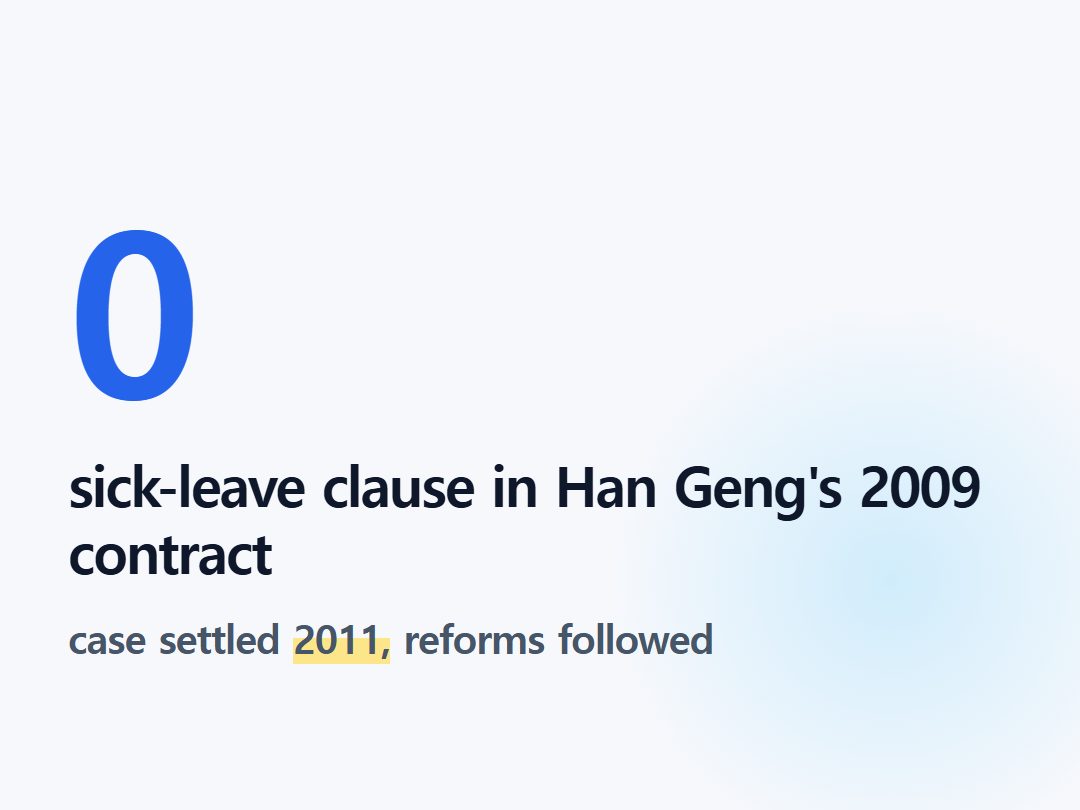
In 2009, singer Han Geng sued SM Entertainment over a 13-year contract that, among other issues, contained no sick-leave provision — meaning there was no contractual basis for cancelling an event on grounds of illness. The case was settled in 2011. It became one of the disputes, alongside a separate case brought by members of JYJ, that pushed regulators to intervene.
Korea's Fair Trade Commission responded by introducing a standardized entertainment contract and, in 2017, prohibiting six categories of unfair contract terms. Legal analysts have since noted that even with those reforms, day-to-day scheduling terms still tend to favor the agency over the individual performer.
Training instills endurance before debut even starts
The habit of performing through discomfort is not learned on stage — it is built during training. Trainees can spend years unpaid, cycling through intensive dance, vocal, and language classes, before an agency even decides whether to let them debut.
Within that system, tolerating exhaustion is treated as evidence of commitment rather than a problem to solve. By the time a trainee debuts, pushing through a stye or a sore ankle is not framed as an exception to house rules — it is simply how the job has always worked, modeled by the seniors they trained under.
Fans read the patch as professionalism, not a warning sign
Fan reaction reinforces the same expectation. Coverage of Jeongyeon's Manila concert praised the group for "pushing through" injuries rather than questioning why several members were performing hurt on the same night.
Framing endurance as dedication is not unique to fans — agencies, broadcasters, and idols themselves use the same language when discussing it publicly. The result is a feedback loop: performing while sick reads as loyalty to fans, which makes the alternative — cancelling — read, unfairly, as letting them down.
2025 brought a wave of idols stepping back mid-career
That loop has started to visibly strain. In 2025, girl group Izna's Yoon Ji-yoon left the group citing health issues, six months after first halting activities. Monsta X's I.M took a three-week break for back pain treatment. 2NE1's Park Bom paused group activities on medical advice, even during the group's 15th-anniversary run.
The timing is notable: that same quarter, Hybe's revenue rose to 705.6 billion won with concert revenue up 31%, and SM posted a record quarterly figure of 302.9 billion won.
One industry executive summed up the tension bluntly: "Artists don't always work because they want to, nor can they rest when they want. Once a song becomes a hit, there's no break."
What agencies still haven't fixed
Fan frustration has followed the same pattern at Hybe specifically. Within a short span, members across TXT, ILLIT, NewJeans, and the multinational group Katseye each took hiatuses for activity-related injuries, including an ankle ligament injury and a microfracture in a foot.
Fans have publicly accused the company of overworking its artists rather than adjusting schedules around them.
No major agency has publicly committed to a guaranteed sick-leave policy or a hard cap on comeback-season scheduling. Until that changes, the eye patch will likely keep showing up on music-show stages — not as a styling choice, but as the most visible sign of a much less visible industry norm.
Documented cases of idols performing with eye patches
| Idol | Group | Condition | Context / Date |
|---|---|---|---|
| Baekhyun | EXO | Stye | Lotte Family Festival, October 2016 |
| Wendy | Red Velvet | Eye infection | "Power Up" promotion, August 2018 |
| Jeongyeon | TWICE | Eye patch | Manila concert, June 2019 |
| Mingi | ATEEZ | Eye infection | "WIN" promotion |
| Yoon Ye-chan | 82Major | Stye | Comeback showcase, caused by dawn rehearsals |
Frequently asked
Why do K-pop idols wear eye patches on stage?
The patch almost always covers a stye or eye infection that appeared mid-promotion, and the idol performed anyway instead of skipping the schedule.
Can K-pop idols take sick days?
Many idol contracts historically had no sick-leave provision, and even after 2017 reforms, scheduling terms still tend to favor the agency over the performer.
Which idols have performed with an eye patch?
Documented cases include EXO's Baekhyun, Red Velvet's Wendy, TWICE's Jeongyeon, ATEEZ's Mingi, and 82Major's Yoon Ye-chan.
Sources
Every factual claim above is traceable. We do not translate articles — we gather facts from multiple outlets and write them ourselves.
- 10 K-Pop Idols Who Looked Surprisingly Good In An Eyepatch — Koreaboo
- 4 Times TWICE's Jeongyeon Pushed Through Hardships To Perform For Her Beloved Fans — Koreaboo
- Concert Goers Praise TWICE for Excellent Performance Despite Injuries of Some Members — allkpop
- EXO's Baekhyun Shows Fans Nothing Will Stop Him From Performing On Stage — Koreaboo
- 6 K-Pop Idols Who Rock The Stage With An Eye Patch — Kpopmap
- 82메이저 윤예찬, 안대 쓰고 등장…"콘셉트 NO, 새벽 연습에 다래끼" — 엑's (Daum)
- K-pop and contract law — Legal Cheek
- K-pop idols halt, quit careers over health concerns while agencies post record revenues — The Korea Herald
- "Stop overworking the artists" — Fans furious as multiple K-Pop idols from HYBE succumb to injuries — Sportskeeda