International fans often notice it before they can explain it: a member stops posting, an act cancels appearances, and weeks pass with only a short agency statement, or nothing at all. Korean fans tend to read these silences calmly, because they already recognize the handful of ordinary, non-scandalous reasons behind them. This piece lays out what those reasons usually are.
The short version
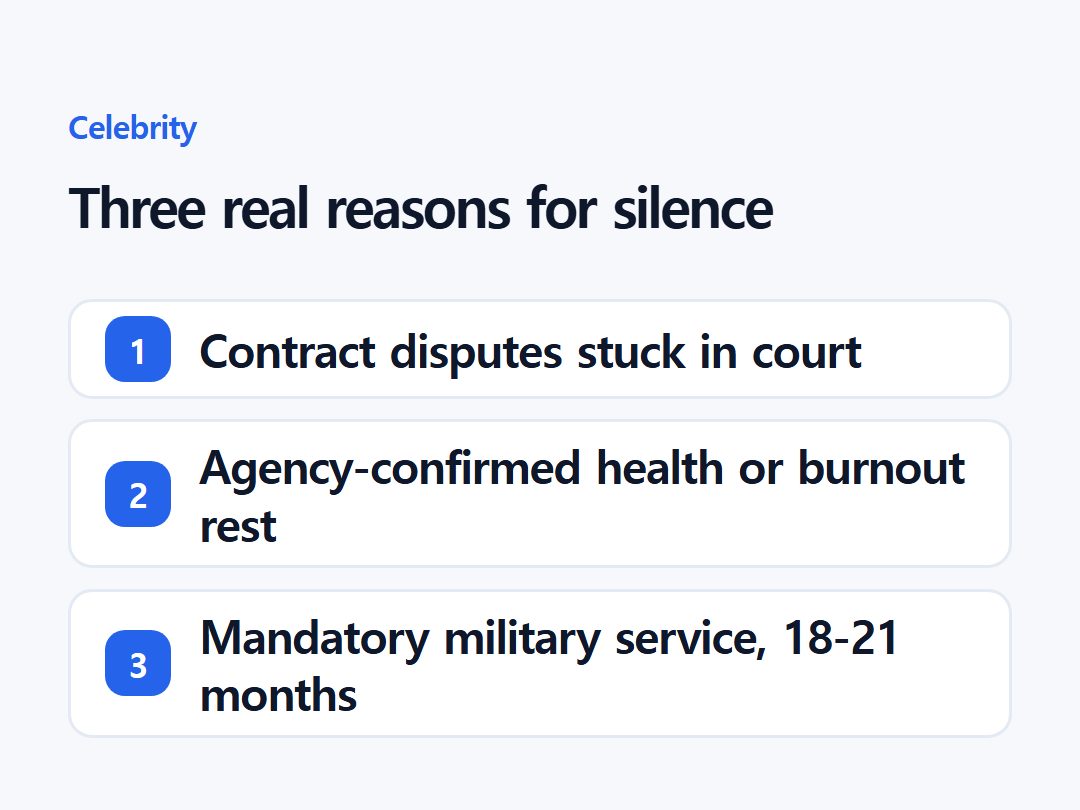
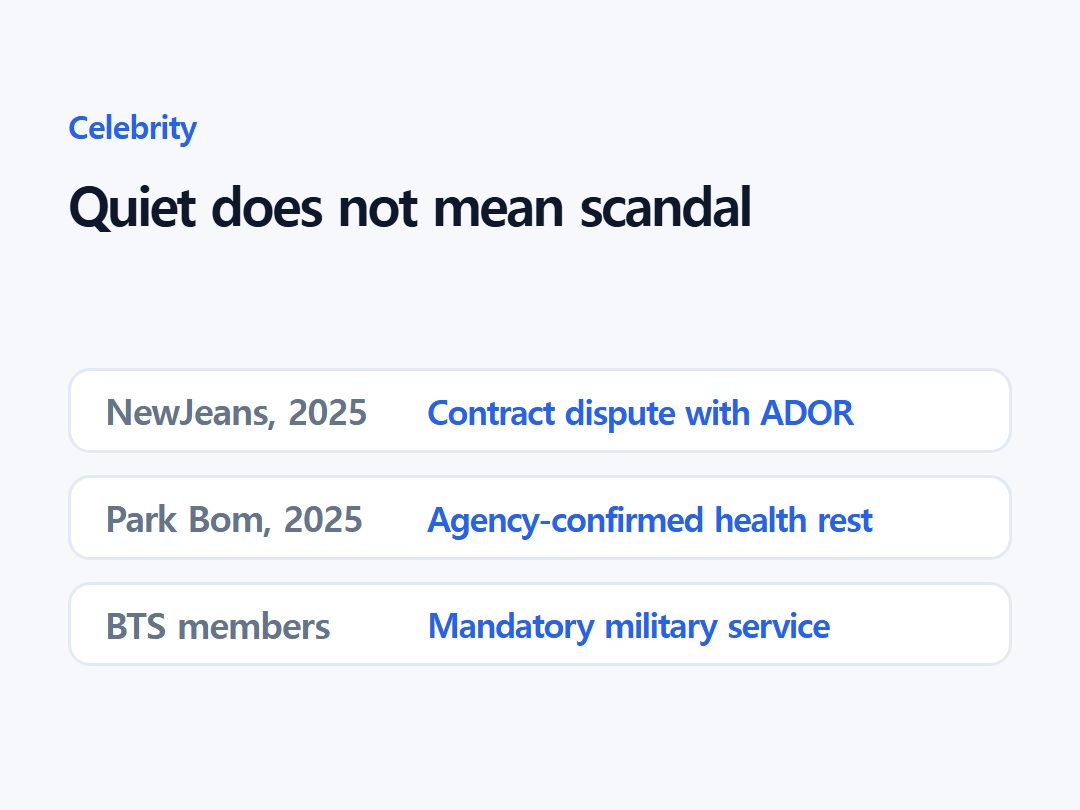
- Korean idols often go silent for health, contracts, or scheduling — not scandal.
- Agencies control contracts tightly, so legal disputes like NewJeans' can force silence.
- Mandatory military service pulls male idols offline for 18 to 21 months.
What silenced Park Bom, I.M, and NewJeans in 2025
2025 produced several examples of the pattern. Singer Park Bom of 2NE1 suspended all public activities for health reasons; her agency, D-NATION Entertainment, said in October that she was in an "emotionally unstable state" requiring urgent treatment and rest.
Monsta X's I.M paused activities for three weeks in late July after his agency, Starship Entertainment, said he had been receiving treatment for back pain. Yoon Ji-yoon of the girl group Izna left the group entirely in 2025, citing health issues, after already halting activities that February.
None of these cases involved a scandal, yet each generated the same confusion abroad: fan forums filled with speculation about what an idol was hiding, even as Korean coverage treated the announcements as routine.
Separately, the girl group NewJeans announced an indefinite hiatus in March 2025 after a Seoul court blocked their attempt to leave their agency, ADOR, a subsidiary of HYBE. That silence had nothing to do with anyone's personal conduct. It was the result of a contract dispute working its way through the Korean legal system.
Why do Korean idols go quiet without a scandal?
To understand why an idol or actor can vanish from public view for months with only a vague statement, or none, international readers need to understand a few features of the Korean entertainment business that Korean fans absorb by osmosis.
The agency system makes silence structural
Nearly every Korean idol, and most actors, work under the "agency system": a company scouts, trains, and manages the performer under an exclusive multi-year contract that controls scheduling, image, endorsements, and even public statements.
When a contract dispute arises, the agency's grip on communication does not loosen, it tightens, because ongoing litigation makes agencies cautious about anything a member says publicly.
This is currently visible in the NewJeans case.
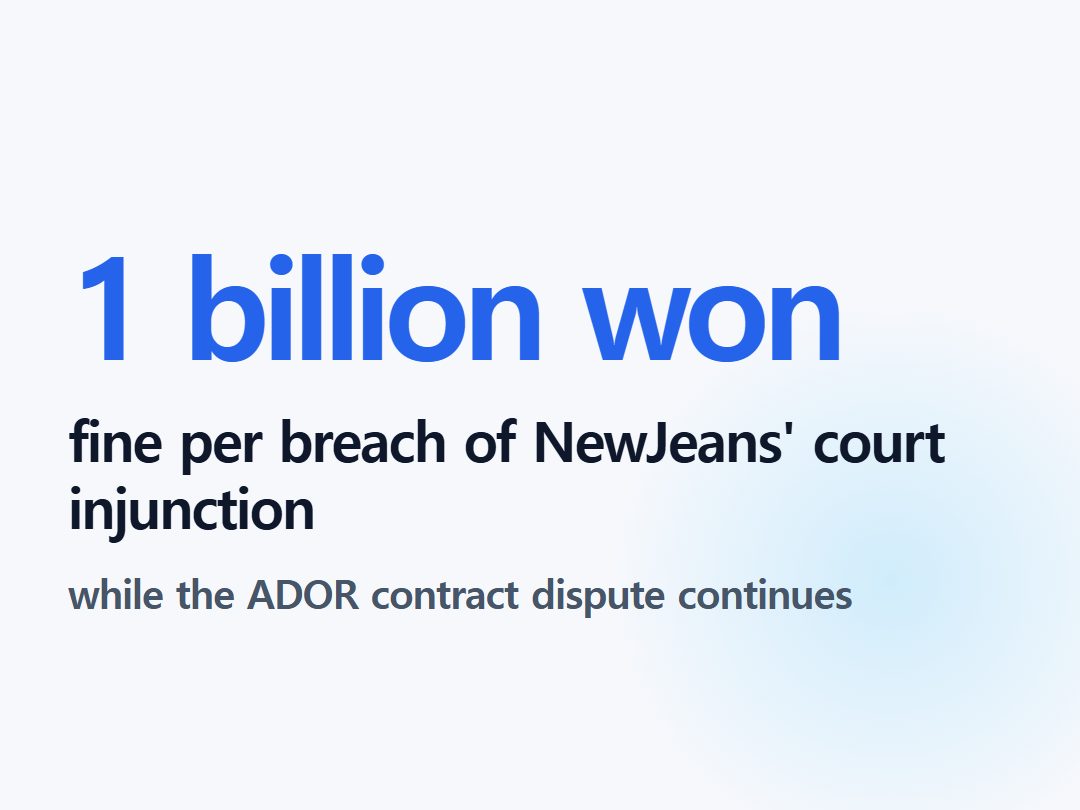
After the group tried to terminate its contract with ADOR in late 2024, the agency sought and won a court injunction barring the members from independent professional activity, including solo endorsements, until the underlying case is resolved, under threat of a fine of about 1 billion won per violation.
A similar dispute played out between SM Entertainment and three EXO members, Chen, Baekhyun and Xiumin, who tried to leave in 2023 over disagreements about profit transparency; Korean courts ultimately sided with the agency. In both cases, going quiet was not evasion.
It was the legally safest option while a court decided who controlled the group's activities.
Health hiatuses are announced without detail, deliberately
Korean agencies routinely announce a health-related hiatus with almost no elaboration, and that vagueness is itself the norm, not a red flag. As a matter of standard practice, agencies release only what a performer has agreed to disclose, treating medical information as private by default.
Park Bom's case illustrates this: her agency confirmed she is receiving treatment and needs rest, without detailing a diagnosis. Monsta X's I.M and Izna's Yoon Ji-yoon received similarly brief explanations.
Industry reporting in 2025 also pointed to a broader pattern: as concerts, comebacks (the K-pop term for a new release cycle, staged more like a scheduled relaunch than a comeback from failure) and awards shows have multiplied, more idols have stepped back for physical or mental exhaustion even as their agencies post record revenue, meaning quiet periods tied to burnout are becoming more common, not less.
"Recharging" is a recognized, unremarkable category
Korean entertainment coverage regularly uses the phrase "재충전," or recharging, to describe a planned gap between promotional cycles that is neither health-related nor scandal-related.
Because idol schedules are dense, agencies build informal rest windows into a group's calendar between album cycles, world tours, and individual side projects.
A performer skipping public appearances for a month or two between activity periods, without any statement at all, is frequently just an unannounced version of this ordinary scheduling gap, not a sign that something is being hidden.
Contracts run on fixed cycles, and renewal windows are naturally quiet
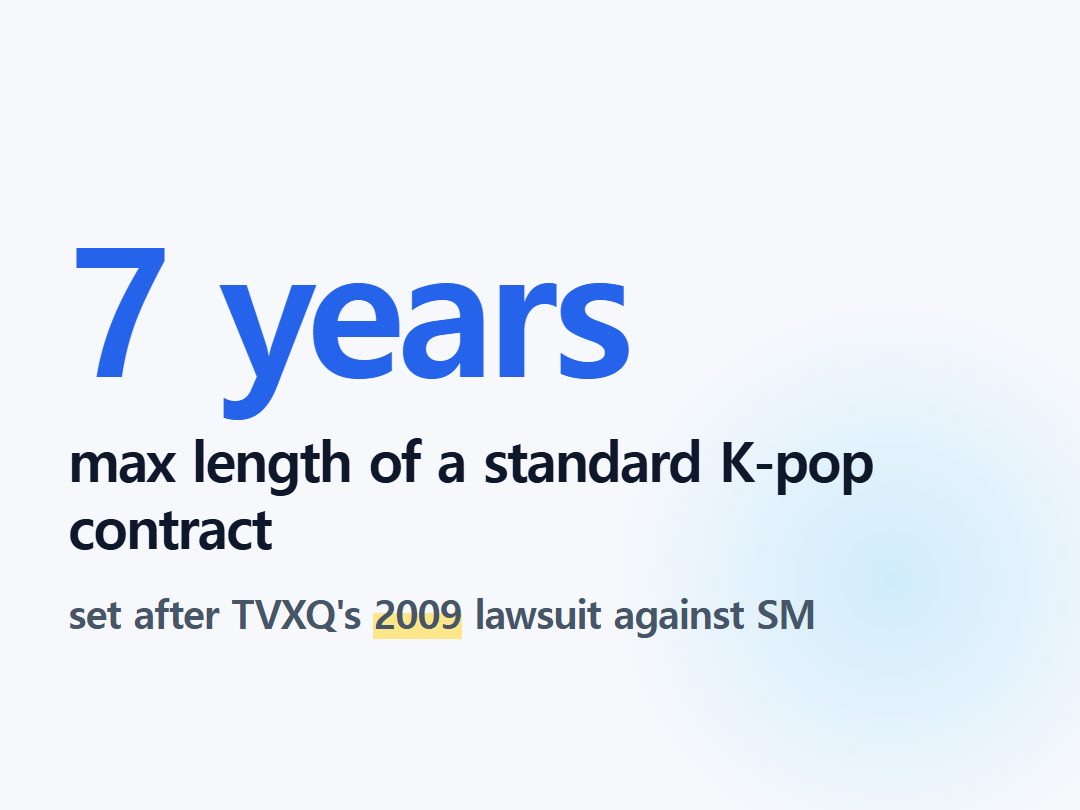
South Korea's Fair Trade Commission introduced a "Standard Exclusive Contract" for performers around 2009-2010, capping most agency deals at seven years, after members of TVXQ sued SM Entertainment over a 13-year contract widely described in Korean media at the time as a "slave contract." That reform is why a group's seventh anniversary is often nicknamed K-pop's "seven-year itch": renewal negotiations cluster around that point, and negotiations are, by design, conducted privately.
A member or group can go quiet for weeks simply because a renewal, a restructured deal, or a departure is being negotiated behind closed doors before any public announcement is made.
Mandatory military service creates long, scheduled absences
Every able-bodied South Korean man between 18 and 28 is legally required to complete military service, roughly 18 months in the army, 20 in the navy, or 21 in the air force, with no exemption for entertainers.
When BTS's members enlisted, South Korea's defense ministry stated plainly that exempting pop culture artists "even though they have made a contribution to the country's reputation is not in line with the government's stance to uphold justice and fairness." For male idols and actors, an 18-to-21-month gap in output is not a mystery to Korean fans.
It is a predictable, government-mandated pause that agencies plan release schedules around well in advance.
How a 2009 lawsuit changed industry norms
The current norms trace back to the industry's harshest period. In the 1990s and 2000s, agencies routinely signed teenage trainees to contracts running 10 to 15 years, with minimal profit share and heavy restrictions on personal conduct.
TVXQ's 2009 lawsuit against SM Entertainment was the case that broke that model open, leading directly to the seven-year cap and to a general shift toward agencies pre-announcing hiatuses through brief official statements rather than leaving fans to guess entirely.
That shift, however, produced a new default: agencies control the narrative of an absence almost completely.
A statement is released, it is short, and follow-up questions are rarely answered in real time, since Korean entertainment reporting norms and defamation law make outlets cautious about speculating beyond an agency's own words.
Domestic fans have learned to read a brief, vague statement as "normal industry process" rather than as a cover story. International fans, arriving without that shared history, are more likely to read the same silence as suspicious.
What happens next for NewJeans and Park Bom?
Several of these situations remain open. NewJeans' contract dispute with ADOR is still working through the Korean court system, and the group's activity status depends on its outcome. Park Bom's agency has not given a timeline for her return.
More broadly, Korean entertainment outlets reported in late 2025 that the volume of health-related idol hiatuses was rising even as agency revenues hit records, a trend industry watchers are now tracking for signs of structural change, such as built-in rest periods, rather than case-by-case crisis response.
Whether agencies begin communicating more directly with international fandoms, who are less familiar with the industry's quiet norms, is also an open question as K-pop's audience keeps growing more global.
Four Korean acts who went quiet in 2025
| Case | Stated reason | What happened |
|---|---|---|
| Park Bom (2NE1) | Health — agency cited an "emotionally unstable state" | Suspended all public activities, announced October 2025 |
| I.M (Monsta X) | Treatment for back pain | Paused activities for three weeks in late July 2025 |
| Yoon Ji-yoon (Izna) | Health issues | Halted activities in February 2025, left the group entirely later that year |
| NewJeans | Contract dispute with agency ADOR after a court injunction | Indefinite hiatus announced March 2025 |
Frequently asked
Why did NewJeans go on hiatus?
A Seoul court blocked their attempt to leave agency ADOR and barred members from independent work, so the group announced an indefinite hiatus in March 2025 while the dispute continues.
Why is Park Bom inactive right now?
Her agency, D-NATION Entertainment, said in October 2025 she was in an "emotionally unstable state" requiring urgent treatment and rest, and has not given a return timeline.
Why do K-pop idols disappear for military service?
Every able-bodied South Korean man aged 18 to 28 must serve roughly 18 to 21 months with no exemption for entertainers, creating a long, government-mandated gap in output.
Sources
Every factual claim above is traceable. We do not translate articles — we gather facts from multiple outlets and write them ourselves.
- K-pop idols halt, quit careers over health concerns while agencies post record revenues — The Korea Herald
- K-pop legal feuds highlight power of contracts as NewJeans, EXO members lose disputes — The Korea Times
- NewJeans Announces An Indefinite Hiatus Following Legal Setback — CelebrityAccess
- Seoul court clips NewJeans' wings with RM3m fine threat every time they go rogue on Ador — Malay Mail
- Park Bom shares updates amid health break, months after $4.5 quadrillion lawsuit claims — Gulf News
- Cycle of controversy: Korea's top stars faced probes, exits and burnout in 2025 — The Korea Times
- An increasing number of K-pop idols are breaking free from big agencies. Why? — The Korea Herald
- K-Pop stars BTS likely to take 18-month military service break — Gulf News