
When a K-pop idol leaves their agency, international fans often assume the hardest part is over once the contract ends. In Korea, that is frequently just the start of a second fight: over who gets to keep the name.
The short version
- Ending an idol's contract doesn't automatically return the group's trademarked name.
- Regulators capped most agency contracts at seven years after a 2009 lawsuit.
- The Boyz and NewJeans still don't know if they'll keep their names.
Boy group The Boyz found this out in December 2024.
After their contract with IST Entertainment ended and they signed with a new label, One Hundred Label, the two companies could not agree on transferring the trademark for "The Boyz." IST said it had offered the 11 members personal, free use of the name — but not a transfer to their new agency, which is the distinction that mattered.
As of that announcement, the group could not confirm it would keep performing under the name it debuted with in 2017.
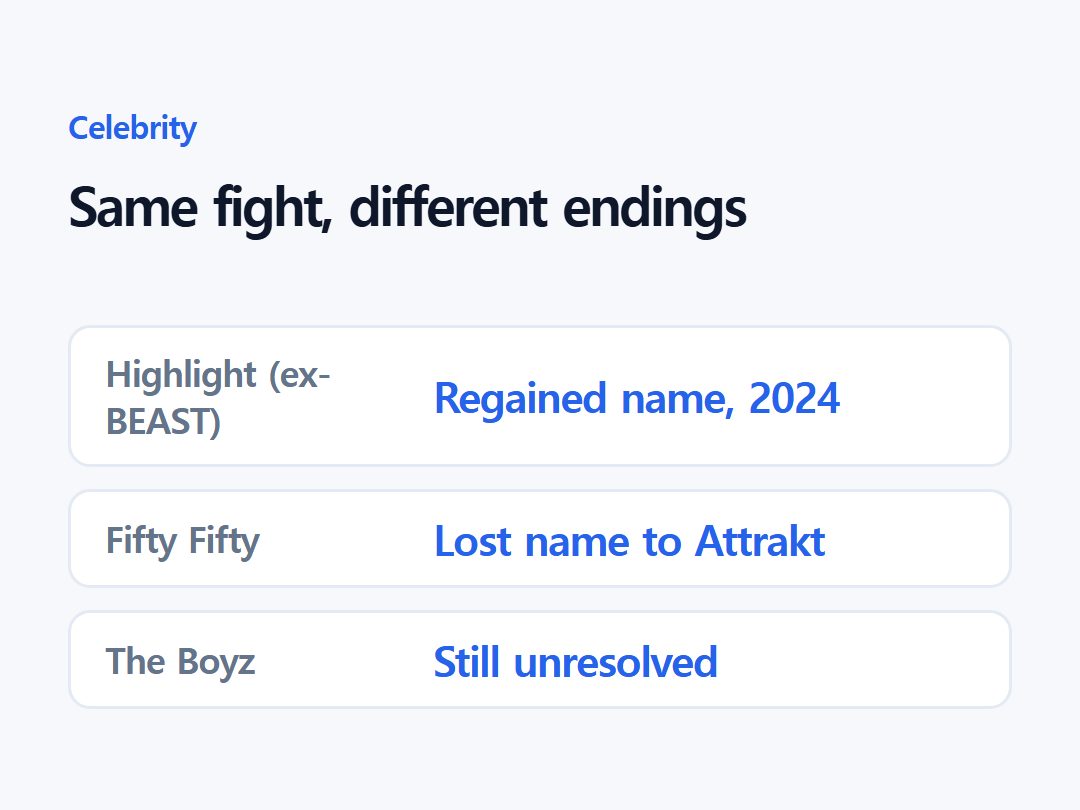
They are not an isolated case. Girl group Fifty Fifty lost the rights to their own name to their former agency, Attrakt, in 2024.
Boy group NewJeans spent late 2024 and 2025 in a court battle with their label, Ador, over whether they could work independently — and, at various points, performed under alternate names rather than risk using "NewJeans" without the agency's consent.
These are not scandals or rumors; they are the visible edge of a legal structure that runs through almost every idol's career.

Why doesn't leaving your agency return your name?
To an international reader, an idol's name feels like a personal identity — something like a stage name a solo Western musician might choose for themselves. In Korea's agency system, it usually works differently.
Idols typically join their company as teenage trainees, sometimes years before debut, and the agency pays for vocal coaching, dance training, styling, housing and the marketing campaign that eventually turns a trainee into a public name.
Because the agency treats that name as a brand it financed into existence, it commonly files to register the group name — and sometimes an individual member's stage name — as a trademark with the Korean Intellectual Property Office (KIPO), the government body that grants and records trademark rights in Korea.
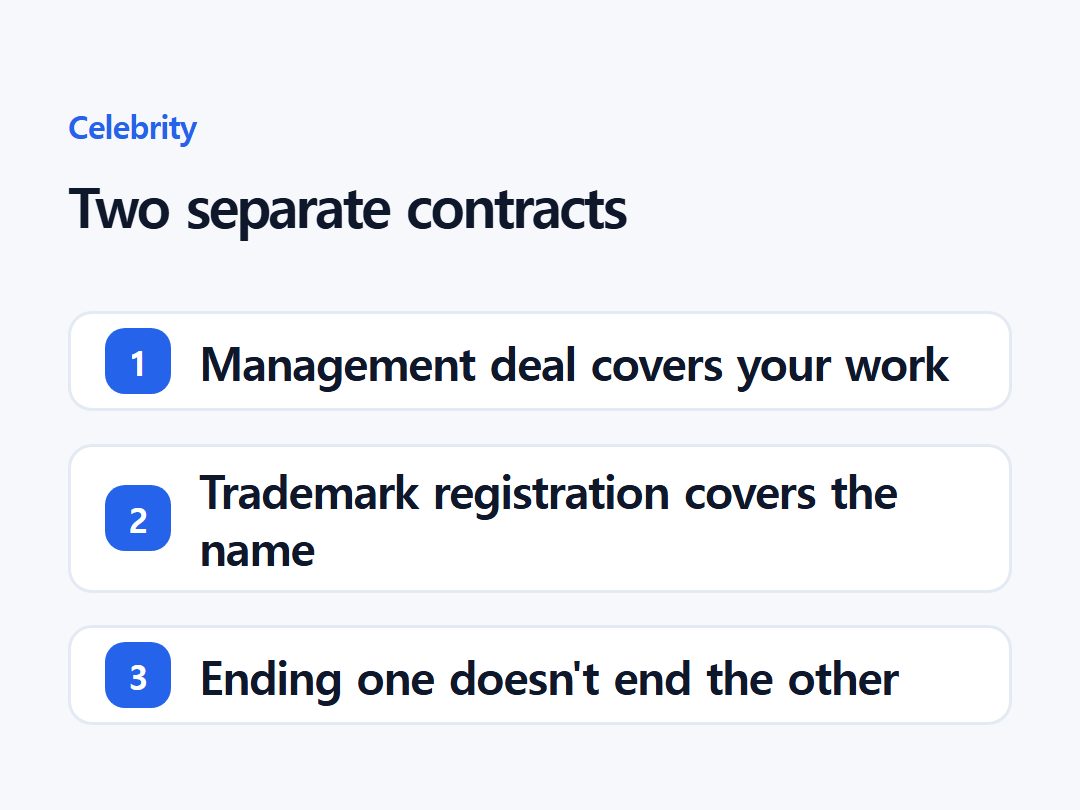
This creates two separate legal tracks that most fans conflate into one. The first is the exclusive contract (전속계약), which governs the working relationship: how long the idol is bound to the agency, how earnings are split, and what happens if either side wants out.
The second is the trademark registration, a property right that exists independently of that contract. Ending the exclusive contract does not automatically return the trademark. If the agency holds the registration, it can keep the name even after the artist walks away — and can, in principle, license it to a rebooted lineup, as Attrakt did when it launched a new set of members under the Fifty Fifty name in 2024.
The issue extends beyond group names. In 2019, LM Entertainment — the agency built around former Wanna One member Yoon Ji-sung after the project group disbanded — filed to trademark a stylized version of his own stage name.
The filing drew criticism because it would have let the agency, not the performer, control whether Yoon could keep using his own name in future promotion.
It illustrated a point that surprises many outside Korea: even a solo artist's personal name, if adopted as a professional identity within the company, is not automatically theirs to keep.
Outcomes vary widely, and that inconsistency is itself part of why the issue matters.
Some agencies negotiate a transfer once a group's contract ends — GOT7 kept its name after leaving JYP Entertainment, and Highlight (the group formerly known as BEAST) reached a mutual agreement with Cube Entertainment in April 2024 to reuse the BEAST name for anniversary purposes, eight years after losing access to it.
Others do not: Attrakt fought a multi-country trademark race against Fifty Fifty's own members in 2023, ultimately winning full ownership from KIPO in May 2024, in Korea, the US, the UK, Japan, China and dozens of other markets.
The gap between those outcomes usually comes down to leverage, timing of the trademark filing, and whether the agency sees more value in cooperating with departing members or retaining the brand for a replacement lineup.
How a 2009 lawsuit reshaped every idol contract
The modern shape of this problem traces back to a 2009 lawsuit that had nothing to do with trademarks at first glance. Three members of TVXQ — Kim Jaejoong, Park Yoochun and Kim Junsu — sued SM Entertainment to void their 13-year exclusive contracts, calling the terms excessive.
The Seoul Central District Court granted a partial injunction, and although the case ultimately settled in 2012 with both sides withdrawing claims, it pushed Korea's Fair Trade Commission to introduce a standard exclusive-contract template capping most idol contracts at seven years.
That single reform reshaped the industry calendar: because so many groups now debut on similar contract terms, a wave of members reach the end of their exclusive deal — and start weighing whether to renew, leave, or renegotiate — around the same point in their careers, which is exactly when name and trademark disputes tend to surface.
Group name battles themselves predate that reform.
In the 2000s, the trademark for H.O.T., one of the earliest major idol groups, ended up registered to a former SM Entertainment executive personally rather than to the members or the company; the Supreme Court invalidated his claim in 2020, more than two decades after the group's debut.
Shinhwa faced a related tangle when SM transferred the group's trademark to a new agency in the mid-2000s, before members eventually left to found their own company in 2011.
More recent cases show the same pattern playing out faster and more publicly, partly because social media lets fans watch trademark filings in near real time.
T-ara's former agency, MBK Entertainment, filed to trademark the group's name in December 2017 after the members sought independence; KIPO ultimately rejected MBK's application in 2018, letting T-ara keep the name.
Girl group Brave Girls had to rebrand as BBGirls after losing rights to their original name upon leaving Brave Entertainment.
And in 2023, when Fifty Fifty's members tried to leave Attrakt, their own parents raced to file trademark applications for the group name and each member's stage name — only for Attrakt to reveal it had already filed first, months earlier.
Will The Boyz and NewJeans keep their names?
Two disputes remain genuinely open.
The Boyz still do not have a confirmed answer on whether they can keep performing under that name with their new agency; as of the failed December 2024 negotiations, IST Entertainment's offer covered individual members, not a transfer to One Hundred Label, leaving the practical question of touring, merchandising and streaming under the old name unresolved.
NewJeans' situation is similarly unsettled: a Seoul court ruled in October 2025 that the group's management contract with Ador remains valid until 2029, but that ruling addresses the working relationship, not the separate question of who controls the trademark if the relationship eventually ends anyway.
Because trademark rights and exclusive contracts are decided in different legal proceedings, on different timelines, resolutions rarely arrive cleanly.
What is worth watching is whether more agencies follow the Highlight and GOT7 pattern of negotiated transfer once a group's run with the company is clearly over, or whether the more adversarial Fifty Fifty and Attrakt approach — racing to lock down the trademark before members can act — becomes the industry default as more veteran groups approach their seven-year mark in the coming years.

How idol name disputes have played out
| Group | Former Agency | Outcome |
|---|---|---|
| GOT7 | JYP Entertainment | Kept the name after leaving |
| Highlight (BEAST) | Cube Entertainment | Regained rights for anniversary use in 2024, 8 years later |
| Fifty Fifty | Attrakt | Lost the name; Attrakt won full trademark ownership in May 2024 |
| T-ara | MBK Entertainment | Kept the name; KIPO rejected MBK's 2017 filing |
| Brave Girls | Brave Entertainment | Lost the name; rebranded as BBGirls |
| The Boyz | IST Entertainment | Unresolved as of the failed December 2024 negotiations |
| NewJeans | Ador | Unresolved; contract ruled valid until 2029 in October 2025 |
Frequently asked
Can K-pop idols keep their name after leaving their agency?
It depends on who owns the trademark, not the contract — GOT7 and T-ara kept their names, but Fifty Fifty and Brave Girls lost theirs to their former agencies.
Why did Fifty Fifty lose the rights to their own name?
Their former agency, Attrakt, filed for the trademark before the members' parents could, and won full ownership from KIPO in May 2024 across Korea, the US, the UK, Japan, China and other markets.
Will NewJeans get to keep their name?
That's still unresolved — a Seoul court ruled in October 2025 that their management contract with Ador is valid until 2029, but that ruling doesn't decide who controls the trademark.
Sources
Every factual claim above is traceable. We do not translate articles — we gather facts from multiple outlets and write them ourselves.
- Use of name 'The Boyz' uncertain following trademark dispute — The Korea Herald
- Who owns rights to K-pop group names? — The Korea Times
- ATTRAKT successfully obtains the trademark rights to the group name FIFTY FIFTY in Korea + 30 other countries — allkpop
- ATTRAKT blocks FIFTY FIFTY members' attempts to trademark group name internationally — allkpop
- Court rules against FIFTY FIFTY over 'Cupid' ownership; ATTRAKT vows to appeal — The Korea Times
- Highlight secures use of B2ST trademark in mutual agreement with Cube Entertainment — allkpop
- K-pop boyband Highlight regain trademark to original name, BEAST — NME
- What's in a Name? LM Entertainment and Idol Trademarks — Seoulbeats
- K-pop superstars T-ara vow to fight for rights to their name; experts predict bitter legal battle ahead — World Trademark Review
- Seoul court rules in Ador's favour, blocking K-pop group NewJeans' independent activities as NJZ — Malay Mail
- Why K-Pop's NewJeans—Or NJZ—Is Fighting an Industry — TIME
- Dispute over termination of exclusive contract between TVXQ's 3 members and SM Entertainment — NamuWiki (English)
- NewJeans Danielle's Dispute Is The Latest In A Long Line Of K-Pop Lawsuits — Forbes