
A K-pop group's ending gets reported in a single sentence: "disbanded." But that one word covers at least five legally and factually different situations, and international fans usually can't tell which one they're watching.
The short version
- Disbandment can mean five different legal endings, not just one event.
- Korean contracts hit a seven-year cap unless both sides renew in writing.
- Courts have sided with agencies in EXO, Fifty Fifty, and NewJeans lawsuits.
A group with no comeback plans for two years and a group whose contract was designed from day one to expire on a specific date both get the same headline. So does a group locked in an active lawsuit, and a group that never issued a disbandment statement at all — it just quietly ran out of members.

Five endings that get called the same word
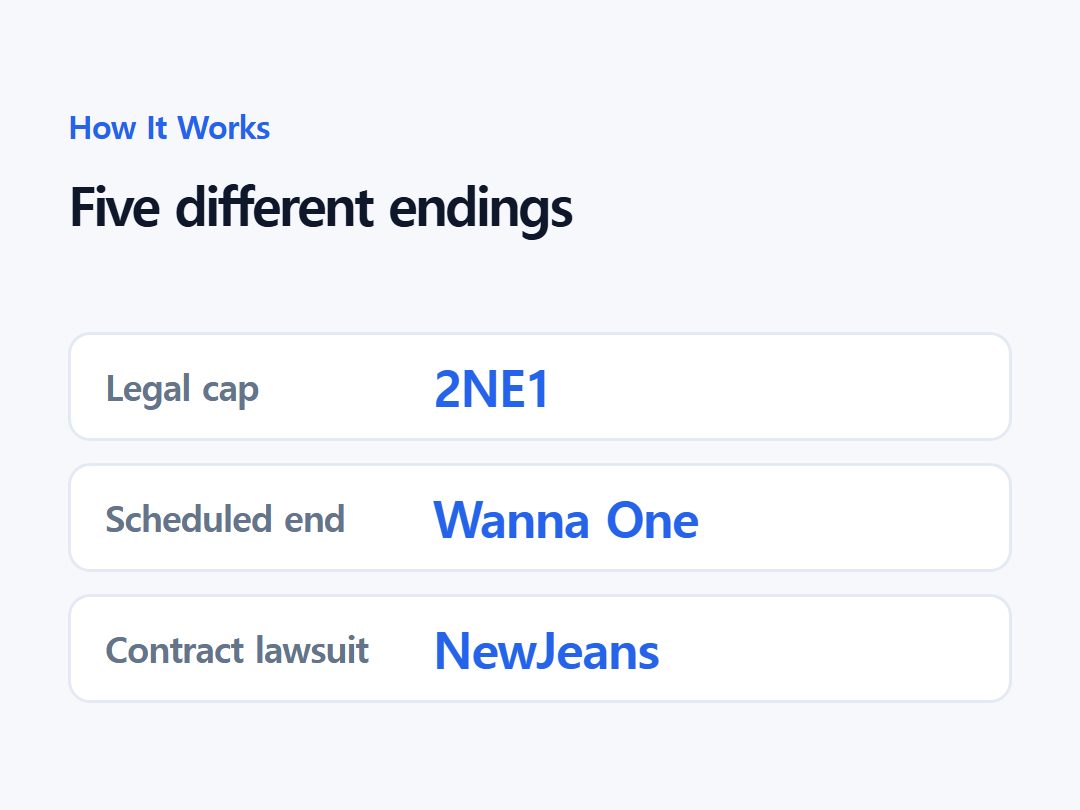
Korean entertainment agencies operate on exclusive contracts (전속계약) — legally binding agreements that cover training costs, promotion schedules, and revenue splits, typically running for years rather than album cycles. "Disbandment" can mean any of the following:
| Type | What actually ends | Example |
|---|---|---|
| Legal cap reached | Contract hits its 7-year limit | Many second-generation groups |
| Scheduled project end | Contract had a fixed end date from debut | Wanna One, IZ*ONE |
| Quiet non-renewal | Agency chooses not to extend | 2NE1, Spica |
| Contract lawsuit | Members contest validity in court | EXO, Fifty Fifty, NewJeans |
| No announcement at all | Members leave one by one | AOA |
A seven-year clock every group is racing
In 2009, TVXQ — one of SM Entertainment's biggest acts — sued the company over a contract that ran 13 years, part of a wave of so-called "slave contract" cases across the industry. South Korea's Fair Trade Commission responded by introducing a standard exclusive contract that caps the length of a first-time deal at seven years.
After seven years, the contract legally ends unless both sides sign a new one in writing. There's no cap on how long a renewal can run — ATEEZ, for instance, re-signed with its agency for another seven years in 2025 — but the seventh anniversary is the point where every group's future gets decided, one way or another. Fans call it the "seven-year curse."
Groups built to end on a fixed date
Not every ending is a rupture. Project groups assembled through survival shows like Produce 101 are contracted for a set period from the start, and their members already belong to separate home agencies.
Wanna One's contract with Swing Entertainment was set to expire December 31, 2018; the group held farewell concerts and closed out activities on January 27, 2019, exactly as planned. IZ*ONE's cross-agency deal was built to run about two and a half years. Talks to extend it collapsed in March 2021 when the members' various agencies couldn't agree on new terms, and the group disbanded that April.
From outside Korea, both looked like sudden breakups of massively popular groups. Inside the system, both were following contracts written years earlier.
When "contract expired" means the label chose not to renew
A contract ending isn't automatically the group's decision — it's frequently the agency's. 2NE1's deal with YG Entertainment expired in May 2016. Member Gong Minzy left once her contract lapsed, and YG initially said the remaining three would continue.
No comeback materialized that summer. In November 2016, YG announced 2NE1's disbandment, re-signing CL and Dara as solo artists but not renewing Park Bom. The company's own statement was blunt: it would rather invest in members' solo careers than in "a team that is uncertain of a comeback."
Smaller agencies produce quieter versions of the same pattern. Girl group Spica left its original label for a bigger one in 2015 after a two-year gap in activity, but the momentum never returned.
In February 2017, the new agency confirmed the members had simply chosen not to renew. Commentary at the time pointed to weak label support and no fixed fanbase as the underlying cause, not any single scandal.
Members suing to leave — and usually losing
Sometimes it's the artists who want out before the contract term is up, and Korean courts have mostly sided with the agencies. Three Chinese members of EXO — Kris, Luhan, and Tao — separately sued SM Entertainment between 2014 and 2015, arguing their contracts ran 12 to 13 years, far past the seven-year cap, and cited underpayment and unequal treatment.
The 2016 settlement didn't go their way: courts ruled the contracts remained binding with SM until 2022, even though the three no longer performed as EXO members.
The pattern repeated more recently. After Fifty Fifty's single "Cupid" became a global hit in 2023, four members sought a court injunction to void their contract with agency Attrakt, citing mistrust and neglect of their health.
In August 2023, a Seoul court dismissed the injunction. Only one member returned to the label; the other three had their contracts terminated and were countersued for roughly 13 billion KRW ($10 million) in damages.
NewJeans followed a similar arc. In November 2024, the members announced they were ending their contract with ADOR after the label's founding producer was removed from her CEO role. ADOR sued to keep the contract intact, and in October 2025 a Seoul court ruled fully in the agency's favor.
Most members dropped their appeal and returned to promotions under ADOR by November 2025. One member, Danielle, was told her contract would not continue and is now a defendant in a separate $33 million damages suit the agency filed in December 2025.
A group that disbanded without anyone announcing it
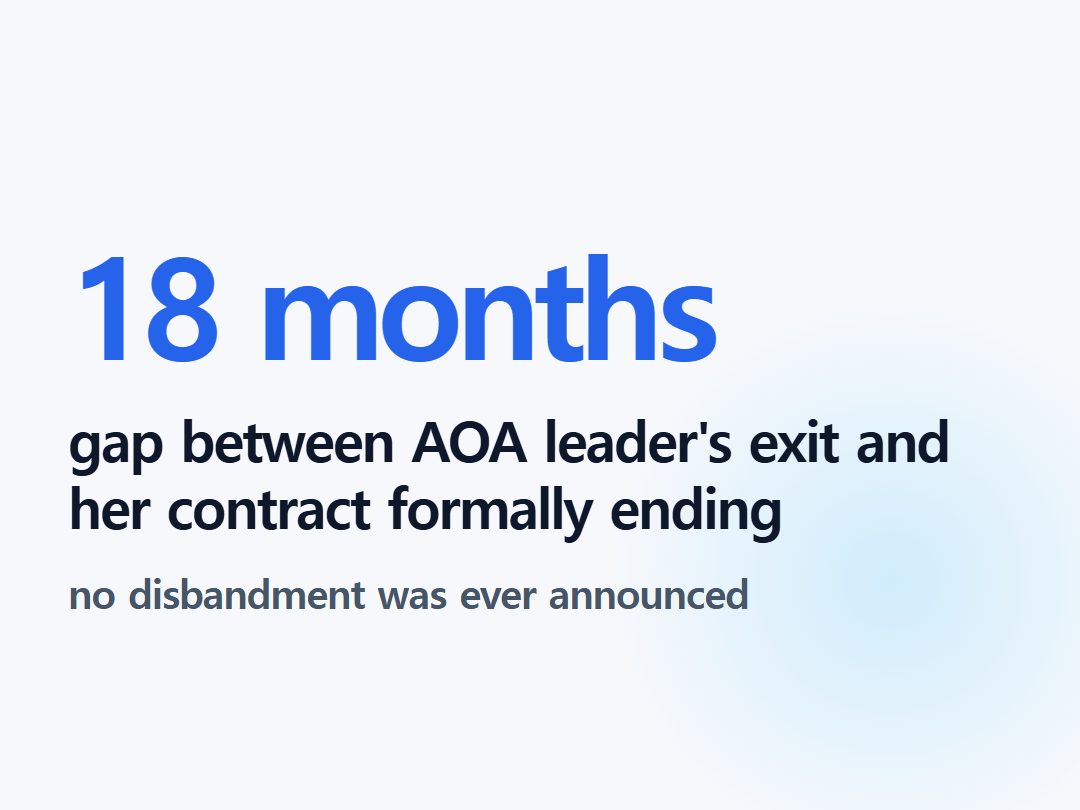
The starkest case is one with no press release at all. Girl group AOA's leader left the group and the industry in 2020 after a former member's bullying allegations, and the agency confirmed her contract had formally ended in January 2022 — eighteen months after her departure was first announced.
From there, members left the agency one at a time: the label's most prominent member in October 2022, another in March 2023, the last remaining original member in May 2024. At no point did the agency issue a statement declaring AOA disbanded. By 2024, every member had simply left, and outlets began describing the group as disbanded purely by inference.
Why a quiet business decision reads as a shock
International coverage tends to compress all of this into one moment — the day a headline runs — because that is the only visible signal. The seven-year cap, contract-renewal negotiations, and non-renewal decisions all happen behind closed doors, sometimes over many months, before any public statement appears.
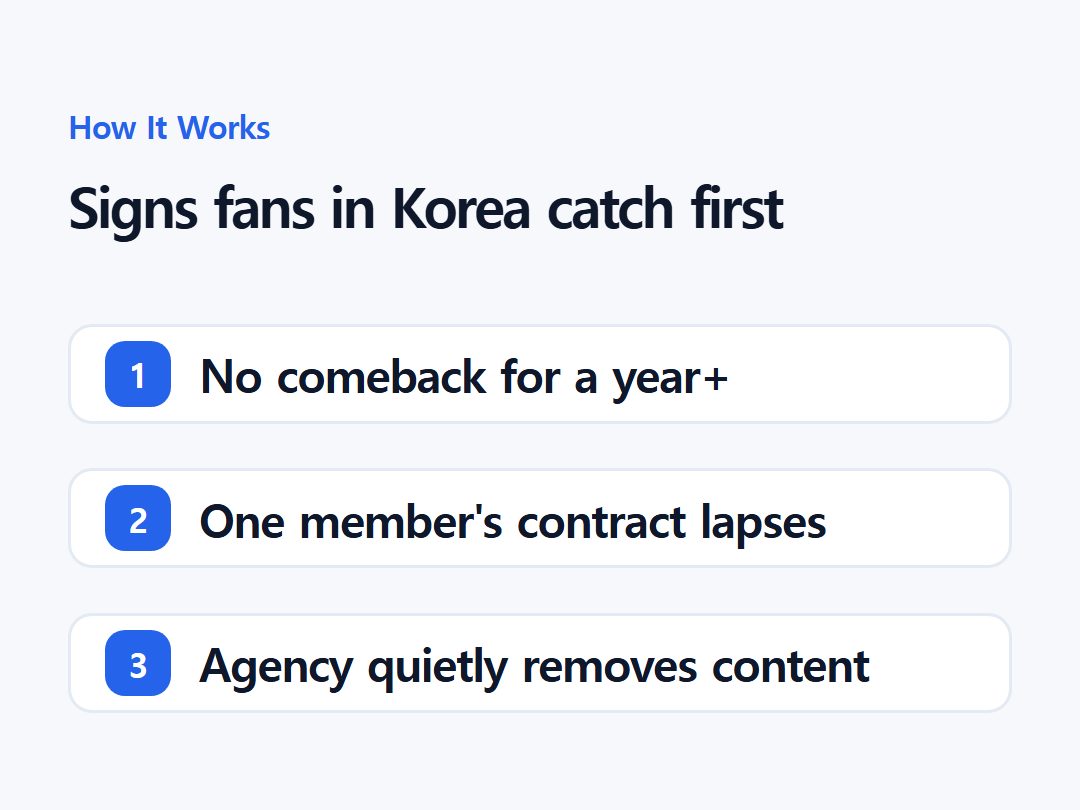
Domestic fans typically read the signs earlier: no comeback announced for a year or more, an individual member's contract lapsing while others stay silent, or an agency quietly removing group content from its channels. None of that is visible to someone who only sees the eventual English-language headline.
What a disbandment does and doesn't settle
Even a completed disbandment rarely closes every question. Individual members' contracts with third parties, unresolved payments, and disputes over who can use a group's name or discography can continue well after a group stops performing together — Wanna One's members, for example, still hold rights tied to their group-era songs years after 2019.
Litigation can also outlast the group's active period entirely. The Fifty Fifty countersuits and the ADOR damages case against Danielle were both still working through Seoul courts in 2026, years or months after the public split.
What's still unresolved
The standard contract fixed the maximum length of a first deal, but not the terms of a renewal, which stay confidential and privately negotiated. The industry has no public benchmark for what a fair second contract looks like.
Court records in active cases like the ADOR-Danielle suit are also partially sealed, meaning the full evidence behind the highest-profile disputes may not become public even after a verdict.
How eight well-known disbandments actually broke down
| Group | Ending type | What happened |
|---|---|---|
| Wanna One | Scheduled project end | Contract expired Dec 31, 2018; closed out activities Jan 27, 2019 |
| IZ*ONE | Scheduled project end | Renewal talks collapsed March 2021; disbanded that April |
| 2NE1 | Quiet non-renewal | Contract expired May 2016; disbandment announced that November |
| Spica | Quiet non-renewal | Members chose not to renew, confirmed February 2017 |
| EXO (Kris, Luhan, Tao) | Contract lawsuit | 2016 settlement ruled contracts binding with SM until 2022 |
| Fifty Fifty | Contract lawsuit | Injunction dismissed August 2023; three members countersued for damages |
| NewJeans | Contract lawsuit | Seoul court ruled fully for ADOR in October 2025 |
| AOA | No announcement | Members left one by one, 2020–2024; no formal disbandment statement |
Frequently asked
What does it mean when a K-pop group disbands?
It can mean five different things: a contract hitting its seven-year legal cap, a scheduled project ending on a pre-set date, an agency's quiet non-renewal, a lawsuit decided in court, or members simply leaving one by one with no formal announcement.
Why do K-pop contracts last seven years?
After TVXQ sued SM Entertainment in 2009 over a 13-year contract, South Korea's Fair Trade Commission introduced a standard exclusive contract that caps a first-time deal at seven years.
What happened between NewJeans and ADOR?
NewJeans announced they were ending their ADOR contract in November 2024, but ADOR sued and a Seoul court ruled fully in the agency's favor in October 2025, after which most members returned to promotions under ADOR.
Sources
Every factual claim above is traceable. We do not translate articles — we gather facts from multiple outlets and write them ourselves.
- Is the '7-year itch' a thing of the past? — The Korea Herald
- K-pop stars punished by unfair contracts — The Korea Times
- 2NE1 Officially Disbands, YG Entertainment Renews Contracts With CL and Dara — Billboard
- Wanna One to officially disband at the end of January — Bandwagon
- MNet confirms that IZ*ONE will disband due to disagreement between the management companies over the contract extension — allkpop
- IZ*ONE contract extension talks fall through, will disband in April — NME
- SPICA disbands after 5 years — allkpop
- EXO V.S. SM Entertainment: What Happened The Last Time EXO Members Filed Lawsuits — Koreaboo
- Court gives final verdict on Kris Wu and Luhan's legal dispute with SM Entertainment — IBTimes India
- Court to rule on Fifty Fifty 'tampering' case — The Korea Herald
- Seoul Court Rules Against FIFTY FIFTY in Contract Dispute — Digital Music News
- Trial opens for Ador's damage suit against former NewJeans member, ex-CEO — The Korea Times
- All NewJeans members drop appeal in contract lawsuit, set for phased return — KED Global
- NewJeans loses contract dispute as Seoul court rules in favor of HYBE's ADOR — Music Business Worldwide
- Why Is Danielle Leaving NewJeans? A Complete Timeline Of ADOR Dispute And $30 Million Lawsuit — Forbes
- K-pop star Jimin leaves AOA, halts activities amid bullying accusations — The Korea Times
- FNC Entertainment announces that their contract with former AOA member Jimin has officially come to an end — allkpop
- After Seol Hyun left, AOA starts breaking up, what will be FNC's future? — KbizoOm